Table of Contents
Introduction
Teaching kids Allah’s names and attributes is one of the most powerful ways to help them connect with their Creator. When children begin to understand that Allah is Ar-Rahman (The Most Merciful), Ar-Razzaq (The Provider), or Al-Hakeem (The Wise), they start to feel love, reverence, and trust toward Allah. This builds not only faith but also a strong emotional foundation that helps them grow into confident and spiritually conscious individuals.
Before introducing Allah’s names and attributes, it’s helpful if your child has already explored these related topics:
- Why Learning About Islam is Fun for Kids – [Learn about Islam through fun activities]
- Meet the Prophets: Stories to Inspire Young Hearts – [Prophets’ stories for kids]
Both of these topics create a natural bridge to understanding Allah’s names, since prophets’ lives are full of examples that reflect Allah’s mercy, wisdom, and justice.
Step 1: Introduce the Names Gradually
When it comes to Teaching Kids Allah’s Names and Attributes, the first rule is: take it slowly. Children absorb information best when it’s given in small, consistent portions.
- Start with 3–5 names at a time.
- Use simple, everyday words to explain their meanings.
- Keep explanations short and relatable.
Example:
- Ar-Rahman → “Allah is always merciful to us, like how your mom forgives you and shows kindness when you make mistakes.”
- Al-Hakeem → “Allah is wise and always knows what’s best for us, even when we don’t understand.”
This step is about planting the seed. The more names children hear and use, the more familiar and meaningful they become over time.
Step 2: Use Stories and Real-Life Examples
Children remember stories far better than abstract explanations. When Teaching Kids Allah’s Names and Attributes, link each name to a short narrative or an event in their daily lives.
- Story Example – Ar-Razzaq (The Provider):
“Imagine a little bird. It doesn’t go shopping or plant food, but every day Allah makes sure it finds something to eat. Just like that, Allah provides food, shelter, and love for us too.” - Story Example – Al-Ghafoor (The Forgiving):
“Remember when you spilled juice on the carpet, and mama forgave you? Allah forgives us too when we say sorry and ask Him for forgiveness.”
This approach turns abstract concepts into memorable, heart-touching lessons.
Step 3: Create Interactive Activities
Kids love to play. Transforming learning into a hands-on experience makes Allah’s names stick in their minds.
- Matching Games: Create cards with names on one side and meanings on the other. Children match them together.
- Drawing & Coloring: Ask your child to draw something that reminds them of Allah’s attribute. For example, for Ar-Rahman, they might draw a mother hugging her child.
- Songs or Rhymes: Create simple rhymes like “Allah is Al-Kareem, He gives us more than we dream!”
👉 Internal Link: Pair these activities with Meet the Prophets to show how Allah’s attributes were reflected in their lives.
Step 4: Encourage Reflection and Application
Learning shouldn’t stop at memorization. Encourage your child to see Allah’s attributes in daily life.
- Ask reflection questions:
- “When did you see Allah’s mercy today?”
- “How do you think Allah helps people when they are sad?”
- Teach them to include the attributes in Du’a:
- “O Ar-Rahman, help me be kind today.”
- “O Al-Hakeem, guide me when I make decisions.”
This reflection deepens the child’s connection and makes the attributes personal and meaningful.
Step 5: Use Visual Learning Tools
Children are visual learners. Visual tools keep them engaged and help with retention.
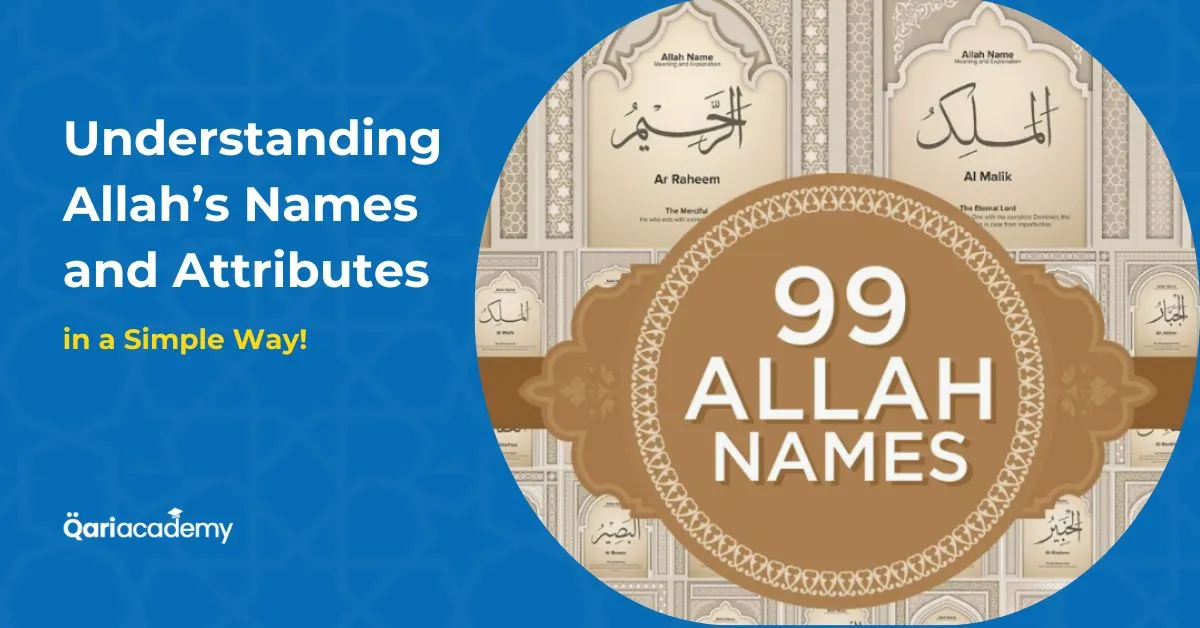
- Flashcards: Simple cards with the Arabic name on one side and the meaning on the other.
- Color-Coded Charts: Categorize names by themes (mercy, knowledge, power).
- Posters: Hang posters in bedrooms, classrooms, or prayer areas. Every glance becomes a quick review.
Over time, these visuals act as silent teachers.
Step 6: Connect Attributes with Emotions
A unique way of Teaching Kids Allah’s Names and Attributes is to connect them with feelings.
- When your child feels scared → remind them of Al-Hafeedh (The Protector).
- When they’re happy → remind them of Ash-Shakoor (The Appreciative).
- When they’re worried → remind them of Al-Fattah (The Opener).
This not only builds emotional intelligence but also teaches children to turn to Allah in every situation.
Step 7: Everyday Integration
Learning should be woven into daily routines:
- At bedtime: Review one name before sleep.
- During meals: Discuss Ar-Razzaq.
- On a walk: Talk about Al-Khaliq (The Creator) while looking at the sky, trees, or animals.
Small, consistent reminders ensure the names are never forgotten.
Bonus Tips for Parents
- Consistency is key: Repeat names daily.
- Positive reinforcement: Praise kids when they recall or use a name correctly.
- Slow and steady: Don’t rush through all 99 names.
- Keep it light: Avoid overloading; make learning enjoyable.
- Model it yourself: Use Allah’s names in your own Du’as so children see them in action.
At QariAcademy, we specialize in making Islamic learning fun and meaningful. Our online classes help children learn Allah’s names and attributes through stories, interactive activities, and engaging methods designed for young hearts.
👉 Enroll today and give your child the gift of knowing Allah in a way that strengthens love, trust, and faith.
FAQ: Teaching Kids Allah’s Names and Attributes
1. What age is suitable?
5–10 years old is the ideal starting range.
2. Can non-Arabic speakers learn the names?
Yes, with simple translations and explanations.
3. How many names to teach at a time?
Introduce 3–5 names per session for best results.
4. Should we include stories?
Yes, stories make names easier to remember.
5. How often should we review?
Daily repetition is most effective.
6. Can siblings learn together?
Absolutely, it makes learning fun and interactive.
7. How to deal with forgetfulness?
Use flashcards, songs, or visual aids to help.
8. Is memorization necessary early on?
Focus on understanding first; memorization can come later.
9. Can songs or rhymes help?
Yes! Songs are powerful tools for memory.
10. How long until children show understanding?
Usually within 2–3 weeks of consistent practice.