Table of Contents
Article Summary
Many Muslim parents in the fear that their children may grow up without loving the Quran. This doesn’t happen suddenly it happens gradually through weak consistency, lack of emotional connection, and competing influences from school and digital life. If not addressed early, the Quran becomes something children “know about” but do not “live with.” However, with the right teaching approach and early intervention, this relationship can be rebuilt before it’s too late—starting with a structured trial learning experience.
1. A Question Most Parents Avoid
There is a question many Muslim parents think about—but rarely say out loud:
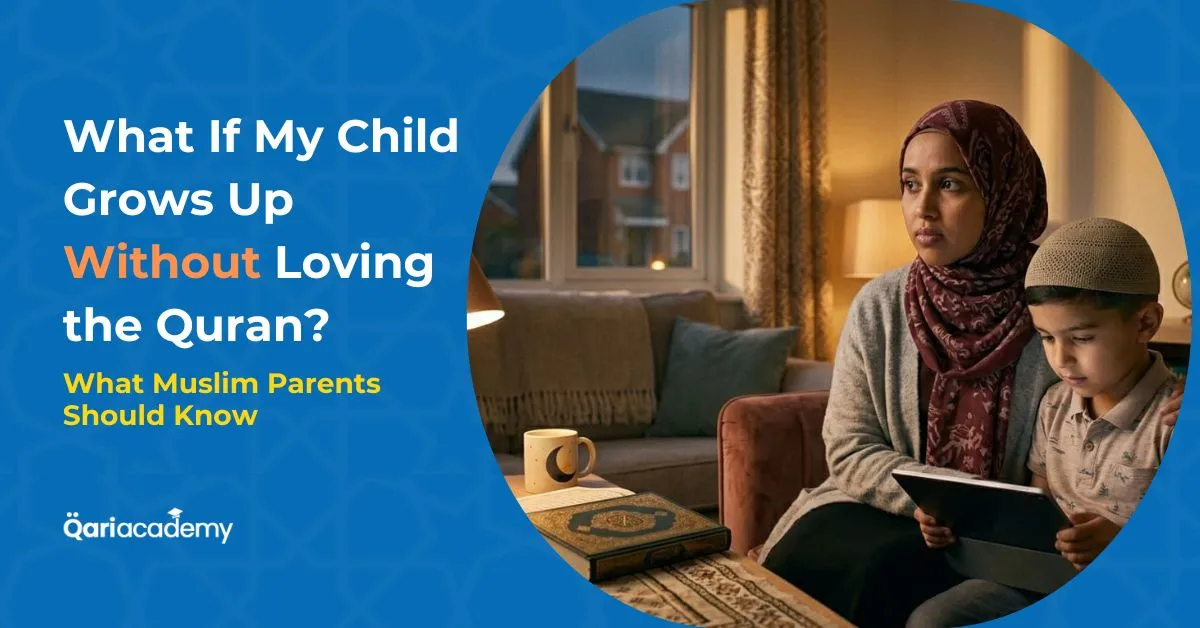
What if my child grows up without loving the Qur’an?
Not just reading it.
Not just memorizing parts of it.
But truly loving it.
Because there is a big difference between:
- A child who knows the Quran
- And a child who feels connected to it
And that gap is growing in many homes across Western countries.
2. It Doesn’t Happen Suddenly
No child wakes up one day and says:
“I don’t care about the Qur’an anymore.”
It happens slowly:
- A missed class becomes normal
- Memorization slows down
- Interest fades quietly
- Other activities take priority
- And the Qur’an becomes “something for weekends or class time”
By the time parents notice, the emotional connection is already weaker.
3. The Real Fear Behind This Question
This is not about academic learning.
This is about identity.
Because many parents are not just asking:
“Will my child learn the Qur’an?”
They are actually asking:
“Will my child keep Islam in their heart when I am not around?”
That is the real fear.
4. The Western Environment Is Extremely Competitive
In countries like:
- USA
- UK
- Canada
Children grow up in environments where:
- Islam is not dominant in daily life
- Friends may not share the same values
- School takes most of their mental energy
- Entertainment is designed to capture attention 24/7
So Qur’an learning is not just “one subject.”
It is competing with an entire lifestyle system.
5. Love for the Quran Is Not Automatic
Many parents assume:
“If my child learns the Quran, they will automatically love it.”
But that is not true.
Love is not automatic.
It is built.
And it is built through:
- Positive experiences
- Encouragement
- Feeling progress
- Emotional safety during learning
If those are missing, learning becomes mechanical.
And mechanical learning does not create love.
6. The Danger of Emotional Distance
The real risk is not that a child forgets memorization.
The real risk is:
The Quran becomes emotionally neutral.
Not loved.
Not hated.
Just… distant.
And once something becomes emotionally neutral, it is easy to ignore.
7. Parents Try Harder… But It Doesn’t Always Work
Many parents respond by:
- Increasing pressure
- Adding more classes
- Asking for more memorization
- Comparing progress with other children
But here is the hidden problem:
Pressure does not create love.
It often creates resistance.
And resistance slowly pushes the child further away.
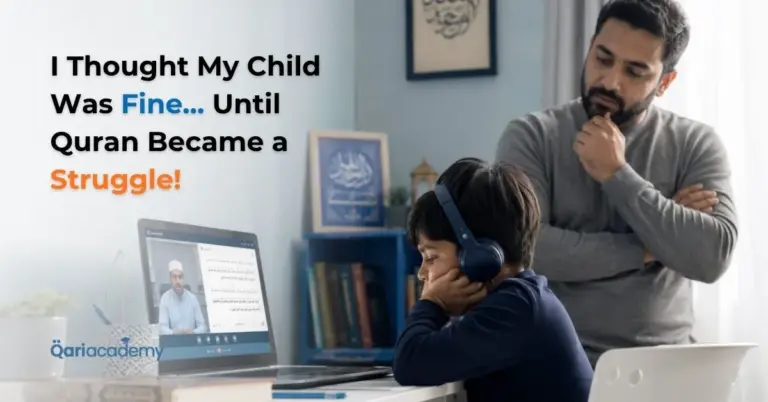
8. The Most Dangerous Stage (Silent Phase)
There is a stage where everything looks “fine”:
- The child still attends classes
- They still say they are learning
- They still appear connected
But internally:
- Interest is low
- Motivation is fading
- Emotional attachment is weak
This is the silent phase.
And it is the most dangerous one.
Because parents feel everything is okay…
while the connection is already weakening.
9. But This Is Not a Lost Case
Here is what many parents don’t realize:
Even if the connection is weak now, it is not permanent.
Children can reconnect with the Qur’an if:
- The method changes
- The experience changes
- The emotional environment improves
- And learning becomes meaningful again
10. The First Step Is Not Pressure — It’s Experience
If your child is struggling, the solution is not to push harder.
It is to let them experience Quran learning differently.
A space where:
- They are understood
- They feel progress
- They are not judged constantly
- And they rediscover confidence
This is where change begins.
11. A Small Step That Can Change the Direction
Sometimes, one session is enough to shift perception.
A structured trial class can:
- Identify the real issue
- Show the child a different learning style
- Rebuild confidence
- And restart the emotional connection
Not by force… but by experience.
12. Final Reflection
The real question is not:
“Is my child learning the Quran?”
The deeper question is:
“Is my child building a lifelong relationship with the Qur’an?”
Because learning can happen in months.
But love lasts for life.
If you are worried that your child is slowly losing connection with the Qur’an, the best first step is not pressure—it is clarity.
We offer a free trial class designed for Muslim children in the USA, UK, and Canada to:
- Understand their current level
- Identify learning gaps
- Rebuild motivation
- And create a clear path forward