(Quick Summary)
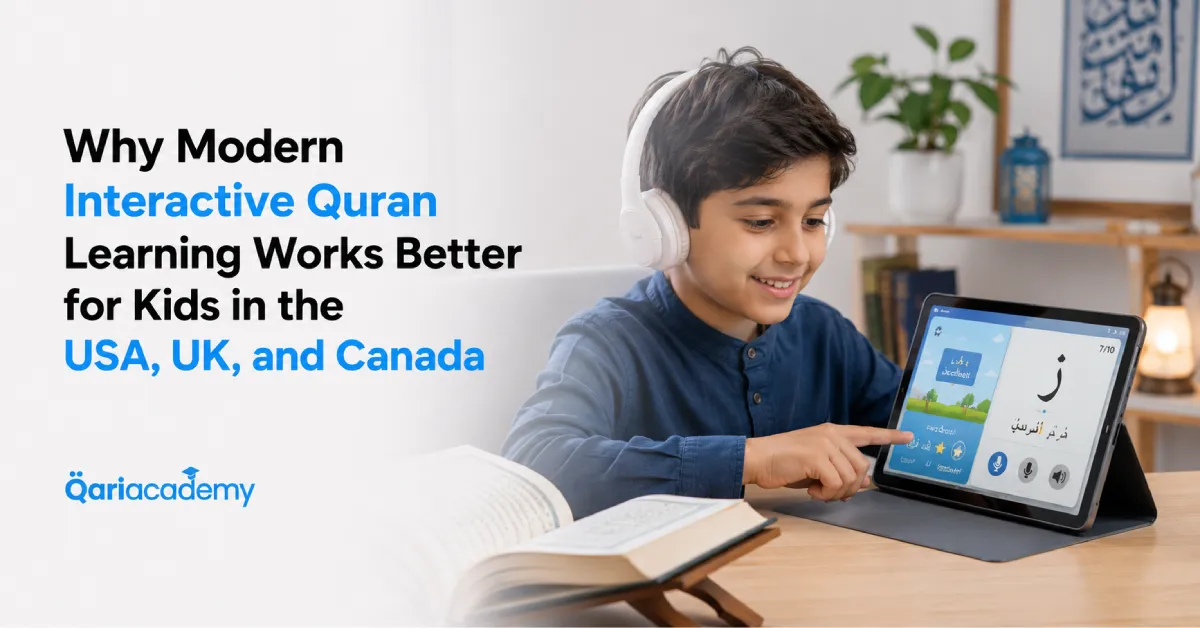
Modern children in the USA, UK, and Canada respond better to interactive, engaging, and structured Qur’an learning methods than traditional passive approaches. Because they grow up in a digital and highly interactive environment, their attention and motivation depend on engagement, feedback, and emotional connection. Modern online Quran classes for kids that use interaction, encouragement, and structured progression significantly improve consistency, understanding, and long-term connection with the Qur’an.
1. The World Children Are Growing Up In Has Changed
Today’s children in Western countries are not learning the same way previous generations did.
They are surrounded by:
- interactive apps
- video-based learning
- instant feedback systems
- gamified experiences
- visual stimulation
So naturally, their brain expects:
engagement, not passive instruction
But many Qur’an learning methods still follow older styles:
- repetition only
- limited interaction
- one-direction teaching
- slow feedback cycles
This creates a gap between:
how children learn today
and
how Qur’an is sometimes taught
2. The Real Problem Is Not the Qur’an
Let’s be clear:
The Qur’an is not the problem.
The method is.
When children in the USA, UK, and Canada struggle with Qur’an learning, it is usually because:
- the method feels outdated
- the experience is not engaging
- progress is not visible
- feedback is not immediate
So they disconnect—not from the Qur’an itself—but from the learning experience.
3. Why Traditional Methods Struggle Today
Traditional Qur’an learning often relies on:
- repetition without engagement
- correction without encouragement
- fixed pacing for all children
- limited interaction
But modern learners need:
- engagement
- variation
- emotional reinforcement
- visible progress
Without this, attention drops quickly.
4. What “Interactive Learning” Actually Means
Interactive learning is not just “using a screen.”
It means:
- the child participates actively
- the teacher responds instantly
- learning feels like dialogue, not lecture
- mistakes are corrected gently in real-time
This creates a learning loop where:
action → feedback → improvement → motivation
5. Why Engagement Matters More Than Intensity
Many parents assume:
more time = better results
But in reality:
engagement = retention
A child can sit for one hour and learn nothing if disengaged.
But 15 minutes of focused, interactive learning can produce strong results.
6. The Psychology Behind Modern Learning
Children today are trained by:
- instant reward systems
- visual feedback loops
- interactive digital environments
So their attention responds to:
- stimulation
- encouragement
- progress visibility
If Qur’an learning does not provide these, the brain labels it as:
low-interest activity
7. Why Modern Online Quran Classes for Kids Work Better
Modern systems in USA, UK, and Canada often include:
- live interaction with teachers
- structured progression plans
- encouragement-based correction
- attention-friendly lesson design
- short, focused learning sessions
This transforms the experience from:
passive learning → active engagement
8. The Shift From “Teaching” to “Experience”
Old model:
Teacher explains → student listens
Modern model:
Teacher interacts → student participates → feedback improves performance
This shift is critical because:
children don’t learn passively anymore—they experience learning
9. Social Proof Insight (Important Observation)
⭐ Real-world pattern:
“Many children who previously struggled with consistency or motivation in Qur’an learning showed noticeable improvement once they switched to interactive, structured, and engaging learning methods.”
Parents commonly report:
- improved focus during sessions
- more willingness to attend classes
- faster understanding
- reduced resistance to learning
This is not coincidence.
It is design.
10. Why Motivation Improves Automatically
When learning becomes interactive:
- children feel involved
- they see progress
- they receive immediate feedback
- they feel success frequently
This naturally builds:
intrinsic motivation
Not forced motivation.
11. The Role of Emotional Feedback
Children don’t only learn with the mind.
They learn with emotion.
Interactive Qur’an learning creates:
- encouragement
- positive reinforcement
- safe correction environment
This reduces fear of mistakes and increases participation.
12. Why Consistency Becomes Easier
One of the biggest challenges parents face is inconsistency.
But when learning is:
- engaging
- short
- structured
- rewarding
Children are more likely to:
continue without resistance
Because they don’t feel forced—they feel involved.
13. The Real Difference You Can Observe
Parents usually notice:
- less resistance to joining classes
- more curiosity
- improved revision habits
- better emotional attitude toward Qur’an
The difference is not intelligence.
It is experience design.
14. Why This Matters More in the West
In the USA, UK, and Canada:
- children are exposed to high-interaction environments daily
- education systems are increasingly digital
- attention spans are shaped by fast feedback loops
So Qur’an learning must adapt to:
the environment children actually live in
Not the environment of the past.
15. The Final Shift: From Obligation to Interest
The ultimate goal is not:
- forcing attendance
- or increasing pressure
The goal is:
turning Qur’an learning into something the child naturally engages with
When this happens:
- consistency becomes natural
- identity becomes stronger
- learning becomes long-term
16. A Simple Way to Experience the Difference
Instead of guessing what works for your child, the most practical step is to observe:
A structured trial session can help you understand:
- how your child responds to interactive learning
- where attention increases or drops
- what teaching style fits them best
- and how motivation changes in real time
This is not a commitment.
It is clarity.
👉 Start a free trial class here: [Insert Link]
17. Final Thought
The future of Qur’an learning is not about replacing tradition.
It is about improving delivery.
When teaching becomes:
- interactive
- structured
- emotionally engaging
Children don’t just learn the Qur’an.
They connect with it.
And that connection is what lasts.