Table of Contents
Introduction
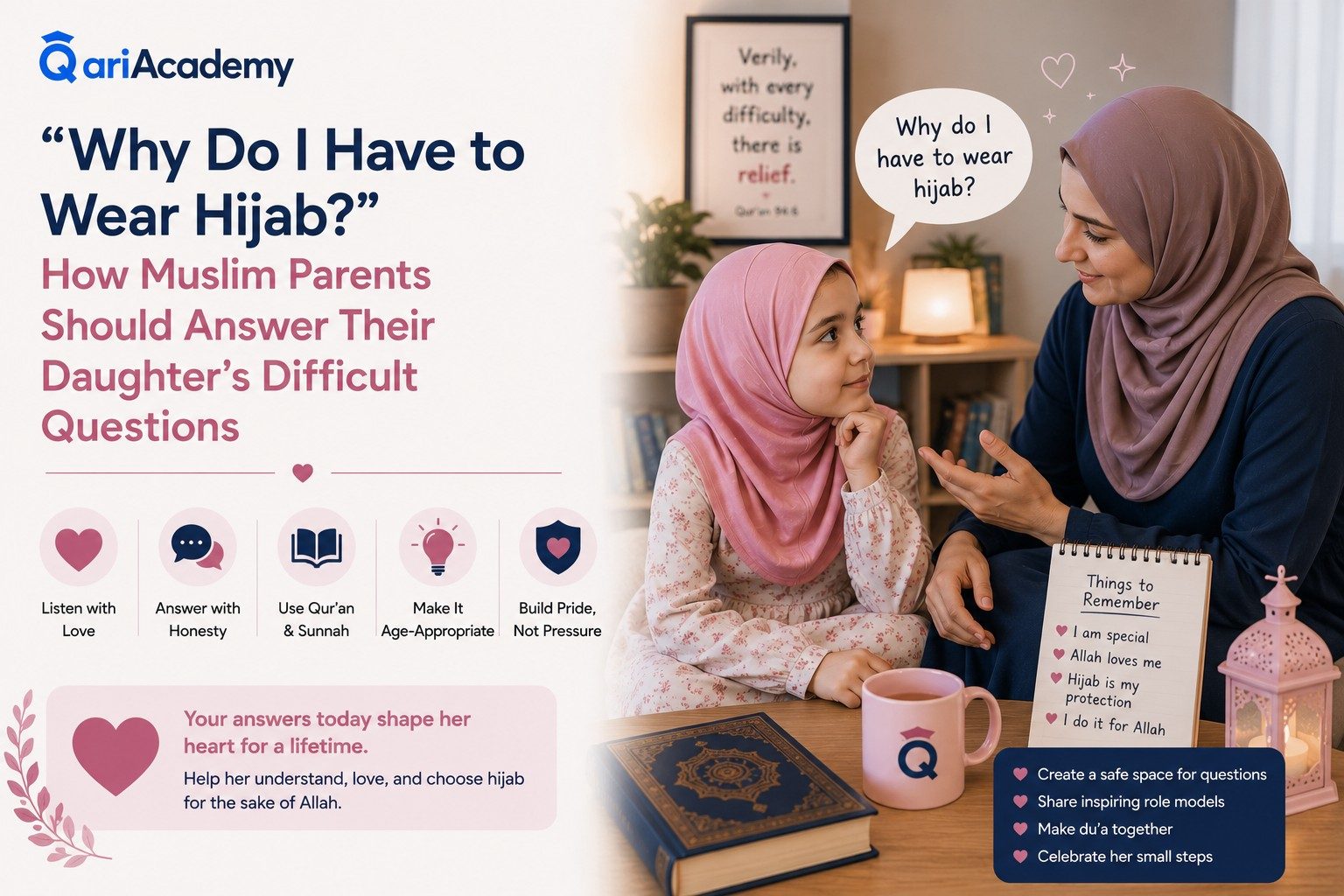
One day, your daughter may look at you while you’re helping her put on her hijab and suddenly ask:
“Mommy, why do we wear hijab?”
It may sound like a simple question.
It isn’t.
That one question can open the door to conversations about Allah, worship, modesty, identity, obedience, confidence, beauty, peer pressure, and what it means to be a Muslim woman.
And the way you answer can influence how your daughter thinks about hijab for years to come.
If your answer is simply:
“Because I said so.”
you may get obedience for the moment, but you haven’t necessarily given her understanding.
If your answer is:
“Because girls have to cover themselves.”
you may unintentionally make hijab sound like a restriction placed only on girls.
And if the conversation becomes:
“Because Allah will punish you if you don’t.”
you may create fear without helping her develop love and conviction.
That’s why understanding why do we wear hijab is not only about knowing the Islamic ruling.
It’s also about knowing how to explain that ruling to a child in a way that builds faith rather than resentment.
For a young Muslim girl, the conversation should gradually help her understand that hijab is connected to worship, modesty, dignity, identity, and obedience to Allah.
The Quran addresses believing women regarding modesty and covering in Surah An-Nur 24:31 and Surah Al-Ahzab 33:59. Quran — Surah An-Nur 24:31 Quran — Surah Al-Ahzab 33:59
But explaining these verses to a five-year-old is very different from explaining them to a sixteen-year-old.
The message should grow with the child.
The First Thing Parents Need to Understand
Before answering your daughter’s question, understand what she is actually asking.
When a child says:
“Why do we wear hijab?”
she may actually mean:
“Why don’t my friends wear it?”
Or:
“Why does my mom wear it?”
Or:
“Why do boys not have the same rule?”
Or:
“Does Allah want me to hide because I’m a girl?”
Or simply:
“I don’t like how this feels.”
Those are completely different questions.
So don’t immediately give a long speech.
Start with:
“That’s a really good question. What made you ask?”
That one sentence can tell you what your daughter is really thinking.
What Is the Best Simple Answer?
For a young child, you can say:
“We wear hijab because we are Muslims and Allah teaches Muslim women to dress modestly. It’s one of the ways we show our obedience to Allah and remember that our bodies are special and deserve respect.”
Then stop.
You don’t need to explain everything at once.
If she asks another question, answer that question.
Children learn through repeated conversations, not one giant lecture.
1. Start With Allah—Not With People
One of the most important things your daughter should understand is that hijab isn’t primarily about pleasing other people.
It isn’t:
“So people won’t talk about you.”
It isn’t:
“So boys won’t look at you.”
It isn’t:
“So your family won’t be embarrassed.”
And it shouldn’t be presented as:
“Because Muslim girls are supposed to look different.”
The foundation is:
We worship Allah.
For a child, you can explain:
“Allah created us, loves us, and teaches us how to live in a good way. Hijab is one of the things Muslim women do because they want to obey Allah.”
That gives hijab a spiritual foundation.
2. Explain That Hijab Is Part of a Bigger Concept: Modesty
A common mistake is to make hijab sound like the entire meaning of modesty.
It isn’t.
Modesty can influence:
- Clothing
- Speech
- Behavior
- Privacy
- Relationships
- How we treat others
- How we present ourselves
Teach your daughter:
“Being modest isn’t only about what we wear. It’s also about how we behave and how we respect ourselves and other people.”
This makes the concept much richer.
A girl who understands modesty as a value is better prepared for situations that clothing rules alone can’t address.
3. Don’t Tell Her That Her Body Is Shameful
This is extremely important.
A young girl should not grow up believing:
“My body is bad.”
Instead:
“Your body is something Allah created, and it deserves respect.”
Then explain that Islam teaches people to have boundaries around their bodies.
There is a huge difference between:
“Your body is shameful.”
and:
“Your body is valuable, private, and deserving of respect.”
The second message can build healthy boundaries without creating unnecessary shame.
4. If She Asks, “Why Do Boys Not Wear Hijab?”
This question is almost inevitable.
Don’t dismiss it.
Don’t say:
“Because you’re a girl.”
That’s technically an answer, but it doesn’t teach much.
Instead, explain that Islam gives both men and women guidelines about modesty.
The Quran first addresses believing men regarding lowering their gaze and guarding their modesty in Surah An-Nur 24:30, followed by guidance for believing women in 24:31. Quran — Surah An-Nur 24:30–31
You can tell your daughter:
“Allah teaches Muslim boys and Muslim girls to be modest. The rules aren’t exactly identical, but both have responsibilities.”
This is much healthier than making hijab sound like a punishment specifically imposed on girls.
5. Don’t Make Boys Responsible for Your Daughter’s Hijab
Avoid teaching:
“You need to cover because boys can’t control themselves.”
That places the responsibility for male behavior on the girl.
Instead:
“Every Muslim person is responsible for their own choices. Allah gives boys responsibilities too, and Allah gives girls responsibilities too.”
This teaches accountability.
Your daughter should understand that her hijab is primarily about her relationship with Allah, not managing other people’s behavior.
6. What If She Says, “But My Friend Doesn’t Wear It?”
This is one of the most important conversations Muslim parents can have, especially in Western countries.
Don’t attack the friend.
Don’t say:
“Her family doesn’t teach her Islam.”
Don’t say:
“She’s not a good Muslim.”
Your daughter doesn’t need to learn to judge other children.
Instead:
“Different families believe different things and make different choices. We are Muslim, and our family tries to follow what Allah has taught us.”
Then teach her something important:
You can respect someone without copying everything they do.
This lesson will become incredibly valuable as she grows older.
7. Teach Confidence Without Teaching Superiority
Your daughter should be proud of being Muslim.
But there’s a difference between:
“I’m proud of my faith.”
and:
“I’m better than people who don’t practice my faith.”
Teach the first.
Avoid the second.
You can say:
“We can be confident Muslims and still be kind and respectful to people who believe differently.”
This becomes particularly important when children attend diverse schools.
8. What If She Says, “I Don’t Want to Wear It?”
Don’t panic.
The statement may mean many things.
Maybe:
- She finds it uncomfortable.
- She wants more choice.
- Her friends don’t wear one.
- Someone teased her.
- She doesn’t understand the reason.
- She feels different.
- She simply doesn’t want to do what her parents tell her.
Start with:
“Tell me why.”
Then listen.
Don’t interrupt immediately.
Don’t turn the conversation into a debate.
Understanding the problem comes before solving it.
9. Don’t Turn Every Question Into a Religious Battle
Some parents become defensive when their child asks difficult questions.
The parent hears:
“Why do we wear hijab?”
and interprets it as:
“I don’t believe in Islam.”
That’s not necessarily true.
Questions can be signs of learning.
A child who asks questions is giving you an opportunity to teach.
You want your daughter to learn:
“I can ask my parents difficult questions about Islam.”
Not:
“If I ask difficult questions, my parents will become angry.”
The first environment builds faith through understanding.
10. What If She Asks, “Is Hijab Mandatory?”
The answer should depend on her age and level of understanding.
With a young child, you don’t need to introduce a detailed discussion of fiqh.
You can say:
“For Muslim women, hijab is an important part of Islamic modesty and obedience to Allah. You’re still learning about Islam and growing up, and we’ll learn about these things together.”
With an older girl approaching puberty, the conversation should become more direct and educational.
She should eventually understand that hijab is considered an Islamic obligation for adult Muslim women by the mainstream scholarly tradition, based on Quranic and Prophetic guidance.
The key is age-appropriate progression.
Don’t give a five-year-old a teenage girl’s conversation.
11. Explain That Worship Is Not Always About What We Feel Like Doing
This is a valuable Islamic lesson beyond hijab.
Children naturally think:
“If I don’t like something, why should I do it?”
You can gently explain:
“Sometimes we do things because we love Allah and trust His guidance, even when something isn’t always easy.”
This applies to:
- Salah
- Fasting
- Charity
- Good manners
- Patience
- Modesty
But be careful not to use this as a way to shut down every question.
You can simultaneously say:
“And you can always ask questions. Learning why we do something is important.”
That balance is powerful.
12. Don’t Promise That Hijab Will Always Be Easy
Avoid saying:
“You’ll love wearing it every day.”
Life isn’t always like that.
Your daughter may eventually experience:
- Heat
- Peer pressure
- School questions
- Negative comments
- Fashion concerns
- Self-image struggles
Instead, teach:
“Sometimes practicing our faith can be difficult, but we can ask questions, seek knowledge, and ask Allah for help.”
That prepares her for reality.
13. Prepare Her for Questions at School
A Muslim girl may hear:
“Why do you wear that?”
“Does your dad make you wear it?”
“Are you allowed to take it off?”
“Isn’t it hot?”
Your daughter should have simple answers.
For example:
“I wear it because I’m Muslim and it’s part of my faith.”
Or:
“It’s important to me and my family.”
She doesn’t need to defend Islamic theology to every classmate.
She can answer simply and move on.
14. Teach Her What to Do If Someone Makes Fun of Her
Unfortunately, children can be cruel.
If someone says:
“Your hijab looks weird.”
Your daughter doesn’t need to insult them back.
Teach her:
“You don’t have to agree with me, but please respect me.”
Or:
“I like wearing it.”
Or simply walk away.
If bullying becomes persistent, she should tell a teacher and her parents.
The goal is not to teach children to tolerate bullying silently.
The goal is to teach them to respond with confidence and appropriate support.
15. Make Hijab Beautiful Without Making Beauty the Point
There is nothing wrong with helping your daughter enjoy beautiful clothing.
Let her:
- Choose colors
- Match outfits
- Pick comfortable fabrics
- Experiment with age-appropriate styles
- Wear special hijabs for Eid
But don’t teach:
“The prettier your hijab looks, the better Muslim you are.”
Hijab isn’t a fashion competition.
It can be beautiful, but its deeper purpose is worship and modesty.
16. Use Positive Experiences
Children remember experiences.
You can create positive memories around Islamic identity through:
- Eid
- Ramadan
- Mosque visits
- Quran classes
- Islamic stories
- Family gatherings
- Muslim community events
If your daughter associates her hijab with:
Eid morning + family + happiness + prayer + celebration
that emotional association matters.
17. Connect the Conversation to Quran
If your daughter is old enough to understand, you can introduce the Quranic basis gradually.
You don’t need to begin by quoting verses and expecting a five-year-old to understand every detail.
Instead:
“Allah teaches us about modesty in the Quran.”
Then, as she grows:
“Let’s read the verse together.”
This can become part of Quran learning itself.
QariAcademy provides one-on-one online Quran learning for children, including Quran reading, Tajweed, Hifz, Quranic Arabic, and Islamic studies. Explore QariAcademy Programs
A structured Quran education can give children a broader understanding of the teachings behind Islamic practices rather than presenting individual rules in isolation.
18. Don’t Use QariAcademy as a “Hijab Enforcement Tool”
This distinction matters.
Quran classes shouldn’t become:
“If you don’t wear your hijab, you’re not going to Quran class.”
That can create an unhealthy association between Quran and punishment.
Instead, Quran education should help your child:
- Know Allah
- Understand the Quran
- Learn Islamic values
- Develop good character
- Ask questions
- Build a relationship with faith
Then individual practices can gradually be understood within that larger foundation.
19. Build a Home Where Islam Is More Than Rules
Ask yourself:
What does your daughter experience when she hears the word Islam?
Does she think:
Rules?
Or:
Allah + Quran + family + prayer + kindness + Ramadan + Eid + purpose?
You want the second.
That doesn’t mean avoiding rules.
Children need boundaries.
But boundaries work best when they exist inside a larger environment of love and meaning.
20. What If Your Daughter Says, “Hijab Makes Me Look Different”?
Don’t automatically say:
“Who cares what people think?”
Of course she cares.
She’s a child.
Instead:
“It’s okay to notice that you look different. Being different isn’t automatically bad.”
Then explain:
“You can be different and still feel confident.”
This teaches resilience.
21. Don’t Make Her Feel Responsible for Representing Every Muslim
A hijabi girl may sometimes feel:
“Everyone is looking at me because I’m Muslim.”
Remind her:
“You don’t have to be perfect to be Muslim.”
She is allowed to:
- Make mistakes
- Learn
- Ask questions
- Grow
- Improve
Her behavior matters, but she doesn’t have to carry the responsibility of representing every Muslim person on earth.
22. Teach Her That Hijab Is Not a Measure of Her Worth
This is critical.
Your daughter should never believe:
“If my hijab isn’t perfect, I’m worthless.”
Her worth is not measured by the perfection of her clothing.
Teach her that being a good Muslim includes:
- Honesty
- Kindness
- Prayer
- Respect
- Helping others
- Good character
- Learning
- Repentance
Hijab is important, but it exists within a much larger Islamic life.
23. What If She Asks, “Will Allah Love Me If I Don’t Wear It?”
This requires sensitivity.
Don’t tell a young child:
“No.”
Instead, explain that Allah’s mercy and love are vast, while also teaching that Muslims try to obey His commands.
You might say:
“Allah loves us and gives us so many blessings. We show our love for Allah by trying to obey Him. When we make mistakes, we ask Allah for forgiveness and keep trying.”
That teaches hope and responsibility.
24. Don’t Teach Hijab Through Shame
Avoid:
“You’re embarrassing me.”
“People are looking at you.”
“You look indecent.”
“Good Muslim girls don’t behave like that.”
These statements can damage self-esteem.
Instead:
“Let’s remember what we believe.”
“This is part of how our family practices Islam.”
“Let’s learn together.”
“You can always ask me questions.”
The difference may seem small.
It isn’t.
25. Let the Conversation Evolve
Your daughter’s questions will change.
At five:
“Why do we wear hijab?”
At eight:
“Why doesn’t my friend wear one?”
At ten:
“Do I have to wear it at school?”
At twelve:
“What happens when I get my period?”
At fourteen:
“What if I don’t want to wear it anymore?”
At sixteen:
“Why does Islam require it?”
You can’t answer all of those questions with the same sentence.
Her understanding should grow as she grows.
A Parent’s Hijab Conversation Guide
| Age/Stage | Main Conversation | Parent’s Goal |
|---|---|---|
| 4–6 | “What is hijab?” | Familiarity |
| 7–9 | “Why do Muslim women wear it?” | Basic understanding |
| 10–12 | “What does modesty mean?” | Preparation |
| Puberty | “What changes religiously?” | Knowledge |
| Teen years | “Why should I choose this?” | Understanding and ownership |
These are educational stages, not rigid religious deadlines.
26. What Parents Should Never Say
Avoid these phrases:
“Because I’m your mother.”
“Because everyone in this family wears it.”
“Because boys will look at you.”
“Because you’ll go to Hell.”
“Because good girls wear hijab.”
“Because I don’t want people talking about us.”
These statements may produce short-term compliance, but they don’t necessarily build understanding.
27. What Parents Can Say Instead
Try:
“We wear hijab because we’re Muslim and want to obey Allah.”
“Allah teaches us about modesty.”
“Your body is valuable and deserves respect.”
“You can ask me anything about Islam.”
“You don’t have to understand everything today. We’re learning together.”
“It’s okay to have questions.”
“You can be confident and modest at the same time.”
These messages create a very different foundation.
28. The Three Things Your Daughter Needs Most
If you remember nothing else from this article, remember these three things:
Knowledge
She needs to know what Islam teaches.
Love
She needs to experience Islam as something meaningful and beautiful.
Trust
She needs to know that she can ask you difficult questions without being shamed.
Without knowledge, hijab can become an unexplained rule.
Without love, it can become a burden.
Without trust, she may eventually stop asking you questions and search for answers elsewhere.
29. A Simple Conversation You Can Have Tonight
If your daughter asks:
“Why do we wear hijab?”
you could say:
“That’s a really good question. We wear hijab because we’re Muslim and Allah teaches Muslim women about modesty. It’s one way we obey Allah and remember that our bodies are special and deserve respect. You don’t have to understand everything right now. As you grow up, we’ll keep learning about it together. And whenever you have a question, you can always ask me.”
Then ask:
“What made you think about that?”
And listen.
That final question may be the most valuable part of the entire conversation.
Conclusion
Understanding why do we wear hijab is important.
But helping a child understand it is a different challenge.
Your daughter doesn’t need a five-year-old version of a theological lecture.
She needs a foundation.
Teach her that hijab is connected to Allah.
Explain modesty in age-appropriate language.
Teach her that her body is valuable—not shameful.
Explain that both Muslim men and women have responsibilities regarding modesty.
Don’t make boys responsible for her hijab.
Don’t compare her with other girls.
Don’t shame her.
Don’t use fear as your primary teaching method.
And don’t become angry simply because she asks difficult questions.
Instead, create a home where Islamic questions are welcome.
As your daughter grows, her questions will become more sophisticated. Your job is not to silence them.
Your job is to help her find trustworthy answers.
And that process starts long before adulthood.
A consistent Quran education can support this journey by giving children a structured opportunity to learn the Quran, Tajweed, Arabic, Hifz, and Islamic studies with qualified teachers. QariAcademy provides live one-on-one online classes designed around the child’s level and learning needs. Explore QariAcademy
The purpose isn’t simply to make your daughter memorize Islamic rules.
It’s to help her understand the faith behind those rules.
Because eventually, you won’t be standing beside her every morning telling her what to wear.
She will have to make decisions for herself.
And when that day comes, you want her choices to come from knowledge, faith, confidence, and a genuine relationship with Allah.
So when she asks you:
“Why do we wear hijab?”
don’t be afraid of the question.
Smile.
Listen.
Answer honestly.
And remember that a difficult question today may be the beginning of a much stronger faith tomorrow.
That is the real purpose of learning why do we wear hijab.
If you want to strengthen your daughter’s Quran and Islamic education alongside these conversations, you can explore QariAcademy’s programs and start with a free trial:
Book a Free Trial at QariAcademy