Table of Contents
Introduction
When school ends, children suddenly have something they rarely have during the year: a lot of free time.
At first, that sounds wonderful.
No homework. No early mornings. No school uniforms. No exams.
But after a few days, many parents begin hearing:
“I’m bored.”
And then comes the phone.
YouTube.
Video games.
TikTok.
Random social media videos.
Hours of scrolling.
The problem isn’t that children need to stay busy every second of their summer.
They don’t.
Children need rest, free play, and time with their families.
But an unstructured summer can quickly become a summer dominated by screens and passive entertainment.
For Muslim parents, summer is actually a unique opportunity.
Instead of thinking only about how to keep your child occupied, ask a bigger question:
How can I make this summer enjoyable while also helping my child grow physically, mentally, socially, and spiritually?
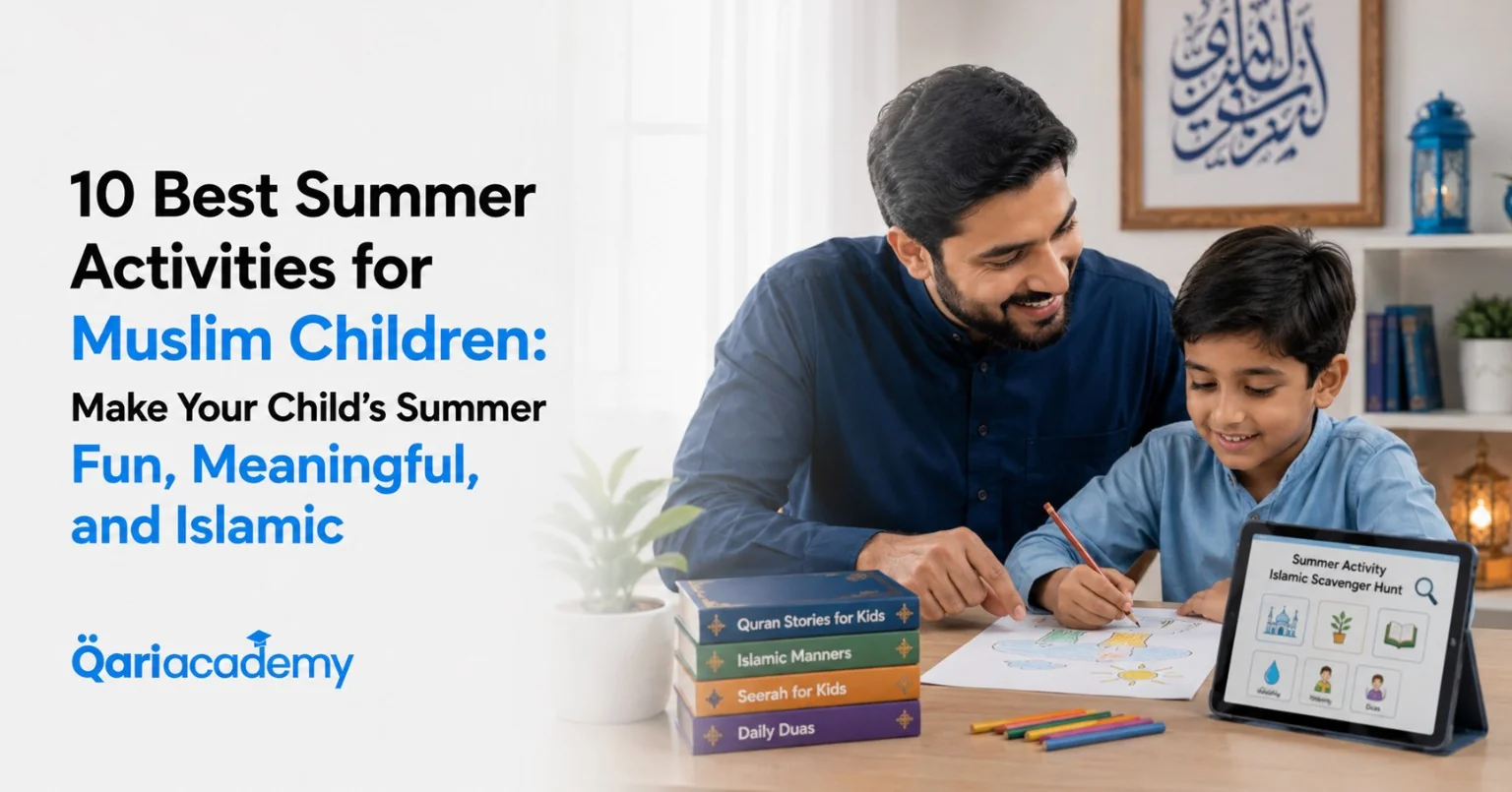
Choosing the right summer activities for Muslim children can help parents create a healthy balance between fun, Islamic learning, family time, physical activity, and personal development.
And the best part?
Islamic learning doesn’t have to feel like another school subject.
With the right approach, Quran learning can become one of the most meaningful parts of your child’s summer.
Why Summer Is So Important for Muslim Children
During the school year, children follow a predictable routine.
They wake up.
Go to school.
Complete homework.
Attend activities.
Go to sleep.
Summer removes much of that structure.
That freedom can be valuable, but it can also create problems if there is no alternative routine.
Children may gradually develop habits such as:
- Sleeping extremely late
- Spending excessive time on screens
- Skipping physical activity
- Eating without structure
- Becoming disconnected from Quran
- Losing their daily routine
- Spending less meaningful time with family
The goal isn’t to create a military-style summer schedule.
It’s to create enough structure that your child has opportunities to do things that matter.
1. Make Quran Learning Part of the Summer Routine
One of the most valuable summer activities for Muslim children is consistent Quran learning.
Summer can actually be one of the easiest times for children to develop a stronger relationship with the Quran because they don’t have the same school workload.
Instead of waiting until the school year begins again, parents can use summer to:
- Improve Quran reading
- Learn Tajweed
- Memorize short surahs
- Review previously memorized Quran
- Learn Islamic vocabulary
- Study Quranic Arabic
- Learn about Islamic manners and character
The key is consistency.
A child doesn’t necessarily need hours of Quran every day.
A short, focused lesson several times a week can be more effective than forcing a child into exhausting sessions.
QariAcademy offers live one-on-one online Quran classes for children, including Quran reading, Tajweed, Hifz, Quranic Arabic, and Islamic studies. This can make it easier for families to maintain a consistent Quran routine even during summer travel and holidays.
:contentReference[oaicite:0]{index=0}
2. Try a Quran Summer Challenge
Children often enjoy challenges.
Instead of saying:
“You need to memorize more Quran this summer.”
create a simple challenge.
For example:
Summer Quran Challenge
- Read Quran every day
- Memorize one short surah
- Review five previously memorized surahs
- Learn five new duas
- Learn ten Islamic words
- Listen to one beneficial Islamic lesson each week
Make the goal realistic.
The objective isn’t to create pressure.
It’s to give your child a sense of achievement.
3. Get Your Child Outside
Summer shouldn’t mean spending the entire day indoors.
Physical activity is essential for children.
Consider:
- Swimming
- Cycling
- Football
- Basketball
- Walking
- Hiking
- Martial arts
- Tennis
- Outdoor games
You don’t need expensive equipment.
Sometimes the best activity is simply going to a park and letting children play.
The World Health Organization recommends that children and adolescents engage in regular physical activity, with an emphasis on activities that strengthen physical fitness and reduce sedentary time.
:contentReference[oaicite:1]{index=1}
4. Connect Sports With Islamic Values
Sports can become more than exercise.
They can teach:
- Discipline
- Teamwork
- Patience
- Losing gracefully
- Respect
- Responsibility
- Self-control
For example, after a football match, ask:
“Did you enjoy winning?”
Then:
“How did you feel when you lost?”
Then:
“What does Islam teach us about how we treat other people when we win?”
Now football has become an opportunity for character development.
5. Plan Family Trips
Children don’t need expensive vacations every week.
Simple family experiences can become unforgettable memories.
Try:
- Visiting a museum
- Going to the beach
- Exploring a new city
- Visiting a zoo
- Going hiking
- Having a family picnic
- Visiting relatives
- Exploring a historical site
The objective is not the price of the activity.
It’s the experience.
A child who spends an afternoon talking to their parents during a family trip may remember it years later.
6. Give Your Child Responsibilities
Summer is an excellent time to teach children independence.
Give them age-appropriate responsibilities.
For younger children:
- Organizing their room
- Watering plants
- Preparing simple snacks
- Helping set the table
For older children:
- Cooking simple meals
- Helping with younger siblings
- Organizing family activities
- Learning basic budgeting
- Planning a shopping list
Don’t treat these responsibilities as punishment.
Tell your child:
“You’re growing up, and we’re teaching you skills you’ll need later.”
7. Start a Muslim Children’s Reading List
Not every summer activity needs a screen.
Create a small reading challenge.
Children can read:
- Stories of the Prophets
- Seerah books
- Islamic history
- Children’s biographies
- Science books
- Fiction appropriate for their age
- Books about different cultures
You could create a simple goal:
Read 5 books this summer.
For older children:
Read 10 books.
Then ask them about what they learned.
8. Teach Your Child Something Practical
Summer is a perfect time for children to learn skills they don’t have time for during school.
Depending on age, they could learn:
- Cooking
- Swimming
- First aid
- Gardening
- Photography
- Drawing
- Coding
- Public speaking
- A new language
- Basic financial skills
The goal is to help children discover:
“I can learn things by myself.”
That sense of competence is incredibly valuable.
9. Create a “Less Screen, More Life” Routine
Don’t make the mistake of thinking the solution is:
“No screens all summer.”
That may be unrealistic.
Instead, establish boundaries.
For example:
| Time | Activity |
|---|---|
| Morning | Quran + breakfast + outdoor activity |
| Afternoon | Free time + reading |
| Evening | Family activity + limited screen time |
The exact schedule should depend on your child’s age and your family’s circumstances.
The important principle is:
Screens shouldn’t automatically become the default activity whenever your child is bored.
10. Teach Children to Use Technology Wisely
Summer often means more unsupervised screen time.
That can expose children to content parents never intended them to see.
Instead of only saying:
“Don’t watch bad things.”
teach your child:
- Don’t click suspicious links
- Don’t communicate privately with strangers
- Don’t share personal information
- Don’t send private pictures
- Tell a parent if something makes you uncomfortable
- Ask before downloading new apps
- Know how to report inappropriate content
Technology education is becoming part of modern parenting.
Parents need to teach children not only how to use devices but how to make responsible decisions while using them.
11. Create an Islamic Family Night
Choose one night each week.
Call it:
Family Islamic Night.
It could include:
- Short Quran reading
- A story from the Seerah
- A family discussion
- Islamic quiz
- Dua practice
- Islamic game
- Family dinner
Keep it enjoyable.
Don’t turn it into another classroom.
The purpose is to create positive memories around Islam.
12. Let Your Child Help Choose the Activities
Here’s an important parenting mistake:
Parents sometimes create a perfect schedule that their children absolutely hate.
Don’t do that.
Give your child choices.
Ask:
“Would you rather swim or play football?”
“Would you rather read this book or that one?”
“Would you like Quran after breakfast or before dinner?”
You remain the parent.
But giving children appropriate choices increases their sense of ownership.
13. Use Summer to Strengthen Salah
Summer can disrupt prayer routines.
Children stay up late.
They sleep late.
They travel.
Their schedule changes.
Use the summer to strengthen Salah gradually.
For younger children:
- Practice wudu
- Pray together
- Explain the meaning of short surahs
For older children:
- Encourage consistency
- Discuss why Salah matters
- Help them organize activities around prayer
One of the best lessons a child can learn is:
We don’t organize prayer around our life. We organize parts of our life around prayer.
14. Encourage Community Activities
Children need social experiences.
Look for:
- Mosque programs
- Islamic summer camps
- Community sports
- Youth activities
- Volunteer opportunities
- Quran programs
These can help children develop friendships with other Muslim children while learning teamwork and responsibility.
15. Give Your Child a Summer Project
A project can keep a child engaged for weeks.
Examples:
Younger Children
Create an Islamic scrapbook.
Older Children
Make a presentation about a Muslim historical figure.
Teenagers
Research a topic related to Islam and present it to the family.
Creative Children
Design Islamic artwork.
Tech-Oriented Children
Create a simple educational website or presentation.
The point is not perfection.
It’s learning through doing.
16. Teach Children to Help Others
Summer is also a good time to teach generosity.
Children can:
- Donate toys
- Help prepare food for others
- Visit relatives
- Help elderly family members
- Participate in community service
- Organize a small charity project with parents
Explain:
“Being Muslim isn’t only about what we receive. It’s also about what we give.”
That turns Islamic values into practical behavior.
17. Don’t Overschedule Your Child
Here’s the opposite mistake.
Some parents hear all these ideas and create:
- Quran class
- Football
- Arabic
- Swimming
- Coding
- Islamic studies
- Reading
- Tutoring
- Summer camp
Every day.
That’s not a vacation.
Children need downtime.
Free play is valuable.
Rest is valuable.
Boredom can even encourage creativity.
The goal is balance, not maximum productivity.
18. A Balanced Muslim Summer
A healthy summer might contain five elements:
Faith
Quran, Salah, Islamic learning
Body
Sports and outdoor activities
Mind
Reading and learning
Family
Trips and shared experiences
Rest
Free time and sleep
If your child’s summer contains all five, you’re probably creating a healthier environment than one dominated by either complete freedom or nonstop activities.
19. Example Weekly Summer Schedule
| Day | Main Activity | Islamic Activity |
|---|---|---|
| Monday | Swimming | Quran lesson |
| Tuesday | Reading project | Salah + Quran review |
| Wednesday | Football | Quran lesson |
| Thursday | Family trip | Islamic story |
| Friday | Outdoor activity | Jumu’ah + family discussion |
| Saturday | Creative project | Quran lesson |
| Sunday | Free day | Quran review |
This is only an example.
Your family’s schedule should be flexible.
20. The Biggest Summer Mistake Parents Make
The biggest mistake isn’t allowing too much screen time.
It’s allowing the screen to become the child’s entire environment.
A child can spend six hours watching videos and still say:
“I’m bored.”
Why?
Because passive entertainment doesn’t necessarily create fulfillment.
Children need to do things.
Build things.
Read things.
Explore things.
Move.
Talk.
Create.
Learn.
Pray.
Help.
Play.
That’s what makes a memorable summer.
21. Make Quran Learning Enjoyable
If your child already associates Quran with school-like pressure, summer is an opportunity to change that.
Choose manageable lessons.
Celebrate progress.
Let the teacher know when your child is struggling.
Use age-appropriate goals.
And avoid constantly saying:
“How many pages did you memorize?”
Instead ask:
“What did you learn today?”
That’s a much better question.
With QariAcademy’s one-on-one online classes, parents can maintain a consistent Quran routine while allowing the child’s schedule to remain flexible during summer travel and activities.
:contentReference[oaicite:2]{index=2}
22. Summer Can Strengthen Your Child’s Identity
A child doesn’t build a strong Muslim identity simply by memorizing information.
Identity develops through:
- Knowledge
- Practice
- Family
- Community
- Positive experiences
- Role models
- Consistency
Summer provides opportunities for all of these.
Instead of asking:
“How much did my child accomplish?”
ask:
“What kind of person is my child becoming?”
That’s the more important question.
Conclusion
The best summer activities for Muslim children aren’t necessarily the most expensive or impressive ones.
They’re the activities that help children grow while still allowing them to enjoy being children.
Let them swim.
Let them play football.
Take them to the park.
Read books.
Visit family.
Learn practical skills.
Create things.
Help others.
Spend time together.
And most importantly, use the summer to strengthen their relationship with Allah and the Quran without turning every activity into another academic requirement.
A short Quran lesson.
A family Salah.
An Islamic story before bed.
A visit to the mosque.
A conversation about good character.
These small experiences can become part of your child’s identity.
QariAcademy can help families maintain that Quranic connection during the summer through live one-on-one classes in Quran reading, Tajweed, Hifz, Quranic Arabic, and Islamic studies. :contentReference[oaicite:3]{index=3}
The goal isn’t to fill every minute of your child’s summer.
It’s to create a summer they will remember.
A summer where they played.
A summer where they learned.
A summer where they spent time with family.
A summer where they became more independent.
And hopefully, a summer where they became a little closer to the Quran.
Because years from now, your child probably won’t remember every worksheet they completed.
But they may remember the summer afternoon when their father taught them to swim.
The family trip to the beach.
The football game with their siblings.
The Quran teacher who encouraged them.
The Eid gathering.
The evening their family sat together and talked.
Those experiences become part of who children are.
So don’t ask only:
“How can I keep my child busy this summer?”
Ask:
“How can I make this summer meaningful?”
That’s the real opportunity.
And if you’re looking for a structured way to keep your child’s Quran learning consistent during the summer, you can explore QariAcademy’s programs and start with a free trial:
:contentReference[oaicite:4]{index=4}
Primary Keyword: summer activities for Muslim children