Table of Contents
Introduction
Your child is growing up in a world where not everyone will believe what your family believes.
At school, your son or daughter may meet children from different religions, cultures, and family backgrounds. They may hear opinions about relationships, gender, religion, morality, and lifestyle that are completely different from what they have learned at home.
And sooner or later, your child may ask:
“If Islam says something is wrong, does that mean I should dislike the person who does it?”
That’s a difficult question.
Some parents respond by teaching children to avoid anyone who thinks differently.
Others go in the opposite direction and become afraid to teach their children that Islam has its own moral boundaries.
Neither extreme is particularly helpful.
Your child needs to learn something more mature:
You can respect a person without agreeing with everything they believe or do.
You can disagree without insulting.
You can maintain Islamic boundaries without becoming hateful.
You can be kind without abandoning your principles.
And you can live confidently as a Muslim without feeling threatened every time someone around you thinks differently.
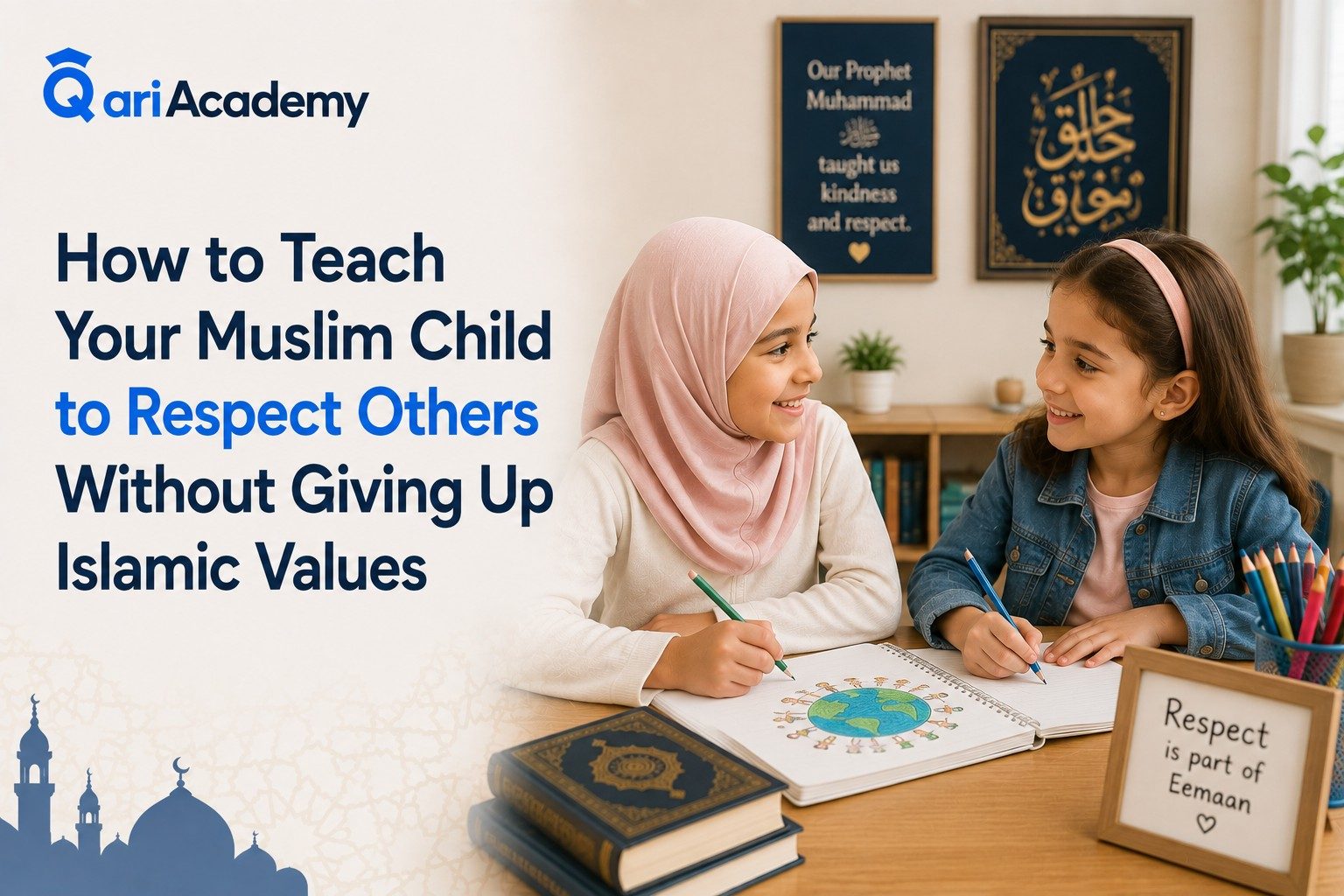
Learning how to raise a Muslim child who can respect others while remaining firmly connected to Islam is one of the most important parenting skills in today’s diverse world.
What Does Respect Actually Mean?
Children often misunderstand respect.
They may think:
“If I respect someone, I have to agree with them.”
That’s not true.
Respect can simply mean:
- Speaking politely
- Not insulting someone
- Not bullying them
- Listening when appropriate
- Treating them fairly
- Not humiliating them
- Respecting their personal boundaries
It doesn’t mean:
“I believe exactly what you believe.”
This distinction is incredibly important.
1. Teach Your Child That People Will Be Different
Don’t wait until your child encounters a difficult situation at school.
Start early.
Explain that people can have different:
- Religions
- Languages
- Cultures
- Traditions
- Family backgrounds
- Opinions
- Personal choices
You can tell your child:
“You don’t have to agree with everyone. But you should always try to treat people fairly.”
This creates a foundation for mature interaction.
2. Teach Your Child What Islam Requires From Them
Islamic values should not disappear simply because your child enters a diverse environment.
Your child should understand that being Muslim includes:
- Honesty
- Mercy
- Justice
- Modesty
- Good manners
- Respect
- Self-control
- Responsibility
The Quran teaches believers to stand firmly for justice, even when it is difficult.
This gives children a powerful principle:
Your character should not depend on whether you like the other person.
3. Don’t Teach Your Child to Hate People Who Disagree
This is one of the biggest mistakes parents can make.
Suppose your child says:
“My classmate doesn’t believe in Islam.”
You don’t need to respond:
“Stay away from him. He’s a bad person.”
Instead:
“He has different beliefs. We believe Islam is true, and we should learn our religion well while treating people fairly.”
That is a much stronger message.
4. Explain That Disagreement Is Normal
Your child will eventually meet adults who disagree with them.
Some will disagree about:
- Religion
- Politics
- Marriage
- Education
- Lifestyle
- Morality
If your child believes every disagreement is an attack, life will become exhausting.
Teach:
“Someone can disagree with you without being your enemy.”
That’s a lesson worth learning early.
5. Give Your Child a Simple Rule
You can teach:
Respect the person.
Understand the belief.
Follow your values.
Don’t allow pressure.
This four-part rule can help children navigate many difficult situations.
6. Teach Them Not to Mock People
Children sometimes make jokes about people who are different.
They may imitate:
- Accents
- Clothing
- Names
- Religious practices
- Family structures
- Physical differences
- Cultural traditions
Teach them that this isn’t acceptable.
The Quran explicitly warns against ridiculing others.
Quran — Surah Al-Hujurat 49:11
You can explain:
“Being Muslim doesn’t give us permission to make fun of someone.”
This is an important part of Islamic character.
7. Teach Your Child That Kindness Is Not Weakness
Some children believe:
“If I’m nice to everyone, people will think I’m weak.”
Correct that idea.
Kindness requires self-control.
Your child can be kind while also being confident.
They can say:
“I don’t agree with you.”
without becoming aggressive.
They can say:
“Please don’t speak to me that way.”
without insulting someone.
That’s strength.
8. Teach Boundaries Alongside Respect
Respect doesn’t mean allowing someone to pressure your child.
Your child should know how to say:
“I’m not comfortable with that.”
“No, I don’t want to.”
“My family doesn’t allow that.”
“I’d rather not talk about this.”
“I’m going to ask my parents.”
These are healthy boundaries.
9. Teach Your Child When to Walk Away
Not every disagreement deserves an argument.
Sometimes the smartest response is:
Walk away.
Your child doesn’t need to prove that Islam is correct in every conversation.
They don’t need to win every debate.
They don’t need to respond to every provocative comment.
Teach them:
“You don’t have to answer everything.”
That can prevent many unnecessary conflicts.
10. What If Someone Insults Islam?
This can be particularly difficult for Muslim children.
A classmate might say:
“Islam is stupid.”
Or:
“Your religion is wrong.”
Your child may feel angry.
Teach them not to respond with another insult.
They can say:
“You don’t have to agree with my religion, but please don’t insult it.”
Or:
“I don’t want to argue about religion.”
If repeated comments become harassment or bullying, your child should tell a trusted adult.
11. Teach Your Child How to Respond to Difficult Questions
Your child may be asked:
“Why do Muslims pray?”
“Why do girls wear hijab?”
“Why can’t Muslims eat pork?”
“Why don’t Muslims drink alcohol?”
“Why does Islam have rules about relationships?”
Your child doesn’t need to know every answer.
Teach them:
“I don’t know, but I can ask my parents.”
This is far better than inventing an answer.
12. Build Confidence Through Islamic Knowledge
A child who knows very little about their religion may become uncomfortable when classmates ask questions.
They may think:
“Maybe my religion is wrong because I can’t answer.”
That’s why Islamic education matters.
Your child should gradually develop an understanding of:
- Quran
- Tawheed
- Prophetic teachings
- Islamic manners
- Worship
- Family
- Modesty
- Relationships
- Islamic history
The goal isn’t to make your child a religious scholar.
It’s to give them a foundation.
13. Make Quran Learning a Positive Experience
Quran shouldn’t only appear when your child has done something wrong.
Avoid:
“You were disrespectful today, so you’re going to Quran class.”
Instead, Quran should be part of normal life.
A consistent Quran routine can help children develop familiarity with the Quran and Islamic concepts.
QariAcademy provides live one-on-one online Quran learning for children and teenagers, including Quran reading, Tajweed, Hifz, Quranic Arabic, and Islamic studies.
QariAcademy — Online Quran Programs
For busy families, one-on-one online lessons can also make it easier to maintain consistency alongside school, sports, and other activities.
14. Don’t Expect the Quran Teacher to Do Everything
Parents sometimes think:
“If my child attends Quran classes, the teacher will teach them how to deal with every modern issue.”
That’s unrealistic.
Quran education is important.
But your child also needs conversations at home.
They need to be able to ask:
“What does Islam say about this?”
“Why does my classmate believe that?”
“Is this allowed?”
Parents should create an environment where those questions are welcome.
15. Don’t Shut Down Difficult Questions
If your child asks something uncomfortable, don’t immediately say:
“Don’t talk about things like that.”
Your child may simply take the question somewhere else.
Instead say:
“That’s an important question. Tell me what you’ve heard.”
Now you can understand what your child is actually thinking.
16. Teach Your Child Critical Thinking
Respect doesn’t mean believing everything.
Your child needs to learn how to ask:
Where did this information come from?
Is it true?
Who is saying it?
What evidence supports it?
Does this agree with what Islam teaches?
This is particularly important because children encounter enormous amounts of information online.
The American Academy of Pediatrics emphasizes the importance of helping families develop healthy media habits and appropriate boundaries around children’s digital lives.
American Academy of Pediatrics — Media and Children
17. Don’t Let TikTok Become Your Child’s Teacher
This is one of the biggest modern parenting challenges.
A child can watch one video and suddenly have a strong opinion about:
- Religion
- Relationships
- Gender
- Politics
- Mental health
- Morality
The problem isn’t only the topic.
It’s the assumption that a 30-second video can explain a complicated subject.
Teach your child:
“Don’t believe something simply because someone said it confidently online.”
That’s a life skill.
18. Teach Them to Respect Other Religions Without Abandoning Islam
Your child may have classmates who are:
- Christian
- Jewish
- Hindu
- Buddhist
- Atheist
- Agnostic
Your child can understand:
“They have a different religion.”
without thinking:
“Therefore I should hate them.”
The Quran establishes principles of justice and good treatment toward those who are not fighting Muslims because of their faith.
Quran — Surah Al-Mumtahanah 60:8
This gives Muslim parents an important framework for teaching children how to interact with people who believe differently.
19. Teach Them That Friendship Requires Wisdom
You don’t need to tell your child:
“Only be friends with Muslims.”
But you also shouldn’t teach:
“Every friendship is automatically healthy.”
Look at the qualities of the friend.
Does the friend:
- Respect your child?
- Encourage good behavior?
- Pressure your child?
- Mock Islam?
- Encourage inappropriate content?
- Respect boundaries?
- Encourage honesty?
These factors matter.
20. Teach Your Child That Peer Pressure Is Real
A child may say:
“Everyone else does it.”
That doesn’t make something right.
Teach:
“Popularity doesn’t determine whether something is right or wrong.”
Your child needs enough confidence to say:
“That’s not for me.”
This skill will become increasingly important during adolescence.
21. Give Them Practical Responses
Children need scripts.
Teach them:
“No, I’m not comfortable with that.”
“I don’t agree.”
“That’s not something I do.”
“Let’s talk about something else.”
“I need to go.”
“I’ll ask my parents.”
These simple sentences can help children navigate difficult situations without escalating them.
22. Don’t Make Your Child Afraid of the Outside World
The world contains many ideas that don’t align with Islam.
You cannot eliminate all of them.
If you raise your child to believe:
“Everyone outside our family is dangerous,”
they may struggle when they become independent.
A stronger message is:
“The world is diverse. Know your values, use good judgment, and choose your friends wisely.”
That’s preparation rather than isolation.
23. Teach Your Child That Their Identity Is Bigger Than Their Friends
Children sometimes change themselves because they desperately want acceptance.
Remind your child:
“You don’t have to become someone else to be liked.”
Your child can be:
- Muslim
- Confident
- Kind
- Funny
- Athletic
- Creative
- Intelligent
- Social
without abandoning their values.
24. Create a Strong Family Identity
Children with a strong sense of belonging often have an easier time handling outside pressure.
Build family traditions.
For example:
- Family Quran time
- Friday family dinner
- Mosque visits
- Islamic stories
- Family outings
- Ramadan traditions
- Eid traditions
These experiences tell your child:
“This is who we are.”
25. Don’t Turn Islam Into a List of “Don’ts”
If your child’s Islamic education is only:
Don’t do this.
Don’t wear that.
Don’t talk to them.
Don’t watch this.
Don’t listen to that.
eventually Islam can feel like an endless list of restrictions.
Teach the positive side too:
- Why we worship Allah
- Why we show mercy
- Why we seek knowledge
- Why we value family
- Why honesty matters
- Why modesty matters
- Why justice matters
- Why Muslims care for others
Children need to understand what Islam builds, not only what it prohibits.
26. Teach Through Real Situations
Suppose your child comes home and says:
“My friend did something I don’t think is right.”
Instead of immediately saying:
“Don’t be friends with them.”
ask:
“What happened?”
Then:
“What do you think Islam teaches about that?”
Now your child is learning to think.
You’re not simply giving an answer.
You’re developing judgment.
27. Don’t Shame Children for Being Curious
Curiosity is part of growing up.
A child may ask about things they don’t understand.
That’s not automatically a sign of bad character.
Your response should be:
“It’s okay to ask questions. Let’s make sure we find reliable answers.”
This keeps communication open.
28. What If Your Child Says, “But My Friend Is a Good Person”?
You can say:
“He may be a good friend in many ways.”
Then explain:
“We can appreciate someone’s good qualities while still disagreeing with certain beliefs or choices.”
This is a sophisticated lesson.
It teaches children to think beyond black-and-white judgments.
29. Teach Your Child Not to Judge Everyone
Your child shouldn’t assume:
“That person believes X, therefore they’re bad.”
Teach them to look at actual behavior.
Does the person lie?
Do they bully?
Do they help others?
Do they respect boundaries?
Are they trustworthy?
Character matters.
30. Protect Your Child Without Creating Fear
Parents have a responsibility to protect their children.
That includes supervising:
- Online activity
- Friendships
- Age-appropriate content
- School environments
- Private communication
But protection should be intelligent.
Don’t monitor every breath your child takes.
Teach them how to make good decisions.
Because eventually, you won’t be there.
31. The Parent’s Biggest Blind Spot
Many parents believe:
“If I control everything my child sees, my child will always make the right choices.”
That’s impossible.
You can control the home environment.
You can establish boundaries.
You can supervise appropriately.
But eventually your child will encounter ideas you don’t control.
The better investment is helping them develop internal judgment.
32. What Does Internal Judgment Look Like?
It means your child can think:
“I understand what this person believes.”
“I know what Islam teaches.”
“I don’t need to insult them.”
“I don’t need to copy them.”
“I can ask questions.”
“I can say no.”
“I know when to seek help.”
That is much stronger than simply obeying because a parent is watching.
33. A Simple Family Rule
You can teach your children:
We don’t hate people because they’re different.
We don’t copy everything people do.
We don’t allow people to pressure us.
We don’t hide difficult questions from our parents.
We follow what we believe is right.
That framework can serve your child in school, online, university, and eventually adulthood.
34. A Practical Table for Parents
| Situation | What Your Child Can Do |
|---|---|
| Someone has different beliefs | Be respectful |
| Someone asks about Islam | Answer simply or ask a parent |
| Someone pressures your child | Say no and leave |
| Someone mocks Islam | Set a boundary and tell an adult if repeated |
| A friend encourages inappropriate content | Reject it and seek help |
| Child is confused | Talk to parents |
| Child sees disturbing content online | Close it and tell an adult |
| Someone bullies another child | Don’t participate |
35. Build a Relationship That Survives Difficult Conversations
Your child needs to believe:
“Even if I ask my parents something uncomfortable, they will listen.”
That doesn’t mean you will agree.
It means you will listen.
You can say:
“I understand why you’re asking.”
Then:
“Here’s what Islam teaches.”
That is much healthier than:
“Don’t ever ask me that again.”
36. Use Islamic Education to Build Confidence
Your child’s relationship with the Quran should grow alongside their understanding of the world.
QariAcademy can support this through structured one-on-one online Quran lessons.
Children can study:
- Quran Reading
- Tajweed
- Hifz
- Quranic Arabic
- Islamic Studies
For parents, the value isn’t simply having another class on the weekly schedule.
It’s helping children develop knowledge that can support their decisions outside the home.
37. Make Islamic Learning Relevant
Don’t let Quran learning become completely disconnected from your child’s real life.
If your child is dealing with friendship problems, discuss character.
If they’re dealing with peer pressure, discuss self-control.
If they’re struggling with anger, discuss patience.
If they’re encountering different beliefs, discuss respectful disagreement.
This makes Islamic education meaningful.
38. Don’t Expect Perfection
Your child will make mistakes.
They may repeat something inappropriate.
They may laugh at something they shouldn’t.
They may follow a friend.
They may say something without thinking.
Correct them.
But don’t immediately conclude:
“My child has lost their values.”
Children are learning.
Your job is to keep teaching.
39. The Goal Is Not Isolation
The ultimate goal isn’t:
“My child never meets anyone different.”
That’s impossible.
The goal is:
“My child can meet people who are different and still know who they are.”
That’s a much stronger form of protection.
40. The Muslim Child You Want to Raise
Imagine your child at 20 years old.
They work with people from different religions.
They meet people with different lifestyles.
They hear opinions they disagree with.
But they remain calm.
They know their values.
They treat people fairly.
They don’t bully.
They don’t blindly follow.
They don’t feel ashamed of being Muslim.
They know how to ask questions.
They know how to say no.
They know when to walk away.
And they know that Islam teaches them both principles and character.
That’s the goal.
Conclusion
Teaching a Muslim child to respect others doesn’t mean weakening their Islamic identity.
In fact, done properly, it can strengthen it.
Your child should understand what Islam teaches.
They should be able to disagree with people respectfully.
They should know that every person deserves fair treatment.
They should understand that kindness doesn’t require agreement.
They should know how to establish boundaries.
They should be confident enough to say no to peer pressure.
And they should feel comfortable coming to you when they encounter something confusing.
The world your child is growing up in is diverse.
You cannot remove every different idea from it.
And you don’t need to.
Instead, give your child something more valuable:
Knowledge instead of fear.
Confidence instead of isolation.
Character instead of hostility.
Critical thinking instead of blind acceptance.
Faith instead of confusion.
QariAcademy can be part of that foundation by providing live one-on-one Quran and Islamic learning for children and teenagers. QariAcademy — Online Quran Programs
A consistent relationship with the Quran can help your child develop Islamic knowledge while you continue teaching them how to navigate real-world situations at home.
The goal isn’t to raise a child who believes:
“Everyone who is different from me is bad.”
And it isn’t to raise a child who believes:
“Every idea is equally correct.”
Raise a child who can say:
“I know what I believe, I respect people, and I don’t have to abandon my values to treat someone well.”
That’s confidence.
That’s maturity.
And that’s the kind of Islamic character that can remain with your child long after they leave your home.
If you’d like to strengthen your child’s Quran and Islamic education alongside your parenting, you can explore QariAcademy’s programs and start with a free trial:
Book a Free Trial at QariAcademy
Primary Keyword: Muslim child respect others