
Introduction
Quran memorization can be one of the most beautiful parts of a child’s Islamic education. Parents often begin Hifz with the hope that their child will develop discipline, confidence, and a lifelong connection with the Quran.
But what happens when memorization starts becoming a source of stress?
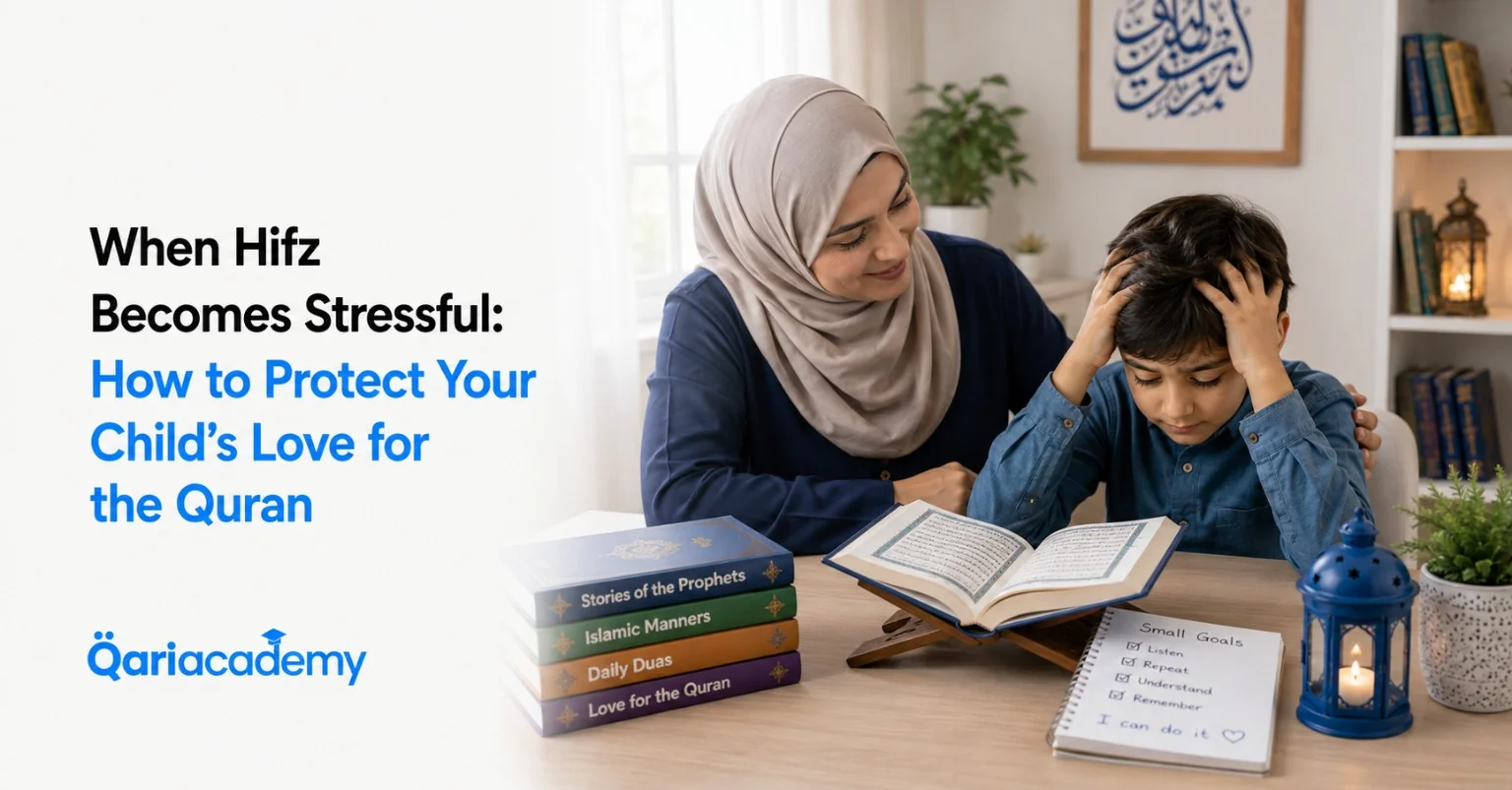
A child may begin complaining before Hifz lessons, becoming upset when they forget verses, avoiding revision, or becoming afraid of making mistakes. Parents may respond by increasing reminders and pressure because they worry their child is falling behind.
This can create a difficult cycle:
Pressure → anxiety → weaker performance → more correction → more pressure.
The goal is not to remove discipline from Hifz. Memorization requires effort, consistency, and patience. The goal is to distinguish healthy challenge from excessive pressure.
Hifz stress in children deserves attention because children can experience pressure from parents, teachers, school, and their own expectations. The American Academy of Pediatrics notes that some stress can be a normal part of learning and development, while persistent or intense stress can affect children’s wellbeing and behavior.
A sustainable Hifz routine should therefore develop two things at the same time:
Strong Quran memorization and a healthy relationship with the Quran.
What Is Hifz Stress in Children?
Hifz stress in children refers to ongoing emotional pressure associated with Quran memorization.
Some frustration is completely normal. A child may forget a verse, struggle with similar passages, or have an occasional difficult lesson.
The concern begins when negative reactions become persistent.
Possible signs include:
- Frequent crying before Hifz lessons
- Avoiding Quran practice
- Fear of making mistakes
- Constant arguments about revision
- Saying, “I’m bad at Quran”
- Becoming unusually perfectionistic
- Losing interest in Quran activities they previously enjoyed
- Significant mood changes around Quran time
- Difficulty concentrating during lessons
- Stress affecting sleep, school, or daily life
One difficult day does not necessarily indicate a serious problem. Parents should look for patterns and changes over time.
Healthy Challenge vs. Unhealthy Pressure
| Healthy Challenge | Unhealthy Pressure |
|---|---|
| Child gets frustrated occasionally | Child is distressed frequently |
| Mistakes are corrected calmly | Child becomes afraid of mistakes |
| Goals are challenging but realistic | Targets consistently feel impossible |
| Revision is part of the routine | Forgetting becomes a family crisis |
| Parents encourage effort | Parents use shame or comparison |
| Child gradually becomes independent | Child becomes increasingly resistant |
The purpose is not to diagnose a child. It is to recognize when the learning environment may need adjustment.
Why Can Hifz Become Stressful?
Hifz itself is not necessarily the problem. Often, the surrounding expectations create the pressure.
Common causes include:
Too Much New Memorization
If a child receives more new material than they can retain, every lesson becomes increasingly difficult.
Weak Revision
When previously memorized material becomes weak, children can feel as though they are constantly losing what they worked hard to learn.
Unrealistic Deadlines
Goals such as “You must finish this Juz this month” may create unnecessary anxiety if they do not match the child’s actual capacity.
Constant Correction
Correction is necessary, but interrupting every few seconds can make a child afraid to recite.
Comparison
Comparing children with siblings, cousins, classmates, or children seen on social media can turn someone else’s achievement into a child’s embarrassment.
School and Family Demands
Children may already be balancing school, homework, sports, activities, and family commitments. Hifz needs to fit realistically into that life.
Teacher-Student Mismatch
A teacher may have excellent Quran knowledge but still not be the right teaching match for a particular child.
Family Conflict
If every Quran session becomes an argument between parent and child, the emotional association with Quran can gradually become negative.
Stop Measuring Hifz Only by Pages
One of the biggest mistakes parents can make is making quantity the main measure of success.
Questions such as:
“How many pages did you memorize?”
“How many Juz are you on?”
“When will you finish?”
are understandable, but they do not tell the whole story.
A better measurement system includes:
- Accuracy
- Retention
- Revision
- Tajweed
- Reading ability
- Consistency
- Independence
- Confidence
A child who memorizes half a page accurately and retains it may be progressing better than a child who memorizes two pages but forgets most of them.
The objective of Hifz is not simply to accumulate pages.
It is to retain, recite, revise, and live with what has been memorized.
Discipline Is Not the Same as Pressure
Parents sometimes worry that reducing pressure means lowering standards.
It doesn’t.
Healthy discipline sounds like:
“Quran is important, so we have a regular time for it.”
Unhealthy pressure sounds like:
“If you don’t perform exactly as expected, you are disappointing us.”
You can maintain high standards for effort, attendance, accuracy, and consistency without making mistakes feel catastrophic.
Try saying:
- “Let’s practice this again.”
- “Your teacher said this section needs more revision.”
- “You don’t have to get it perfect immediately.”
- “Let’s find out which part is difficult.”
- “You’re improving. Keep going.”
This creates accountability without shame.
Listen Before You Change the Routine
If your child is becoming stressed, do not immediately increase the workload.
First ask:
“What is the hardest part of Hifz for you right now?”
Then listen.
The problem may not be memorization itself.
Perhaps the child is:
- Exhausted after school
- Afraid of making mistakes
- Confused by similar verses
- Overwhelmed by the amount of revision
- Uncomfortable with the teacher
- Being tested too frequently
- Practicing at the wrong time of day
You cannot solve a problem you have not correctly identified.
The American Academy of Pediatrics recommends listening and connecting calmly with children experiencing stress rather than responding only to the behavior itself.
Make Revision the Foundation of Hifz
Strong revision can actually reduce stress.
Instead of treating all memorized material the same, divide it into:
New: Current memorization.
Recent: Material learned recently.
Older: Established Hifz.
Weak: Passages requiring additional attention.
This gives the child a manageable system.
Memory also benefits from repeated retrieval over time rather than relying on one concentrated practice session. For Hifz, that means reviewing a passage shortly after learning it, then revisiting it over subsequent days and weeks.
The exact schedule should be determined according to the child’s age, ability, and teacher’s recommendations.
Reduce New Memorization When Necessary
If your child is overwhelmed, temporarily reducing new Hifz can be a smart adjustment.
It does not mean giving up.
It can create space to:
- Strengthen older memorization
- Improve Tajweed
- Rebuild confidence
- Correct pronunciation
- Establish better revision habits
- Restore motivation
Think of it as stabilizing the foundation before building higher.
A temporary revision-focused period may be more productive than continuously adding new material that the child cannot retain.
Create Flexible Hifz Days
Families should recognize that not every day has the same energy level.
A child may have:
- Exams
- Homework
- Sports
- Family events
- Travel
- Illness
- A particularly tiring school day
Instead of demanding identical performance every day, create three types of Quran days:
Heavy Day: New memorization + revision.
Light Day: Revision and reading.
Minimum Day: A few minutes of Quran contact to maintain continuity.
This approach is especially practical for Muslim families living in the USA, UK, Canada, Australia, and other Western countries where children often have demanding school and extracurricular schedules.
Stop Becoming the “Quran Police”
Constant reminders can unintentionally make Quran feel like surveillance.
“Did you revise?”
“Did you memorize?”
“Can you recite it?”
“Why did you forget?”
Repeated throughout the day, these questions can create resistance.
Instead, establish one predictable Quran practice period.
Use:
- A visible schedule
- A simple checklist
- Teacher-assigned goals
- A consistent practice time
The system should carry some of the responsibility rather than the parent repeatedly reminding the child.
Give Your Child Appropriate Choices
Small choices can increase a child’s sense of ownership.
Instead of:
“Revise now.”
Try:
“Would you like to revise before dinner or after dinner?”
Instead of:
“Start this surah.”
Try:
“Would you like to review this surah or the one you learned last week?”
You are not giving the child control over whether Quran matters.
You are giving them limited control over how they participate.
Protect the Parent-Child Relationship
Parents should support Hifz without becoming a second Quran teacher.
If you are not trained in Tajweed, avoid turning every home practice session into a technical lesson.
Your role can be to:
- Provide time
- Listen
- Encourage
- Maintain the routine
- Communicate with the teacher
- Celebrate improvement
The teacher can handle detailed technical correction.
This division can reduce unnecessary parent-child tension.
What If Your Child Says, “I Hate Hifz”?
Don’t panic.
Ask:
“What do you dislike about it?”
The answer may be:
“I hate being tested.”
“I hate forgetting.”
“I hate being tired.”
“I don’t understand this.”
“I don’t like making mistakes.”
“I don’t like the amount of work.”
“I don’t like my teacher.”
The child may not actually hate the Quran. They may hate their current experience of learning Quran.
That distinction matters.
Fixing the workload, timing, teaching style, or expectations can sometimes change the child’s attitude significantly.
The Teacher-Child Relationship Matters
A good Quran teacher should correct mistakes without humiliating the child.
Children should understand that mistakes are part of learning.
Parents can ask:
- “Do you feel comfortable asking your teacher questions?”
- “What happens when you make a mistake?”
- “Do you understand what your teacher wants you to practice?”
Parents should also ask the teacher:
- Is the current memorization target appropriate?
- Is the child retaining older material?
- What is the main difficulty?
- Does the child need more reading practice?
- Should new memorization temporarily be reduced?
QariAcademy’s one-on-one approach allows lessons to be adapted to a student’s level and pace, which can be useful when a child needs a different balance between Hifz, reading, revision, and Tajweed.
Don’t Sacrifice Sleep or School
Hifz should be part of a child’s life, not something that consumes the rest of it.
If memorization consistently causes:
- Lack of sleep
- Severe fatigue
- Missed homework
- Significant academic decline
- Constant emotional distress
the schedule deserves reassessment.
A shorter, focused practice session can be more productive than forcing a tired child through a long session.
The goal is sustainable learning.
A Simple Recovery Plan
If Hifz has already become stressful, consider a gradual reset.
| Period | Parent Focus | Child Focus |
|---|---|---|
| Week 1 | Listen and understand | Explain difficulties |
| Week 2 | Reduce unnecessary pressure | Rebuild confidence |
| Week 3 | Establish a predictable routine | Practice consistently |
| Week 4 | Review progress | Gradually resume new Hifz |
Do not try to recover every missed page immediately.
The priority is to restore a healthy system.
Once the child is stable, new memorization can gradually increase again.
Protect the Joy of Quran Outside Hifz
Not every Quran interaction needs to be a test.
Sometimes:
- Listen to a favorite reciter together.
- Read Quran as a family.
- Discuss a simple meaning.
- Let the child recite a familiar surah.
- Listen during a family drive.
- Talk about a Quranic lesson.
Create a distinction between:
Hifz Time: Memorization, revision, and focused practice.
Family Quran Time: Listening, reading, reflection, and connection.
This helps the child experience the Quran beyond performance.
For additional support with children’s Quran learning and Tajweed, QariAcademy’s resources on Quran learning for children and Tajweed for kids can complement a structured learning routine.
When Should Parents Seek Additional Help?
If stress becomes severe or persistent, or begins affecting sleep, school, relationships, or the child’s general wellbeing, parents should take it seriously.
The American Academy of Pediatrics recommends seeking appropriate professional support when a child’s mood, behavior, health, or functioning changes significantly.
This does not mean Quran is the problem.
It means the child’s wellbeing comes first, and families may need additional support to understand what is happening.
How QariAcademy Can Help
QariAcademy provides live, one-on-one Quran instruction for children, with programs that can include Quran reading, Tajweed, Hifz, and Quranic Arabic. Lessons are designed around the student’s current level and learning needs.
For a child experiencing Hifz stress in children, an individualized approach may help identify whether the underlying issue is:
- Too much new memorization
- Weak revision
- Reading difficulties
- Tajweed challenges
- Poor lesson timing
- An unsuitable pace
- Teacher-student mismatch
The goal should not be to make the child memorize faster at any cost.
The goal is to create a sustainable learning environment where the child can continue developing without losing their positive relationship with the Quran.
Parents can also explore QariAcademy’s Hifz program and Quran learning options and use the free trial and enrollment page to find an appropriate starting point.
Frequently Asked Questions
Is it normal for children to feel stressed during Hifz?
Some frustration is normal when children learn something challenging. Persistent fear, frequent distress, strong avoidance, or significant changes in mood deserve closer attention.
Does reducing Hifz pressure mean lowering standards?
No. Parents can maintain standards for effort, accuracy, consistency, and revision while adjusting unrealistic workloads and expectations.
How do I know if my child is under too much Hifz pressure?
Look for persistent patterns such as fear of lessons, frequent crying, strong avoidance, perfectionism, repeated family conflict, or effects on sleep and school.
Should I stop Hifz if my child is stressed?
Not necessarily. First identify the cause. The solution may be less new material, more revision, a different schedule, or a different teacher.
Should parents compare their child’s Hifz progress with other children?
No. Children differ in memory, reading ability, Arabic exposure, practice time, and family circumstances. Compare your child’s progress with their own previous performance.
Does revision help reduce Hifz stress?
It can. Strong revision helps children retain what they have learned instead of constantly feeling that previous work is disappearing.
Can online Quran classes help a stressed child?
They can when the teacher provides individualized attention and an appropriate pace. However, changing the format alone will not solve stress if the workload or expectations remain unrealistic.
Is it okay to take a short break from new memorization?
Yes. A temporary reduction in new memorization can sometimes help rebuild confidence and strengthen revision while maintaining a small amount of Quran practice.
Conclusion
When Hifz becomes stressful, the answer is not always to stop—and it is not always to push harder.
The first step is to understand why the child is struggling.
Maybe the workload is too high.
Maybe revision is insufficient.
Maybe the lesson timing is poor.
Maybe school demands have increased.
Maybe the child is afraid of mistakes.
Maybe the teacher is not the right fit.
Maybe parents have unintentionally turned every Quran interaction into a test.
Once the real problem is identified, the solution becomes much clearer.
Remember that Hifz stress in children should not be ignored simply because Quran memorization is important. Quran is important, which is precisely why the learning environment deserves thoughtful attention.
Your child should learn discipline without learning fear.
They should experience correction without humiliation.
They should understand that accuracy matters without believing that every mistake is a disaster.
And gradually, they should develop enough ownership that their relationship with the Quran can continue even when parents are no longer supervising every practice session.
The goal is not simply to produce a child who memorizes many pages.
The goal is to help raise a child who can memorize, revise, recite, understand, and remain connected to the Quran.
Sometimes moving more slowly is exactly what allows a child to keep moving forward.
If your child’s current Hifz routine has become stressful, start by listening. Reassess the workload. Strengthen revision. Protect sleep and school responsibilities. Communicate with the teacher. Give your child appropriate choices. Then rebuild gradually.
A sustainable Quran routine is more valuable than an impressive target that cannot be maintained.
QariAcademy offers one-on-one online Quran classes for children, including Quran reading, Tajweed, Hifz, and Quranic Arabic, with lessons adapted to individual student needs.
If you believe your child’s current Hifz routine needs a different pace or learning approach, a QariAcademy free trial can help you explore whether the teaching style and learning plan are a better fit.