Table of Contents
Introduction
Choosing a Quran teacher for your child is about much more than finding someone who can recite the Quran correctly.
Parents often start with questions such as:
- How many years of experience does the teacher have?
- Does the teacher know Tajweed?
- Is the teacher qualified?
- Does the teacher teach online?
- How much does the program cost?
These are important questions, but there is another question that may matter even more:
Can this teacher make my child want to keep learning the Quran?
A child can have a highly knowledgeable teacher and still struggle if the teaching style does not match their personality, age, or learning needs.
On the other hand, a patient and engaging teacher can sometimes transform a child who previously found Quran lessons difficult into a student who looks forward to each class.
Research involving 707 students in Dutch Islamic primary schools found generally high levels of closeness and low levels of conflict in student-teacher relationships. The researchers also noted that negative teacher-student relationships can put students’ emotional and academic adjustment at risk.
This is particularly important in Quran education.
A Quran teacher is not simply teaching a subject. They are helping a child develop a relationship with the Quran.
So, what makes a good Quran teacher for children?
1. Strong Quran and Tajweed Knowledge
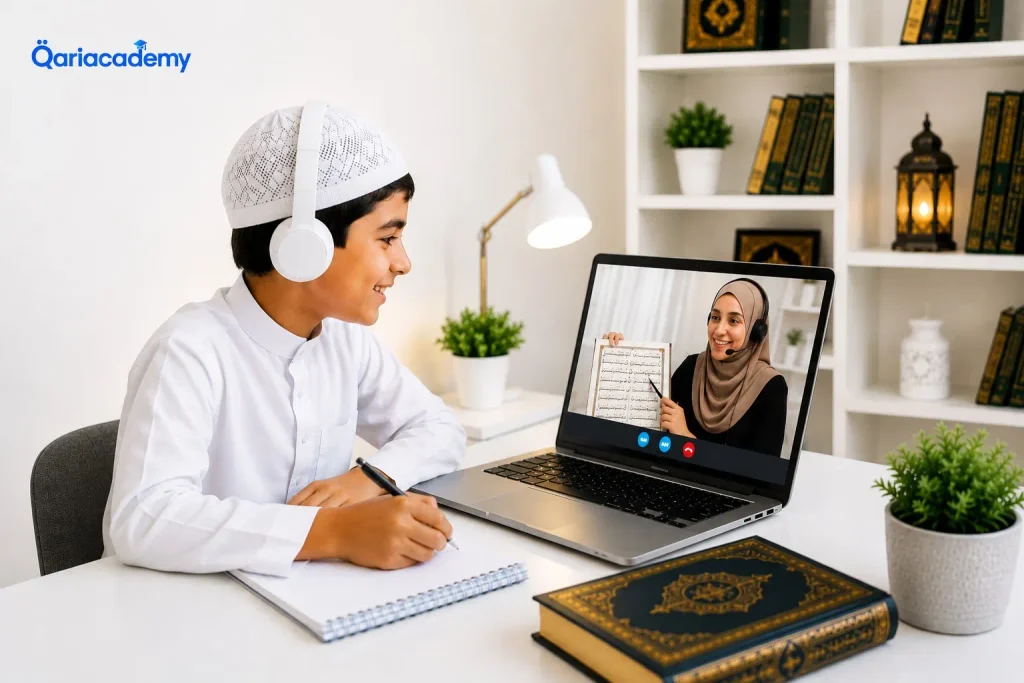
The first requirement is obvious: a Quran teacher needs strong knowledge of Quran recitation and Tajweed.
Children are building foundational habits. If they repeatedly pronounce letters incorrectly or apply Tajweed rules incorrectly, those mistakes can become difficult to correct later.
A good teacher should be able to:
- Listen carefully to recitation
- Identify pronunciation problems
- Explain Tajweed rules clearly
- Demonstrate the correct pronunciation
- Correct mistakes patiently
- Know when a child needs more practice
- Adjust the lesson according to the student’s level
But there is an important distinction.
Knowing the Quran is not the same as knowing how to teach it to a child.
A teacher may be an excellent reciter but still struggle to explain a concept to a seven-year-old.
That is why parents should evaluate both Quran knowledge and teaching ability.
| What Parents Should Look For | Why It Matters | What to Observe |
|---|---|---|
| Strong Quran recitation | Establishes correct foundations | Accurate pronunciation |
| Tajweed knowledge | Prevents repeated reading errors | Clear explanations |
| Teaching ability | Converts knowledge into learning | Child actually understands |
2. Patience When Children Make Mistakes
Children forget.
They become distracted.
They confuse letters.
They forget a Surah they memorized last week.
Sometimes they make the exact same mistake five times.
A good Quran teacher understands that this is part of learning.
Instead of making the child feel embarrassed, the teacher calmly brings them back to the correct answer.
For example:
Instead of:
“We already studied this. Why did you forget?”
A better approach is:
“That’s okay. Let’s try it together one more time.”
The difference may seem small, but it can change how the child feels about the entire lesson.
A 2024 study examining Quran-based communication in Islamic religious education found that communication based on gentle, respectful, and easy-to-understand language was associated with more comfortable teacher-student interactions, greater student confidence in participation, and reduced anxiety when expressing opinions.
A child should feel safe making mistakes.
If a child becomes afraid of making mistakes, they may stop asking questions.
If they understand that mistakes are part of learning, they are more likely to keep trying.
That is why patience isn’t simply a nice personality trait.
It is part of good teaching.
3. A Teacher Who Understands Children
Teaching a six-year-old is not the same as teaching a thirteen-year-old.
A younger child may need:
- Shorter activities
- More repetition
- Simple explanations
- Frequent encouragement
A teenager may need:
- More independence
- Deeper explanations
- Greater responsibility
- More challenging material
- Opportunities to ask questions
A good teacher changes the approach without changing the learning objective.
| Child’s Age/Level | Common Need | Effective Teacher Response |
|---|---|---|
| Young beginner | Simplicity and repetition | Short, clear activities |
| Developing learner | Practice and encouragement | Guided correction |
| Older student | Independence and challenge | Deeper discussion and responsibility |
This is one of the biggest differences between teaching a curriculum and teaching a child.
4. A Good Quran Teacher Makes the Child Participate
One-way teaching can quickly become boring.
Teacher reads.
Child repeats.
Teacher corrects.
Child repeats.
Some repetition is necessary, especially when developing recitation.
But an effective teacher also asks the child to think.
For example:
“Can you find the Madd here?”
“Why did we pronounce this letter this way?”
“Can you read the next verse without my help?”
“What mistake did you notice in your own recitation?”
These questions turn the child from a passive listener into an active learner.
Research on teacher-student interaction in Quranic education has highlighted interactive, one-to-one scaffolding as an important pattern in the learning process.
That is particularly relevant to online Quran classes.
The child shouldn’t spend the lesson simply watching the teacher.
The child should be doing most of the learning.
5. A Good Teacher Gives Specific Encouragement
Children need encouragement.
But there is a difference between meaningful encouragement and saying:
“Amazing!”
after everything.
Specific feedback is more powerful.
Instead of:
“Good job!”
the teacher might say:
“Your pronunciation of that letter was much clearer today.”
Or:
“You remembered the Tajweed rule from our last lesson.”
Now the child understands exactly what they did well.
They begin to recognize progress.
And that can create a powerful cycle:
Practice → Improvement → Confidence → Motivation → More Practice
6. A Good Teacher Builds a Positive Relationship
A child does not have to be best friends with their Quran teacher.
But they should feel comfortable with them.
The teacher should be:
Warm + Respectful + Consistent + Structured
This balance is important.
Too much strictness can create fear.
Too much softness can remove structure.
The ideal teacher creates an environment where the child knows:
“My teacher expects me to work, but my teacher also wants me to succeed.”
Research involving Islamic primary-school students found generally positive teacher-student relationships, while the broader educational literature shows that negative relationships can interfere with students’ emotional and academic adjustment.
7. Real Story: When the Teacher Makes Quran Learning Enjoyable
Real parent experiences illustrate this better than theory.
One published testimonial from a parent of a nine-year-old described how the child eventually learned to read Quran with Tajweed and particularly enjoyed the relationship with the teacher. The parent emphasized that the teacher helped make the experience enjoyable rather than simply another task.
Another published student testimonial from a ten-year-old specifically mentioned that the teacher used games and stories, describing the course as fun.
These are not controlled scientific studies, so they shouldn’t be treated as proof that every child will respond the same way.
But they illustrate an important principle:
Children often remember how learning felt, not just what they learned.
That is why an excellent teacher thinks about engagement as well as accuracy.
8. The Teacher Understands Different Learning Speeds
One child may memorize a Surah quickly.
Another may need twice as much revision.
That does not automatically mean the second child is less intelligent or less motivated.
A good teacher asks:
Why is this child struggling?
Perhaps:
- The material is too difficult.
- The child needs more revision.
- The child has a pronunciation problem.
- The lesson is moving too quickly.
- The child is tired.
- The child needs a different explanation.
Instead of immediately increasing pressure, the teacher identifies the underlying problem.
| Situation | Weak Approach | Better Approach |
|---|---|---|
| Slow memorization | Pressure the child | Identify the obstacle |
| Frequent mistakes | Criticize repetition | Target the specific mistake |
| Fast progress | Keep giving easy work | Increase the challenge |
The goal is not to make every child learn at the same speed.
The goal is to help each child make meaningful progress.
9. A Good Teacher Has a Clear Plan
Parents should know where their child is going.
A structured Quran program should make it possible to answer questions such as:
- What is my child learning now?
- What have they completed?
- What needs revision?
- What are they struggling with?
- What is the next learning goal?
Without a plan, lessons can become disconnected activities.
With a plan, every lesson contributes to a larger objective.
For example:
| Learning Area | Current Goal | Next Step |
|---|---|---|
| Quran Reading | Improve fluency | Longer passages |
| Tajweed | Master basic rules | Apply them independently |
| Hifz | Memorize selected Surahs | Strengthen revision |
The plan should also remain flexible.
A child who struggles with a particular skill may need more time before moving forward.
10. A Good Teacher Communicates With Parents
Parents shouldn’t have to ask every week:
“How is my child doing?”
A good teacher communicates meaningful progress.
Instead of:
“Today’s lesson was good.”
a useful update might be:
“Today we reviewed Surah Al-Fil and practiced Madd. Your child improved in identifying the rule but still needs more practice applying it independently.”
That gives the parent something actionable.
The parent knows:
What happened → What improved → What needs work
This also creates a partnership between teacher and parent.
11. A Good Teacher Knows How to Correct Without Discouraging
Correction is essential in Quran learning.
But the way correction happens matters.
Imagine a child reads a verse incorrectly.
The teacher could immediately say:
“Wrong.”
Or the teacher could say:
“Let’s slow down and try that word again.”
The second response still corrects the mistake.
But it protects the child’s confidence.
Research on Islamic education has similarly emphasized respectful and empathetic communication between teachers and students.
Correction should improve the recitation without damaging the learner.
That is a skill.
12. A Good Teacher Makes Online Quran Lessons Interactive
For families choosing online Quran classes, this becomes especially important.
Online learning should not mean:
Teacher talks → Child watches.
A strong one-to-one online lesson can include:
- Live recitation
- Screen sharing
- Immediate correction
- Interactive questions
- Tajweed exercises
- Revision challenges
- Memorization practice
- Progress tracking
- Personalized feedback
The advantage of one-to-one learning is that the teacher can devote the lesson to one child’s specific needs.
But there is an important warning:
One-to-one does not automatically mean personalized.
A teacher can still deliver the exact same lesson to every child.
True personalization happens when the teacher changes the lesson based on what the child actually needs.
13. Real Story: Patience Can Change the Experience
A published testimonial from a parent whose son had studied online for several years described the teacher as highly competent and patient. The parent also highlighted that the teacher knew how to involve the child and make Quran learning enjoyable, saying the child looked forward to spending time with the teacher.
Notice what the parent praised.
Not simply:
“The teacher knows Quran.”
The praise focused on:
Competence + patience + involvement + enjoyment.
That combination is exactly what parents should look for.
Again, one family’s experience cannot guarantee the same outcome for every child.
But it gives parents a practical picture of what effective teaching can look like.
14. A Great Teacher Helps the Child Love the Quran
This may be the most important quality.
The objective isn’t simply to finish pages.
It isn’t simply to complete a Juz.
It isn’t simply to achieve a memorization target.
Those goals can be valuable.
But the larger goal is to help the child develop a lasting relationship with the Quran.
A child who finishes a large amount of memorization but grows to dislike Quran lessons has not experienced the ideal outcome.
A child who progresses steadily, learns correctly, develops confidence, and begins to see the Quran as something meaningful has gained something much more valuable.
15. What Parents Should Look For During a Trial Lesson
A trial lesson should not only answer:
“Can this teacher teach Quran?”
It should answer:
“Can this teacher teach MY child?”
Watch carefully.
| What to Observe | Positive Sign | Warning Sign |
|---|---|---|
| Communication | Child understands easily | Child seems confused |
| Correction | Calm and specific | Harsh or impatient |
| Engagement | Child participates | Child mostly watches |
| Structure | Clear lesson objective | No clear direction |
And after the lesson, don’t only ask:
“Did you like the teacher?”
Ask:
“What did you enjoy about the lesson?”
Then ask:
“Was anything difficult or uncomfortable?”
Those answers can tell you much more.
Red Flags Parents Should Watch For
A teacher may not be the right fit if they consistently:
- Shame the child for mistakes
- Become angry when the child forgets
- Compare the child with other students
- Use excessive pressure
- Ignore questions
- Have no clear learning plan
- Give little or no feedback
- Repeat the same lesson regardless of the child’s needs
- Focus only on completing pages
- Communicate poorly with parents
One difficult lesson does not necessarily mean the teacher is unsuitable.
Look for patterns.
Qualified Teacher vs. Excellent Children’s Quran Teacher
This distinction is worth remembering.
| Qualified Teacher | Excellent Children’s Teacher |
|---|---|
| Knows Quran and Tajweed | Knows Quran and knows how children learn |
| Corrects mistakes | Corrects mistakes constructively |
| Follows a curriculum | Adapts the curriculum to the child |
The second column is what parents should ultimately look for.
How QariAcademy Approaches Children’s Quran Learning
At QariAcademy, the focus can be built around the idea that children need more than a teacher who simply reads and corrects.
A strong children’s Quran learning experience should combine:
- 1-on-1 live lessons
- Qualified Quran teachers
- Personalized instruction
- Tajweed and Quran reading
- Memorization and revision
- Age-appropriate teaching
- Ongoing progress
- A supportive learning environment
The objective is not to rush a child through the Quran.
It is to help them learn correctly, progress consistently, and develop a positive relationship with the Quran.
Give Your Child the Right Start
If you’re still searching for a Quran teacher for your child, don’t choose based only on a profile picture, years of experience, or the lowest price.
Watch the teacher teach.
See how they respond to mistakes.
Notice whether your child participates.
Ask about the learning plan.
And most importantly, ask yourself:
“Can I see my child continuing to learn with this teacher for the long term?”
If the answer is yes, you’ve found something much more valuable than simply a Quran class.
You’ve found a teacher who may become an important part of your child’s Quran journey.
Ready to see whether QariAcademy is the right fit for your child?
Book a Quran Trial with QariAcademy
Give your child the opportunity to meet a qualified teacher, experience a personalized lesson, and discover a learning approach that fits their level and needs.
Frequently Asked Questions
What makes a good Quran teacher for children?
A good Quran teacher combines strong Quran and Tajweed knowledge with patience, communication skills, child-friendly teaching methods, encouragement, and the ability to personalize lessons.
Should my child’s Quran teacher be strict?
A teacher should provide structure and clear expectations, but excessive harshness is not the same as effective discipline. Children need both boundaries and a supportive environment.
How can I tell if a Quran teacher is good during a trial?
Look at how the teacher communicates, corrects mistakes, engages your child, explains concepts, and adjusts the lesson to your child’s level.
Is experience more important than personality?
Neither should be considered alone. Experience and Quran knowledge are important, but a teacher’s patience, communication, and ability to connect with children can determine whether those qualifications translate into effective learning.
Should the Quran teacher communicate with parents?
Yes. Parents should receive useful information about progress, strengths, weaknesses, and areas that need additional practice.
Can online Quran classes work for children?
Yes, particularly when the lessons are interactive and personalized. The quality of the teacher and teaching approach matters more than simply whether the lesson happens online or in person.
Conclusion
The best Quran teacher for children isn’t necessarily the teacher with the most impressive résumé.
It is the teacher who can combine knowledge with teaching ability, correction with compassion, structure with flexibility, and high expectations with encouragement.
A child needs someone who can say:
“This needs improvement.”
without making them feel:
“I’m not good enough.”
They need someone who can challenge them without overwhelming them.
Someone who notices their weaknesses but also recognizes their progress.
And someone who can make Quran learning feel like a meaningful journey rather than another obligation.
Real parent and student experiences repeatedly highlight qualities such as patience, involvement, enjoyment, and effective teaching—not simply technical knowledge.
Ultimately, choosing a Quran teacher is not simply about asking:
“Who can teach my child the Quran?”
The better question is:
“Who can teach my child the Quran in a way that helps them continue loving and learning it?”
That is the teacher worth looking for.
Reliable Sources & Further Reading
- British Journal of Educational Psychology study on teacher-student relationships in Islamic primary schools
- PubMed – Teacher-student relationships in Islamic primary education
- Research on Quran-based communication and teacher-student relationships
- Research on teacher-student interaction in Quranic learning
- Published parent and student testimonials about online Quran learning