Table of Contents
Introduction
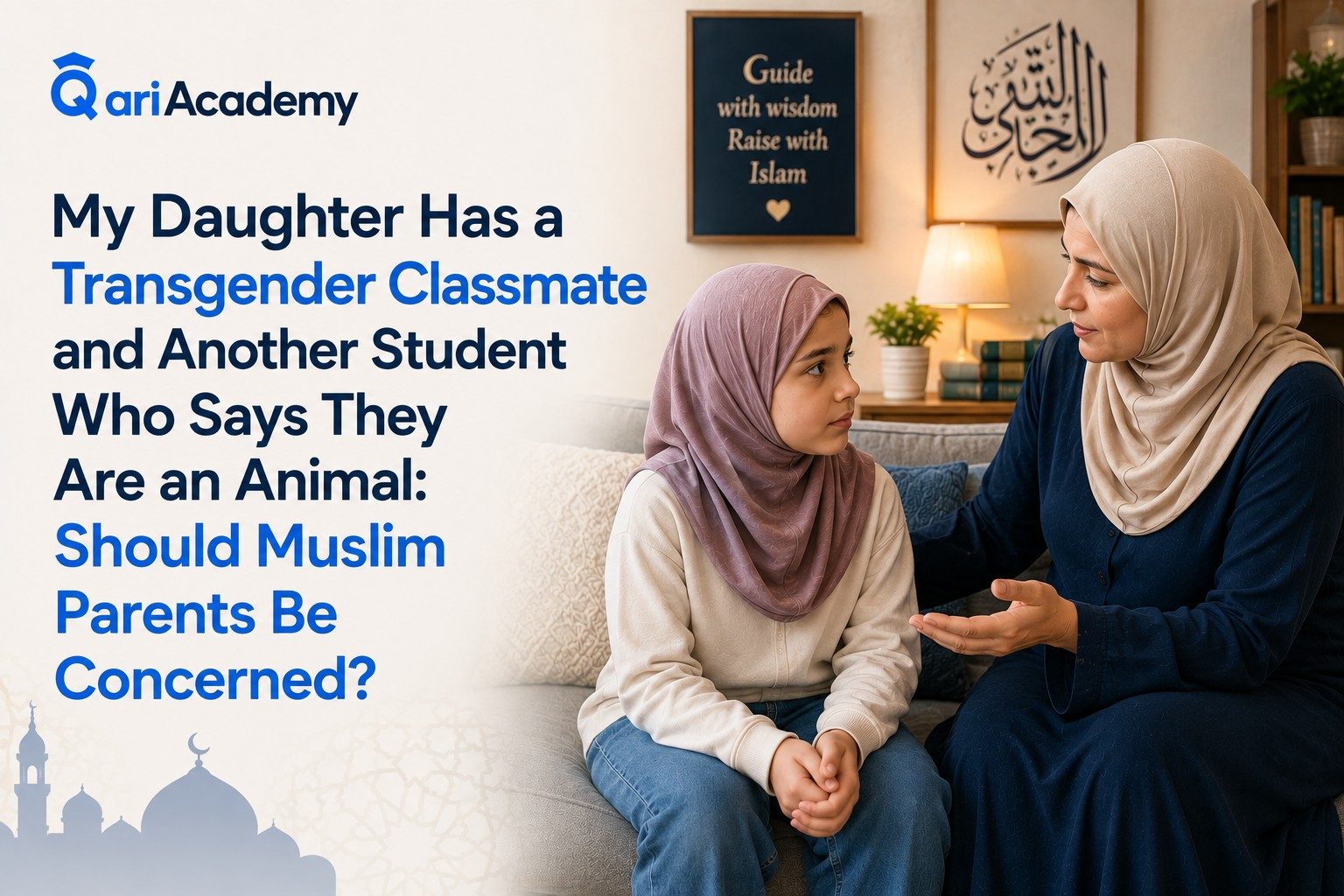
Imagine your daughter comes home from school and says:
“Mom, there is a girl in my class who says she is a boy.”
Or:
“Dad, one of my classmates says they are transgender.”
Then perhaps she adds something even more confusing:
“There is another student who says they are an animal.”
For many Muslim parents, this can be deeply confusing.
You may immediately wonder:
Is my child being exposed to inappropriate ideas?
Could this influence her beliefs?
Should I tell her to stay away from these students?
How do I explain what Islam teaches without teaching my daughter to hate or bully anyone?
And perhaps the most important question:
How do I protect my child’s Islamic identity while preparing her to live respectfully in a diverse society?
These questions deserve a thoughtful answer.
If your Muslim child has a transgender classmate, the answer should not be panic, hatred, or pretending that the issue doesn’t exist.
Your child needs an age-appropriate explanation of what she is seeing, a clear understanding of your family’s Islamic beliefs, and practical guidance about friendships and boundaries.
At the same time, parents should avoid turning another child’s identity into something their child is encouraged to mock, ridicule, or fear.
There is an important distinction:
You can teach your child what Islam believes without teaching your child to mistreat people who believe differently.
That distinction is becoming increasingly important for Muslim families raising children in diverse schools.
1. Don’t Panic When Your Child Tells You
Your first reaction can determine whether your daughter continues talking to you about difficult subjects.
If she says:
“There’s a transgender student in my class.”
and you immediately say:
“Stay away from them! They’re dangerous!”
your daughter may learn:
“My parents don’t want to discuss this.”
Next time she sees something confusing, she may turn to the internet instead.
Instead, remain calm.
Ask:
“What happened?”
“What did the student say?”
“What did the teacher say?”
“What do you think it means?”
Listen first.
You don’t have to approve of an idea simply because you’re willing to discuss it.
2. Ask What Your Child Actually Understands
Children often repeat words without fully understanding them.
Your daughter may say:
“She is transgender.”
But she may not know what transgender means.
She may have heard the word from another child.
She may have seen a video.
She may have misunderstood a conversation.
So ask:
“What do you understand that word to mean?”
This gives you an opportunity to correct misunderstandings without making the conversation frightening.
3. Give an Age-Appropriate Explanation
You don’t need to give a young child an unnecessarily detailed explanation about sexuality or gender.
Keep it simple.
For example:
“Some people believe that their gender identity is different from the sex they were assigned at birth. They may describe themselves as transgender.”
Then explain:
“Our family follows Islamic teachings about men, women, and how Allah created us.”
The exact wording should depend on the child’s age and maturity.
The goal is understanding, not overwhelming the child.
4. Explain Your Islamic Beliefs Clearly
Your daughter shouldn’t have to figure out your family’s beliefs from classmates.
Explain calmly that Islam teaches Muslims to believe that Allah created human beings as male and female and that Islamic teachings establish specific boundaries regarding gender, modesty, marriage, and family.
You don’t need to turn the conversation into an attack against another child.
You can say:
“Different people have different beliefs about these things. In our family, we follow what we believe Allah has revealed.”
That is enough for many children.
5. Teach the Difference Between Respect and Agreement
This is perhaps the most important lesson in the entire conversation.
Tell your daughter:
“You can treat someone respectfully without agreeing with everything they believe.”
She can be polite.
She can work with the student.
She can sit next to the student.
She can participate in a school activity with the student.
And she can still maintain her own Islamic beliefs.
Respect does not automatically mean agreement.
6. Don’t Teach Your Child to Mock Someone
This should be completely clear.
Your daughter should never:
- Make fun of someone’s identity
- Use insulting names
- Encourage classmates to exclude them
- Spread rumors
- Share private information
- Record them to embarrass them
- Post insulting comments online
The Quran warns believers against ridiculing and insulting others.
The principle of good character remains important even when we disagree strongly.
7. Teach Your Child That Disagreement Is Not Hatred
Your daughter may eventually say:
“But I don’t agree with what they believe.”
You can respond:
“You don’t have to.”
Then add:
“But you also don’t have to hate them.”
This is an important skill.
Your child will encounter many people whose beliefs differ from Islam.
If every disagreement becomes personal hatred, she will struggle to navigate the world.
8. Should My Daughter Be Friends With a Transgender Student?
There isn’t a one-word answer that applies to every child and every situation.
Parents should consider:
- The child’s age
- The nature of the friendship
- How much time they spend together
- What they talk about
- Whether there is inappropriate content
- Whether the friendship pressures your child
- Whether your child’s Islamic values are being respected
- Whether there are healthy boundaries
A child can be polite and cooperative with a classmate without developing an extremely close friendship.
The same principle applies to any friendship.
The question isn’t only:
“What does this child identify as?”
The question is:
“What influence does this relationship have on my child?”
9. Look at Behavior, Not Just Labels
Suppose the transgender student is:
- Kind
- Respectful
- Helpful
- Academically focused
- Not pressuring your daughter
That is different from a situation where another child:
- Encourages inappropriate content
- Pressures your daughter to hide things from parents
- Sends sexual material
- Encourages risky behavior
- Ridicules Islam
- Pressures her to adopt beliefs she doesn’t understand
Parents should evaluate the actual behavior.
Labels alone don’t tell you everything about a person.
10. Teach Your Child Healthy Boundaries
Your daughter should know that she can say:
“I don’t want to talk about that.”
“I’m not comfortable with this.”
“My parents have different beliefs.”
“Let’s talk about something else.”
“No, thank you.”
These skills are useful with everyone.
Boundaries aren’t only for dealing with people who have different identities.
They are part of healthy relationships generally.
11. What If the Student Talks About Sexual Topics?
This is where parents need to pay attention.
If your child is young and another student begins discussing explicit sexual topics, sharing sexual images, or encouraging inappropriate behavior, the issue becomes one of age-appropriate safety, regardless of the student’s identity.
Teach your child:
“If someone shows you something inappropriate, leave and tell an adult.”
“If someone asks you to keep a sexual secret, tell us.”
“If someone asks for a private picture, never send one.”
This is much more practical than simply telling your child:
“Stay away from that person.”
12. Don’t Make Your Child Afraid of Everyone Who Is Different
A child who is taught that every different person is dangerous may become fearful of the world.
Your daughter will meet people with different:
- Religions
- Cultures
- Family structures
- Political beliefs
- Personal values
- Lifestyles
You cannot eliminate difference from her environment.
Instead, teach her how to navigate difference.
That is a much more durable form of protection.
13. What About the Student Who Says They Are an Animal?
Children may sometimes use unusual labels, jokes, role-playing, or identities they have encountered online.
If your child says:
“There is a student who says they are an animal.”
don’t immediately assume you know exactly what is happening.
Ask:
“What does the student actually do?”
“Are they pretending or seriously identifying that way?”
“What did the teacher say?”
“Does it affect the classroom?”
Sometimes children exaggerate what they see.
Sometimes they misunderstand.
Sometimes a student is expressing something genuinely unusual.
You need facts before forming conclusions.
14. Don’t Let Social Media Define Reality
Children can encounter strange or extreme ideas online.
A child may see:
- Viral videos
- TikTok trends
- Memes
- Online communities
- Influencers
- Identity-related content
- Satirical content
Then they may assume:
“Everyone is doing this.”
That may not be true.
Teach your child to ask:
“Where did this information come from?”
“Is this real?”
“Is this a joke?”
“Is this a reliable source?”
Critical thinking is an important part of modern parenting.
15. Teach Your Child That Not Everything Online Deserves Attention
Your daughter doesn’t need to investigate every unusual identity she encounters.
She doesn’t need to watch dozens of videos about it.
She doesn’t need to argue with people online.
She doesn’t need to join online communities simply because she is curious.
She can ask you.
That’s why keeping communication open is so important.
16. Don’t Ban Questions
If your daughter asks:
“Why does someone think they’re a different gender?”
don’t say:
“Don’t ask questions like that.”
Questions don’t disappear because parents refuse to answer them.
Your daughter may simply find another source.
Instead say:
“That’s a good question. Let’s talk about it.”
You can then explain the Islamic perspective in an age-appropriate way.
17. Teach Her Where to Get Answers
Your daughter should know that not every TikTok creator is qualified to explain Islam.
Not every influencer understands psychology.
Not every classmate knows what they’re talking about.
Teach her to seek reliable information from:
- Parents
- Qualified teachers
- Trusted Islamic scholars
- Reliable educational sources
- Age-appropriate books
This is especially important for sensitive topics.
18. Strengthen Her Islamic Knowledge
A child who understands her faith is less likely to feel lost when encountering unfamiliar ideas.
She should gradually learn:
- Quran
- Tawheed
- Prophetic character
- Islamic manners
- Modesty
- Family and marriage
- Islamic views on relationships
- Respect for others
- How to deal with disagreement
This isn’t about creating a child who fears the outside world.
It’s about creating a child who knows what she believes.
19. Quran Learning Can Provide a Strong Foundation
Consistent Quran education can become an important part of that foundation.
QariAcademy offers live one-on-one online Quran learning for children and teenagers, including Quran reading, Tajweed, Hifz, Quranic Arabic, and Islamic studies.
One advantage of individualized learning is that children can learn at a level appropriate to their age and ability.
They can also ask questions and receive guidance without feeling that they have to perform in front of a large group.
For parents, this can complement the Islamic conversations happening at home.
Explore QariAcademy Quran Programs
20. Don’t Expect Quran Class to Replace Parenting
At the same time, don’t make the mistake of thinking:
“Once my daughter starts Quran classes, she’ll automatically know how to handle every issue.”
Islamic education is important.
But children also need:
- Conversations
- Examples
- Boundaries
- Supervision
- Community
- Emotional support
A teacher can support your child’s development.
Parents remain central.
21. Teach Your Daughter How to Respond if Someone Asks Her About Islam
A classmate might say:
“Does your religion allow this?”
Your daughter can respond:
“Our religion has different teachings about gender and relationships.”
Or:
“I don’t know enough to answer that.”
Or:
“That’s something I’d rather talk about with my parents.”
She doesn’t need to debate.
22. Don’t Make Her the Representative of All Muslims
Your daughter is a child.
She isn’t responsible for defending Islam against every argument her classmates make.
If someone asks a complicated question, she can say:
“I don’t know.”
That’s okay.
Teach her that saying “I don’t know” is better than giving an incorrect answer.
23. What If Someone Insults Her Religion?
If the student says:
“Your religion is wrong.”
your daughter can respond calmly:
“You can have your opinion, but please respect my beliefs.”
If the behavior becomes repeated harassment or bullying, she should involve a teacher.
Respect should work both ways.
24. What If Your Daughter Is Pressured to Adopt the Same Identity?
This requires a different conversation.
Teach her:
“You should never change something about yourself simply because another person pressures you.”
She can listen.
She can ask questions.
She can learn.
But she doesn’t have to imitate every person she meets.
This applies to:
- Religion
- Clothing
- Relationships
- Language
- Social media
- Behavior
- Lifestyle
25. Teach Her How Influence Actually Works
Children don’t usually change their values because someone says:
“You should believe this.”
Influence is often gradual.
It can come through:
- Constant exposure
- Emotional attachment
- Social pressure
- Fear of being excluded
- Desire to fit in
- Online communities
That’s why parents should pay attention to the overall environment, not just one classmate.
26. Don’t Assume One Friend Will Change Everything
Parents sometimes become obsessed with one child:
“That student will influence my daughter.”
But influence comes from many places.
Your daughter is influenced by:
- Parents
- Siblings
- Teachers
- Friends
- Social media
- Entertainment
- School
- Community
Instead of focusing entirely on one classmate, strengthen the positive influences around your child.
27. Build Strong Family Communication
Ask your daughter regularly:
“What did you learn today?”
“Did anything surprise you?”
“Did anyone say something you didn’t understand?”
“Did anything make you uncomfortable?”
These questions can open the door to conversations naturally.
You don’t have to interrogate her.
Make discussion part of normal family life.
28. Avoid Turning Every Dinner Into an Investigation
There is a difference between being involved and being intrusive.
If every conversation becomes:
“Who talked to you?”
“What did they say?”
“Did anyone mention gender?”
your child may become exhausted.
Instead, create an environment where difficult subjects can come up naturally.
29. What If the School Teaches Gender Identity?
Parents should find out exactly what is being taught.
Ask the school:
- What is the curriculum?
- What age group is involved?
- What material will children see?
- Is the topic part of health education?
- What resources are being used?
- How can parents review the material?
Then discuss what your child has learned at home.
Don’t rely only on rumors from other parents or children.
30. Don’t Teach Your Child to Lie
If your daughter is asked:
“Do you believe transgender people are valid?”
she doesn’t need to lie.
She can respectfully say:
“My family has different beliefs about gender.”
Teaching honesty is important.
She doesn’t have to reveal every personal belief to everyone, but she also doesn’t need to pretend.
31. Teach Her That Kindness Doesn’t Require Changing Her Beliefs
This is one of the strongest lessons you can give her.
She can:
- Help a classmate
- Share school supplies
- Work on a project
- Be polite
- Sit together at lunch
while maintaining her own Islamic beliefs.
Kindness is not surrender.
32. What If Your Daughter Becomes Confused?
Don’t panic.
Confusion is not the same as rejection of Islam.
Children are exposed to new ideas.
They ask questions.
They compare.
They learn.
Your response should be:
“Let’s talk about what you’re thinking.”
Then:
“What does Islam teach?”
“What have you heard?”
“What do you believe?”
This gives you an opportunity to guide rather than simply control.
33. Don’t Use Shame as Your Main Tool
Avoid saying:
“Only bad Muslims think about these things.”
That can make your daughter hide her questions.
Instead:
“It’s okay to have questions. Let’s make sure we find good answers.”
You can firmly teach Islamic boundaries without making your child afraid of her own questions.
34. The Parent’s Biggest Blind Spot
Many parents think:
“If my child has a transgender classmate, my child is automatically at risk.”
That’s too simplistic.
The real questions are:
What is my child being exposed to?
What is she being taught?
How is she responding?
Does she understand our family’s values?
Does she feel comfortable talking to us?
Are there inappropriate behaviors or pressure?
These questions lead to better parenting decisions.
35. Another Blind Spot: Protecting Your Child Through Fear
Fear can work temporarily.
You can tell your daughter:
“Never talk to that person.”
But what happens when you’re not there?
What happens when she goes to university?
What happens when she has a job?
What happens when she meets people with different beliefs?
She needs something stronger than fear.
She needs judgment.
36. The Goal Is Islamic Confidence
You want your daughter to eventually be able to say:
“I know what Islam teaches.”
“I respect people.”
“I don’t agree with everything I see.”
“I know how to set boundaries.”
“I know when to ask for help.”
“I don’t need to insult people to defend my faith.”
That’s much stronger than simply saying:
“My parents told me not to talk to them.”
37. A Simple Family Framework
Teach your child these five principles:
1. Respect people
Never mock or bully someone because they are different.
2. Know your beliefs
Learn what Islam teaches.
3. Keep boundaries
Don’t participate in things that conflict with your values.
4. Ask questions
Come to parents or trusted teachers when confused.
5. Think critically
Don’t accept everything from classmates or the internet automatically.
These five principles can help children navigate many difficult situations.
38. What Parents Can Say
You can tell your daughter:
“You will meet people who believe differently from us.”
“You don’t have to hate them.”
“You don’t have to agree with them.”
“You do need to treat them respectfully.”
“And if something makes you uncomfortable or confused, you can always come to us.”
“Your job isn’t to fight everyone who disagrees with Islam.”
“Your job is to know your faith, live by it, and treat people with good character.”
That is a powerful message.
39. A Practical Parent Checklist
| Question | What Parents Should Consider |
|---|---|
| Does my child understand what she is seeing? | Ask before assuming |
| Does she know our Islamic beliefs? | Explain them clearly |
| Is she being pressured? | Watch for manipulation |
| Is there inappropriate content? | Set clear boundaries |
| Is she bullying anyone? | Correct it immediately |
| Is she being bullied? | Involve the school |
| Does she ask questions freely? | Keep communication open |
| Does she have reliable Islamic education? | Build consistent learning |
| Is her screen use supervised appropriately? | Review digital habits |
| Does she know how to respond respectfully? | Practice simple responses |
40. The Long-Term Goal
Your daughter will eventually enter a world far more diverse than her current classroom.
She will meet people with:
- Different religions
- Different cultures
- Different beliefs
- Different lifestyles
- Different ideas about marriage
- Different ideas about gender
You cannot protect her by eliminating all differences.
You protect her by giving her a strong foundation.
She needs:
Knowledge.
Faith.
Critical thinking.
Good character.
Healthy boundaries.
A safe relationship with her parents.
That is what allows a young Muslim to live confidently in a diverse society without losing her identity.
Conclusion
If your Muslim child has a transgender classmate, don’t make the situation bigger than it needs to be.
Don’t panic.
Don’t encourage hatred.
Don’t tell your child that every person who is different is dangerous.
But don’t avoid the subject either.
Talk.
Listen.
Explain what Islam teaches.
Keep the explanation age-appropriate.
Teach your child to respect people without automatically agreeing with their beliefs.
Teach healthy boundaries.
Pay attention to inappropriate content or pressure.
Monitor your child’s digital environment.
And make sure she has a strong Islamic foundation.
Your child doesn’t need to live in a bubble.
She needs to learn how to live confidently outside the bubble.
That requires more than rules.
It requires knowledge.
QariAcademy can support your child’s Quranic and Islamic education through live one-on-one online lessons in Quran reading, Tajweed, Hifz, Quranic Arabic, and Islamic studies. QariAcademy — Online Quran Programs
Consistent Quran learning can help your child build a stronger relationship with the Quran while you continue having honest conversations about the challenges she encounters at school and online.
The goal is not to raise a child who is terrified of people who are different.
The goal is to raise a Muslim young woman who can say:
“I know what I believe.”
“I know how to treat people.”
“I know my boundaries.”
“I know where to find reliable answers.”
“And I know I can always talk to my parents.”
If you’d like to strengthen your child’s Quran and Islamic education alongside your parenting, you can explore QariAcademy’s programs and start with a free trial:
Book a Free Trial at QariAcademy
Because the strongest protection isn’t isolation.
It’s faith, knowledge, character, and wisdom.
Primary Keyword: Muslim child transgender classmate