Table of Contents
Introduction
One of the biggest fears many Muslim parents have is not something that happens inside their home.
It happens outside it.
At school.
With friends.
On the playground.
In group chats.
On social media.
During sleepovers.
And sometimes your child may come home and say something that immediately makes you worry:
“My friends all do this.”
“Everyone in my class thinks this is normal.”
“My friend told me I should try it.”
“They said I’m weird because I don’t do what they do.”
“I didn’t want to say no because I was afraid they’d stop being my friend.”
This is peer pressure.
And for Muslim parents, it can feel particularly difficult because children may face pressure to participate in things that conflict with Islamic values.
But here’s the important part:
You cannot protect your child from every form of peer pressure simply by telling them to stay away from other children.
Eventually, your child will have to make decisions without you standing next to them.
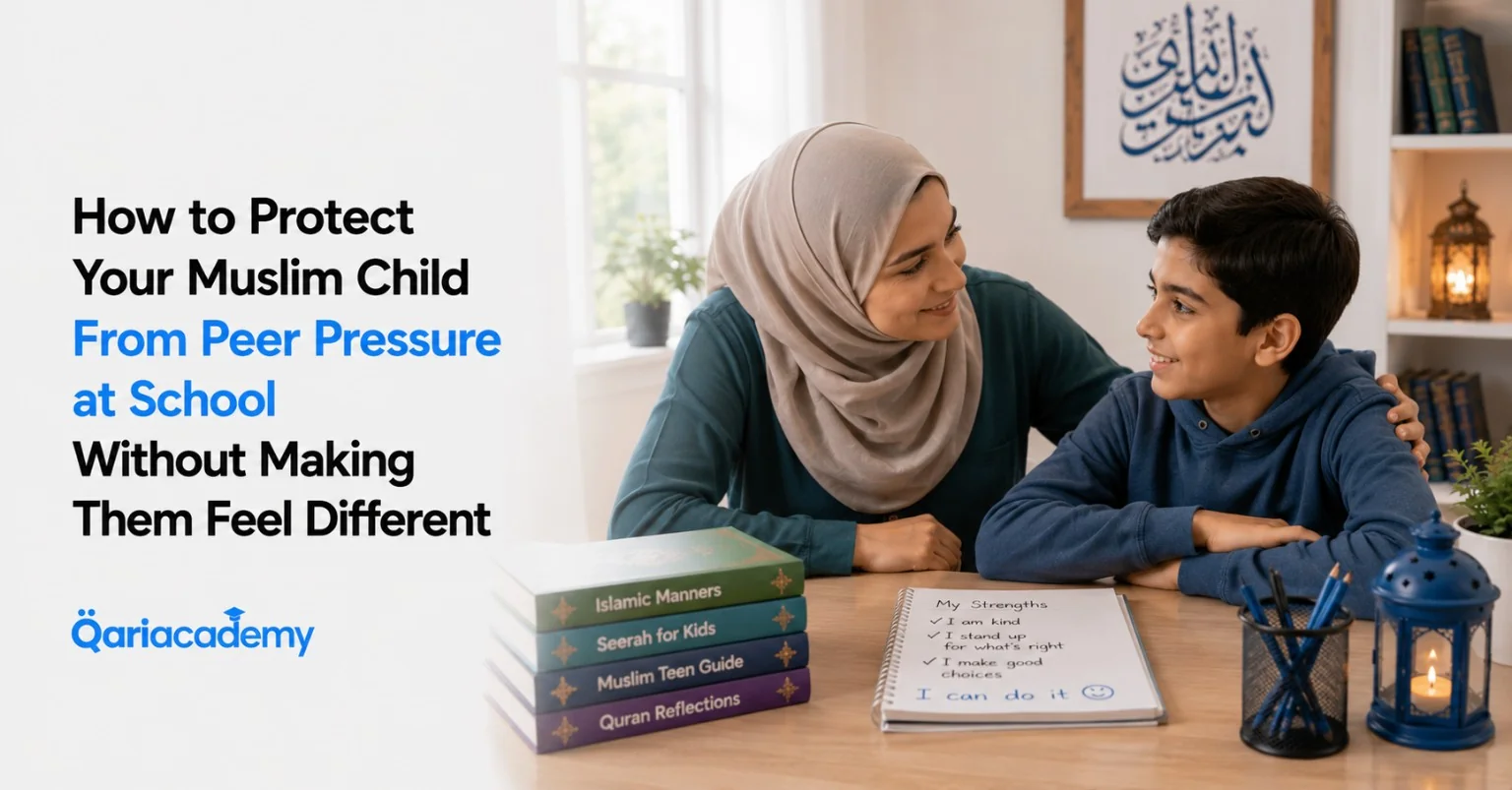
That’s why the real goal is not simply to protect your Muslim child from peer pressure.
The goal is to raise a child who knows how to recognize pressure, say no, maintain their Islamic values, and make good decisions even when nobody is watching.
What Is Peer Pressure?
Peer pressure doesn’t always look like someone saying:
“Do this or you’re not my friend.”
Sometimes it’s much more subtle.
It can sound like:
“Everyone is doing it.”
“Don’t be boring.”
“Come on, just try it.”
“Your parents don’t have to know.”
“Why are you so religious?”
“Don’t be different.”
“Everyone at school believes this.”
These statements can make children feel that they need to change themselves to fit in.
For Muslim children, that pressure may involve clothing, relationships, language, entertainment, alcohol or drugs as they get older, inappropriate online content, religious practices, or attitudes toward Islam.
The pressure isn’t always obvious.
That’s why children need to understand how it works.
1. Teach Your Child That Peer Pressure Is Normal
Don’t make your child think:
“Something is wrong with me because my friends are influencing me.”
Almost every child experiences social pressure at some point.
What matters is how they respond.
Tell your child:
“It’s normal to want your friends to like you. But you don’t have to do everything they do.”
That simple statement can remove a lot of shame.
Your child doesn’t need to feel weak because they want to belong.
Wanting acceptance is a normal human feeling.
The important lesson is learning how to balance that desire for friendship with personal values and good judgment.
2. Teach Your Child How to Recognize Pressure
Your child needs to recognize the warning signs.
Peer pressure may be happening when someone:
- Keeps asking after your child says no
- Makes fun of your child’s beliefs
- Says everyone else is doing something
- Threatens to exclude your child
- Tells your child to hide something from parents
- Offers inappropriate content
- Encourages your child to break family rules
- Makes your child feel guilty for saying no
Teach your child:
“If someone doesn’t respect your no, that’s not healthy friendship.”
This is a powerful lesson because children sometimes think pressure is simply part of friendship.
It isn’t.
A good friend can disagree with you, but a good friend should not repeatedly pressure you into doing something you don’t want to do.
3. Teach Your Child to Say No
This sounds simple.
But many children don’t know how to do it.
They may worry:
“What will they think of me?”
“What if they laugh?”
“What if I lose my friends?”
Give them simple sentences.
They can say:
“No, I’m not doing that.”
“That’s not for me.”
“My parents don’t allow it.”
“I don’t want to.”
“I’m good.”
“Let’s do something else.”
Then walk away if necessary.
Your child doesn’t need to give a ten-minute explanation.
Sometimes the strongest answer is simply:
“No.”
4. Practice at Home
Don’t wait for a real situation.
Role-play.
You pretend to be the friend.
Say:
“Come on, everyone is watching this video.”
Let your child respond.
Then make it harder:
“Why are you scared?”
“Your parents aren’t here.”
“Everyone else is doing it.”
Practice until saying no feels natural.
This can be particularly useful for younger children and teenagers.
The more comfortable your child becomes saying no at home, the easier it may be to say no when facing real pressure.
5. Teach Your Child That “Everyone Is Doing It” Doesn’t Mean It’s Right
This is one of the oldest forms of peer pressure.
“Everyone does it.”
But your child needs to learn:
Popularity doesn’t determine morality.
Something doesn’t become right simply because many people do it.
Likewise, something doesn’t become wrong simply because few people do it.
Teach your child to ask:
“What do I believe is right?”
“What does Islam teach?”
“What are the consequences?”
“Is this good for me?”
Those questions build judgment.
Your goal isn’t to raise a child who automatically follows whatever adults say.
Your goal is to raise a child who can think carefully and make responsible decisions.
6. Give Your Child a Strong Islamic Identity
Children who don’t understand their own beliefs can feel vulnerable when classmates challenge them.
If your child only knows:
“Islam says don’t do that.”
they may eventually ask:
“Why?”
That’s why Islamic education needs to go deeper.
Teach them:
- Why Muslims pray
- Why modesty matters
- Why family matters
- Why honesty matters
- Why certain behaviors are prohibited
- Why Allah gives guidance
- Why Muslims follow the Quran and Sunnah
Knowledge creates confidence.
A child who understands the reasons behind Islamic values is more likely to be able to explain and defend those values when facing social pressure.
7. Don’t Make Islam Sound Like a Long List of Restrictions
If your child’s entire Islamic education consists of:
“Don’t do this.”
“Don’t wear that.”
“Don’t watch this.”
“Don’t talk to them.”
“Don’t go there.”
they may eventually see Islam as a collection of restrictions.
Instead, explain the wisdom behind Islamic values whenever appropriate.
Talk about:
- Purpose
- Self-respect
- Responsibility
- Mercy
- Discipline
- Worship
- Family
- Character
Children need to understand what Islam gives them, not only what Islam asks them to avoid.
Islamic parenting should not simply be about creating a list of things children aren’t allowed to do.
It should help them understand the kind of person they are being raised to become.
8. Make Quran Learning Consistent
A strong Quran routine can help children develop a deeper connection with their faith.
But consistency is important.
You don’t need to overwhelm a child with long lessons.
A manageable routine can be more sustainable.
QariAcademy offers live one-on-one online Quran learning for children and teenagers, including Quran reading, Tajweed, Hifz, Quranic Arabic, and Islamic studies.
One-on-one learning can also give children an opportunity to ask questions and learn at a pace suited to their level.
For families with busy school, sports, and extracurricular schedules, maintaining a consistent Quran routine can provide an important anchor.
Explore QariAcademy’s Quran Programs
9. Don’t Expect a Quran Teacher to Replace Parents
A Quran teacher can teach.
A parent has to parent.
Don’t think:
“If I enroll my child in Quran classes, peer pressure won’t affect them.”
That’s unrealistic.
Children need:
- Islamic education
- Parental guidance
- Positive friendships
- Good examples
- Healthy boundaries
- Open communication
All of these work together.
Quran education can strengthen your child’s foundation, but it doesn’t replace conversations at home.
10. Know Your Child’s Friends
You don’t need to interrogate your child.
But you should know who they spend time with.
Ask:
“Who did you sit with today?”
“What did you guys do?”
“What do you like about your friend?”
“What do you usually do together?”
These questions help you understand the friendship without making your child feel like they’re under investigation.
The goal is awareness, not surveillance.
11. Don’t Automatically Assume Every Non-Muslim Friend Is Bad
This is an important distinction.
Your child may have a non-Muslim friend who is:
- Kind
- Honest
- Respectful
- Helpful
- Responsible
That doesn’t automatically mean the friendship is harmful.
Likewise, a Muslim friend can sometimes be a negative influence.
The important question is:
What kind of influence does this friendship have on my child?
Look at behavior and character.
This is a much more useful approach than judging a child simply because of their religion.
12. Watch for Secretive Friendships
Parents should pay attention when a child suddenly starts saying:
“Don’t tell Mom.”
“My parents don’t know.”
“It’s our secret.”
“Don’t tell anyone.”
Secrecy doesn’t automatically mean something dangerous is happening.
But it is a reason to ask questions.
Teach your child:
“Adults and older children should never pressure you to keep unsafe or inappropriate secrets from your parents.”
Your child should know that there is a difference between privacy and secrecy that makes them uncomfortable.
13. Teach the Difference Between a Surprise and a Secret
This can be especially useful for younger children.
A birthday surprise is temporary and happy.
An inappropriate secret is something someone demands the child hide.
Teach:
“If someone tells you to hide something that makes you uncomfortable, you should tell us.”
This is an important safety principle.
It gives children a simple rule they can remember when they are unsure what to do.
14. Don’t Shame Your Child When They Admit a Mistake
Suppose your son says:
“I watched something my friend showed me.”
If your immediate reaction is screaming and punishment, he may learn:
“I should never tell my parents what happens.”
Instead, stay calm.
Ask:
“What did you see?”
“How did it happen?”
“Did anyone pressure you?”
Then address the behavior.
You can be firm without making honesty feel dangerous.
This distinction matters enormously.
If children know that telling the truth will always result in an explosive reaction, they may become better at hiding mistakes rather than better at avoiding them.
15. Keep Communication Open
Your child should know:
“If something happens at school, I can tell Mom and Dad.”
That trust is one of the strongest forms of protection.
Have regular conversations.
Not only when something goes wrong.
Ask about:
- Friends
- School
- Teachers
- Social media
- Games
- Videos
- Problems
- Questions
Make communication normal.
When talking becomes normal, difficult conversations become much easier.
16. Don’t Interrogate Your Child Every Day
There is a difference between involvement and surveillance.
If every afternoon becomes:
“Who talked to you?”
“What did they say?”
“Who did you sit with?”
“Did anyone show you anything?”
your child may stop talking.
Instead, make conversations natural.
Sometimes talk while driving.
Sometimes while eating.
Sometimes before bed.
Children often open up when the conversation doesn’t feel like an interrogation.
17. Teach Your Child That Being Different Isn’t Something to Be Ashamed Of
A Muslim child may sometimes feel:
“Everyone else is doing this except me.”
That’s when confidence matters.
Tell your child:
“You don’t have to copy everyone to belong.”
“You can be Muslim and still have friends.”
“You can say no without being rude.”
“You don’t need everyone’s approval.”
This is powerful.
Your child needs to understand that being different does not automatically mean being inferior.
18. Give Your Child Positive Muslim Friendships
Children need community.
Help them find positive environments such as:
- Mosque youth programs
- Islamic schools or activities
- Quran classes
- Muslim sports groups
- Community events
- Islamic camps
Your child doesn’t need to live exclusively around Muslims.
But having Muslim friends can make Islamic identity feel normal rather than unusual.
A child who has positive Muslim peers may feel less pressure to hide or apologize for practicing Islam.
19. Use Sports as a Positive Outlet
Sports can help children develop confidence and discipline.
Football, basketball, swimming, martial arts, and other activities can give children healthy social environments.
But parents should still pay attention to the culture surrounding the activity.
A positive sport can become unhealthy if the environment constantly pressures children toward behaviors that conflict with family values.
Again, look at the environment.
The activity itself isn’t necessarily the problem.
The question is whether the environment supports your child’s overall development.
20. Teach Your Child How to Leave a Situation
Sometimes saying no isn’t enough.
If friends continue pressuring your child, teach them:
“I’m leaving.”
Then leave.
Your child doesn’t have to win the argument.
Walking away can be a sign of maturity.
Children sometimes believe that they need to prove themselves.
Teach them that they don’t.
21. Give Them an Excuse When Necessary
Some children are afraid that saying:
“I don’t want to do that because I’m Muslim.”
will make them stand out.
That’s okay.
They can simply say:
“No, I’m not interested.”
Or:
“I have to go.”
Or:
“My parents are expecting me.”
The goal isn’t to force your child to debate religion every time.
It’s to help them exit uncomfortable situations.
22. Teach Them What a Good Friend Looks Like
Ask your child:
“What makes someone a good friend?”
Let them answer.
Then discuss qualities such as:
- Honesty
- Loyalty
- Respect
- Encouragement
- Trust
- Kindness
- Good judgment
Then ask:
“Does your friend treat you that way?”
This helps your child evaluate friendships independently.
Instead of you deciding who is a good friend, you’re teaching your child how to recognize one.
23. Don’t Choose Every Friend for Your Child
Parents need to guide.
But if you control every friendship, your child may never learn how to evaluate people independently.
As children get older, gradually give them more responsibility.
Explain why certain friendships concern you.
Don’t simply say:
“You’re forbidden from talking to him.”
Instead:
“I’ve noticed that whenever you’re with him, you end up doing things you know aren’t good for you. What do you think about that?”
Now you’re teaching judgment.
24. Pay Attention to Sudden Changes
Parents should notice major changes such as:
- Suddenly hiding their phone
- Becoming extremely secretive
- Losing interest in family
- Major changes in behavior
- Constantly defending a new friend
- Becoming aggressive when questioned
- Significant changes in sleep
- Suddenly accessing inappropriate content
One sign doesn’t automatically mean something is wrong.
But a pattern deserves attention.
Look at the overall picture before jumping to conclusions.
25. Protect Your Child’s Digital Environment
Peer pressure doesn’t stop when school ends.
It continues through:
- YouTube
- TikTok
- Gaming chats
- Group messages
- Discord
- Other social platforms
A child may leave school at 3 PM and continue interacting with the same social environment until midnight.
That’s why digital parenting matters.
The American Academy of Pediatrics recommends that families develop healthy media habits and boundaries appropriate to children’s age and development.
American Academy of Pediatrics — Media and Children
26. Don’t Give Your Child Unlimited Internet Access
Especially for younger children.
Consider:
- Parental controls
- Age-appropriate accounts
- Screen-time limits
- Device-free bedrooms
- Regularly reviewing installed apps
- Knowing which platforms your child uses
- Keeping younger children’s devices in shared spaces
The goal isn’t spying.
It’s responsible parenting.
As children get older, supervision can gradually shift toward greater responsibility and trust.
27. Teach Your Child About Online Peer Pressure
Online pressure can be even stronger because children may feel that everyone is watching.
A group chat might say:
“Send a picture.”
“Join this challenge.”
“Watch this.”
“Don’t tell your parents.”
Your child needs to know:
They can leave the chat.
They can block someone.
They can report content.
They can tell you.
They don’t have to participate.
28. Make “Come Tell Me” a Family Rule
Tell your child:
“If you ever see something online that scares you, confuses you, or makes you uncomfortable, come tell me.”
And add:
“You won’t get in trouble for telling me.”
This can dramatically improve communication.
Of course, parents may still need to address behavior afterward.
But the first priority is keeping communication open.
29. What If Your Child Has Already Given In?
Don’t treat one mistake as a permanent identity.
Suppose your child:
- Watched inappropriate content
- Lied to you
- Joined a bad group chat
- Followed a friend into something wrong
- Broke a family rule
Address it.
Explain the consequences.
Set boundaries.
Then help them move forward.
Don’t tell them:
“You’re a bad child.”
Instead:
“That was a bad decision. Let’s talk about how to make a better decision next time.”
There’s a major difference.
30. Teach Accountability Without Shame
Children need consequences.
But consequences should teach.
Ask:
“What happened?”
“What decision did you make?”
“What could you have done differently?”
“What can we change so this doesn’t happen again?”
This builds responsibility.
The goal of discipline should be to help the child make better decisions in the future, not simply to make them feel bad about the past.
31. The Most Powerful Protection Is Internal
You can install parental controls.
You can monitor devices.
You can check friendships.
You can talk to teachers.
All of these can help.
But eventually your child will have a phone you can’t see.
They’ll go somewhere you aren’t present.
They’ll make decisions without you.
That’s why the ultimate protection is internal:
Faith.
Knowledge.
Self-control.
Confidence.
Good judgment.
External controls are useful.
But they cannot replace internal character.
32. Build Your Child’s Relationship With Allah
A child shouldn’t only hear about Allah when they have done something wrong.
Talk about Allah in positive ways.
Talk about:
- Mercy
- Gratitude
- Guidance
- Forgiveness
- Worship
- Purpose
- Good character
Help your child understand that Islam isn’t simply a set of rules imposed by parents.
It is a relationship with Allah.
When faith becomes meaningful rather than merely restrictive, children have a stronger foundation for making decisions independently.
33. Make Quran Part of Family Life
Read Quran together when possible.
Listen to Quran.
Discuss simple meanings.
Encourage regular learning.
Don’t make every Quran interaction about testing:
“How many verses did you memorize?”
Ask:
“What did you understand?”
“What did you learn?”
“What do you think this teaches us?”
That creates a deeper relationship with the Quran.
34. QariAcademy Can Support This Foundation
Parents can’t always be the only source of Islamic education.
A consistent teacher can provide structure, accountability, and encouragement.
QariAcademy offers live one-on-one online Quran learning for children and teenagers, including:
- Quran Reading
- Tajweed
- Hifz
- Quranic Arabic
- Islamic Studies
One-on-one lessons allow the teacher to work according to the child’s level and needs.
For busy families, online lessons can also fit around school, sports, and other activities.
The goal isn’t simply to add another class to your child’s schedule.
It’s to help build a stronger Islamic foundation that can support the child when they face difficult decisions outside the home.
35. Don’t Expect a Teacher to Replace You
QariAcademy can support your child’s learning.
But the home remains the most important environment.
Your child needs to see:
- Parents praying
- Parents reading Quran
- Parents speaking respectfully
- Parents controlling their anger
- Parents practicing Islamic values
Children learn far more from what parents consistently do than from what parents occasionally say.
36. Create a Family Code
You can establish simple rules:
We don’t lie to our parents.
We don’t hide unsafe things.
We don’t bully people.
We don’t follow the crowd blindly.
We respect others.
We know our Islamic values.
We ask for help when we’re confused.
These rules are simple enough for children to remember.
They also create a shared family culture.
37. Have Regular Conversations About Peer Pressure
Don’t wait for a crisis.
Once a week, ask something simple:
“What would you do if your friends wanted you to do something you knew was wrong?”
Let your child answer.
Then discuss different scenarios.
For example:
“What if your friends wanted you to watch something inappropriate?”
“What if they made fun of you for praying?”
“What if they said you’re boring because you don’t drink?”
“What if they told you not to tell your parents?”
Your child can practice responses before facing the real situation.
38. Teach Them That Walking Away Is Sometimes the Strongest Choice
Children often think strength means winning an argument.
Teach:
“Sometimes strength means leaving.”
You don’t have to prove yourself.
You don’t have to impress everyone.
You don’t have to respond to every challenge.
You can simply walk away.
This can be particularly important for teenagers, who may feel pressure to demonstrate confidence in front of their friends.
39. What Parents Should Never Say
Avoid statements such as:
“Everyone outside this family is bad.”
“You can’t trust anyone.”
“Muslims should never talk to non-Muslims.”
“Your friends are going to destroy you.”
These messages may create fear rather than wisdom.
Instead:
“Choose your friends carefully.”
“Know your values.”
“Treat people well.”
“Don’t let anyone pressure you.”
“Come to us when you’re unsure.”
The second approach prepares your child for reality rather than trying to make reality disappear.
40. The Goal: A Child Who Can Stand Alone
Eventually, your child will be an adult.
You won’t control:
- Their phone
- Their friends
- Their university
- Their workplace
- Their social media
- Their free time
So don’t measure success by how well your child behaves when you’re watching.
Measure it by how well they make decisions when you’re not.
That’s the real goal of parenting.
Conclusion
Learning how to protect your Muslim child from peer pressure isn’t about building a wall around your child.
It’s about building something inside them.
Teach them Islamic values.
Teach them critical thinking.
Teach them how to recognize manipulation.
Teach them how to say no.
Teach them how to leave uncomfortable situations.
Teach them how to choose good friends.
Teach them how to use technology responsibly.
And most importantly, make sure they know they can always come home and talk to you.
Your child will encounter pressure.
That’s inevitable.
The question is whether they will face that pressure with fear and confusion or with knowledge, confidence, and faith.
A strong Islamic foundation can make a significant difference.
QariAcademy can support your family’s efforts by providing live one-on-one Quran and Islamic learning for children and teenagers.
Through Quran reading, Tajweed, Hifz, Quranic Arabic, and Islamic studies, children can build knowledge and consistency while parents continue providing guidance at home.
If you want to strengthen your child’s Quranic and Islamic foundation, you can explore QariAcademy’s programs and start with a free trial:
Start a Free Trial at QariAcademy
Remember:
You cannot control everything your child will see.
You cannot control every person your child will meet.
You cannot eliminate every form of peer pressure.
But you can give your child something more valuable than control.
You can give them:
Faith.
Knowledge.
Confidence.
Boundaries.
Critical thinking.
And the ability to make the right decision even when nobody is watching.
That is the kind of protection that can last a lifetime.
Primary Keyword: protect Muslim child from peer pressure