Table of Contents
Introduction: What Is Zakat and Charity?
Every Muslim child should learn about kindness and helping others — these are among the most beautiful teachings of Islam.
Zakat and Charity (Sadaqah) are ways Muslims show love and care for people around them.
- Zakat is one of the Five Pillars of Islam. It’s a special type of giving that Muslims must do every year when they have enough savings.
- Charity (Sadaqah) is a voluntary act of kindness. It can be done anytime — even smiling or helping a friend is a form of charity!
When children understand these values early, they grow up to be compassionate and responsible Muslims who care about others.
What Is Zakat in Simple Words?
Zakat means “purification and growth.”
It purifies our wealth and helps it grow in blessings. When we give from what Allah has given us, our hearts become cleaner and our communities stronger.
Imagine you have 100 candies. If you give 2.5 candies to help someone who doesn’t have any — that’s Zakat! It’s only a small part of what you own, but it can make a big difference in someone’s life.
The Purpose of Zakat
Allah commanded Zakat to:
- Help those in need — such as the poor and the orphans.
- Reduce greed — so we don’t become attached to money.
- Build unity — everyone feels cared for and connected.
- Spread fairness — no one feels left behind in society.
In the Qur’an, Allah says:
﴾ خُذْ مِنْ أَمْوَالِهِمْ صَدَقَةً تُطَهِّرُهُمْ وَتُزَكِّيهِمْ بِهَا﴿
(Surah At-Tawbah 9:103)
How Is Zakat Calculated?
Parents can explain Zakat to kids with a simple example:
- Muslims give 2.5% of their saved wealth once a year if they have reached a certain amount (called Nisab).
- This means if someone saved $1000, they give $25 as Zakat.
Children can practice this idea using toy money or drawings — turning it into a fun, educational activity!
What Is Charity (Sadaqah)?
Unlike Zakat, Sadaqah is not limited to money. It can be any good deed.
The Prophet ﷺ said:
“Every act of kindness is charity.” (Sahih Muslim)
Examples of Sadaqah:
- Smiling at someone. 😊
- Helping a classmate with homework. ✏️
- Feeding animals. 🐦
- Donating clothes or toys. 🎁
- Saying kind words. 💬
Even small children can do Sadaqah every day!
The Difference Between Zakat and Sadaqah
| Feature | Zakat | Sadaqah |
|---|---|---|
| Obligation | Must be given once a year | Voluntary anytime |
| Amount | 2.5% of wealth | Any amount or good act |
| Purpose | Purify wealth | Earn more rewards |
| Recipients | Specific categories | Anyone in need |
Teaching kids this difference helps them understand that Zakat is a duty, while Sadaqah is a gift from the heart.
Why Teaching Kids About Charity Matters
When children practice giving from a young age:
- They learn gratitude — appreciating what they have.
- They build empathy — caring for others’ feelings.
- They develop discipline — sharing regularly.
- They grow closer to Allah — by obeying His commands.
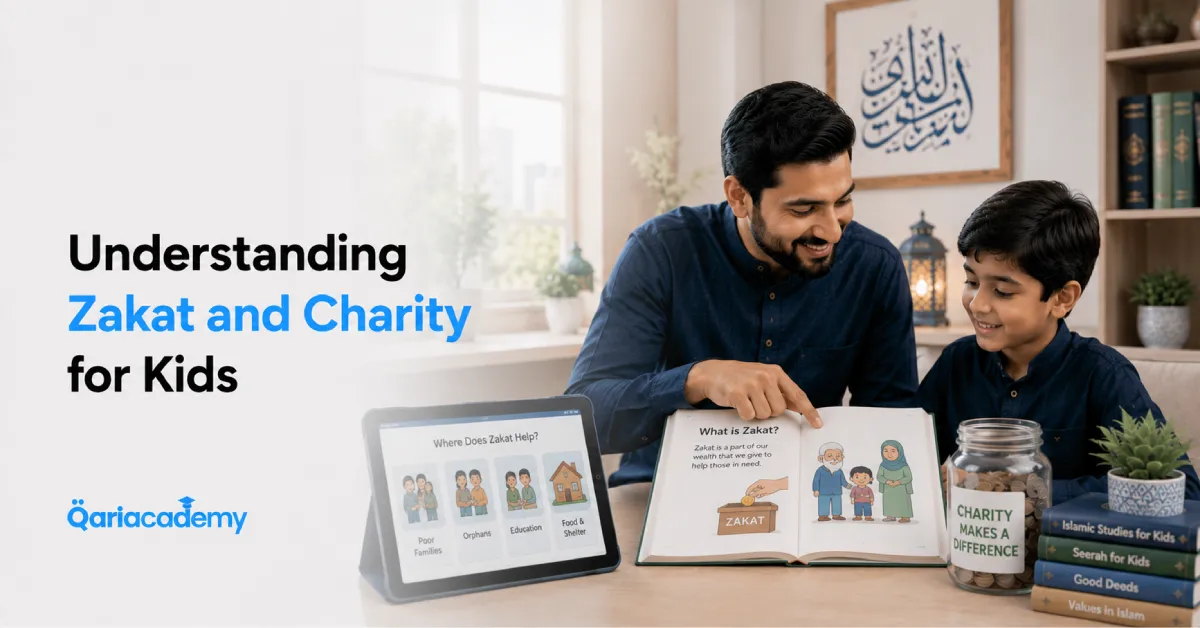
Families can make charity a regular family activity — for example, setting a “charity jar” at home and filling it weekly to help someone.
Stories That Teach the Spirit of Giving
Story 1: Abu Bakr (RA) and the True Meaning of Giving
Abu Bakr (RA) once gave all his wealth to help Muslims in need. When the Prophet ﷺ asked what he left for his family, Abu Bakr replied:
“I left Allah and His Messenger for them.”
This teaches us that true faith means trusting Allah’s blessings will never end.
Story 2: A Child’s Charity
A young boy saw a poor man outside the mosque. He ran home, took his favorite toy, and gave it away. His parents smiled and said, “You just gave Sadaqah!”
Even a small gift can make Allah very pleased.
How Parents Can Teach Zakat and Sadaqah at Home
- Talk About It During Ramadan:
Ramadan is the best time to discuss giving — it’s when rewards are multiplied. - Use Storybooks and Illustrations:
Share stories from the Qur’an and Seerah about generosity. - Create a Family Charity Plan:
Choose a cause together — like helping orphans or donating food. - Encourage Daily Acts of Sadaqah:
Make kindness a family habit — say “Let’s find one good deed today!” - Connect Giving to Gratitude:
Remind kids: “When we give, Allah gives us more.”
How Zakat Helps the World
Zakat is not just about money — it’s about building a fair world.
When Muslims all over the globe give their Zakat:
- The poor receive food and shelter.
- Orphans are cared for.
- Schools and hospitals are built.
- The whole society becomes more peaceful.
Every child who learns this grows up knowing their small actions can make a huge difference!
Teaching Generosity Beyond Money
Explain to kids that generosity is a lifestyle:
- Sharing knowledge
- Giving time
- Listening to others
- Being patient and forgiving
These are spiritual charities that make our hearts pure and strong.
Qur’anic Verses About Giving
- “And spend from what We have provided you before death approaches one of you…” (Al-Munafiqun 63:10)
- “Whoever does an atom’s weight of good will see it.” (Az-Zalzalah 99:7)
- “The example of those who spend their wealth in the way of Allah is like a seed growing seven ears, in every ear a hundred grains.” (Al-Baqarah 2:261)
Related Articles You Might Enjoy
- Understanding Ramadan and Its Special Rules
- Learning the Stories of the Sahabah (Companions) Easily
- Understanding Allah’s Names and Attributes in a Simple Way
- Easy Steps to Teach Kids Du’as and Daily Prayers
Encourage Your Child to Learn With QariAcademy
At QariAcademy, we help your child not only read and memorize the Qur’an but also understand its values — like Zakat, kindness, and gratitude.
Our fun, live online classes make Islamic learning engaging for kids everywhere 🌍.
✨ Enroll today and help your child grow with Qur’an-centered values:
👉 Join QariAcademy Now
FAQ: Understanding Zakat and Charity for Kids
1. What age should I start teaching my child about Zakat?
You can start as early as 5 years old using simple stories and examples.
2. How can I explain Zakat to a small child?
Use toys, money jars, or drawings to show how giving a small part can help others.
3. Should kids pay Zakat?
Zakat is only required for adults, but children can learn and practice generosity.
4. What’s the best way to teach Sadaqah?
Encourage daily good deeds — helping, sharing, and being kind.
5. How can we make charity a habit at home?
Keep a family charity jar or plan monthly donations together.
6. Can Sadaqah be non-monetary?
Yes! Smiling, helping, or saying kind words are all acts of Sadaqah.
7. Is Zakat only for money?
It mainly applies to wealth, but can also include gold, business profits, or crops.
8. How does Zakat benefit society?
It reduces poverty, strengthens unity, and creates fairness among people.
9. Can kids collect money for charity?
Yes, under supervision — it teaches them teamwork and compassion.
10. How can QariAcademy help my child learn Islamic values?
Our teachers include moral lessons like generosity, patience, and gratitude in every class.