Table of Contents
Introduction: Teaching Kids About the Sacred Journey
Every Muslim dreams of visiting the holy cities of Makkah and Madinah, where our beloved Prophet Muhammad ﷺ lived, taught, and prayed. For adults, performing Hajj and Umrah is one of the most emotional and spiritual experiences of their lives.
But how can we explain these beautiful journeys to our children?
Children learn best through stories, visuals, and emotional connection. Teaching them about Hajj and Umrah early helps them love Islam deeply and understand the importance of obedience, unity, and sacrifice.
Just like we teach our kids about Ramadan and its special rules, or help them learn about Zakat and Charity, we can introduce Hajj and Umrah in a way that makes their little hearts excited and curious.
1. What Are Hajj and Umrah?
Hajj and Umrah are two Islamic acts of worship performed in Makkah, the holiest city in Islam.
- Hajj is one of the five pillars of Islam and is obligatory once in a lifetime for every Muslim who is physically and financially able.
- Umrah, on the other hand, is voluntary, but it’s also a great act of worship that can be done at any time of the year.
👉 Hajj = The Major Pilgrimage (once a year, during Dhul Hijjah).
👉 Umrah = The Minor Pilgrimage (anytime during the year).
Both involve traveling to Makkah, wearing simple white clothes, visiting sacred places, and performing special rituals that bring Muslims closer to Allah.
2. Why Do Muslims Perform Hajj and Umrah?
The purpose is not just traveling — it’s about purifying the heart and connecting with Allah.
Hajj and Umrah teach children about:
- Obedience: Following Allah’s commands like Prophet Ibrahim (A.S.) did.
- Patience: Handling challenges during the journey with faith.
- Unity: Seeing millions of Muslims from different countries, colors, and languages — all worshipping the same Allah.
- Equality: Everyone wears the same simple clothes (Ihram), showing that no one is better than another except by their good deeds.
It’s a beautiful lesson that Islam unites hearts, not appearances.
3. The Story Behind Hajj: Prophet Ibrahim’s Faith
To help kids understand Hajj, we can start with the story of Prophet Ibrahim (A.S.) and his family.
- Prophet Ibrahim left his wife Hajar and baby Isma’il in the desert of Makkah as Allah commanded.
- When baby Isma’il cried from thirst, Hajar ran between the hills of Safa and Marwah looking for water.
- Allah then caused the miraculous Zamzam Well to gush from the ground!
- Later, Allah commanded Prophet Ibrahim and Isma’il to build the Kaaba, the first house of worship on Earth.
Every step of Hajj honors this great story of trust, sacrifice, and love for Allah.
4. The Steps of Umrah (Simple for Kids)
Here’s a simplified way to explain Umrah to children:
- Wearing Ihram:
Boys wear two white sheets; girls wear modest clothes. Everyone avoids perfume and fancy things. - Saying the Talbiyah:
Muslims say: “Labbayk Allahumma Labbayk…”
(“Here I am, O Allah, here I am!”) - Tawaf:
Walking seven times around the Kaaba, remembering Allah with every step. - Sa’i:
Walking between Safa and Marwah like Hajar did — it reminds us of her strong faith. - Cutting Hair:
Boys trim or shave their hair; girls cut a small portion to show renewal and obedience.
These steps remind children of simplicity, gratitude, and devotion.
5. The Steps of Hajj (Simplified for Young Learners)
The Hajj rituals take place over several days in the month of Dhul Hijjah.
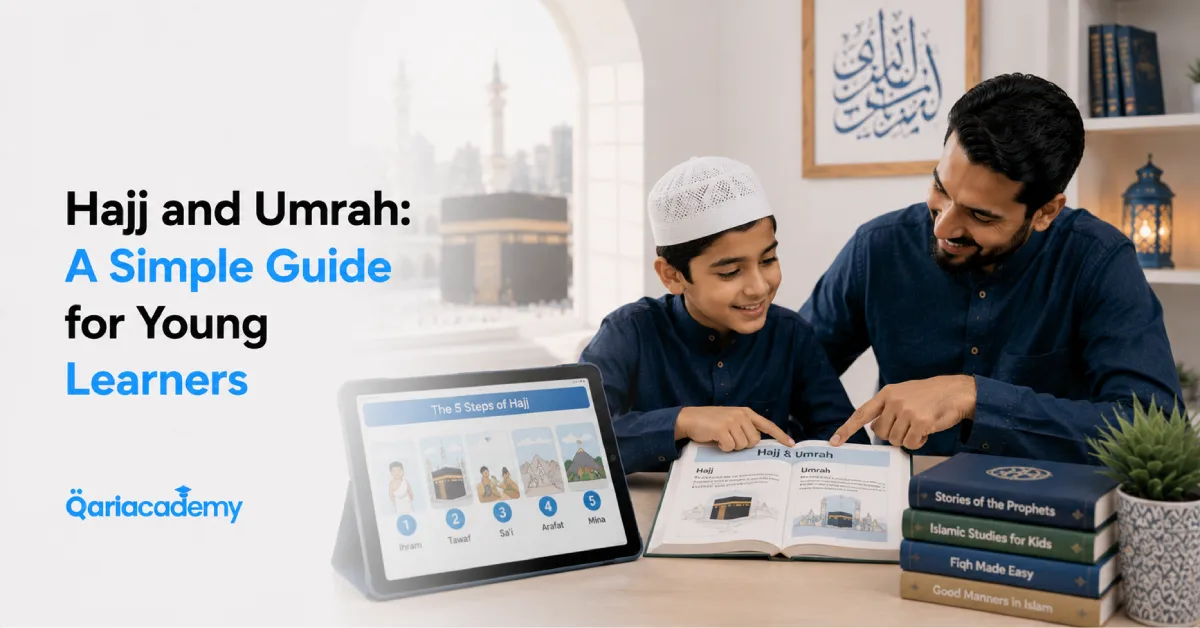
Here’s an easy version for kids:
- Ihram:
Muslims wear simple clothes and make the intention to perform Hajj. - Tawaf and Sa’i:
Just like Umrah — going around the Kaaba and walking between Safa and Marwah. - Mina:
Pilgrims spend the night in Mina, praying and preparing for the next day. - Arafat:
The most important day of Hajj!
Pilgrims stand together and pray to Allah, asking forgiveness. - Muzdalifah:
After sunset, they collect small stones for the next ritual. - Stoning the Jamarat:
Pilgrims throw stones at three pillars, symbolizing rejecting Shaytan (Satan). - Animal Sacrifice (Qurbani):
Like Prophet Ibrahim’s story, a sheep is sacrificed, and the meat is shared with the poor. - Tawaf al-Ifadah and Shaving Hair:
Another circumambulation of the Kaaba to complete the Hajj. - Farewell Tawaf:
Before leaving Makkah, pilgrims do one last Tawaf to say goodbye to the sacred place.
6. Beautiful Lessons Kids Learn from Hajj and Umrah
Teaching children about Hajj and Umrah helps them understand:
- Faith and obedience – Doing what Allah loves, even when it’s hard.
- Equality and unity – All Muslims are one family.
- Sacrifice and gratitude – Giving up comforts to please Allah.
- Forgiveness and renewal – Coming back from Hajj with a pure heart.
Encourage your child to imagine themselves as a mini pilgrim, walking with millions of Muslims saying “Labbayk Allahumma Labbayk!”
7. Fun Ways to Teach Kids About Hajj and Umrah
Parents can make learning about Hajj and Umrah interactive:
- 🧩 Create a Hajj map or timeline with pictures of each ritual.
- 🎥 Watch short children’s videos about Prophet Ibrahim and Hajar.
- 🎨 Make a craft Kaaba using cardboard and black fabric.
- 🕋 Role-play the rituals using toys or Lego to build the Kaaba.
- 📖 Read storybooks about Hajj and discuss what your child learns.
This approach turns learning into love — and love into faith.
8. Related Islamic Lessons
To build your child’s full understanding of Islam, explore these related lessons from QariAcademy:
- Introduction to Ramadan and Its Special Rules
- Understanding Zakat and Charity for Kids
- Learning the Stories of the Sahabah (Companions) Easily
- Understanding Allah’s Names and Attributes in a Simple Way
These interconnected lessons help your child grow in both knowledge and love for Islam.
9. Join QariAcademy: Make Islamic Learning Fun and Meaningful
At QariAcademy, we believe that every Muslim child deserves to learn Islam in a joyful and inspiring way — through stories, games, and loving teachers.
👩🏫 Enroll your child in our online Quran and Islamic Studies programs today and see how they fall in love with learning the Qur’an, Arabic, and Islamic manners!
👉 Visit QariAcademy.com and book your free trial class now!
FAQ: Hajj and Umrah for Kids
Q1: At what age can I start teaching my child about Hajj?
➡️ You can start as early as 5–6 years old, using stories and simple visuals.
Q2: Can children perform Umrah?
➡️ Yes, children can perform Umrah with their parents, and Allah rewards both.
Q3: What’s the difference between Hajj and Umrah?
➡️ Hajj is obligatory once in a lifetime during Dhul Hijjah; Umrah is voluntary and can be done any time.
Q4: Why do pilgrims wear white clothes?
➡️ It shows equality and purity — everyone stands equal before Allah.
Q5: What is the meaning of “Labbayk Allahumma Labbayk”?
➡️ It means “Here I am, O Allah, here I am!” showing readiness to obey Allah.
Q6: Why do Muslims go around the Kaaba?
➡️ It’s an act of worship showing love, unity, and obedience to Allah’s command.
Q7: What is the story of Zamzam water?
➡️ It’s the miracle Allah gave to Hajar and Isma’il when they were thirsty in Makkah.
Q8: Why do we throw stones at the Jamarat?
➡️ It reminds us to reject Shaytan’s whispers and stay strong in faith.
Q9: What can children learn from Hajj?
➡️ They learn patience, humility, teamwork, and love for Allah.
Q10: How can parents make Hajj meaningful at home?
➡️ By sharing stories, watching videos, and doing Hajj-themed crafts or family discussions.