Table of Contents
Introduction: The Gateway to Reading the Holy Quran
Learning to read the Holy Quran in its original, divine Arabic text is one of the most foundational and rewarding milestones in a Muslim’s spiritual life. For millions of non-Arabic speaking children, adult beginners, and converts to Islam (reverts) living in Western nations—such as the United States, United Kingdom, Canada, Australia, and Western Europe—the classical Arabic script can initially appear complex and intimidating.
Unlike the Latin alphabet used in English, Arabic is written from right to left, features letters that change shape based on their position within a word, and utilizes unique phonetic sounds generated deep within the throat and vocal tract that do not exist in European languages.
How does a 5-year-old child growing up in London or New York, or an adult revert in Toronto who has never spoken a word of Arabic, bridge this gap smoothly and confidently?
The answer has existed for over a century: Norani Qaida (also spelled Noorani Qaida).
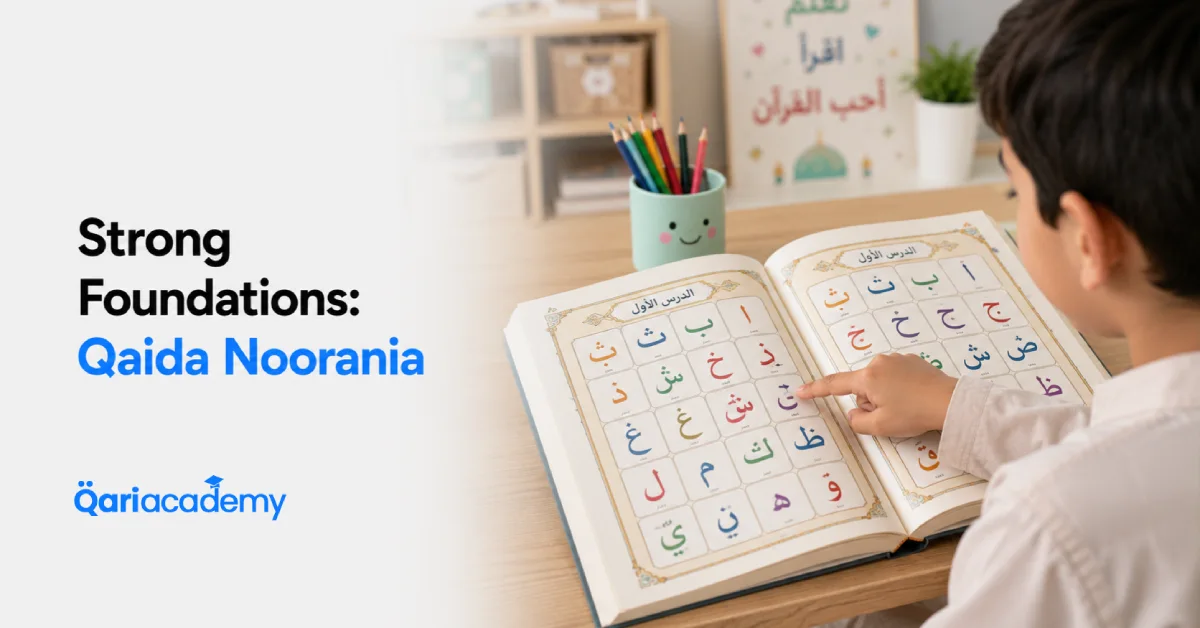
Norani Qaida is a world-renowned, time-tested pedagogical primer specifically engineered to teach non-Arabic speakers how to decode, pronounce, and blend Arabic letters accurately. It breaks down the complexities of Arabic phonetics into clear, logical, and micro-digestible building blocks.
With the advent of modern virtual learning, taking an interactive Norani Qaida Course Online has become the most effective way to master Arabic reading. Through personalized, one-on-one virtual classrooms, beginners of all ages can build flawless pronunciation, master essential phonetic rules, and transition seamlessly to reading directly from the Mus-haf.
This comprehensive guide serves as an exhaustive roadmap for parents and adult learners exploring how an online Norani Qaida course lays the unshakeable foundation for lifelong Quranic recitation.
Part 1: What Is Norani Qaida and Why Is It Essential for Beginners?
To understand why Norani Qaida remains the undisputed standard in beginner Arabic literacy, we must look at its pedagogical design.
The Norani Qaida Learning Ladder
- Step 1: Individual Alphabets (Mufradat): Letter recognition
- Step 2: Compound Forms (Murakkabat): Joining shapes & positions
- Step 3: Short Vowels (Harakat): Fatha, Kasra, Damma
- Step 4: Tanween & Long Vowels (Madd): Sound elongations
- Step 5: Silent Signs (Sukoon) & Doubled Letters (Shaddah)
- Step 6: Direct Quranic Words & Verse Decoding
Developed by the great Indian Quran scholar Sheikh Noor Muhammad Ludhyanvi, Norani Qaida was designed with a single overarching objective: to teach students how to read Quranic Arabic accurately without requiring them to learn complex Arabic grammar rules first.
Why Traditional Arabic Language Books Fail Quranic Beginners
Generic conversational Arabic textbooks focus on vocabulary (e.g., teaching words for “car,” “house,” or “market”). In contrast, Norani Qaida focuses strictly on phonetic decoding and articulation points (Makharij al-Huroof).
It trains the student’s eyes to recognize visual letter shapes instantly and trains their vocal apparatus to produce exact Quranic sounds. By focusing exclusively on phonetic mechanics, a student completes the entire booklet in a matter of months, fully equipped to open any page of the Quran and read it correctly.
Part 2: Detailed Chapter Breakdown — What You Will Learn in the Course
An online Norani Qaida course at a premier academy like QariAcademy guides students through a structured, step-by-step curriculum across 17 distinct lessons.
Lesson 1: The Single Alphabets (Al-Huroof Al-Mufradah)
- Objective: Recognizing and correctly pronouncing all 29 individual Arabic letters in their isolate forms.
- Key Challenge: Distinguishing between visually similar letters that differ only by dot placements (e.g., ب [Ba], ت [Ta], ث [Tha], ن [Noon], ي [Ya]).
- Phonetic Focus: Isolating heavy letters (Tafkheem) from light letters (Tarqeeq).
Lesson 2: Compound Letters (Al-Huroof Al-Murakkabah)
- Objective: Recognizing letters when they are joined together to form words.
- Key Challenge: Arabic letters change their visual form depending on whether they appear at the beginning, middle, or end of a word (e.g., how ك [Kaf] or هـ [Ha] transforms visually when connected).
Lesson 3: The Disconnected Letters (Al-Muqatta’at)
- Objective: Learning to pronounce the mysterious individual letters that appear at the beginning of certain Quranic chapters (such as الم, يس, كهيعص).
Lessons 4 to 6: Short Vowels (Harakat) and Tanween
- Short Vowels (Harakat): Understanding Fatha (short ‘a’ sound), Kasra (short ‘i’ sound), and Damma (short ‘u’ sound). Students learn to pronounce these sounds quickly without improper elongation.
- Double Vowels (Tanween): Learning the double vowel signs (Fathatain, Kasratain, Dammatain) that add a silent ‘N’ sound to the end of letters.
Lessons 7 to 9: Long Vowels (Madd) and Soft Letters (Leen)
- Madd Letters: Learning how Alif, Waw, and Ya elongate short vowel sounds by two natural counts.
- Leen Letters: Mastering the soft, smooth pronunciation of Waw Sakinah and Ya Sakinah when preceded by a Fatha (e.g., Bayt, Khawf).
Lessons 10 to 13: Sukoon, Shaddah, and Nunnation
- Sukoon (Resting Sign): Learning how to pronounce a stationary letter that has no vowel mark attached to it.
- Shaddah (Emphasis Sign): Mastering doubled letters, where a consonant is pronounced twice—first with a rest (Sukoon) and second with a vowel (Harakah).
- Nasal Resonance (Ghunnah): Practicing the rich, 2-count nasal echo produced through the nose when pronouncing Noon or Meem marked with a Shaddah.
Lessons 14 to 17: Comprehensive Quranic Word Exercises
- Objective: Combining all previously learned phonetic rules to decode long, multi-syllable Quranic words and full verses directly from the text.
Part 3: Overcoming Pronunciation Challenges for Native English Speakers
Teaching Arabic reading to students born and raised in Western countries requires specialized pedagogical awareness. English speakers naturally struggle with several Arabic vocal mechanics.
Common Phonetic Challenges & Corrections
- Throat Letters (Halqiyyah)
- Ayn (ع) & Ha (ح) -> Require activating deep throat muscles.
- Heavy vs. Light Pairs
- Soft ‘T’ (ت) vs. Heavy ‘T’ (ط)
- Soft ‘S’ (س) vs. Heavy ‘S’ (ص)
- Soft ‘D’ (د) vs. Heavy ‘D’ (ض)
- Explosive Sounds
- Qaf (ق) -> Deep throat click vs. English Kaf (ك) front-mouth.
The Role of 1-on-1 Virtual Instruction
In a self-study video or a crowded group classroom, subtle pronunciation errors go uncorrected. For example, if a child pronounces Ayn (ع) as a simple English ‘A’, or confuses Saad (ص) with Seen (س), it alters the meaning of sacred Quranic words.
In a 1-on-1 Norani Qaida Course Online, a certified tutor watches the student’s mouth movements via webcam, listens to every micro-sound, and provides immediate, gentle corrections until the vocal muscle memory becomes automatic.
Part 4: Who Benefits Most from an Online Norani Qaida Course?
Norani Qaida is universally applicable across all age groups, but instruction methods adapt based on student demographics.
1. Young Children (Ages 4 to 8)
- Needs: Short attention spans, high energy, need for visual stimulation.
- Online Strategy: Interactive 30-minute sessions using digital color-coded Qaida software, playful screen-drawing tools, digital star rewards, and visual animations that turn phonetic practice into a fun game.
2. Adult Beginners and Working Professionals
- Needs: Limited free time, desire for clear logical explanations, self-consciousness about starting as an adult.
- Online Strategy: Private, confidential 1-on-1 sessions scheduled early morning or late evening. Tutors provide structured explanations of phonetic mechanics without rushing or causing embarrassment.
3. Reverts to Islam (Converts)
- Needs: Zero prior exposure to Arabic, need for cultural empathy, step-by-step guidance.
- Online Strategy: Patient, encouraging instruction paired with practical guidance on how to pronounce short Surahs and daily prayers (Salah) accurately.
Part 5: Comparing Learning Formats — Self-Study Apps vs. 1-on-1 Online Class
With many mobile apps and YouTube videos available today, parents often ask whether hiring a live online tutor is necessary.
| Feature / Metric | Free Mobile Apps / YouTube | Live 1-on-1 Online Class (QariAcademy) |
| Real-Time Error Correction | None (App cannot hear mispronunciations). | Instant correction of every letter sound. |
| Articulation Point Guidance | Static audio playback only. | Live visual demonstration of throat/tongue placement. |
| Student Accountability | Low (Easy to drop or skip days). | High (Structured weekly schedule & progress tracking). |
| Interactive Engagement | Passive screen tapping. | Active 2-way conversation & vocal practice. |
| Customized Learning Pace | Rigid, automated sequences. | 100% adapted to child’s cognitive speed. |
Part 6: Why QariAcademy Is the Premier Choice for Norani Qaida Online
At QariAcademy, we have transformed traditional Norani Qaida instruction into a modern, highly engaging virtual learning experience.
- Certified Al-Azhar Educators: All tutors hold formal Ijazah credentials and possess deep expertise in foundational Arabic phonetics and early childhood education.
- Native English Fluency: Tutors speak fluent English, allowing them to explain complex articulation concepts clearly to Western-born kids and adult beginners.
- Dedicated Female Instructors: We offer access to certified female Quran scholars for sisters, young girls, and mothers seeking private female instruction.
- Interactive Digital Tools: We utilize high-definition, color-coded digital Norani Qaida software that allows students to highlight, zoom, and interact on-screen in real time.
- Flexible Scheduling Across All Time Zones: Easily book morning, after-school, or weekend sessions across US, UK, Canadian, European, and Australian time zones.
Frequently Asked Questions (FAQ)
Q1: How long does it usually take to complete the Norani Qaida Course Online?
Answer: On average, a child or adult taking 3 sessions per week completes the entire Norani Qaida booklet in 3 to 6 months. The exact duration depends on student age, class frequency, and daily at-home practice.
Q2: What age is best for a child to start Norani Qaida?
Answer: Children can begin as early as ages 4 to 5. At this developmental stage, children absorb new language phonetics with incredible ease. Tutors use gentle, game-based teaching methods tailored to young minds.
Q3: What happens after completing the Norani Qaida course?
Answer: Once a student graduates from Norani Qaida, they are fully prepared to read written Arabic text. They naturally advance to our Quran Recitation & Applied Tajweed Course, where they begin reading directly from the Mus-haf starting with Juz ‘Amma.
Q4: Are parents required to sit in during online classes for young children?
Answer: For very young children (ages 4–5), having a parent nearby during the first few lessons helps settle the child. However, as students become familiar with their tutor and the interactive software, they learn independently during sessions.
Q5: How do I know if my child is ready to move to the next lesson?
Answer: Our instructors conduct brief oral evaluations at the beginning of every session to test retention of previous lessons. Parents also receive formal monthly progress portals tracking completed chapters and phonetic mastery scores.
Conclusion: Laying the Foundation for a Lifetime with the Quran
The journey of a thousand miles begins with a single step. In Quranic education, that first essential step is mastering the building blocks of Arabic reading through Norani Qaida.
By investing in a structured, interactive Noorani Qaida Course Online, you equip your child or yourself with the skills needed to pronounce the words of Allah accurately, beautifully, and confidently for the rest of your life.
Begin Your Arabic Reading Journey Today with QariAcademy
Transform your beginner Arabic reading experience with the world’s leading 1-on-1 virtual Quran academy.
🎁 Claim Your FREE 1-on-1 Trial Lesson Today
Meet a certified instructor, experience our interactive digital Norani Qaida classroom, and receive a personalized learning roadmap with zero obligation or credit card required.
👉 [Click Here to Register for Your Free Trial at QariAcademy]