Table of Contents
Introduction
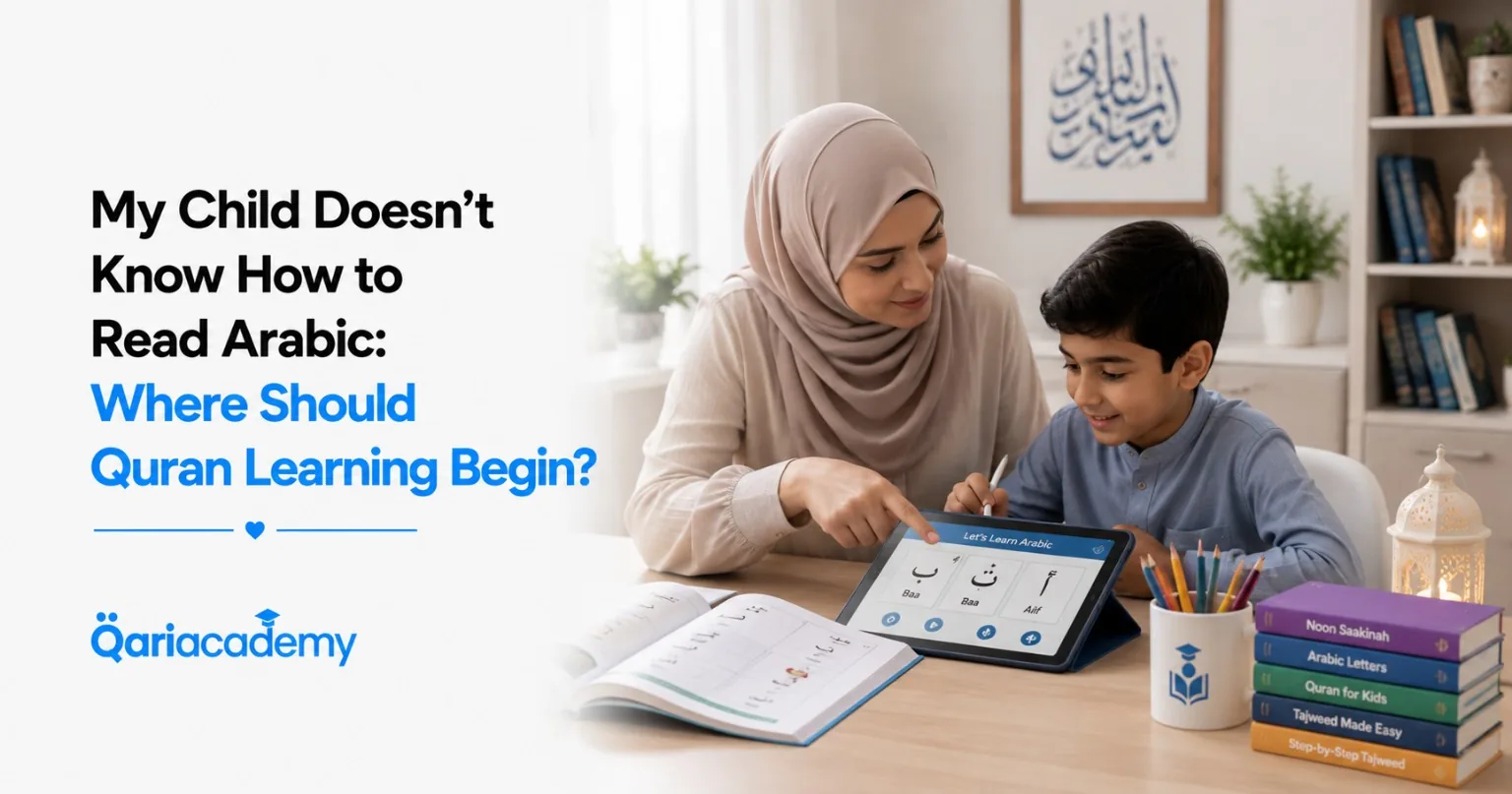
One of the most common concerns Muslim parents have is simple but important: “My child doesn’t know how to read Arabic. Where should Quran learning begin?”
If your child is growing up in an English-speaking environment, this situation is completely understandable. A child may be fluent in English, comfortable with school reading, and even familiar with short Quranic surahs from listening to family members—but still be unable to recognize Arabic letters or read a single Quranic word independently.
This can leave parents wondering whether they should start directly with Quran recitation, memorize short surahs first, teach the Arabic alphabet, or enroll their child in a Quran class.
The answer is important: Quran learning should begin at the child’s actual level, not at the level the parent wishes the child were already at.
If a child cannot recognize Arabic letters, jumping directly into full Quran pages can create frustration. On the other hand, spending months simply memorizing isolated letters without gradually connecting them to real Quranic reading can make learning unnecessarily slow.
The goal should be to build a clear pathway:
Arabic letters → letter sounds → joining letters → short vowels → words → Quranic reading → Tajweed → fluent recitation.
For many children, this foundation is the difference between seeing Quran learning as a difficult school subject and developing confidence and affection toward the Quran.
This guide explains exactly where to begin, what your child should learn first, which mistakes parents should avoid, and how structured online Quran education can help children who are starting from zero.
1. First, Don’t Panic: Your Child Is Not “Behind”
Before discussing teaching methods, there is one mindset that parents need to change.
If your child does not know how to read Arabic, that does not mean your child is bad at Quran.
It simply means your child has not yet developed the specific reading skills required to decode Arabic script.
A child who grows up in the United States, United Kingdom, Canada, Australia, or another non-Arabic-speaking country naturally receives far more exposure to English than Arabic.
At school, the child sees English everywhere:
- Books
- Signs
- Screens
- Worksheets
- Games
- Apps
- School assignments
- Conversations
Arabic may only appear occasionally at home, in the mosque, or during Islamic education.
Therefore, expecting the child to automatically read Arabic is unrealistic.
The better question is not:
“Why doesn’t my child know how to read Arabic yet?”
The better question is:
“What is the next skill my child needs to learn?”
That change in perspective makes Quran education much more productive.
2. Quran Learning Should Begin With Assessment
Before choosing a curriculum, determine what your child can actually do.
Many parents make the mistake of assuming that their child is either a complete beginner or already knows the basics.
In reality, children often have mixed abilities.
For example, a child might:
- Recognize most Arabic letters.
- Know the names of the letters but not their sounds.
- Read letters individually but not connect them.
- Recognize some short vowels.
- Read very slowly.
- Memorize several surahs orally.
- Pronounce some Quranic words incorrectly.
- Know Al-Fatihah by heart but be unable to read it independently.
These are very different starting points.
A good teacher should therefore evaluate several areas before deciding where to begin.
| Skill | Beginner Question | Why It Matters |
|---|---|---|
| Arabic letters | Can the child recognize the letters? | Forms the foundation of reading |
| Letter sounds | Can the child pronounce each letter correctly? | Prevents pronunciation errors |
| Letter connection | Can the child join letters? | Necessary for reading words |
| Harakat | Can the child recognize Fathah, Kasrah, and Dammah? | Helps decode vowel sounds |
| Sukoon | Can the child read letters with Sukoon? | Builds more advanced decoding |
| Tanween | Can the child read basic Tanween patterns? | Prepares the child for Quranic text |
| Quran reading | Can the child read simple Quranic words? | Shows practical reading ability |
| Tajweed | Does the child apply basic rules? | Improves accuracy and recitation |
| Memorization | What surahs does the child already know? | Helps connect memorization with reading |
This is one reason a trial or evaluation lesson can be useful before committing to a long-term program.
At QariAcademy, for example, the enrollment process includes a free one-on-one evaluation/trial lesson, allowing the teacher to understand the student’s level before the family chooses a regular plan.
3. If Your Child Knows Nothing, Start With the Arabic Alphabet
If your child genuinely cannot recognize Arabic letters, the first step is not memorizing Juz Amma.
It is the Arabic alphabet.
The child needs to become comfortable recognizing letters visually and producing their sounds.
For example:
ا — ب — ت — ث — ج — ح — خ
The goal is not merely for the child to repeat the teacher.
The child should eventually be able to look at a letter and immediately recognize it.
This is called letter recognition, and it is one of the fundamental building blocks of reading.
Parents should avoid rushing through the alphabet.
A child may be able to repeat:
“Alif, Ba, Ta, Tha…”
but still struggle when the letters are presented randomly.
That distinction is critical.
Recognition vs. Memorization
Knowing the alphabet in sequence is not the same as being able to read Arabic.
For example, if you ask:
What comes after ب?
A child might answer:
ت
But if you show the child:
ت
and ask:
What letter is this?
the child may hesitate.
Therefore, practice should include letters in different orders and visual forms.
4. The Next Step: Learn the Correct Sounds
Once children recognize Arabic letters, they need to understand their sounds.
This is especially important for Quran learning because Arabic contains sounds that may not exist in English.
Examples include:
- ح
- خ
- ع
- غ
- ص
- ض
- ط
- ظ
- ق
A child who grows up speaking English may naturally replace unfamiliar Arabic sounds with sounds that exist in English.
This is why pronunciation should be corrected early.
The objective is not to make the child sound perfect immediately.
The objective is to prevent incorrect pronunciation from becoming a permanent habit.
A patient teacher can gradually demonstrate:
- Where the sound comes from.
- How the mouth and tongue are positioned.
- How the sound differs from similar letters.
- How the letter changes when combined with vowels.
- How the sound appears in Quranic words.
This is much more effective than simply saying, “Repeat after me.”
5. Teach Harakat Before Expecting Fluent Reading
After the Arabic letters become familiar, children need to learn the short vowels, commonly known as Harakat.
The three basic short vowels are:
- Fathah ـَ
- Kasrah ـِ
- Dammah ـُ
For example:
بَ — بِ — بُ
The child needs to understand that the same letter can produce different sounds depending on the vowel.
This is a major milestone.
Without understanding Harakat, Quranic reading can feel like trying to guess a code.
With Harakat, the child begins to understand how Arabic words are constructed.
A simple progression might look like this:
| Stage | Example | Skill |
|---|---|---|
| Letter | ب | Recognize the letter |
| Fathah | بَ | Read “ba” |
| Kasrah | بِ | Read “bi” |
| Dammah | بُ | Read “bu” |
| Two letters | بَتَ | Combine sounds |
| Short word | كَتَبَ | Decode a word |
| Quranic word | رَبِّ | Apply reading skills to Quran |
This gradual progression gives the child small victories.
And small victories matter.
6. Learning to Join Arabic Letters
One of the biggest jumps for beginners is moving from individual letters to connected letters.
Arabic script is different from English because many Arabic letters connect to neighboring letters.
For example, a child may recognize:
ب + ا + ب
but still struggle to read:
باب
This is normal.
The child must learn that letters can look different depending on where they appear in a word.
Arabic letters can have:
- Isolated forms
- Beginning forms
- Middle forms
- Ending forms
Children should therefore practice reading connected forms rather than only memorizing isolated letters.
This is where a structured beginner curriculum becomes particularly useful.
7. Qaida: The Bridge Between the Alphabet and the Quran
For many Quran learners, a foundational Qaida book or similar beginner reading curriculum provides the bridge between recognizing Arabic letters and reading the Quran.
The exact teaching resource can vary, but the principle is the same:
Do not throw a complete beginner into a full Quran page before they have the tools to decode it.
A structured beginner curriculum gradually introduces:
- Individual letters
- Harakat
- Letter combinations
- Sukoon
- Tanween
- Madd
- Shaddah
- More complex combinations
- Quranic words
- Reading Quranic passages
This gives the student a logical progression.
The child learns one concept, practices it, and then builds on it.
At QariAcademy, beginner Quran instruction can be structured around foundational reading skills, including approaches such as Iqra Qaida, Noorani Qaida, and Noor Al-Bayan, depending on the student’s needs.
8. When Should the Child Start Reading the Quran?
Parents sometimes ask:
“Should I wait until my child finishes the Qaida before allowing them to read the Quran?”
Not necessarily.
The transition should happen gradually.
A child can begin seeing real Quranic words while continuing foundational exercises.
For example, the teacher might introduce a short surah after the child has developed enough decoding ability.
This has an important psychological benefit.
The child begins to realize:
“What I am learning in this book actually helps me read the Quran.”
That connection can increase motivation.
However, there is an important distinction between memorizing a surah and reading a surah.
A child may memorize:
Surah Al-Ikhlas
perfectly by listening and repeating.
But if you show the child the written page, they may not be able to read it.
That means the child has developed memorization but not independent reading.
Both skills are valuable, but they should not be confused.
9. Listening Is Helpful—but Listening Alone Is Not Enough
Children should absolutely listen to Quran recitation.
Listening can help them become familiar with:
- Correct pronunciation
- Rhythm
- Fluency
- Surah structure
- Repetition
- Memorization
But listening should complement reading rather than replace it.
Think about the difference between these two situations:
Child A: listens to Surah Al-Mulk every night but cannot decode Arabic letters.
Child B: learns Arabic reading and also listens to the surah regularly.
Child B has a stronger foundation for independent Quran reading.
A balanced routine might include:
Listening + Reading + Recitation + Correction + Review
rather than relying on listening alone.
10. When Should Tajweed Begin?
Another common mistake is assuming that Tajweed should wait until the child is already fluent.
Tajweed should not necessarily be taught as a huge collection of complicated rules from day one.
Instead, correct pronunciation should be integrated into the learning process from the beginning.
For example, when a child learns a letter, the teacher should already encourage correct pronunciation.
Later, the student can gradually learn concepts such as:
- Makharij
- Sifaat
- Madd
- Ghunnah
- Qalqalah
- Noon Sakinah and Tanween
- Meem Sakinah
- Rules of stopping and starting
The timing and depth should depend on the child’s age and level.
The important principle is:
Correct reading first; technical terminology gradually.
A six-year-old does not necessarily need the same Tajweed explanation as a twelve-year-old.
11. What Should a Beginner Quran Curriculum Look Like?
A practical beginner pathway might look like this:
| Level | Main Focus | Expected Development |
|---|---|---|
| Level 1 | Arabic letters | Recognizes letters |
| Level 2 | Letter sounds | Pronounces letters |
| Level 3 | Harakat | Reads short vowels |
| Level 4 | Connected letters | Reads combinations |
| Level 5 | Sukoon & Tanween | Reads more complex patterns |
| Level 6 | Madd & Shaddah | Handles common Quranic structures |
| Level 7 | Short Quranic words | Begins independent reading |
| Level 8 | Short surahs | Reads familiar passages |
| Level 9 | Tajweed foundations | Improves accuracy |
| Level 10 | Fluency & revision | Reads with increasing confidence |
This is not a rigid timeline.
Some children will move quickly.
Others will need more repetition.
The important thing is that the curriculum responds to the child rather than forcing every child through the same pace.
12. How Long Does It Take to Learn Quran Reading?
Parents often want an exact answer.
“How many months will my child need?”
There is no responsible universal answer.
A child’s progress depends on:
- Age
- Previous Arabic exposure
- Native language
- Ability to concentrate
- Frequency of lessons
- Lesson duration
- Practice between lessons
- Teacher quality
- Consistency
- Learning difficulties
- Parental support
A child who studies 30 minutes twice per week and practices at home may progress differently from a child who has four or five lessons every week.
Consistency is often more important than occasional intensive sessions.
A realistic goal is not:
“My child must finish the alphabet in two weeks.”
A better goal is:
“My child should consistently master one skill before moving to the next.”
13. Why One-on-One Quran Classes Can Help Beginners
For a child who knows little or no Arabic, individualized instruction can be particularly valuable.
In a group class, the teacher has to divide attention between multiple students.
One child may already know the alphabet.
Another may be struggling with Ba and Ta.
Another may be ready for Quran reading.
A single lesson cannot always move at the ideal pace for everyone.
One-on-one instruction allows the teacher to adjust:
- Lesson speed
- Repetition
- Examples
- Correction
- Homework
- Reading material
- Difficulty level
QariAcademy uses one-on-one live online lessons and describes its approach as personalized according to each student’s level and goals. Its Quran programs cover beginners through more advanced students.
For families living in Western countries, online lessons can also eliminate the need to travel to a local center several times each week.
14. Why the Teacher Matters More Than Many Parents Realize
A curriculum is important.
But the teacher is often the person who determines whether the child enjoys the journey.
A good beginner Quran teacher should be able to:
- Explain concepts simply.
- Repeat without becoming frustrated.
- Correct pronunciation kindly.
- Recognize when the child is confused.
- Adjust the lesson to the child’s age.
- Keep the student engaged.
- Celebrate progress without creating unhealthy pressure.
- Communicate with parents.
- Build confidence.
This is especially important for children who have previously struggled with Arabic.
A child who repeatedly hears:
“You don’t know this yet.”
may begin believing that Quran reading is something they are bad at.
A better teacher communicates:
“You haven’t learned this yet. Let’s learn it together.”
That difference can change the entire learning experience.
15. Common Mistakes Parents Make
Mistake 1: Starting With Memorization Only
Memorization is beneficial, but it does not automatically teach reading.
Mistake 2: Moving Too Fast
Parents sometimes want visible results immediately.
But rushing foundational skills often creates bigger problems later.
Mistake 3: Comparing Siblings
One child may learn Arabic reading quickly while another needs considerably more repetition.
Comparison can damage motivation.
Mistake 4: Treating Quran Class Like School Homework
Quran education should develop knowledge, discipline, and a positive relationship with the Quran—not simply become another assignment.
Mistake 5: Ignoring Pronunciation
Incorrect pronunciation can become habitual if it is not corrected early.
Mistake 6: Expecting the Teacher to Do Everything
A weekly lesson is not enough by itself.
Children benefit enormously from short, consistent practice at home.
Mistake 7: Changing Teachers Too Frequently
Sometimes a teacher change is necessary.
But constantly changing teachers can prevent the child from developing a stable learning relationship.
Mistake 8: Focusing Only on Speed
Finishing a Qaida quickly is less important than actually mastering it.
16. A Simple Home Practice Routine
Parents do not need to turn their home into a classroom.
A short routine can be enough.
For example:
10–15 Minutes a Day
3 minutes: Review previous letters or reading patterns.
4 minutes: Practice the current lesson.
3 minutes: Read a few words or Quranic examples.
2–5 minutes: Listen and repeat selected Quranic verses.
The key is consistency.
Ten minutes every day can be more productive than one long practice session once a week.
Parents should also avoid turning every mistake into a correction.
If the teacher has already identified the main skill being developed, focus on that skill instead of correcting everything simultaneously.
17. What If My Child Is Older?
Do not assume that an older beginner is a hopeless case.
A 12-year-old who cannot read Arabic may actually progress quickly because they can understand explanations that younger children cannot.
Older children can often learn:
- Letter patterns
- Reading rules
- Pronunciation concepts
- Tajweed terminology
- Self-correction strategies
more consciously.
The biggest challenge may not be ability.
It may be embarrassment.
An older child may think:
“Everyone else knows how to read Quran except me.”
Parents should never make the child feel ashamed.
Instead, normalize the starting point.
Say:
“You are learning something new, and we are going to build it step by step.”
Confidence is not a luxury in Quran education.
It is part of the learning process.
18. What If My Child Is Very Young?
Young children need an age-appropriate approach.
For younger learners, lessons may need more:
- Visual material
- Repetition
- Movement
- Games
- Short activities
- Encouragement
- Frequent changes of activity
The goal is not to force a young child to sit through a long academic lecture.
The goal is to create positive associations with Quran learning.
QariAcademy specifically describes its children’s programs as child-friendly and includes interactive activities, quizzes, and games as part of its approach.
19. How QariAcademy Can Support a Child Starting From Zero
For parents searching for “my child doesn’t know how to read Arabic”, one of the most important things to look for is not simply a Quran teacher who can recite well.
You need a learning system that understands beginners.
QariAcademy offers Quran and Arabic programs for children and adults, including Quran reading, Tajweed, Hifz, Arabic, and Islamic Studies. The academy states that its classes are one-on-one and designed for students at different levels.
Its enrollment system also allows parents to provide information about the child’s age, preferred teacher gender, number of weekly classes, lesson duration, and desired course, helping the academy match the learning arrangement to the student’s needs.
This can be particularly useful for families who are trying to fit Quran education around:
- School schedules
- Homework
- Sports
- Family commitments
- Different time zones
- Multiple children
- Busy parents’ routines
The academy also states that parents can receive progress updates and stay involved in the child’s learning journey.
The bigger advantage, however, is the structure.
Instead of asking:
“Which Quran page should my child memorize this week?”
parents can ask:
“What foundational skill does my child need next?”
That is a much stronger educational approach.
20. What Parents Should Look For in an Online Quran Academy
Before enrolling your child anywhere, ask these questions:
| Question | Why It Matters |
|---|---|
| Does the teacher assess my child’s level? | Prevents inappropriate placement |
| Are classes one-on-one? | Allows personalized instruction |
| Does the teacher work with beginners? | Beginners require different methods |
| Can the lesson schedule fit our routine? | Consistency matters |
| Does the teacher correct pronunciation? | Prevents bad habits |
| Is there parent feedback? | Helps parents understand progress |
| Is there a free trial? | Lets you evaluate the fit |
| Can the curriculum change as my child improves? | Prevents stagnation |
| Is the teacher comfortable teaching children? | Child engagement matters |
| Is there a structured progression? | Ensures foundational skills are not skipped |
These questions are more important than simply asking:
“How many surahs will my child memorize?”
Because the number of memorized surahs does not tell you whether the child can independently read Arabic.
21. A Practical Roadmap for Parents
If your child currently cannot read Arabic, you can use this roadmap:
Month 1: Discover the Starting Level
Have a qualified teacher assess:
- Letter recognition
- Pronunciation
- Harakat
- Reading ability
- Memorized surahs
Stage 2: Build the Alphabet Foundation
Work on:
- Letter recognition
- Letter sounds
- Similar-looking letters
- Difficult Arabic sounds
Stage 3: Build Decoding Skills
Introduce:
- Fathah
- Kasrah
- Dammah
- Sukoon
- Tanween
- Madd
- Shaddah
Stage 4: Begin Quranic Reading
Introduce simple Quranic words and short passages.
Stage 5: Develop Fluency
Increase:
- Reading speed
- Accuracy
- Confidence
- Independent reading
Stage 6: Develop Tajweed
Gradually introduce the rules necessary for accurate Quran recitation.
Stage 7: Connect Reading and Memorization
Now the child can increasingly memorize what they can also see and read.
This produces a much stronger relationship between memorization and literacy.
22. The Goal Is Bigger Than “Finishing the Quran”
Parents naturally want their children to read the Quran.
But the deeper goal should be independence.
Imagine the difference between these two children.
Child A can only recite when an adult prompts every word.
Child B can open the Mushaf, recognize the words, work through unfamiliar passages, and recite with increasing confidence.
Child B has gained something much more valuable than completing a particular textbook.
They have gained a lifelong skill.
That is why foundational Quran reading deserves serious attention.
23. What Success Should Look Like
Success does not necessarily mean that your child becomes a perfect reciter immediately.
Instead, look for gradual signs of development.
Your child should begin to:
- Recognize Arabic letters quickly.
- Distinguish similar letters.
- Pronounce unfamiliar sounds more accurately.
- Read Harakat correctly.
- Connect letters.
- Decode unfamiliar words.
- Read short Quranic passages.
- Correct mistakes independently.
- Read with greater confidence.
- Enjoy Quran lessons more.
- Become increasingly independent.
These are meaningful achievements.
And they build toward something much bigger: the ability to engage with the Quran throughout life.
Conclusion: Where Should Quran Learning Begin?
So, my child doesn’t know how to read Arabic—where should Quran learning begin?
It should begin exactly where the child is.
If your child cannot recognize Arabic letters, start with the alphabet.
If the letters are familiar but the sounds are difficult, work on pronunciation.
If the child knows the letters but cannot combine them, focus on connected forms.
If the child can read basic words, introduce Quranic reading.
If the child can read but makes frequent pronunciation mistakes, develop Tajweed and correction.
In other words:
Do not start with the page you want your child to reach. Start with the skill your child needs today.
A strong Quran journey is built step by step.
Arabic letters become sounds.
Sounds become words.
Words become Quranic verses.
Verses become recitation.
Recitation develops into fluency.
And, with time, reading the Quran can become a natural part of the child’s life rather than something they associate with pressure or frustration.
For families who need structured support, one-on-one online Quran education can provide a practical way to begin from the child’s current level. QariAcademy offers personalized Quran and Arabic lessons, beginner-friendly programs, flexible scheduling, and a free trial/evaluation lesson before families commit to a regular plan.
Most importantly, don’t wait until your child “gets older” or somehow becomes interested on their own.
Start small.
Start patiently.
Start at their level.
And let every correctly recognized letter be the beginning of a much longer journey with the Quran.
Ready to Find Your Child’s Starting Level?
If your child is a complete beginner or struggles to read Arabic, you don’t need to guess where to begin. A teacher can evaluate their current ability and help identify the most appropriate starting point.
Book a free evaluation/trial lesson with QariAcademy and take the first step toward helping your child read the Quran with confidence.