Table of Contents
For many parents, booking an online Quran trial class is the first time their child will meet a Quran teacher online.
That naturally creates questions:
What will happen during the trial?
Will the teacher simply teach a normal lesson?
Will my child be tested?
What if my child is a complete beginner?
What if they already read Quran?
And perhaps most importantly:
Will the trial help me understand what my child actually needs?
At QariAcademy, the trial is designed to give families an opportunity to experience a real one-on-one lesson before committing to a regular plan. The current QariAcademy process describes a 30-minute free trial, followed by an assessment of the student’s level and needs and a personalized learning plan.
Book a Free Quran Trial at QariAcademy
Is an Online Quran Trial Class a Real Lesson?
Yes.
A trial should not feel like a sales presentation with a few minutes of Quran reading at the end.
At QariAcademy, the trial takes place as a live one-on-one online session with a qualified teacher. The purpose is to allow the student and teacher to interact while giving the teacher an opportunity to understand the child’s current ability.
This matters because a parent may describe a child as:
“He already knows Quran.”
But that statement can mean very different things.
The child might:
- Memorize several Surahs but struggle to read.
- Read Quran but make frequent Tajweed mistakes.
- Recognize Arabic letters but struggle to connect them.
- Read fluently but understand very little Arabic.
- Have studied Quran previously but stopped for several months.
- Be a complete beginner.
A trial allows the teacher to see the difference.

What Happens Before the Trial?
The process begins when the parent submits the trial form.
QariAcademy’s enrollment page currently asks for information such as the student’s age, country, course preference, number of students, preferred teacher gender, weekly class frequency, class duration, available days and times, and preferred trial date and time.
This information helps establish the basic context before the actual lesson.
For example, a parent may select:
- Quran Reading
- Quran Memorization
- Quran Tajweed
- Arabic Language
- Islamic Studies
The parent can also provide information for multiple children when enrolling siblings.
This is useful because the trial is not necessarily trying to answer one question:
“Can my child read Quran?”
It may need to answer:
“Where should this particular child begin?”
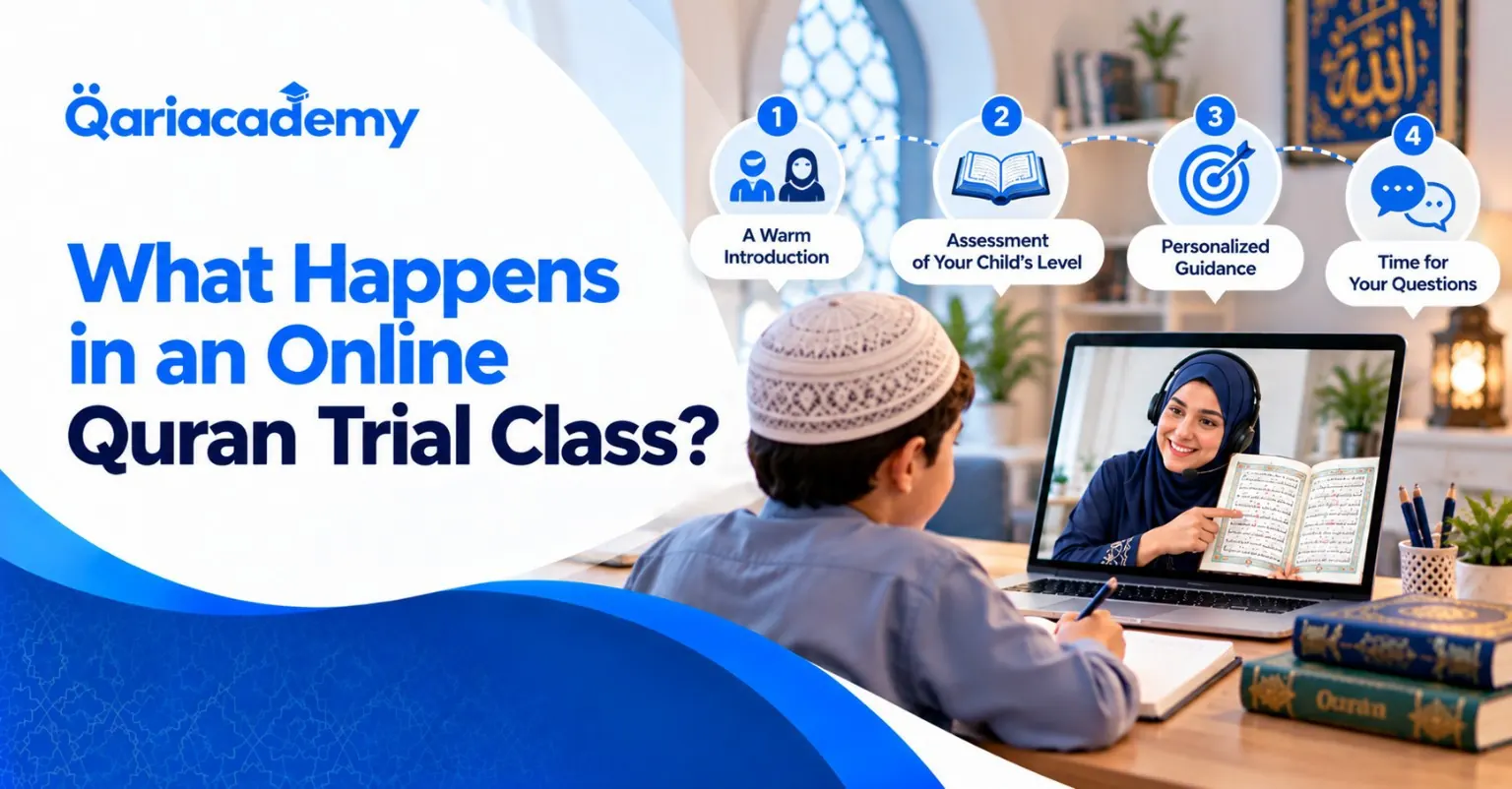
Step 1: A Warm Introduction
The first few minutes should help the child become comfortable.
This is especially important for younger children.
An unfamiliar teacher, a new website, a camera, a microphone, and a new learning environment can make a child nervous.
A good trial therefore should not begin with:
“Read this page.”
Instead, the teacher can first establish a friendly connection.
The teacher may ask simple questions such as:
- What is your name?
- How old are you?
- Have you learned Quran before?
- Do you enjoy reading Quran?
- What have you studied previously?
For a young child, this isn’t wasted time.
It gives the teacher information about the child’s communication, confidence, previous experience, and comfort level.
QariAcademy describes its online classes as child-friendly and emphasizes engaging methods designed for young learners.
Step 2: Understanding the Child’s Previous Experience
The teacher needs to know what the child already knows before deciding what to teach.
A child who has never studied Arabic should not be assessed in exactly the same way as a child who has completed Noorani Qaida.
Similarly, a child who reads Quran fluently should not spend the entire trial identifying Arabic letters.
The teacher may therefore ask about:
| Area | What the teacher may want to understand |
|---|---|
| Arabic letters | Can the child recognize them? |
| Harakat | Can the child read basic vowel marks? |
| Reading | Can the child combine letters and words? |
| Quran | Can the child read directly from the Mushaf? |
| Tajweed | Does the child apply basic rules? |
| Memorization | What has the child already memorized? |
| Arabic | Does the child understand or speak Arabic? |
This is why parents should not worry if the teacher does not immediately start a full Quran lesson.
The teacher is trying to understand the starting point first.
Step 3: Assessment of Your Child’s Quran Level
This is usually one of the most valuable parts of the trial.
The teacher may ask the child to perform activities appropriate to their age and claimed level.
For a beginner, that could involve:
- Arabic letter recognition
- Letter sounds
- Harakat
- Connecting letters
- Simple words
For a child who already reads Quran, the teacher may instead listen to:
- Fluency
- Pronunciation
- Makharij
- Tajweed
- Accuracy
- Confidence
- Ability to correct mistakes
The purpose isn’t to give the child a stressful examination.
It is to determine what the child can already do and what needs development.
QariAcademy’s recent content on Quran placement assessment similarly explains that two children of the same age can have very different Quran reading abilities and that an assessment can identify letters, Harakat, connected reading, pronunciation, and Tajweed readiness.
What If My Child Is a Complete Beginner?
There is nothing wrong with being a complete beginner.
A child does not need to know Arabic before attending an online Quran trial.
In fact, the assessment is particularly useful for beginners because it helps establish the appropriate starting point.
For example, the teacher may discover that the child:
Recognizes some letters → needs Harakat practice → is ready for Qaida
rather than starting directly with Quranic verses.
QariAcademy’s Quran programs accommodate students at different levels, and its Quran for Kids program is designed for children ages 5–15.
Explore QariAcademy’s Quran for Kids Program
What If My Child Already Reads Quran?
The trial should also be useful for an advanced or developing reader.
A child who says:
“I can read Quran.”
may still need significant Tajweed improvement.
The teacher may listen for:
- Incorrect letter pronunciation
- Missing Madd
- Incorrect Ghunnah
- Qalqalah mistakes
- Heavy and light letters
- Raa pronunciation
- Reading speed
- Fluency
- Repeated mistakes
This is why simply asking a child to read a page does not tell the whole story.
A teacher needs to listen to how the child reads.
Step 4: The Teacher Identifies Strengths and Areas for Improvement
An effective trial should not focus only on mistakes.
The teacher should also identify what the child already does well.
For example:
Strengths
- Excellent Arabic letter recognition
- Good reading confidence
- Strong memorization
- Good listening skills
- Good basic pronunciation
Areas to develop
- Makharij
- Fluency
- Tajweed
- Arabic vocabulary
- Reading unfamiliar words
- Memorization revision
This creates a much more useful picture than simply saying:
“Your child is beginner/intermediate.”
A useful assessment should answer:
What can the child do now?
What should they work on next?
Step 5: Personalized Guidance
Once the teacher understands the child’s level, the next question becomes:
What should happen after the trial?
QariAcademy’s current process states that after the trial, the child’s level and needs are assessed and a learning plan is created around them.
For example:
| Child’s Current Level | Possible Next Focus |
|---|---|
| Cannot recognize Arabic letters | Arabic alphabet + Qaida |
| Knows letters but struggles with Harakat | Basic reading foundations |
| Reads simple Arabic | Quran reading development |
| Reads Quran with mistakes | Tajweed + pronunciation |
| Reads fluently | Tajweed refinement + fluency |
| Strong reader + memorization goal | Hifz + structured revision |
The important point is that the trial should lead to a next step, not simply end with “goodbye.”
Step 6: The Parent Gets a Chance to Ask Questions
Parents should not feel that the trial is only for the teacher to evaluate the child.
It is also an opportunity for parents to evaluate whether the program is appropriate for their family.
Useful questions include:
About the child’s level
- What level is my child currently at?
- What are their strongest skills?
- What are the main weaknesses?
- Should they focus on reading or Tajweed first?
About the curriculum
- What will my child learn first?
- How will lessons progress?
- How much homework will they receive?
- How will progress be measured?
About the schedule
- How many classes per week would you recommend?
- How long should each class be?
- What happens if we need to reschedule?
About the teacher
- Does the teacher have experience teaching children?
- Can we request a male or female teacher?
- What happens if the teacher is unavailable?
QariAcademy’s enrollment and course pages provide flexible scheduling options and allow parents to indicate teacher gender preferences and preferred lesson frequency.
What Should Parents Pay Attention to During the Trial?
Parents should watch the interaction—not just listen to the Quran reading.
Ask yourself:
| What to Observe | Why It Matters |
|---|---|
| Does the teacher make the child comfortable? | Children learn better when they can participate confidently |
| Does the teacher listen carefully? | Shows whether instruction is individualized |
| Does the teacher correct mistakes clearly? | Important for pronunciation and Tajweed |
| Does the teacher adjust difficulty? | Shows responsiveness to the child’s level |
| Does the child participate? | Indicates engagement |
| Does the teacher explain the next step? | Helps parents understand the learning plan |
The trial is therefore an opportunity to evaluate the teaching relationship, not just the teacher’s knowledge.
What If the Child Is Shy During the Trial?
This is extremely common.
Some children who normally read well may become quiet when meeting a new teacher.
Parents should not immediately conclude:
“My child cannot learn online.”
The child may simply need a few minutes to become comfortable.
The teacher can help by:
- Asking simple questions
- Using familiar material
- Starting with something the child knows
- Avoiding unnecessary pressure
- Giving positive feedback
- Gradually increasing the difficulty
This is particularly important with younger children.
QariAcademy’s current positioning emphasizes child-friendly classes and engaging methods rather than treating young learners like adults.
What If the Child Makes Many Mistakes?
That is actually one reason the trial exists.
The trial is not a performance where the child needs to prove they are already good at Quran.
Mistakes give the teacher information.
For example:
If the child confuses Arabic letters, the teacher may recommend foundational reading work.
If the child reads but has pronunciation problems, Tajweed and Makharij may become the priority.
If the child reads accurately but struggles with memorization, the teacher may recommend a more structured Hifz and revision routine.
The goal is not:
“Does my child make mistakes?”
The better question is:
“What kind of mistakes does my child make, and what should we do about them?”
What Happens After the Trial?
After the trial, the family can decide whether the program is appropriate.
QariAcademy’s current enrollment process explicitly states that the trial is free and that there is no payment required before experiencing it. The enrollment page also states that there is one free trial class per student with no obligation to continue.
If the family decides to continue, they can select an appropriate tuition plan based on:
- Course
- Number of students
- Classes per week
- Lesson duration
- Schedule
- Teacher preference
QariAcademy currently offers customizable weekly schedules, including 1–5 classes per week depending on the program and plan.
Does the Trial Determine the Exact Long-Term Pace?
Not necessarily.
A trial gives the teacher an initial picture.
Children can change considerably after several weeks of consistent learning.
A child who initially struggles with reading may improve quickly once they establish a regular routine.
Another child may progress quickly at first and then need more time when they reach harder Tajweed material.
That is why ongoing assessment matters.
QariAcademy describes regular progress reports and ongoing feedback as part of its learning model, allowing parents to stay informed about their child’s development.
Why a Trial Can Be Especially Helpful for Online Quran Classes
Some parents worry about online Quran learning before trying it.
They may wonder:
- Will my child pay attention?
- Will the teacher be able to hear the pronunciation?
- Will my child feel comfortable?
- Is online Quran learning suitable for young children?
- Will the lesson feel personal?
A trial answers these questions better than a website description can.
You can actually see:
Child + Teacher + Platform + Lesson
working together.
QariAcademy’s online Quran model uses live one-on-one lessons, and its website describes the trial as a 30-minute session with a qualified teacher.
How Parents Can Prepare Their Child for the Trial
You do not need to spend hours preparing.
In fact, trying to make your child memorize something specifically for the trial can give the teacher a less accurate picture of their normal ability.
Instead:
Before the class
- Make sure the child knows the appointment time.
- Check the internet connection.
- Have the Quran or Qaida nearby.
- Choose a quiet place.
- Make sure the camera and microphone work.
- Tell the child they are meeting a teacher—not taking a difficult exam.
Most importantly:
Let the teacher see the child as they really are.
If the child is a beginner, that’s okay.
If the child makes mistakes, that’s okay.
If the child reads well, that’s useful too.
The purpose is to determine the right next step.
A Trial Class Is Not Just About the Teacher
Parents sometimes focus entirely on:
“Is this teacher good?”
But there are actually three things to evaluate.
1. Teacher fit
Does the teacher communicate well with the child?
2. Learning fit
Does the teaching approach match the child’s current level?
3. Family fit
Does the schedule and program work for your family’s routine?
All three matter.
A teacher can be excellent, but if the child is uncomfortable, the learning relationship may need adjustment.
Likewise, a child may enjoy the teacher, but the lesson may not be challenging enough.
The trial gives parents information about all three.
Questions to Ask Yourself After the Trial
Before enrolling, take a few minutes and ask:
- Did my child feel comfortable?
- Did the teacher understand their level?
- Did the teacher identify specific strengths and weaknesses?
- Was the lesson appropriate for the child’s age?
- Did my child participate?
- Was the correction respectful and clear?
- Did the teacher explain what should happen next?
- Does the proposed schedule fit our family?
- Can we maintain regular practice at home?
These questions can help turn the trial into a meaningful decision rather than simply asking whether the teacher was “nice.”
What a Good Trial Should Leave You With
By the end of an online Quran trial class, parents should ideally have a clearer understanding of:
Where is my child now?
What does my child need next?
How should we support that learning?
And:
Is this teaching environment a good fit for my child?
That is much more valuable than simply completing a 30-minute lesson.
Final Thoughts
An online Quran trial class should give parents and children a realistic introduction to the learning experience.
At QariAcademy, the current process starts with a free one-on-one trial, allows the teacher to understand the student’s level and needs, and then uses that information to guide the student’s learning plan.
For a beginner, the trial can help identify the right starting point.
For a child who already reads Quran, it can reveal areas for Tajweed, pronunciation, fluency, or memorization development.
And for parents, it provides an opportunity to see how the teacher communicates with their child and what the next stage of learning could look like.
So if you have been hesitant to book an online Quran class because you are unsure whether your child is ready, remember:
The trial is precisely where you can find out.
Book Your Free Online Quran Trial at QariAcademy
Frequently Asked Questions
What happens in an online Quran trial class?
The student meets the teacher in a live one-on-one session. The teacher gets to know the student, reviews their previous experience, assesses their Quran level and learning needs, and provides guidance on the appropriate next step. QariAcademy’s current process describes the trial as a 30-minute session followed by assessment and personalized planning.
Is the QariAcademy Quran trial free?
Yes. QariAcademy’s enrollment page currently states that new students can take one free trial class with no obligation to continue.
How long is the online Quran trial?
QariAcademy’s current website describes the free trial as a 30-minute online session.
Does my child need to know Arabic before the trial?
No. The purpose of the assessment is partly to determine the child’s current level. Beginners can start from foundational Arabic reading skills.
Will my child be tested during the trial?
The teacher may ask the child to read, recognize letters, demonstrate previous learning, or recite Quran depending on their level. The purpose is assessment and placement rather than a stressful formal examination.
What if my child makes mistakes during the trial?
That’s completely normal. Mistakes help the teacher identify which skills need attention and what the child should work on next.
Can parents choose a male or female Quran teacher?
QariAcademy’s current enrollment form allows parents to indicate a preference for a male, female, both, or any teacher, subject to availability.
Can siblings take Quran classes?
Yes. QariAcademy’s enrollment system allows parents to register multiple students and provides family discounts for multiple students from the same family.
What happens after the Quran trial?
If the family decides to continue, the child’s level and needs are used to guide the learning plan, after which the family can select an appropriate course and schedule.
Should parents prepare their child before the trial?
Basic technical preparation is useful—working internet, camera, microphone, Quran or Qaida, and a quiet space. But parents should not try to coach the child into appearing more advanced than they really are. An accurate assessment is more useful.
Registration Link:
Book a Free Trial with QariAcademy