Table of Contents
Introduction
Few things hurt a parent more than hearing their daughter say:
“They make fun of me because I’m Muslim.”
Maybe another student laughed at her hijab.
Maybe someone mocked her name.
Maybe classmates made jokes about Islam.
Maybe someone told her that her religion is “weird.”
Or perhaps the bullying has become more serious, with repeated insults, exclusion, online harassment, or threats.
For parents, the immediate reaction can be overwhelming.
You may feel angry.
You may want to confront the other child’s parents.
You may want to tell your daughter to ignore it.
You may even wonder whether she should stop wearing something that makes her stand out.
But before making a decision, stop and think.
Your daughter is facing two problems at the same time:
She is being bullied.
And she is trying to understand what it means to remain confidently Muslim in an environment where some people may not understand or respect her beliefs.
Learning how to support a Muslim daughter being bullied at school requires more than telling her to “be strong.”
She needs emotional support, practical strategies, appropriate school intervention, and a strong foundation in her identity.
Most importantly, she needs to know:
The problem is the bullying—not her being Muslim.
What Counts as Bullying?
Not every unpleasant interaction is necessarily bullying.
Children can disagree.
They can misunderstand one another.
They can make occasional insensitive comments.
Bullying generally involves repeated harmful behavior, a power imbalance, or difficulty for the targeted child to stop the behavior.
The U.S. Centers for Disease Control and Prevention explains that bullying can have significant effects on children’s mental health, school experiences, and overall wellbeing. CDC — Bullying and Youth Violence Prevention
So parents shouldn’t automatically dismiss repeated incidents as:
“They’re just kids.”
Sometimes they aren’t.
Sometimes a child is being targeted.
1. Believe Your Daughter
When your daughter says:
“They’re bullying me.”
don’t immediately respond:
“Ignore them.”
Instead say:
“I’m glad you told me.”
Then ask:
“Tell me exactly what happened.”
Let her speak.
Don’t interrupt.
Don’t immediately tell her what she should have done.
First understand.
Children sometimes stop reporting bullying when they believe adults will minimize the situation.
Your first job is to make her feel heard.
2. Ask Specific Questions
Instead of:
“Are kids being mean to you?”
ask:
- Who is doing it?
- What did they say?
- Where did it happen?
- How often does it happen?
- Was anyone else there?
- Did a teacher see it?
- Did they threaten you?
- Did they touch you?
- Did they post anything online?
- Are you afraid to go to school?
Specific questions give you useful information.
They also help you determine whether you’re dealing with teasing, social exclusion, repeated bullying, discrimination, or something more serious.
3. Don’t Blame Her
Never say:
“Why didn’t you stand up for yourself?”
or:
“You need to be tougher.”
She may already feel powerless.
Your job is not to make her feel responsible for someone else’s bad behavior.
Instead:
“What they did isn’t your fault.”
That sentence matters.
4. Ask How It Made Her Feel
Two children can experience the same event differently.
Your daughter may feel:
- Embarrassed
- Angry
- Afraid
- Lonely
- Confused
- Ashamed
- Frustrated
Ask:
“How did you feel when they said that?”
Don’t rush to correct her feelings.
If she says:
“I felt embarrassed.”
don’t say:
“You shouldn’t care what they think.”
She does care.
She’s a child.
Help her process the feeling rather than pretending it doesn’t exist.
5. Teach Her That Being Muslim Is Not Something to Hide
This is where parents need to be particularly careful.
You may think:
“Maybe she should stop wearing hijab so they won’t bother her.”
That may reduce one source of attention.
But it can also unintentionally teach:
“When people attack my identity, I should hide my identity.”
That’s a dangerous lesson.
Instead, teach:
“You don’t have to be ashamed of being Muslim.”
At the same time, don’t force your daughter into unnecessary confrontation.
Confidence doesn’t mean fighting everyone.
6. Teach Her the Difference Between Confidence and Aggression
Your daughter doesn’t need to insult the bully back.
She doesn’t need to fight.
She doesn’t need to prove she’s tougher.
She can say:
“That’s not okay.”
“Please don’t speak to me like that.”
“I don’t agree with you.”
“I’m going to talk to my teacher.”
Then walk away.
This is strength.
7. Give Her Simple Responses
Children need scripts.
When they’re under pressure, they don’t always know what to say.
Teach her:
If someone mocks her hijab
“I wear it because I’m Muslim.”
If someone says Islam is weird
“You don’t have to believe what I believe, but please respect me.”
If someone makes fun of her name
“That’s my name, and I like it.”
If someone keeps teasing her
“Stop. I’m going to tell my teacher.”
Then leave.
She doesn’t need to win the argument.
She needs to stay safe.
8. Don’t Encourage Retaliation
Avoid:
“If they hit you, hit them back.”
That can escalate the situation and create consequences for your daughter.
Teach her to prioritize safety.
If there is physical violence, threats, or immediate danger, she should seek an adult immediately.
9. Document Serious Incidents
If bullying continues, keep records.
Write down:
- Date
- Time
- Location
- What happened
- Names of students involved
- Witnesses
- Teacher response
- Screenshots of online harassment when appropriate
Documentation can help when communicating with the school.
Don’t turn your daughter into a detective.
The purpose is to establish a pattern when necessary.
10. Talk to the School
Parents shouldn’t wait months hoping bullying will disappear.
If the behavior is repeated or serious, contact the appropriate teacher, counselor, or school administrator.
Keep your communication factual.
Instead of:
“Your school is allowing children to attack Muslims!”
say:
“My daughter has reported repeated incidents involving comments about her religion and hijab. We’d like to understand what happened and what steps can be taken to ensure her safety.”
This approach makes it easier for the school to respond constructively.
11. Ask the School for a Specific Plan
Don’t settle for:
“We’ll keep an eye on it.”
Ask:
“What will happen if it occurs again?”
“Who should my daughter report it to?”
“How will the school monitor the situation?”
“How will you communicate with us?”
You want an actual process.
12. Understand the Difference Between Bullying and Religious Discrimination
If students repeatedly target your daughter specifically because she is Muslim, the situation may involve more than ordinary teasing.
Examples include:
- Repeated anti-Muslim insults
- Mocking Islamic practices
- Targeting hijab
- Slurs about Muslims
- Threats because of religion
- Deliberate exclusion based on religion
Depending on the country and school system, discrimination based on religion may trigger additional school policies or legal protections.
Parents should familiarize themselves with the relevant rules where they live.
13. Don’t Make Your Daughter Responsible for Educating Everyone
Your daughter doesn’t have to answer every question about Islam.
If someone asks:
“Why do Muslims do that?”
she can answer if she wants.
But she doesn’t have to become:
The classroom representative for 2 billion Muslims.
Teach her:
“You can answer when you feel comfortable, but you don’t owe everyone a debate.”
That’s empowering.
14. Teach Her When to Walk Away
Not every comment deserves a response.
Sometimes the strongest response is:
Nothing.
Walk away.
Find a friend.
Tell a teacher.
Continue your day.
Your daughter doesn’t need to prove herself to every person who wants a reaction.
15. Build a Strong Muslim Identity at Home
A child who hears about Islam only when something goes wrong may associate Islam with conflict.
Instead, make Islam part of normal family life.
That can include:
- Quran
- Salah
- Ramadan
- Eid
- Islamic stories
- Family discussions
- Mosque
- Community
- Good character
Then your daughter has a broader identity than:
“The girl who wears hijab.”
She understands:
“I am Muslim, and Islam is part of my whole life.”
16. Connect Her to the Quran
When children are bullied because of their identity, they may start asking:
“Why am I different?”
“Why do I have to be Muslim?”
“Why can’t I just be like everyone else?”
This is where Islamic education becomes especially important.
She needs knowledge—not just instructions.
QariAcademy provides live one-on-one Quran education for children and teenagers, including Quran reading, Tajweed, Hifz, Quranic Arabic, and Islamic studies. QariAcademy — Online Quran Programs
A qualified teacher can give a child another positive Muslim relationship outside the immediate family.
That’s valuable.
17. Don’t Use Quran as a Weapon Against Bullies
Avoid telling your daughter:
“They’re bad people because they don’t believe.”
That can make her respond to prejudice with more prejudice.
Teach:
“We can disagree with someone’s beliefs while still treating them fairly.”
Islamic confidence doesn’t require hatred of people who believe differently.
18. Teach Her About the Prophet’s Character
The life of Prophet Muhammad ﷺ contains many lessons about patience, dignity, courage, forgiveness, and responding to hostility without abandoning principles.
You can teach age-appropriate stories that demonstrate:
- Patience
- Courage
- Forgiveness
- Standing for truth
- Avoiding unnecessary revenge
- Trusting Allah
The objective isn’t to tell your daughter:
“Just tolerate bullying.”
That’s not the lesson.
The lesson is:
Don’t let someone else’s bad behavior turn you into someone you don’t want to become.
19. Help Her Build Friendships
One good friend can make a huge difference.
Encourage your daughter to develop friendships with children who:
- Respect her
- Include her
- Support her
- Don’t pressure her
- Don’t mock her beliefs
She doesn’t need a huge social circle.
She needs a few healthy relationships.
20. Don’t Isolate Her From School Unless Necessary
Your instinct may be:
“I don’t want her going back.”
Sometimes changing schools may eventually be appropriate.
But don’t make that decision immediately unless safety requires it.
Removing a child from every difficult environment can sometimes prevent them from developing confidence and coping skills.
First determine:
Can the school address the problem effectively?
If yes, work with them.
If no, then consider alternatives.
21. Watch for Signs the Bullying Is Affecting Her
Pay attention to changes such as:
- Not wanting to go to school
- Falling grades
- Sleep problems
- Frequent headaches or stomachaches
- Withdrawal
- Loss of interest in activities
- Persistent sadness
- Fear
- Changes in eating
- Avoiding friends
These can indicate that the situation is affecting her more deeply.
If you’re concerned about her emotional wellbeing, seek appropriate professional support.
22. Be Careful With the Phrase “Be Strong”
Parents often say:
“You have to be strong.”
But your daughter may interpret that as:
“I’m not allowed to feel hurt.”
Instead say:
“You can be strong and still feel upset.”
That’s a much healthier message.
Strength doesn’t mean feeling nothing.
Strength means knowing what to do despite difficult feelings.
23. Teach Her That Her Hijab Doesn’t Make Her Less Free
A child may eventually say:
“I wish I didn’t wear hijab because people stare at me.”
Don’t dismiss that.
Say:
“I understand why that feels difficult.”
Then discuss why your family values hijab.
The goal is to strengthen understanding, not silence the emotion.
24. Let Her Ask Difficult Islamic Questions
She may ask:
“Why do I have to be different?”
“Why don’t boys have to do the same thing?”
“Why do people say bad things about Muslims?”
“Why can’t I do what my friends do?”
Don’t be frightened by these questions.
They’re opportunities.
If you don’t know the answer, say:
“Let’s learn about that together.”
You want her to associate difficult Islamic questions with trusted adults and reliable knowledge, not anonymous social media accounts.
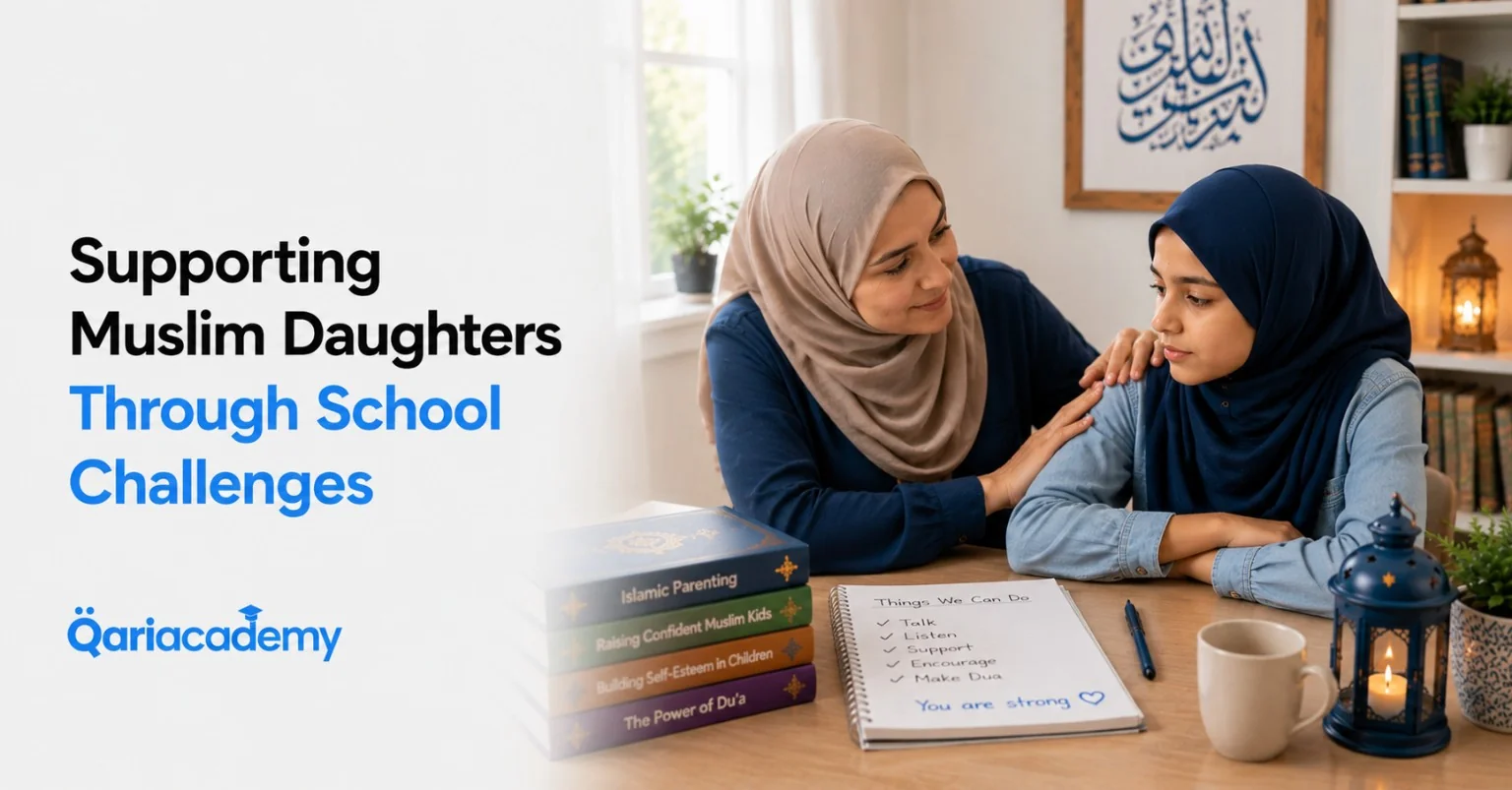
25. Create a Family Response Plan
Your daughter should know exactly what to do if bullying happens.
Step 1
Stay calm and move away if possible.
Step 2
Tell a trusted adult.
Step 3
Tell parents.
Step 4
Document repeated incidents.
Step 5
Escalate through the school if necessary.
Step 6
Seek additional support if the bullying continues.
This gives her a sense of control.
26. A Simple Bullying Response Table
| Situation | What Your Daughter Can Do |
|---|---|
| One rude comment | Ignore or calmly respond |
| Repeated teasing | Tell a teacher |
| Hijab/religion insults | Report repeated behavior |
| Online harassment | Save evidence and report |
| Threats | Tell an adult immediately |
| Physical aggression | Get to safety and seek immediate help |
The response should match the seriousness of the behavior.
27. Teach Her That Asking for Help Is Not Weakness
Some children think:
“If I tell a teacher, I’m a snitch.”
Explain:
“Getting help when someone is hurting you is responsible.”
She isn’t required to solve everything alone.
Adults exist to protect children.
28. Parents Should Also Control Their Own Emotions
This is difficult.
If someone insults your daughter, you may feel furious.
But don’t make your anger her additional burden.
She already has enough to deal with.
Instead of:
“I’ll go to that child’s house myself!”
say:
“I’m going to help you handle this.”
That makes you a source of security rather than another source of chaos.
29. What If the Bully Is a Close Friend?
This can be especially painful.
Your daughter may say:
“She used to be my best friend.”
Explain that relationships can change.
A friend who repeatedly humiliates her isn’t behaving like a healthy friend.
Teach her:
“You can forgive someone without giving them unlimited access to you.”
That’s an important life lesson.
30. What If the Bullying Happens Online?
Online bullying can follow a child home.
Unlike school bullying, there may be no place where the child feels completely away from it.
Teach her:
- Don’t respond emotionally.
- Block where appropriate.
- Report harassment.
- Save evidence.
- Tell parents.
- Don’t retaliate publicly.
If threats or serious harassment are involved, involve the appropriate adults and authorities.
31. Don’t Force Her to “Defend Islam”
Your daughter doesn’t have to debate classmates about theology.
If someone says:
“Islam is bad.”
she can simply say:
“I don’t agree.”
She doesn’t need to prove everything about Islam at recess.
Her job is to be a child.
Parents and teachers can handle serious issues.
32. Build Confidence Through Activities
Confidence isn’t created only through conversations.
Encourage activities where your daughter can succeed:
- Sports
- Art
- Reading
- Quran
- Languages
- Science
- Volunteering
- Clubs
The more dimensions her identity has, the less power one bully has over her sense of worth.
33. Make Quran Learning Part of Her Routine
A consistent Quran routine can provide stability.
Not because Quran is a “solution” to bullying.
It isn’t.
But because children benefit from having stable sources of identity, meaning, and belonging.
QariAcademy offers individualized online Quran classes that can fit around school schedules and help children build Quran reading, Tajweed, Hifz, Arabic, and Islamic studies skills. QariAcademy — Online Quran Programs
For some families, having a trusted Quran teacher can also give a child another adult they feel comfortable learning from and talking to.
34. Don’t Make Her Feel Like She Has to Be Perfect
Sometimes Muslim children think:
“If someone sees me make a mistake, they’ll think Islam is bad.”
That’s too much pressure.
Teach her:
“You’re a child. You’re learning.”
She can be Muslim and still:
- Make mistakes
- Get nervous
- Say something awkward
- Need help
- Learn gradually
Her worth doesn’t depend on being a perfect representative of Islam.
35. What If She Wants to Stop Wearing Hijab?
This is a sensitive situation.
Don’t immediately threaten her.
Ask:
“What is making you want to stop?”
Maybe she is being bullied.
Maybe she is struggling with faith.
Maybe she feels uncomfortable.
Maybe she wants acceptance from friends.
You need to understand the reason before responding.
The answer may require a combination of:
- Emotional support
- Islamic education
- School intervention
- Practical changes
- Trusted mentorship
The worst response is often the fastest one.
36. The Parent’s Biggest Blind Spot
Some parents focus entirely on:
“How do I stop the bullying?”
That’s important.
But ask another question:
“What happens inside my daughter after the bullying stops?”
Does she still believe:
“Being Muslim is something embarrassing”?
Does she still think:
“I need to hide my identity”?
Does she still feel:
“Nobody understands me”?
Stopping the bully is only half the job.
The other half is rebuilding confidence.
37. Help Her Develop an Internal Identity
Your daughter should eventually be able to say:
“I’m Muslim because I believe in Islam.”
Not:
“I’m Muslim because my parents make me.”
That’s why Quran education matters.
That’s why Islamic discussions matter.
That’s why questions matter.
That’s why role models matter.
You want her faith to become something she understands and owns.
38. What Parents Should Say Every Day
Small messages matter.
“I’m proud of you.”
“You don’t have to change who you are to make everyone like you.”
“You can always talk to me.”
“Being Muslim is something you can be confident about.”
“You don’t need to argue with everyone.”
“You deserve to be treated with respect.”
These messages build resilience.
39. A Parent’s Checklist
| Question | Yes/No |
|---|---|
| Does my daughter feel safe telling me about bullying? | |
| Do I know what is actually happening? | |
| Have I contacted the school if necessary? | |
| Does she know which adult to approach? | |
| Does she have at least one supportive friend? | |
| Does she know how to respond calmly? | |
| Does she understand she isn’t responsible for the bullying? | |
| Does she have a positive Muslim identity? | |
| Does she have a consistent Quran/Islamic learning routine? | |
| Does she know she can ask difficult questions? |
40. The Bigger Lesson
Your daughter will probably encounter people who disagree with her throughout her life.
She may encounter:
- Different religions
- Different cultures
- Different political opinions
- Different lifestyles
- People who misunderstand Islam
- People who criticize Islam
You cannot remove all disagreement from her life.
But you can teach her how to respond.
You can teach:
Confidence without arrogance.
Respect without surrender.
Boundaries without hatred.
Faith without fear.
Patience without accepting abuse.
That’s a much more valuable education than simply telling her:
“Ignore them.”
Conclusion
When a Muslim daughter is being bullied at school, parents need to resist two opposite mistakes.
The first is minimizing the situation:
“Ignore it. Kids are kids.”
The second is overreacting:
“We’ll handle this ourselves.”
The better approach is thoughtful and strategic.
Listen to your daughter.
Understand exactly what is happening.
Take repeated bullying seriously.
Document serious incidents.
Work with the school.
Teach your daughter practical responses.
Make sure she knows when to walk away and when to seek help.
Don’t encourage retaliation.
Don’t make her ashamed of being Muslim.
And don’t make her responsible for defending Islam against every classmate who has an opinion.
At the same time, build her internal confidence.
Help her understand her faith.
Give her positive Muslim role models.
Keep Quran and Islamic learning part of her life.
QariAcademy can support this foundation through structured one-on-one online Quran learning in Quran reading, Tajweed, Hifz, Quranic Arabic, and Islamic studies. QariAcademy — Online Quran Programs
Your daughter doesn’t need to grow up believing:
“I must hide my Muslim identity so people won’t hurt me.”
She needs to learn:
“I can be Muslim, confident, respectful, and strong. And when someone treats me unfairly, I know how to get help.”
That’s the kind of resilience that will serve her far beyond school.
Because eventually, school will end.
But the confidence, faith, character, and judgment she develops during these years will follow her into adulthood.
And if your daughter ever comes home and says:
“Mom, someone made fun of me because I’m Muslim.”
don’t begin with:
“Why didn’t you fight back?”
Begin with:
“I’m glad you told me. Tell me what happened.”
Then listen.
Then act.
And remind her:
“There is nothing wrong with you for being Muslim.”
If you want to strengthen her Quran and Islamic education alongside the support you provide at home, you can explore QariAcademy’s programs and start with a free trial:
Book a Free Trial at QariAcademy