Table of Contents
Introduction
Your son loves football.
He waits all week for the next match.
He talks about his favorite players, practices his skills in the garden, and doesn’t want to miss a single training session.
Then you look at the schedule.
The football match is during Maghrib.
Training overlaps with the Quran lesson.
The tournament is on Friday.
And suddenly you find yourself asking:
How can I balance football with Salah and Quran without making my child hate one of them?
This is a real challenge for many Muslim parents.
Sports are important for children. Football can teach teamwork, discipline, confidence, patience, and perseverance. At the same time, Salah and Quran are central parts of a Muslim child’s spiritual development.
The mistake is thinking that you have to choose one.
You don’t.
The real goal is to teach your child that football can be part of their life, but Salah remains a priority within that life.
Learning how to balance football with Salah and Quran isn’t about preventing your child from enjoying sports.
It’s about teaching them how to organize their life around their values.
Why Football Can Actually Be Good for a Muslim Child
Some parents become worried when their child becomes obsessed with football.
But football itself isn’t the problem.
Physical activity can be extremely beneficial for children.
The World Health Organization recommends regular physical activity for children and adolescents because of its benefits for physical and mental health. WHO — Physical Activity Guidelines for Children and Adolescents
Football can teach children:
- Discipline
- Teamwork
- Communication
- Patience
- Resilience
- Respect
- Handling disappointment
- Working toward a goal
The question isn’t:
“Should my Muslim child play football?”
A better question is:
“How can football exist alongside Islam instead of competing with it?”
1. Teach Your Child That Salah Comes First
Your child needs to understand the priority.
If a football match happens to overlap with Salah, the solution isn’t automatically:
“Skip Salah because it’s an important match.”
Instead, teach:
“We can enjoy football, but we don’t leave our Salah behind.”
This principle should be taught gradually according to the child’s age and level of religious responsibility.
Your child needs to see that prayer isn’t something we do only when it’s convenient.
It’s part of the structure of a Muslim’s day.
2. Don’t Wait Until Match Day to Think About Prayer
One of the biggest mistakes parents make is dealing with Salah only after the schedule has already become a problem.
Check the schedule beforehand.
If your child’s match starts at 5:30 PM and ends at 7:00 PM, check the prayer times.
Ask:
- Will Asr occur during the match?
- Will Maghrib begin before the match ends?
- Is there a prayer facility nearby?
- How long will it take to get there?
- Can your child pray before the match?
- Does the team have a break?
Planning ahead can solve many problems.
3. Speak to the Coach
Don’t assume the coach will understand your family’s needs automatically.
Explain respectfully:
“My son is Muslim, and he needs to pray at certain times. We want him to participate fully, but we’d appreciate a short opportunity for prayer when necessary.”
Many coaches may be willing to accommodate reasonable religious needs when parents communicate clearly.
The important thing is to communicate before there is a conflict.
4. Teach Your Child to Communicate Too
As children get older, parents shouldn’t always have to speak for them.
Teach your son to say:
“Coach, I need a few minutes to pray.”
That’s a valuable life skill.
He learns that he can confidently explain his religious commitments without being embarrassed.
5. Find Out Whether the Venue Has a Prayer Space
Some sports facilities may have:
- Prayer rooms
- Quiet rooms
- Multi-purpose rooms
- Outdoor areas
- Nearby mosques
Don’t assume.
Ask.
You may discover that solving the problem is much easier than you thought.
6. Carry a Small Prayer Kit
For tournaments and long football days, prepare a simple bag containing:
- Prayer garment if needed
- Small prayer mat
- Water bottle
- Clean clothing if necessary
- Quran or Quran app if appropriate
Your child then learns:
“I prepare for Salah wherever I go.”
That is a valuable habit.
7. Use Football to Teach Discipline
Here’s an opportunity parents often miss.
Football requires discipline.
Your child can’t become a good player by practicing only when he feels like it.
He has to:
- Show up
- Practice
- Listen to the coach
- Repeat skills
- Accept correction
- Work with teammates
Use that same principle when discussing Salah.
You can say:
“You don’t become a great football player by training only when you feel like it. Salah also teaches us consistency.”
Now you’re connecting something your child already loves with a religious principle.
8. Don’t Make Quran Feel Like the Enemy of Football
Imagine your child hears:
“You can’t play football because you have Quran.”
Eventually he may begin thinking:
Quran = the thing stopping me from having fun.
That’s not what you want.
Instead, explain:
“We are going to organize your schedule so you can enjoy football and keep your Quran lessons.”
That changes the message completely.
9. Adjust the Quran Lesson Schedule When Necessary
If your child has football training every Tuesday at 6 PM, don’t automatically schedule the Quran lesson at 6 PM.
Look for another suitable time.
For example:
- Before school
- After training
- Another weekday
- Weekend
- Earlier in the day
One of the advantages of live online Quran learning is scheduling flexibility.
QariAcademy offers one-on-one online Quran classes for children, including Quran reading, Tajweed, Hifz, Quranic Arabic, and Islamic studies. QariAcademy — Online Quran Programs
For families with busy sports schedules, finding a lesson time that fits the child’s routine can make Quran learning much easier to maintain.
10. Don’t Cancel Quran Every Time Football Appears
There’s another extreme.
Some parents become so flexible that every football activity becomes an excuse to cancel Quran.
One match becomes:
“We’ll skip Quran today.”
Then another tournament.
Then training.
Then a friend’s match.
Eventually, Quran becomes optional.
The message your child receives is:
Football is important. Quran can wait.
That’s not the message you want.
Instead, create a consistent routine and only make changes when genuinely necessary.
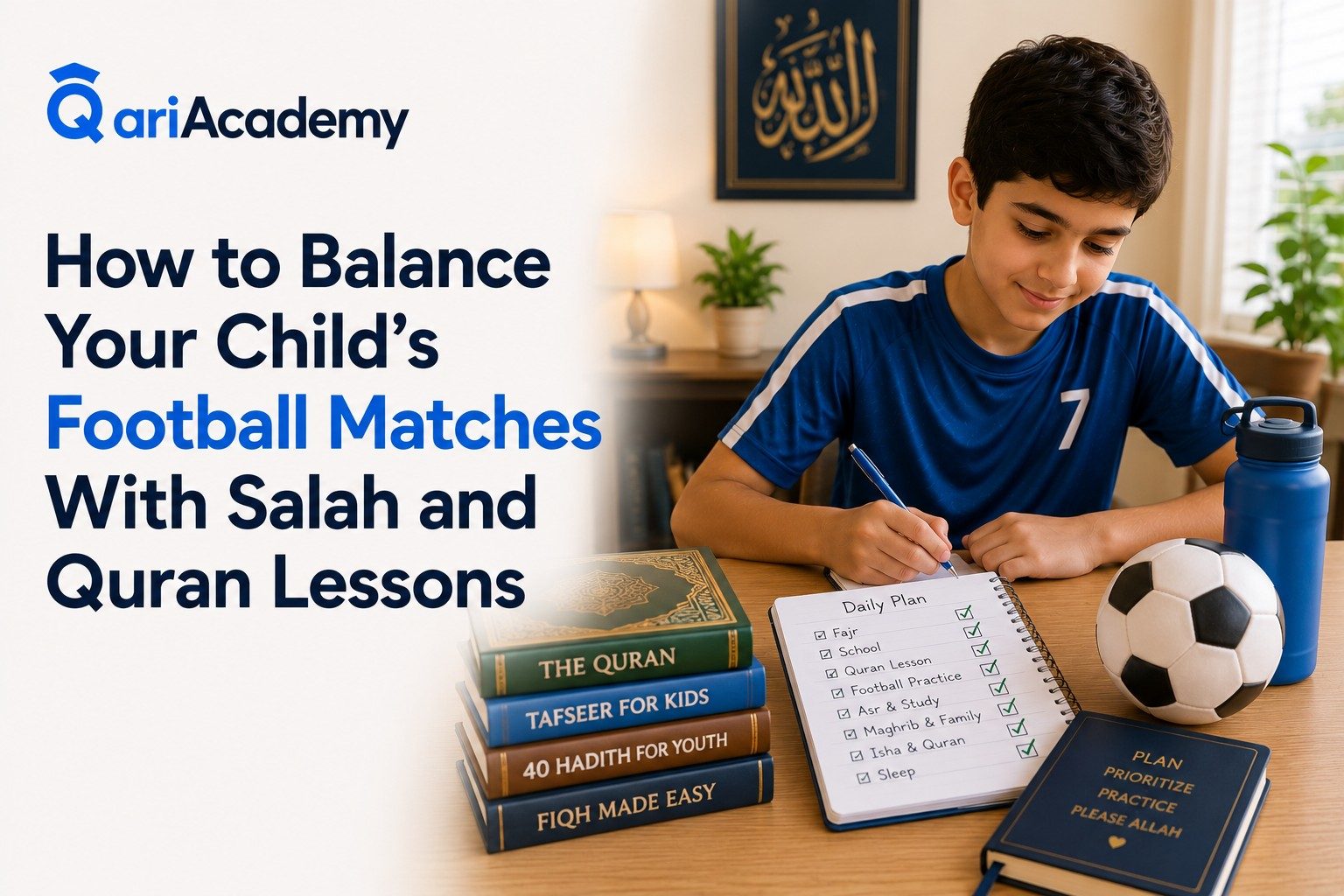
11. Create a Weekly Schedule
A simple schedule can make everything easier.
For example:
| Activity | Frequency |
|---|---|
| Football training | 2–3 times weekly |
| Football match | 1 time weekly |
| Quran lesson | 2–3 times weekly |
| Salah | Daily |
| Family time | Weekly |
| Free play | Daily |
The exact schedule depends on the child’s age and commitments.
The important thing is that Quran and Salah aren’t competing with football every single day.
They are both built into the routine.
12. Friday Football Needs Special Planning
Friday can be particularly important for Muslim families.
If your child has a football match or training around Jumu’ah, plan ahead.
For boys who are obligated to attend Jumu’ah according to the applicable Islamic rulings, parents should prioritize making arrangements that allow them to fulfill that obligation.
Don’t wait until the last minute.
Check:
- Match time
- Mosque time
- Travel time
- Changing facilities
- Whether the team can accommodate the schedule
A little planning can prevent unnecessary stress.
For specific fiqh questions regarding Jumu’ah and children’s obligations, parents should consult a qualified local scholar.
13. Teach Your Child That Missing a Match Is Sometimes Okay
This can be difficult.
Your child might say:
“But everyone else is going!”
Or:
“The coach needs me!”
Or:
“This is the most important match of the season!”
Parents need to be willing to say:
“I understand that the match is important. But some responsibilities are more important.”
This is not about making your child feel guilty.
It’s about teaching priorities.
Children need to learn that sometimes we give up something we really want because something more important requires our attention.
That lesson will help them throughout life.
14. Don’t Turn Every Sports Conflict Into a Religious Lecture
If your child misses a match because of Salah, don’t spend the entire car ride saying:
“See? This is why football is dangerous.”
That creates resentment.
Instead:
“I know missing the match was disappointing. You handled a difficult situation responsibly.”
That’s enough.
15. Praise the Right Behavior
If your child says:
“I told the coach I needed to pray.”
Praise him.
If he remembers to check prayer times before a tournament, praise him.
If he asks where he can pray, praise him.
You are reinforcing independence.
You want him eventually to think:
“I need to figure out how to pray.”
rather than:
“Mom needs to remind me.”
16. Teach Your Child to Plan Around Salah
As your child grows, planning should become his responsibility.
Teach him to ask:
“What time is the match?”
“What time is Salah?”
“Where can I pray?”
“How long will it take?”
This develops practical religious maturity.
17. Use Technology Wisely
A prayer-time app can help older children stay aware of Salah times while they’re busy.
But don’t let technology replace parental teaching.
The app can tell your child:
“It’s time for Maghrib.”
But your child needs to understand:
“Why do I stop what I’m doing and pray?”
That’s the deeper lesson.
18. Teach Your Child That Athletes Can Be Muslim Role Models
Children often admire football players.
Use that interest positively.
Talk about Muslim athletes who demonstrate:
- Discipline
- Humility
- Hard work
- Faith
- Good character
This can help your child understand that being serious about sport doesn’t require abandoning Islamic identity.
Your child can aspire to become:
A great football player and a committed Muslim.
Those identities don’t have to compete.
19. Don’t Let Football Become Your Child’s Entire Identity
This is an important blind spot for parents.
There is nothing wrong with loving football.
But be careful if your child’s entire identity becomes:
“I’m a football player.”
What happens if he gets injured?
What happens if he isn’t selected?
What happens if another player becomes better?
What happens if he eventually stops playing?
Children need multiple dimensions to their identity.
Teach:
“Football is something you do. It isn’t everything you are.”
Your child’s identity can include:
- Muslim
- Son
- Brother
- Student
- Friend
- Athlete
- Learner
That’s healthier.
20. Teach Your Child How to Handle Losing
Football gives parents countless opportunities to teach character.
Your child will lose games.
He’ll miss goals.
He’ll sit on the bench.
He may be substituted.
He may make mistakes.
Use these moments.
Ask:
“How did you handle losing?”
Then:
“What can we learn from it?”
And:
“How can we respond in a way that Allah loves?”
Sports can become a classroom for Islamic character.
21. Teach Respect for Opponents
Your child should understand:
Winning doesn’t give you permission to humiliate others.
Losing doesn’t give you permission to insult the referee.
Being talented doesn’t give you permission to disrespect teammates.
Football can reinforce:
- Good manners
- Humility
- Patience
- Fairness
- Respect
These are Islamic values too.
22. Don’t Use Football as a Reward for Quran Every Time
Some parents say:
“If you finish Quran, you can play football.”
Occasionally using privileges as incentives isn’t necessarily harmful.
But if this becomes the permanent structure, your child may learn:
Quran is the unpleasant task I must complete before I get to do what I actually enjoy.
That’s not ideal.
You want Quran to eventually become something meaningful in its own right.
23. Make Quran Lessons Engaging
If your child loves football but hates Quran, don’t immediately conclude:
“He’s lazy.”
Maybe the lesson isn’t engaging.
Maybe the level is too difficult.
Maybe the teacher isn’t a good fit.
Maybe the class is too long.
Maybe the child needs more encouragement.
Talk to the teacher.
Adjust the approach.
A good Quran program should challenge the child without making them feel constantly defeated.
24. Choose the Right Quran Lesson Length
A child who has football training three evenings a week may struggle with long lessons.
Shorter, focused sessions may work better.
For example:
- 30-minute lessons
- 2–3 times per week
- Consistent timing
This can be easier to maintain than occasional long sessions.
QariAcademy offers flexible one-on-one online Quran learning, allowing families to choose a schedule that works around school and extracurricular activities. QariAcademy — Online Quran Programs
25. Create a “No Conflict” Rule
Parents can establish a simple family principle:
“Before we register for a new activity, we check that it doesn’t consistently interfere with Salah or Quran.”
This doesn’t mean your child can never have a conflict.
It means you plan before committing.
Ask:
“When are the practices?”
“When are the matches?”
“What will happen during Ramadan?”
“What about Friday?”
That makes your priorities clear.
26. Don’t Overload Your Child
Football + Quran + Arabic + school + tutoring + swimming + coding + everything else can become too much.
Your child needs rest.
Ask:
“Is my child thriving, or simply surviving?”
If the schedule constantly produces:
- Exhaustion
- Irritability
- Poor sleep
- Missed prayers
- Constant rushing
- No family time
then something needs to change.
27. A Balanced Weekly Example
Here’s one possible structure:
Monday
Football training + Quran lesson
Tuesday
School + free time + Quran review
Wednesday
Football training + family time
Thursday
Quran lesson + free play
Friday
Jumu’ah + family activity
Saturday
Football match + prayer planning
Sunday
Rest + Quran lesson + family time
This is only an example.
Your child’s schedule should be adapted to your location, school calendar, prayer times, and football commitments.
28. What If the Coach Says, “He Can’t Leave the Match”?
This requires respectful communication.
Explain:
“We understand the importance of the game. Prayer is also an important religious responsibility for our family. We’re happy to work with you to find a practical solution.”
Perhaps your child can:
- Pray before the match
- Pray during a break
- Pray immediately afterward if Islamically appropriate
- Have another player cover temporarily
The exact solution depends on the prayer time and circumstances.
The important thing is to communicate rather than assume conflict is unavoidable.
29. What If Your Child Says, “I Don’t Want to Pray During Football”?
Don’t immediately shout.
Ask:
“Why?”
Maybe he’s embarrassed.
Maybe he doesn’t want teammates asking questions.
Maybe he’s afraid of missing the match.
Maybe he simply doesn’t understand the importance of Salah.
Each problem requires a different solution.
If he’s embarrassed, teach him confidence.
If he’s worried about missing the match, help him plan.
If he doesn’t understand the importance of Salah, focus on education.
30. Teach Confidence in Muslim Identity
Your child shouldn’t feel that praying makes him strange.
He can say:
“I’m Muslim, and I need to pray.”
That’s it.
He doesn’t need a long explanation.
A confident child can practice his religion without feeling that he has to apologize for it.
31. Quran Can Also Improve Discipline
Consistent Quran learning requires:
- Repetition
- Patience
- Focus
- Memory
- Listening
- Correction
Those are also useful athletic skills.
So don’t present Quran and football as opposites.
Both can teach discipline.
The difference is their purpose.
Football trains the body and certain mental skills.
Quran develops the child’s relationship with Allah and their Islamic knowledge.
A healthy child can benefit from both.
32. Use Ramadan as a Special Opportunity
Ramadan may create additional scheduling challenges for young athletes.
Training times may change.
Energy levels may change.
Prayer schedules change.
Instead of treating Ramadan as a problem, use it as an opportunity to teach planning.
Talk with your child about:
- Salah
- Quran
- Sleep
- Training
- Nutrition
- Rest
The goal is to teach balance rather than eliminating everything enjoyable.
For children who are not yet obligated to fast, parents should also consider their age, health, and individual circumstances rather than forcing practices beyond what is appropriate.
33. Teach Your Child That Priorities Change
There may be times when football is the priority.
There may be times when family is the priority.
There may be times when school is the priority.
There may be times when worship requires immediate attention.
Learning to evaluate priorities is part of growing up.
You can teach your child:
“Not everything important is equally important.”
That’s a lesson that extends far beyond football.
34. The Biggest Mistake Parents Make
The biggest mistake isn’t allowing football.
It’s allowing football to become the organizing principle of the entire family.
Every weekend revolves around matches.
Every evening revolves around training.
Every conversation revolves around performance.
And eventually:
Salah gets squeezed.
Quran gets squeezed.
Family time gets squeezed.
Sleep gets squeezed.
That’s when parents need to step back.
Your child can be passionate about football without the entire household becoming controlled by football.
35. The Bigger Parenting Goal
Your child will eventually become an adult.
You won’t always be there to remind him:
“It’s time to pray.”
You won’t always be there to schedule Quran.
You won’t always be there to check the match timetable.
Eventually, he has to do this himself.
That’s why the ultimate goal is not:
“How do I make my child pray?”
It’s:
“How do I help my child become someone who chooses to pray?”
And that’s why Islamic education matters.
Conclusion
Learning how to balance football with Salah and Quran isn’t about taking football away from your child.
It’s about teaching your child that enjoying sports and maintaining a strong relationship with Allah can exist together.
Let your child play.
Let them compete.
Let them dream.
Let them enjoy scoring goals and celebrating with teammates.
But also teach them that Salah has a place in every schedule.
Teach them to check prayer times.
Teach them to speak to their coach.
Teach them to find a place to pray.
Teach them to prepare.
And teach them that sometimes a match may have to take second place.
The goal isn’t to raise a child who thinks:
“Islam prevents me from enjoying life.”
It’s to raise a child who understands:
“Islam helps me organize my life around what matters most.”
Football can teach discipline.
Quran can teach discipline.
Football can teach patience.
Quran can teach patience.
Football can teach your child how to lose.
Islam can teach your child how to respond to difficulty.
The two don’t have to be enemies.
With thoughtful planning, they can actually complement each other.
QariAcademy can help families maintain consistent Quran learning alongside busy extracurricular schedules through live one-on-one online lessons in Quran reading, Tajweed, Hifz, Quranic Arabic, and Islamic studies. QariAcademy — Online Quran Programs
The important thing is not to create the most productive child.
It’s to create a balanced child.
A child who can play.
A child who can learn.
A child who can compete.
A child who can rest.
A child who can pray.
A child who can open the Quran.
And eventually, a young Muslim who knows how to make good choices even when his parents aren’t standing next to him.
So the next time your child says:
“But I have football training!”
don’t automatically answer:
“Then you can’t go.”
Instead ask:
“Okay. How can we make football and Salah work together?”
That question teaches something much more valuable than a simple yes or no.
It teaches your child how to live their faith in the real world.
If you’re looking for a flexible Quran program that can fit around your child’s football, school, and family schedule, you can explore QariAcademy’s programs and start with a free trial:
Book a Free Trial at QariAcademy
Primary Keyword: balance football with Salah and Quran