TL;DR (Too Long; Didn’t Read)
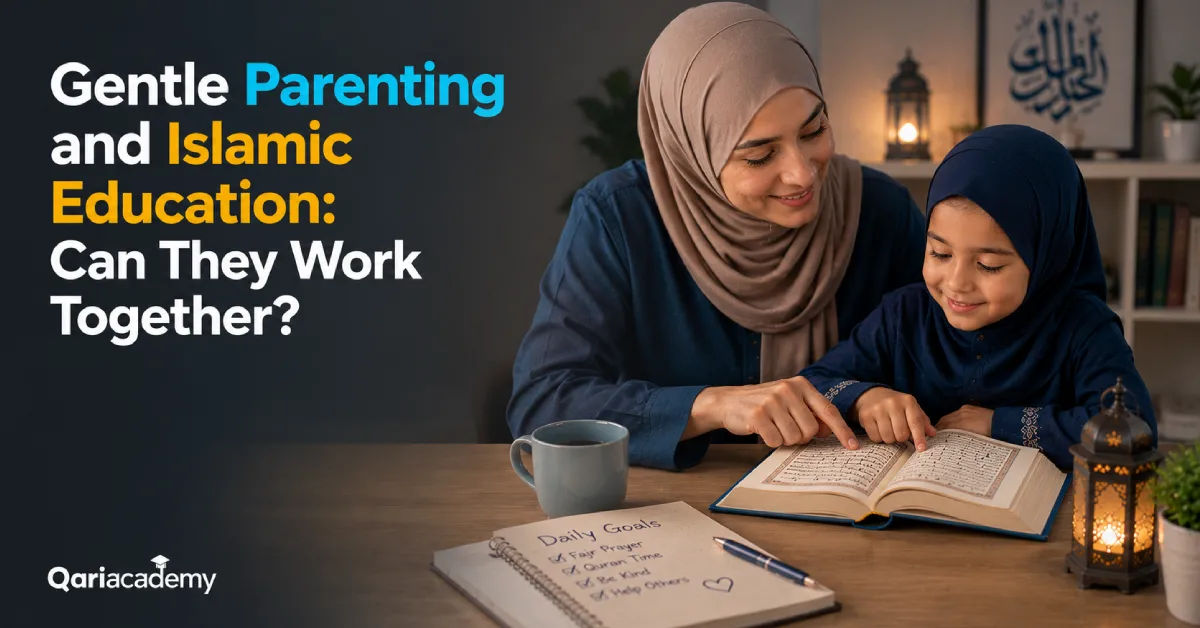
Many modern parents are adopting “Gentle Parenting”—an approach based on empathy, respect, and healthy boundaries. But can this work with the discipline required for Quranic studies? The answer is a resounding YES. In fact, it is the Sunnah. This article explores how Gentle Parenting and Islamic Education are perfectly aligned and how QariAcademy uses positive reinforcement and emotional intelligence to teach the Quran without the need for harshness or fear.
The Myth of the “Strict” Teacher
For a long time, there was a misconception that religious education must be strict, loud, and demanding to be effective. Many of us grew up with the idea that the Quran teacher’s “stick” was a necessary tool for Hifz.
However, as we understand more about child psychology and the Sunnah of the Prophet ﷺ, we realize that Gentle Parenting and Islamic Education are not just compatible—they are inseparable. You cannot plant the love of Allah in a heart that is paralyzed by fear.
1. Empathy Before Instruction
Gentle parenting starts with understanding the child’s emotional state.
- The Problem: Forcing a tired or frustrated child to recite a difficult page often leads to a meltdown and a long-term dislike for the Quran.
- The QariAcademy Approach: Our teachers practice “Emotional Check-ins.” If a student is having a bad day, we don’t just push through the lesson. We validate their feelings, offer a few minutes of encouragement, and adapt the lesson’s intensity. This empathy builds trust, which makes the child more willing to listen and learn.
2. Natural Consequences vs. Punitive Punishment
Gentle parenting focuses on teaching, not punishing.
- The Problem: Traditional methods often use shame or physical “reminders” for forgetting verses.
- The QariAcademy Approach: We replace punishment with Accountability and Support. If a student hasn’t reviewed their portion, we don’t shame them. Instead, we work with them during the session to find a better review strategy. We teach them that the “consequence” of not reviewing is simply needing more time to reach their goal—a natural, logical result that encourages responsibility without fear.
3. The Prophet ﷺ as the Ultimate Gentle Parent
The Prophet Muhammad ﷺ was the most gentle teacher to ever live. He never struck a child, never shamed a student, and always led with mercy.
- The Sunnah: He ﷺ would let his grandchildren, Al-Hasan and Al-Husayn, climb on his back while he was in Sujud. He didn’t see this as a “disruption” of worship, but as an opportunity for love.
- The QariAcademy Philosophy: We model our teaching after this Prophetic Gentleness. At QariAcademy, we believe that being “Gentle” doesn’t mean being “Easy” or having “No Standards.” It means maintaining high standards of Hifz while using the highest standards of Akhlaq (character).
4. Collaborative Goal Setting
In gentle parenting, children are seen as partners in their own growth.
- The Problem: Dictating exactly what a child must do creates resistance.
- The QariAcademy Approach: We practice Collaborative Hifz. We ask our students: “How many Ayahs do you feel confident mastering this week?” By giving them a voice, we honor their autonomy. When a child helps set the goal, they are far more motivated to achieve it.
5. Focus on the Root Cause, Not Just the Behavior
When a child “misbehaves” or refuses to attend a Quran class, a gentle approach asks: “Why?”
- The Discovery: Is the child bored? Is the level too hard? Are they distracted by digital screens?
- The QariAcademy Solution: Our 1-on-1 sessions allow us to identify these root causes. We don’t just tell the child to “sit still”; we make the lesson so engaging that they want to sit still. By solving the underlying problem (boredom or anxiety), the “misbehavior” disappears naturally.
Conclusion: A Legacy of Love
Gentle Parenting and Islamic Education: Can They Work Together? Absolutely. In fact, it is the only way to ensure that the Quran remains a source of comfort for your child as they grow into adulthood.
At QariAcademy, we are proud to be at the forefront of this “Gentle Revolution” in Islamic education. We don’t just want your child to memorize the Quran; we want them to feel the love and mercy of the One who revealed it.