Table of Contents
Introduction
One of the most painful moments for a Muslim parent can be realizing that their son has stopped praying.
Maybe he used to pray with you when he was younger.
Then school became busier.
Football became more important.
His phone became harder to put down.
One prayer was missed.
Then another.
Eventually, you realize that your son may go through an entire day without Salah.
You ask:
“Why doesn’t he pray anymore?”
“What am I doing wrong?”
“Should I force him?”
“Should I punish him?”
“How can I make him understand how serious this is?”
These are difficult questions.
And if your son doesn’t pray, the solution is not always as simple as repeating:
“Go pray.”
“Did you pray?”
“Why haven’t you prayed?”
“You’re going to be punished.”
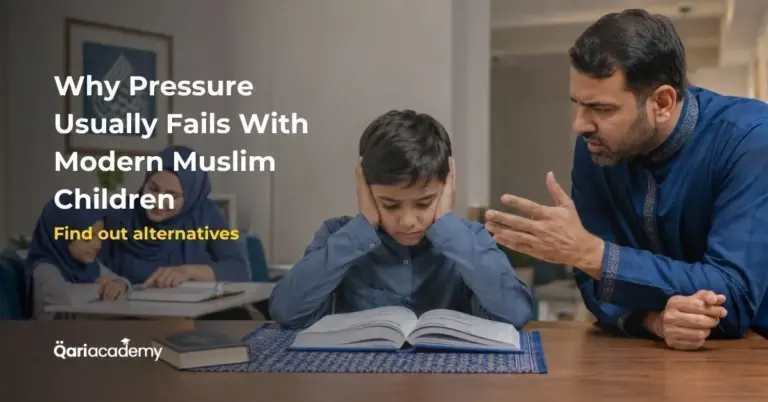
Those reminders may be necessary at certain stages, but if every conversation becomes a confrontation, something important can happen:
Your son may start associating Salah with pressure, arguments, and parental control rather than worship and his relationship with Allah.
The goal isn’t simply to make him stand up and pray while you’re watching.
The real goal is to help him understand why Salah matters, develop the habit, and eventually pray because he recognizes it as his responsibility before Allah.
Why Is My Son Not Praying?
Before trying to fix the problem, find out what is actually causing it.
Not every child stops praying for the same reason.
Your son might be:
- Forgetting because his routine is chaotic
- Embarrassed to pray around friends
- Struggling with consistency
- Feeling disconnected from Islam
- Going through teenage rebellion
- Finding prayer boring because he doesn’t understand what he is saying
- Spending too much time on games or social media
- Staying up too late
- Feeling overwhelmed by school
- Questioning aspects of his faith
- Simply never having developed a strong prayer habit
These problems require different solutions.
That’s why the first question shouldn’t always be:
“Why don’t you pray?”
Try:
“Can you tell me what makes Salah difficult for you?”
Then listen.
1. Don’t Start With Anger
Imagine your son misses Fajr.
You wake him up and immediately say:
“You never care about Salah!”
He may hear:
“My parents are angry with me again.”
Instead, try:
“I know getting up for Fajr is difficult. Let’s figure out how we can make it easier.”
You’re still taking Salah seriously.
But you’re approaching the problem instead of attacking the child.
2. Make Sure He Understands Why Salah Matters
Sometimes parents assume children understand the importance of Salah because they’ve heard about it for years.
They may not.
Your son may know:
“I have to pray.”
But he may not understand:
“Why?”
Explain that Salah isn’t simply another task on a Muslim’s daily checklist.
It is an act of worship and a direct expression of a Muslim’s relationship with Allah.
The Quran describes Salah as an established obligation for believers at appointed times. Quran — Surah An-Nisa 4:103
Tell your son:
“Allah doesn’t need our prayer. We need our relationship with Allah.”
That can change the conversation.
3. Ask Him What He Thinks About Salah
This may be uncomfortable.
But ask:
“What do you think about prayer?”
Don’t interrupt.
He might say:
“It’s boring.”
“I don’t understand Arabic.”
“I don’t feel anything.”
“I don’t have time.”
“I forget.”
“I don’t know why I have to do it.”
“I just don’t want to.”
Each answer gives you something to work with.
4. Don’t Immediately Turn Every Question Into a Debate
If your son says:
“Why do I have to pray?”
don’t immediately respond:
“Because Allah commanded you. End of discussion.”
Yes, Allah’s command matters.
But your son may be asking because he genuinely wants to understand.
Explain:
“Salah is one of the ways we remember Allah, thank Him, ask Him for help, and keep our relationship with Him alive.”
Then ask:
“What part of prayer is difficult for you?”
You’re moving the conversation from confrontation to education.
5. Teach Him the Meaning of What He Says
This is one of the biggest opportunities parents overlook.
A child may spend years reciting:
Al-Fatihah.
Subhan Rabbiyal Azeem.
Subhan Rabbiyal A’la.
Tashahhud.
But if he doesn’t understand what those words mean, Salah can become mechanical.
Help him learn the meanings gradually.
When he understands that he is standing before Allah, praising Him, asking Him for guidance, and making dua, prayer can become more meaningful.
6. Don’t Expect Emotion Every Time
Another misconception is that your son must always feel something during Salah.
Sometimes prayer will feel deeply meaningful.
Sometimes it won’t.
That’s normal.
Worship involves consistency, not waiting for the perfect emotional moment.
You can explain:
“Sometimes you pray because you feel close to Allah. Sometimes you pray because you are training yourself to remain close to Allah even when you don’t feel motivated.”
That’s an important life lesson.
7. Help Him Build a Routine
Motivation is unreliable.
Routine is more dependable.
If your son wakes up late, rushes to school, comes home, plays football, eats dinner, plays video games, and goes to bed, Salah can easily become an afterthought.
Help him build prayer around his day.
For example:
Fajr: Wake up, pray, then prepare for school.
Dhuhr: School prayer arrangement when appropriate.
Asr: Pray before football or another activity when feasible.
Maghrib: Pray before dinner or immediately when the time begins, depending on circumstances.
Isha: Pray as part of his bedtime routine.
The exact schedule will depend on prayer times and your family’s circumstances.
8. Use His Existing Routine
Don’t create an entirely new system if you don’t need to.
Connect Salah to things he already does.
For example:
After school → Dhuhr/Asr
Before football → Salah
Before dinner → Maghrib
Before getting ready for bed → Isha
Habits become easier when they are attached to existing routines.
9. Don’t Let Football Always Win
This is especially important if your son loves sports.
If every football match means:
“We’ll pray later.”
and every training session means:
“Just skip it today.”
eventually your child learns:
Football is important. Salah is optional.
Instead, teach him:
“Let’s figure out how you can play and still pray.”
Planning around Salah is a skill.
It teaches him how to live his religion in the real world.
10. Don’t Let Screens Control the Prayer Schedule
Video games and social media can create another problem.
Your son may say:
“Just five more minutes.”
Then twenty minutes pass.
Then the prayer time is almost over.
Don’t allow entertainment to become the highest priority in the household.
Establish clear rules around devices.
For example:
When it’s time for Salah, the game pauses.
Not:
“Salah can wait until the game ends.”
Your child learns from what you consistently prioritize.
11. Pray Together
One of the simplest strategies is also one of the most powerful:
Make Salah a family experience.
Instead of repeatedly shouting:
“Go pray!”
say:
“Come, let’s pray.”
There’s a big difference.
Your son sees that Salah isn’t something you’re forcing him to do while everyone else continues living.
It’s something the family does together.
12. Let Him See You Pray
Children learn from observation.
If your son regularly sees his parents stop what they’re doing when it’s time for Salah, he receives a powerful message:
Prayer matters.
You don’t necessarily need a speech.
Your behavior teaches him.
13. Don’t Make the Mosque a Punishment
Avoid:
“Because you didn’t pray, you’re going to the mosque with your father.”
That can create the association:
Mosque = punishment.
Instead, create positive experiences around the mosque.
Take him:
- For Jumu’ah
- For community events
- To meet friends
- To attend age-appropriate classes
- To participate in community activities
Help him experience the mosque as a place where Muslims belong.
14. Give Him a Positive Muslim Community
Teenage boys are strongly influenced by peers.
If all his friends see religion as embarrassing, maintaining Salah can become difficult.
Positive Muslim friendships can make a significant difference.
Look for:
- Youth groups
- Mosque activities
- Islamic camps
- Quran programs
- Sports activities with Muslim peers
- Positive mentors
Your goal isn’t to isolate your son from everyone who isn’t Muslim.
It’s to make sure he also has a community where his faith feels normal.
15. Don’t Turn Quran Into a Punishment for Not Praying
Avoid:
“You aren’t praying, so now you’re going to take extra Quran classes.”
That can make your son associate Quran with punishment.
Instead, Quran learning should be a normal part of his development.
QariAcademy provides live one-on-one online Quran learning for children and teenagers, including Quran reading, Tajweed, Hifz, Quranic Arabic, and Islamic studies. QariAcademy — Online Quran Programs
A consistent Quran-learning relationship can help children build knowledge and understanding rather than simply hearing religious instructions from parents when they have done something wrong.
16. Use Quran to Help Him Understand Salah
Quran learning shouldn’t be completely separate from daily life.
If your son is learning Quran, connect what he’s learning to his worship.
Discuss:
- Why we worship Allah
- What gratitude means
- Why humans need guidance
- What dua means
- What accountability means
- What the Quran says about prayer
This helps him understand that Salah is part of a larger relationship with Allah.
17. Don’t Compare Him to Other Children
Avoid:
“Your cousin prays every prayer.”
“Look at that boy at the mosque.”
“Your friend is better than you.”
Comparison often creates shame rather than commitment.
Focus on your son’s own progress.
Say:
“Let’s work on becoming more consistent than we were last week.”
That’s measurable.
18. Don’t Humiliate Him in Front of Others
Never embarrass your son publicly about Salah.
Avoid:
“He never prays!”
“He doesn’t care about Islam!”
“Tell him to pray!”
Public humiliation can damage trust.
Correct privately.
Encourage privately.
Celebrate progress privately.
19. Give Him Responsibility as He Gets Older
Younger children naturally need more reminders.
Teenagers need increasing responsibility.
Instead of constantly reminding your son:
“Did you pray?”
teach him to manage his own Salah.
Ask:
“How are you doing with your prayer schedule?”
“Is anything making it difficult?”
“Do you need help setting up reminders?”
You’re gradually transferring responsibility from parent to child.
20. Teach Him That Salah Is More Important Than Convenience
This is one of the deeper lessons.
Life will constantly create excuses:
“I’m tired.”
“I’m busy.”
“I’m traveling.”
“I’m playing.”
“I’m studying.”
“I’m watching something.”
If Salah only happens when convenient, it will eventually disappear.
Teach:
“We organize parts of our day around Salah.”
Not:
“We pray if the day allows it.”
21. What If He Says, “I Don’t Feel Like It”?
Don’t panic.
Ask:
“Do you only do important things when you feel like doing them?”
Then give examples:
Football training.
Homework.
Taking care of your body.
Getting enough sleep.
Sometimes discipline comes before motivation.
Explain:
“You don’t have to feel motivated every time. You build the habit by doing it consistently.”
22. What If He Says, “I’m Too Busy”?
Ask him to show you his schedule.
Literally sit down together.
Write:
School.
Football.
Gaming.
Homework.
Sleep.
Family.
Salah.
Quran.
Now look at the schedule together.
Sometimes you’ll discover that he really is overloaded.
Sometimes you’ll discover that several hours are disappearing into entertainment.
Either way, you’re dealing with reality rather than arguing.
23. What If He Says, “I Don’t Believe”?
This is a different situation.
Don’t panic.
Don’t scream.
Don’t immediately accuse him of leaving Islam.
Ask:
“What makes you feel that way?”
Then listen carefully.
He may have questions about:
- Allah
- Science
- Suffering
- Religion
- Other religions
- Rules
- Society
- Something he saw online
If your son is seriously questioning his faith, this is exactly when you need knowledge, patience, and trusted guidance, not simply punishment.
24. Don’t Be Afraid of Difficult Questions
Your son may ask:
“Why does Allah require prayer?”
“Why are there five prayers?”
“Why do I have to pray if Allah knows what’s in my heart?”
“Why can’t I just be a good person?”
These are opportunities.
If you don’t know the answer, say:
“That’s a good question. Let’s find the answer together.”
You don’t have to pretend you know everything.
25. Teach Him About the Meaning of Time
Salah teaches something modern children desperately need:
The day doesn’t belong entirely to you.
There are moments when you stop.
You step away from entertainment.
You step away from school.
You step away from football.
You remember Allah.
Then you return to your responsibilities.
This rhythm can actually help children develop discipline.
26. Use Technology as a Tool
For older children, prayer reminders can be useful.
But don’t rely entirely on notifications.
The ultimate goal isn’t:
“My phone told me to pray.”
It’s:
“I know it’s time to pray.”
Technology should support the habit, not replace it.
27. Help Him Prepare for Salah
Sometimes children avoid prayer because the process feels inconvenient.
Make it easy.
Keep:
- Prayer clothes where needed
- Prayer mat accessible
- Wudu facilities convenient
- A clean prayer space
Reduce unnecessary friction.
28. Make Quran Learning Consistent
If your son has no regular connection to Quran, it can be harder for him to build a broader Islamic routine.
A manageable schedule may work better than occasional intense lessons.
For example:
30 minutes, 2–3 times a week
can be more sustainable than long sessions that your child begins to resent.
QariAcademy offers flexible one-on-one online Quran lessons that can be arranged around school, sports, and family schedules. QariAcademy — Online Quran Programs
29. Focus on Progress, Not Perfection
If your son currently prays one prayer consistently, don’t ignore that progress.
Build from it.
If he improves from one prayer to three, acknowledge the progress.
Then continue.
The goal is ultimately consistency in the required prayers, but habit formation can require a thoughtful process.
30. Parents Must Be Consistent Too
You cannot expect your son to take Salah seriously if he sees adults constantly delaying or skipping it without a serious reason.
Children notice.
If the family stops for prayer, your son sees:
This matters.
If everyone continues watching television while he is told to pray alone, he may see:
This is something they make me do.
Your example matters enormously.
31. What Should You Do When He Refuses?
This depends heavily on his age and circumstances.
With a younger child, parents naturally provide more direct supervision and instruction.
With an older teenager, the approach should increasingly include education, responsibility, accountability, and honest conversation.
Avoid turning every refusal into a massive confrontation.
Stay consistent.
Keep communicating.
Set reasonable family expectations.
Seek qualified Islamic guidance if you’re dealing with persistent refusal and are unsure about the appropriate religious or parenting response.
32. Don’t Let One Bad Week Become a Religious Identity
If your son misses several prayers, don’t say:
“You’re becoming a bad Muslim.”
Instead:
“You’ve been struggling with Salah recently. Let’s figure out what’s happening.”
A behavior can change.
Don’t turn it into your child’s identity.
33. Teach Him That Returning to Allah Is Always Possible
One of the most important messages is:
A mistake doesn’t mean you give up.
If he misses a prayer, don’t let him think:
“I’ve already failed, so what’s the point?”
Teach him to return to worship and seek guidance according to the applicable Islamic rulings.
Allah’s mercy should remain part of the conversation.
34. The Parent’s Biggest Blind Spot
Many parents focus on:
“How do I make my son pray?”
But a better question is:
“How do I help my son develop a relationship with Allah strong enough that Salah becomes meaningful to him?”
That’s a much bigger goal.
External pressure may produce temporary compliance.
Internal conviction is what can sustain a Muslim throughout adulthood.
35. A Simple Conversation You Can Have Tonight
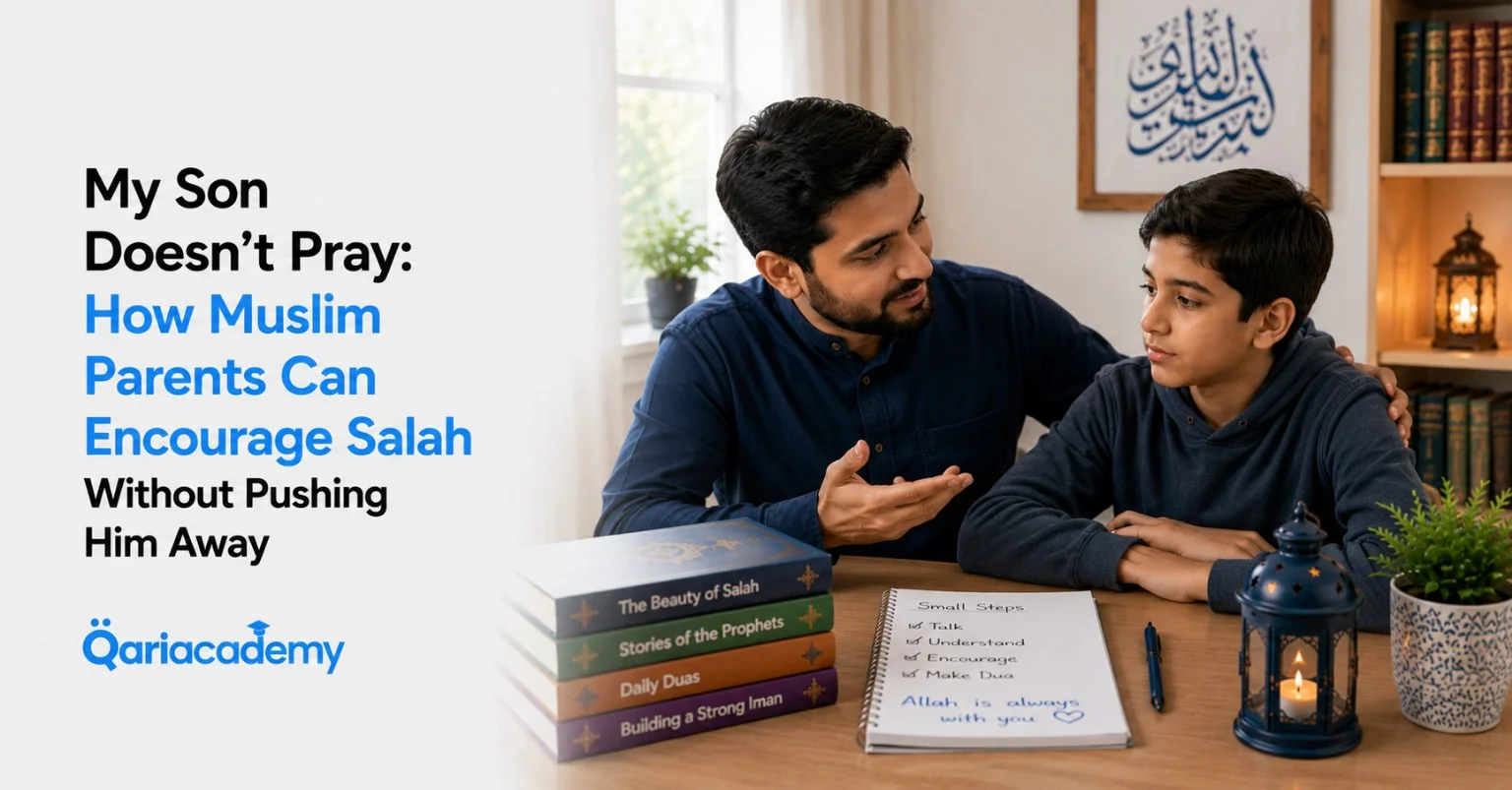
Sit with your son when you’re both calm.
Don’t start during an argument.
Say:
“I know I’ve reminded you about Salah a lot. I don’t want every conversation between us to become an argument.”
Then:
“I want to understand what makes prayer difficult for you.”
Listen.
Don’t interrupt.
Then say:
“I love you, and that’s why this matters to me. I don’t want to control you forever. I want to help you build a relationship with Allah that will stay with you when I’m not around.”
That conversation may accomplish more than another ten reminders.
36. A Practical Family Salah Plan
| Problem | Possible Solution |
|---|---|
| He forgets | Prayer reminders + routine |
| He sleeps through Fajr | Earlier bedtime + alarm + parental support |
| Football interferes | Check prayer times and plan ahead |
| Gaming interferes | Pause devices at prayer time |
| He doesn’t understand Salah | Teach meanings and purpose |
| He feels embarrassed | Build confidence and explain his rights |
| He has religious questions | Discuss them and seek qualified guidance |
| He lacks consistency | Build gradually and track progress |
37. The Role of QariAcademy
Quran education should not be used as punishment.
It should help your son build knowledge, confidence, and a relationship with the Quran.
QariAcademy offers live one-on-one Quran classes for children and teenagers, including:
- Quran Reading
- Tajweed
- Hifz
- Quranic Arabic
- Islamic Studies
Explore QariAcademy’s Quran Programs
A consistent teacher can provide something parents sometimes struggle to provide: a structured learning relationship outside the parent-child dynamic.
Your son may respond differently to a teacher explaining the importance of Salah than he responds to hearing the same message from Mom or Dad.
That doesn’t replace parental guidance.
It complements it.
38. Don’t Expect the Teacher to “Fix” Him
This is another important point.
Don’t send your son to Quran class thinking:
“The teacher will make him religious.”
That’s too much responsibility to place on a teacher.
Islamic development happens through:
Home + parents + education + community + personal choices.
QariAcademy can support the education component, but the family environment remains extremely important.
39. The Long-Term Goal
Your son won’t live with you forever.
Eventually, he may:
- Go to university
- Get a job
- Travel
- Live alone
- Make his own schedule
- Have complete control over his phone
You won’t be able to say:
“Go pray.”
five times a day.
That’s why the ultimate goal is not surveillance.
It’s internal responsibility.
You want him to reach a point where he looks at the clock and thinks:
“It’s time for Salah.”
Not because his mother is asking.
Not because his father is watching.
But because he knows that Salah is part of who he is.
Conclusion
If your son doesn’t pray, don’t assume that shouting louder will automatically solve the problem.
Take the problem seriously, but approach your son with wisdom.
Find out why he’s struggling.
Explain the importance of Salah.
Teach him the meaning of what he recites.
Build a practical routine.
Plan around football and other activities.
Control unnecessary screen distractions.
Pray together.
Let him see you pray.
Build positive Muslim friendships.
Give him access to reliable Islamic education.
And most importantly, keep the relationship between you and your son strong.
Remember that the goal is not simply:
“My son prayed because I told him to.”
The goal is:
“My son understands why he prays and chooses to maintain his relationship with Allah.”
That’s a much more powerful outcome.
Salah is not supposed to be merely another item on a child’s schedule.
It is one of the foundations of Muslim life.
And your job as a parent isn’t simply to force your child through the motions.
Your job is to guide him toward understanding, discipline, faith, and responsibility.
That takes time.
It takes patience.
It takes good example.
And sometimes it requires outside support.
QariAcademy can help strengthen your son’s Quranic and Islamic education through live one-on-one online lessons tailored to his level and schedule. QariAcademy — Online Quran Programs
A consistent Quran routine can help your son build the knowledge and connection that support a stronger Islamic identity.
If you’re looking for a structured Quran program for your child, you can explore QariAcademy and start with a free trial:
Book a Free Trial at QariAcademy
And remember:
Don’t make your son afraid of failing at Islam.
Teach him how to return to Allah when he struggles.
Don’t make every missed prayer a battle.
Make Salah a part of family life.
Don’t only tell him that prayer is an obligation.
Help him understand why it matters.
And don’t focus only on the child you see today.
Think about the Muslim man you are helping him become.
Because one day, you won’t be there to remind him.
And when that day comes, the most valuable thing you can give him isn’t the memory of how many times you told him:
“Go pray.”
It’s the understanding that Salah is part of who he is.
Primary Keyword: son doesn’t pray