Table of Contents
Introduction
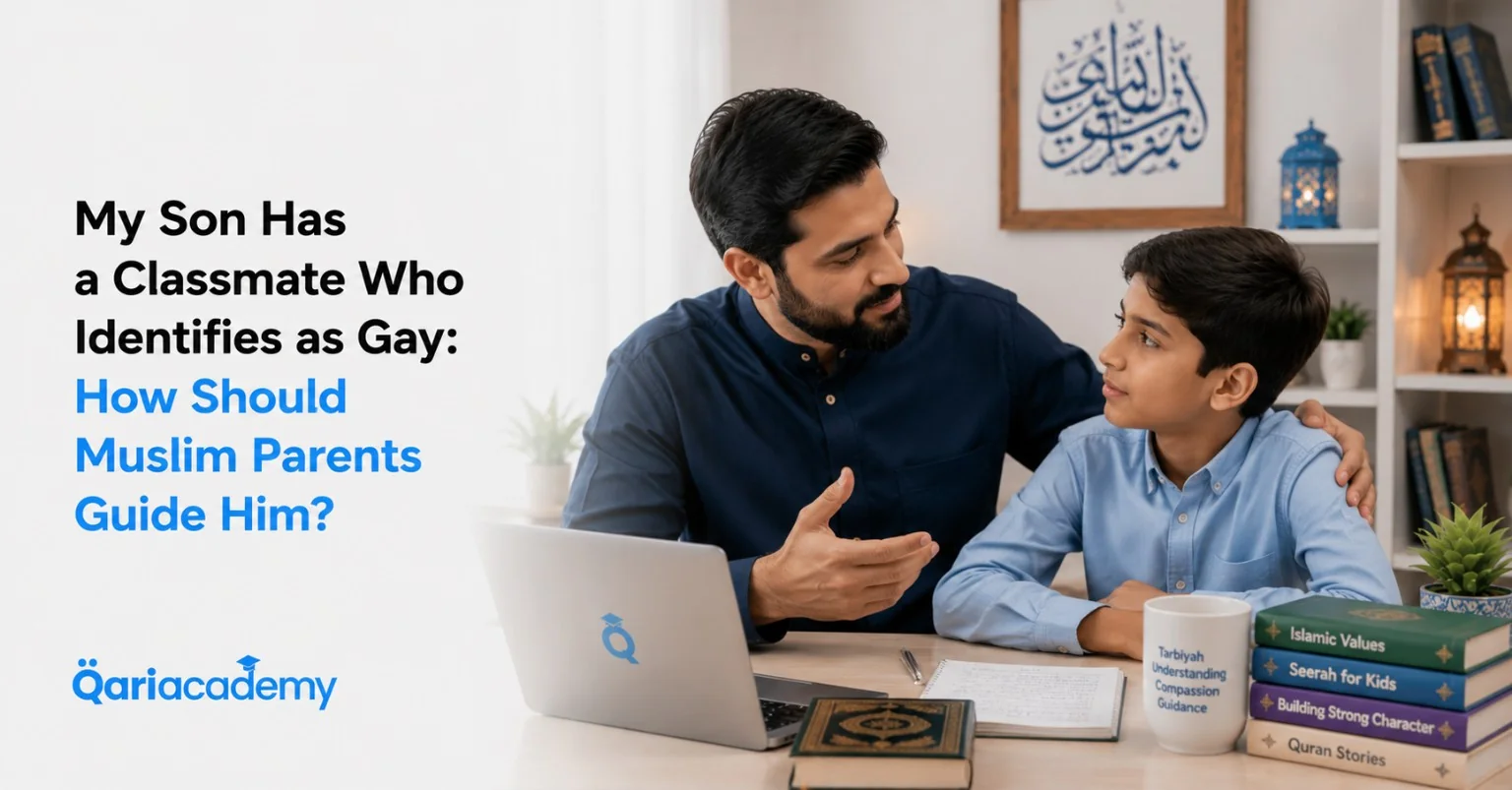
One day, your son may come home from school and say:
“Dad, one of my classmates says he’s gay.”
Or:
“Mom, my friend says he likes boys. What does that mean?”
For many Muslim parents, this can immediately create anxiety.
You may wonder:
Should I tell my child to stay away from him?
Can my son be friends with him?
Will this influence my child?
How do I explain the Islamic perspective without teaching my child to hate or insult another person?
These are difficult questions, especially when Muslim children are growing up in schools where they regularly interact with people who have different beliefs, values, family structures, and lifestyles.
The answer requires balance.
If your Muslim child has a gay classmate, you don’t need to teach him to hate that child.
At the same time, you don’t need to teach him that every belief or behavior is automatically consistent with Islam.
Your child can learn something extremely important:
We can respect people without agreeing with everything they believe or do.
That principle will help him throughout his life.
Your Child Needs a Clear Message
The first thing your child needs to understand is simple:
Every person deserves to be treated with dignity and respect.
Islam does not give children permission to mock, insult, humiliate, or bully someone because they are different.
The Quran says:
“Let not a people ridicule another people.”
Quran — Surah Al-Hujurat 49:11
This principle is especially important when children encounter classmates who are different from them.
Your son doesn’t have to agree with another child’s beliefs.
But he should still speak respectfully.
1. Don’t Panic When Your Child Tells You
Your first reaction matters.
If your son says:
“My friend says he’s gay.”
and you immediately respond:
“Stay away from him! He’s dangerous!”
your son may learn that this is a subject he can never discuss with you.
Next time, he may simply stop telling you.
Instead, stay calm.
Ask:
“What happened?”
“What did he tell you?”
“How do you feel about it?”
You’re gathering information before making assumptions.
2. Ask What Your Child Means by “Gay”
Children sometimes repeat words they hear without fully understanding them.
Your son may know that his classmate uses the word “gay,” but he may not understand what it means.
Give an age-appropriate explanation.
You don’t need to provide unnecessary details.
You can simply say:
“Sometimes people describe themselves as gay when they experience romantic or emotional attraction toward people of the same sex.”
Then explain:
“Islam has its own teachings about relationships and sexual behavior, and our family follows those teachings.”
Simple.
Calm.
Age-appropriate.
3. Teach Your Child the Difference Between a Person and a Belief
This is one of the most important lessons.
Tell your son:
“We don’t have to agree with everything someone believes to treat them respectfully.”
Your child will encounter people who disagree with Islam about many things.
Some may have different beliefs about:
- Religion
- Marriage
- Family
- Gender
- Politics
- Morality
- Lifestyle
If your child learns that disagreement automatically means hatred, he will struggle to interact with people throughout his life.
Teach him:
Respect the person. Evaluate the belief.
4. Explain the Islamic Perspective Clearly
Your child should not be confused about what your family believes.
Depending on his age, explain that Islam has specific teachings about marriage, sexuality, and relationships.
For example:
“In our family, we believe that marriage is between a man and a woman, and that romantic and sexual relationships should follow the boundaries Allah has given us.”
The goal isn’t to turn your child into a debater.
He simply needs to understand his own beliefs.
5. Don’t Teach Him That Being Different Makes Someone Evil
This is an important distinction.
Your child can believe:
“Islam does not permit this type of relationship.”
without believing:
“Anyone who identifies this way is a bad person.”
Those are not the same statement.
Your child should learn to separate moral disagreement from personal hatred.
6. Teach Him Not to Bully His Classmate
Make this absolutely clear.
No:
- Insults
- Jokes
- Name-calling
- Public humiliation
- Spreading rumors
- Sharing private information
- Encouraging other children to exclude him
- Online harassment
Tell your son:
“You don’t have to agree with him, but you must not bully him.”
This is an important Islamic lesson.
Good character doesn’t disappear simply because someone disagrees with us.
7. Can My Muslim Child Be Friends With Him?
This requires more nuance than simply saying “yes” or “no.”
There is a difference between:
Being polite and friendly at school
and
Developing an extremely close friendship that significantly influences your child’s values and behavior.
Your child may sit next to him.
Work on a school project with him.
Play football with him.
Talk during class.
None of those interactions automatically mean your child has adopted the other child’s beliefs.
At the same time, parents should pay attention to the nature of the friendship and the influence it has on their child.
8. Look at the Friendship, Not Just the Label
Don’t focus only on:
“He’s gay.”
Ask:
What kind of friend is he?
Does he:
- Respect your son’s boundaries?
- Encourage good behavior?
- Bully others?
- Pressure your son?
- Introduce inappropriate content?
- Encourage secrecy?
- Respect your family’s values?
- Make your son uncomfortable?
These questions are more useful than simply focusing on a label.
A child’s behavior and influence matter.
9. Teach Your Son About Boundaries
Your son needs boundaries with everyone.
That includes classmates who are Muslim.
And classmates who aren’t Muslim.
And boys.
And girls.
Teach:
“You don’t have to participate in conversations that make you uncomfortable.”
He can say:
“I don’t want to talk about that.”
or:
“I’m not comfortable with this.”
or:
“Let’s talk about something else.”
Then he can walk away.
10. Pay Attention to Age-Appropriate Content
This is where parents should be especially involved.
If your son is young, he may encounter discussions or content about sexuality before he is emotionally prepared to understand them.
Parents should know what their children are exposed to through:
- School
- YouTube
- Social media
- Streaming platforms
- Games
- Group chats
The American Academy of Pediatrics recommends that families create thoughtful media habits and boundaries appropriate to children’s ages and development.
American Academy of Pediatrics — Media and Children
The solution isn’t necessarily to ban every conversation.
It’s to make sure your child has a trusted adult who can explain difficult subjects correctly.
11. Don’t Let the Internet Become the Teacher
This is a major blind spot for parents.
If you refuse to discuss sensitive topics, your child may simply search for answers online.
And the internet won’t necessarily explain them according to your family’s values.
Your child may encounter:
- Sexual content
- Explicit videos
- Ideological arguments
- Mockery of religion
- Aggressive anti-religious content
- Misleading information
So create an environment where your child can say:
“I saw something online and I don’t understand it.”
without being immediately punished.
12. Give Your Child a Simple Response
Your child doesn’t need a sophisticated argument.
If his classmate says:
“I’m gay.”
your child can simply say:
“Okay.”
He doesn’t have to debate.
If the classmate asks:
“Do you agree with me?”
your son can say:
“My family and religion have different beliefs about relationships.”
Then move on.
That’s enough.
13. What If the Classmate Asks About Islam?
Your son can answer respectfully.
For example:
“I’m Muslim, and Islam teaches us that marriage is between a man and a woman.”
If he doesn’t know how to answer a more complicated question:
“I’m not sure. I’ll ask my parents.”
Teaching children to say “I don’t know” is much better than teaching them to invent answers.
14. What If the Classmate Makes Fun of Islam?
Now the situation changes.
Your child should not be expected to tolerate religious bullying.
Teach him:
“You can disagree with me, but don’t insult my religion.”
Then he can walk away or report repeated harassment.
The same standard applies both ways.
Your son should respect others.
Others should respect him.
15. Don’t Tell Your Child That Every LGBTQ Person Is Dangerous
This is an important parenting distinction.
Your child needs to understand Islamic boundaries.
But telling him:
“These people are dangerous.”
as a blanket statement can create unnecessary fear and prejudice.
Instead, teach:
“We evaluate people’s behavior individually. We don’t know someone’s character simply because of a label.”
That is a more mature way to think.
16. Teach Your Son That Islamic Identity Doesn’t Require Isolation
Your child is going to live in a diverse society.
He will meet people who:
- Are not Muslim
- Practice other religions
- Have different political beliefs
- Have different family structures
- Have different lifestyles
You cannot realistically remove every difference from his environment.
Instead, prepare him to navigate differences while maintaining his own values.
That’s a much stronger form of Islamic parenting.
17. Strengthen His Understanding of Islam
Children who don’t understand their own beliefs can easily become confused when confronted with different ideas.
This doesn’t mean you should hide those ideas from them.
It means they need a foundation.
Teach them:
- Quran
- Tawheed
- Prophetic character
- Islamic manners
- Family values
- Marriage in Islam
- Modesty
- Appropriate boundaries
- Respect for others
The Quran repeatedly emphasizes good character and justice.
Your child should understand that Islamic identity includes both belief and behavior.
18. Quran Education Can Help
A structured Quran-learning environment can give your child a stronger foundation.
QariAcademy offers live one-on-one online Quran classes for children and teenagers, including Quran reading, Tajweed, Hifz, Quranic Arabic, and Islamic studies.
QariAcademy — Online Quran Programs
The advantage of one-on-one learning is that children can receive instruction at their own level.
They can also ask questions without feeling that they’re being judged by an entire classroom.
For parents trying to build a strong Islamic foundation at home, consistent Quran learning can become one part of that broader effort.
19. Don’t Expect Quran Classes to Solve Everything
This is another important point.
Don’t think:
“If I enroll my son in Quran classes, he won’t be influenced by anyone else.”
That’s unrealistic.
Children live in the real world.
They attend school.
They use technology.
They have friends.
They hear different opinions.
Quran education should give them knowledge and grounding, but parents still need to talk with them about what they encounter.
20. Teach Your Son How to Think, Not Just What to Think
This is one of the biggest opportunities in modern parenting.
Instead of only saying:
“That’s wrong.”
teach your child to ask:
- What does Islam teach?
- Why does Islam teach this?
- What does the Quran say?
- What does authentic Sunnah teach?
- Is this information reliable?
- Is someone trying to pressure me?
- Can I disagree respectfully?
These questions build intellectual maturity.
21. Don’t Turn Every Conversation Into a Religious Lecture
If your child says:
“My classmate is gay.”
you don’t need to immediately give a 45-minute lecture.
Sometimes:
“Okay. What happened?”
is the best first response.
Then you can address the specific issue.
Parenting isn’t about delivering speeches.
It’s about having conversations.
22. Watch for Emotional Influence
Parents should pay attention if a friendship becomes unusually intense.
For example:
- Constant messaging
- Secret conversations
- Pressure to hide the friendship
- Sharing sexual content
- Pressure to change beliefs
- Emotional dependence
- Inappropriate conversations
These are warning signs regardless of the other child’s identity.
The issue is the behavior.
23. Teach Your Child That “No” Is Allowed
Your son should know:
“You don’t have to participate in something because your friend wants you to.”
He can say:
“No.”
“I’m not comfortable with that.”
“My parents don’t allow it.”
“That’s not something I want to do.”
These skills will protect him in many situations throughout his life.
24. Don’t Make Your Child Afraid of Asking Questions
Your son may eventually ask:
“What if I have questions about sexuality?”
Don’t panic.
Don’t shame him.
Say:
“You can always ask us questions. We’ll give you answers that are appropriate for your age and consistent with our beliefs.”
That keeps communication open.
25. Be Careful About Shame
Shame can make children secretive.
If your child believes:
“My parents will freak out if I tell them what I saw.”
he may hide things.
A better message is:
“You can always tell us when something confuses you.”
You can correct behavior without making your child afraid of you.
26. What If Your Child Says, “I Think He’s a Nice Person”?
You can agree.
Say:
“He may be a nice person. We can treat him kindly.”
Then add:
“Being kind to someone doesn’t mean we have to agree with everything they believe.”
That’s a very important distinction.
27. What If Your Child Says, “But Everyone at School Thinks It’s Normal”?
Don’t respond:
“Everyone is wrong.”
Instead ask:
“What does our religion teach?”
Then explain.
Your child’s values should not depend entirely on what happens to be popular at school.
At the same time, don’t teach him to look down on classmates.
28. Teach Him Respect Without Compromise
Your son can say:
“I respect you as a person.”
while also saying:
“I don’t share that belief.”
That is mature disagreement.
It will help him not only at school but later in university, work, and wider society.
29. What If the School Teaches About LGBTQ Topics?
This requires parents to understand what exactly is being taught.
Don’t rely on your child’s interpretation alone.
Ask the school:
- What is the educational objective?
- What material will be presented?
- What age group is involved?
- Is the content part of health education?
- How can parents understand the curriculum?
Then decide how to discuss it at home according to your family’s values and the applicable school policies.
30. Don’t Teach Your Child to Mock Other Families
Your child may encounter classmates with family structures different from his own.
Teach:
“You don’t make fun of someone’s family.”
Your child can understand:
“Our family follows Islamic teachings about marriage and family.”
without saying:
“Your family is disgusting.”
Respectful disagreement is a skill.
31. The Parent’s Biggest Blind Spot
Many parents think the only danger is:
“My child will become influenced.”
But there’s another danger:
Your child may learn prejudice instead of Islamic character.
If you teach him that everyone who is different should be hated, you haven’t strengthened his Islam.
You’ve weakened his ability to practice Islamic manners in a diverse world.
The goal isn’t to remove every difference from his life.
It’s to teach him how to remain grounded while living among people who are different.
32. A Simple Family Framework
Teach your child these five rules:
1. Respect people
Never bully or humiliate someone because they are different.
2. Know your beliefs
Understand what Islam teaches.
3. Keep boundaries
Don’t participate in conversations or activities that violate your values.
4. Ask questions
Come to your parents when you’re confused.
5. Walk away from pressure
A friend should never force you to do something you don’t want to do.
These principles are simple enough for children to remember.
33. What Should You Say to Your Child?
You could say:
“You’re going to meet people who believe different things from us. That’s part of living in the world.”
“Our job as Muslims is to know what we believe and behave with good character.”
“You don’t have to agree with everything someone believes.”
“But you also don’t get permission to insult or bully them.”
“If anyone pressures you to do something that makes you uncomfortable, come to us.”
“And if you have a question about something you see at school or online, you can always ask us.”
That’s a much stronger message than:
“Stay away from everyone who is different.”
34. Build a Stronger Islamic Foundation at Home
The best protection isn’t fear.
It’s knowledge.
Talk about Islam regularly.
Read Quran together.
Discuss the Prophet’s character.
Talk about friendship.
Discuss modesty and boundaries.
Explain marriage.
Answer difficult questions.
Let your child see that Islam can handle honest questions.
QariAcademy can complement this home environment with structured one-on-one Quran learning and Islamic studies. QariAcademy — Online Quran Programs
The objective isn’t to isolate your child from the world.
It’s to prepare him to navigate the world without losing his values.
35. The Long-Term Goal
Your son will eventually become an adult.
He will meet people with completely different beliefs.
He will work with them.
Study with them.
Travel with them.
Live around them.
He cannot spend his entire life avoiding everyone who disagrees with Islam.
So teach him something more powerful:
Know who you are.
Know what you believe.
Treat people fairly.
Keep your boundaries.
Think critically.
Ask for help when you need it.
That’s mature Muslim character.
Conclusion
If your Muslim child has a gay classmate, your first responsibility isn’t to panic.
It’s to teach.
Teach your child what Islam says about relationships and sexuality in an age-appropriate way.
Teach him that every person deserves dignity.
Teach him not to bully or humiliate classmates.
Teach him that respecting someone doesn’t require agreeing with every belief they have.
Teach him healthy boundaries.
Teach him to recognize inappropriate pressure.
Teach him to ask questions.
And most importantly, make sure your child knows that home is the safest place to discuss difficult subjects.
Your son will encounter many ideas during his childhood.
Some will agree with Islam.
Some won’t.
Your goal isn’t to make sure he never hears anything different.
Your goal is to help him develop enough knowledge, confidence, and character to respond wisely.
That’s why Islamic education matters.
QariAcademy can support your family’s efforts by providing live one-on-one Quran learning in Quran reading, Tajweed, Hifz, Quranic Arabic, and Islamic studies. QariAcademy — Online Quran Programs
A consistent relationship with the Quran can help your child build a stronger foundation while you continue having honest conversations with him at home.
Remember:
Respect does not mean agreement.
Kindness does not mean abandoning your values.
Boundaries do not require hatred.
And Islamic confidence does not require your child to insult people who live differently.
If you want to strengthen your child’s Quran and Islamic education alongside your parenting, you can explore QariAcademy’s programs and start with a free trial:
Book a Free Trial at QariAcademy
The ultimate goal isn’t to raise a child who is afraid of people who are different.
It’s to raise a young Muslim who can walk into a diverse world and say:
“I know what I believe. I know how to treat people. I know my boundaries. And I know that when I have difficult questions, I can come home and ask.”
Primary Keyword: Muslim child has a gay classmate