Table of Contents
Introduction
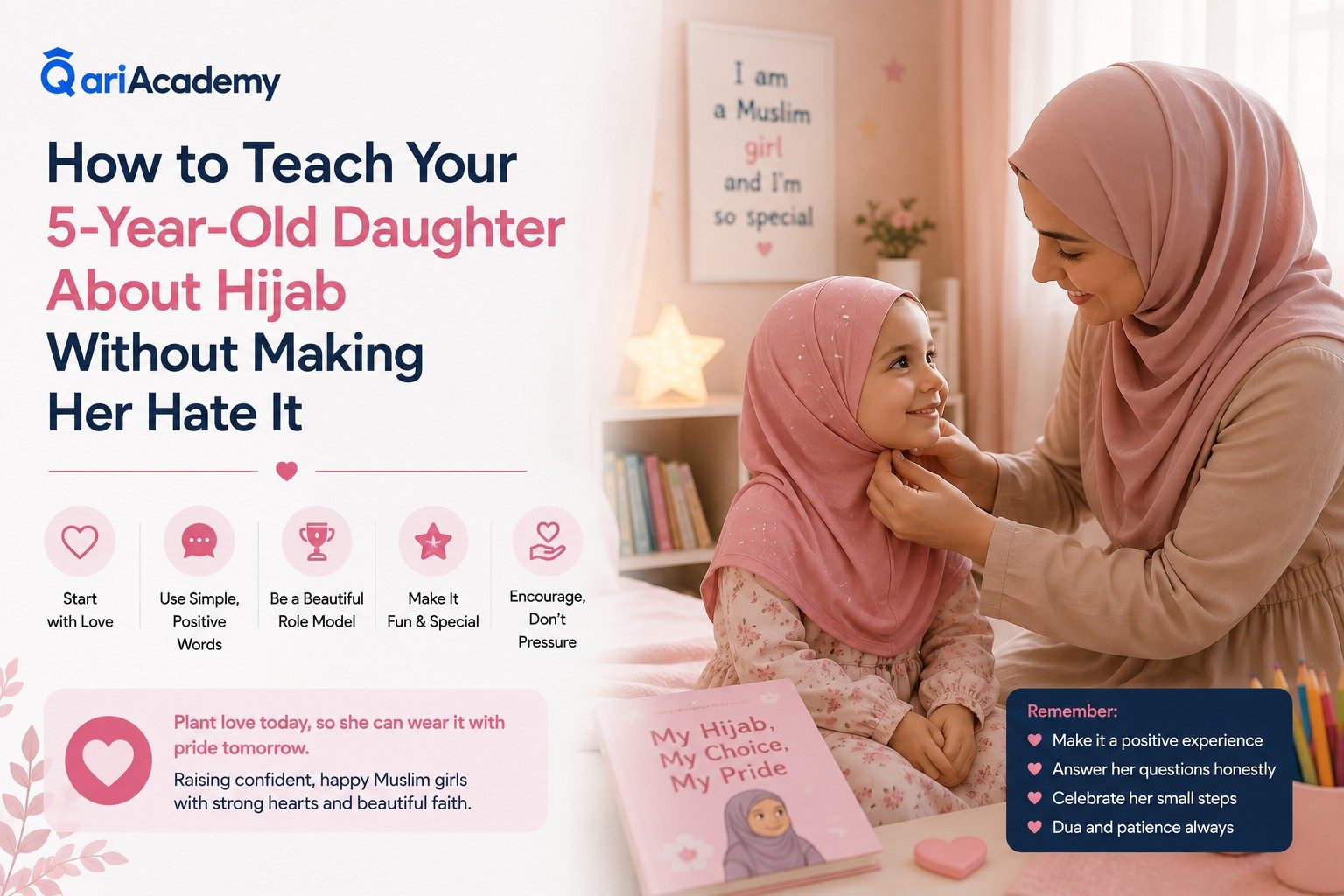
Learning how to teach your 5-year-old daughter about hijab is not really about teaching her how to wear a piece of clothing.
It is about introducing her to an Islamic value in a way that she can understand, appreciate, and eventually embrace as she grows older.
At five years old, your daughter is still developing her understanding of religion, identity, modesty, and personal responsibility. She may happily put on a beautiful hijab one day and then throw it on the floor the next.
She may ask:
“Why do I have to wear it?”
Or:
“Why doesn’t my friend wear one?”
Or even:
“I don’t want to wear it!”
How you respond to those moments matters.
If hijab becomes associated with constant arguments, shame, comparison, or punishment, your daughter may eventually associate the hijab itself with those negative emotions.
But if hijab is introduced through love, positive modeling, encouragement, beautiful experiences, and age-appropriate conversations, it can become something she associates with her Muslim identity.
The goal of learning how to teach your 5-year-old daughter about hijab is therefore not to force a five-year-old to carry the responsibility of an adult.
The goal is to plant the right seeds early.
Should a 5-Year-Old Be Required to Wear Hijab?
This is where parents sometimes become confused.
Islamic obligations are connected to maturity and puberty, and a five-year-old child is not in the same legal position as an adult Muslim woman.
That distinction matters.
A young girl can be introduced to hijab and modesty without treating her as though she has reached the stage of religious obligation.
Think about how children learn Salah.
A parent doesn’t expect a five-year-old to have the same understanding and responsibility as an adult.
Instead, the child is gradually introduced to prayer, encouraged to participate, and allowed to develop familiarity with worship.
Hijab can be approached with a similar educational mindset.
The early years are about:
Love → familiarity → understanding → positive habits → gradual responsibility.
1. Start With Your Own Example
Your daughter is watching you.
Long before she understands the rules of hijab, she understands what her mother does.
If she sees you wearing hijab naturally, confidently, and comfortably, she learns something powerful:
“This is part of being a Muslim woman.”
She may imitate you by:
- Putting on your hijab
- Standing in front of the mirror
- Choosing colors
- Wearing a small scarf
- Pretending to get ready like Mom
Don’t dismiss these moments as meaningless.
They’re opportunities.
Instead of saying:
“You’re too young to understand.”
say:
“You look beautiful, MashaAllah.”
Then explain simply:
“Mommy wears hijab because I’m Muslim, and it’s one of the ways I practice my faith.”
Your daughter doesn’t need a complicated theological explanation.
She needs a positive emotional association.
2. Make Hijab Feel Normal—Not Like a Punishment
Imagine two families.
Family A
“Put your hijab on!”
“Why are you always taking it off?”
“You’re embarrassing me.”
“Look at that girl. She wears hers properly.”
Family B
“Would you like the pink one or the blue one today?”
“Let’s fix it together.”
“MashaAllah, you look lovely.”
Both families may want the same outcome.
But the emotional experience is completely different.
Children remember emotions.
If hijab is always connected to criticism, the child may eventually think:
Hijab = pressure.
You want her to gradually think:
Hijab = Muslim identity + modesty + love + belonging.
3. Let Her Choose Some Things
A five-year-old wants autonomy.
That’s normal.
Give her choices within the boundary you’ve established.
For example:
“Would you like the pink hijab or the purple one?”
“Do you want this style or that style?”
“Should we wear matching colors today?”
You aren’t asking:
“Do you believe in hijab?”
You’re giving her a sense of participation.
This distinction is important.
Parents provide the values. Children can have choices within those values.
4. Don’t Turn Hijab Into a Beauty Competition
Be careful with compliments.
There’s nothing wrong with telling your daughter she looks beautiful.
But don’t make her believe:
“I’m valuable because my hijab makes me pretty.”
Hijab is connected to modesty and worship, not simply appearance.
Instead of constantly saying:
“You look prettier with your hijab.”
also say:
“I love how you’re learning about your deen.”
“MashaAllah, you remembered your hijab.”
“You’re learning how to be responsible.”
This helps connect hijab with character rather than appearance.
5. Explain Hijab in Language a Five-Year-Old Understands
Avoid giving a five-year-old a long lecture.
Keep it simple.
You might say:
“Hijab is something Muslim women wear because Allah loves modesty.”
Or:
“When Muslim girls grow up, hijab becomes part of how they dress modestly.”
Or:
“It’s one of the ways Muslim women show their faith.”
Then stop.
Let her ask questions.
If she asks another question, answer that one.
Children don’t need a 30-minute lesson.
They need hundreds of small conversations over time.
6. Don’t Use Fear as Your Main Teaching Method
This is one of the biggest mistakes parents can make.
Avoid making a five-year-old terrified of Allah because she doesn’t want to wear a hijab.
Statements such as:
“Allah will punish you.”
“You’re a bad Muslim girl.”
“Allah won’t love you if you don’t wear it.”
can create fear and shame rather than genuine faith.
At this age, emphasize:
- Love of Allah
- Gratitude
- Modesty
- Good manners
- Kindness
- Worship
- Muslim identity
The child should learn that Islam is a relationship with Allah—not simply a list of things she is afraid to get wrong.
7. Introduce Modesty Before Making Hijab the Entire Conversation
Hijab shouldn’t be an isolated subject.
Teach modesty through everyday life.
For example:
Our bodies deserve respect.
We choose appropriate clothes.
We don’t show private parts of our bodies to others.
We respect other people’s boundaries.
We knock before entering someone’s room.
These lessons help children understand the broader concept of modesty.
Then hijab becomes part of a larger Islamic value rather than a random clothing rule.
8. Use Stories
Five-year-olds learn through stories.
Instead of lecturing, tell her stories about:
- Muslim women
- Sahabiyyat
- Mothers
- Teachers
- Muslim girls growing up
- Women who are confident in their faith
The objective isn’t to make every story about hijab.
Show her that Muslim women can be:
- Intelligent
- Kind
- Brave
- Educated
- Helpful
- Confident
- Modest
- Strong in faith
This creates a broader identity.
Her message becomes:
“I am a Muslim girl, and hijab is one part of who I am.”
Not:
“I am the girl who has to wear this thing.”
9. Make Hijab Part of Special Moments
You can introduce hijab gradually through meaningful occasions.
For example:
- Eid
- Going to the mosque
- Visiting family
- Quran class
- Islamic events
- Ramadan activities
These occasions can create positive memories.
Imagine your daughter remembering:
“I wore my little hijab when we went to the mosque with Mommy.”
That memory can be far more powerful than:
“Mom forced me to wear it because she was angry.”
10. Don’t Compare Her With Other Girls
Avoid statements like:
“Look at your cousin. She always wears her hijab.”
Or:
“Your friend is more modest than you.”
Comparison often creates resentment.
Your daughter isn’t competing with another five-year-old.
She is developing.
Her relationship with Islam is personal.
Focus on her progress.
Say:
“You’re learning.”
“You’re getting better.”
“I’m proud of how you’re trying.”
That encourages growth without humiliation.
11. What If She Refuses?
This will happen.
Don’t assume that refusal means she hates Islam.
A five-year-old may refuse something simply because:
- She doesn’t like how it feels.
- She’s hot.
- She wants independence.
- She wants to copy her friends.
- She is tired.
- She wants control.
Ask:
“What don’t you like about it?”
Maybe the solution is practical.
Perhaps the fabric is uncomfortable.
Maybe the style keeps slipping.
Maybe she doesn’t like the color.
Maybe she feels different from her friends.
Listen before turning it into a religious battle.
12. Separate Discomfort From Defiance
This distinction is important.
If your daughter says:
“It keeps hurting my neck.”
that’s different from:
“I don’t want anything to do with Islam.”
Don’t treat every complaint as a spiritual crisis.
Sometimes children simply need:
- A lighter fabric
- A different size
- A different style
- Better adjustment
- A break
- More choice
Good parenting requires understanding the actual problem.
13. Talk About Why Some Girls Don’t Wear Hijab
Eventually your daughter may ask:
“Why doesn’t my friend wear one?”
This is a perfect opportunity to teach without judging others.
You can say:
“Different families make different choices. We are Muslim, and we follow what we believe Allah has taught us.”
You don’t need to criticize her friend’s family.
Teach your daughter to respect others while remaining confident in her own beliefs.
That’s an important skill, particularly for Muslim children growing up in multicultural environments.
14. Teach Her That Hijab Is Not Her Entire Identity
This is a subtle but important point.
Your daughter is more than her clothes.
She is:
- A daughter
- A student
- A friend
- A Muslim
- A learner
- A future woman
- A person with talents and dreams
Hijab should be part of her identity—not the only thing you discuss with her.
Ask her about:
- What she learned at school
- Her favorite book
- Her hobbies
- Her friends
- Her Quran
- Her dreams
Build the whole child.
15. Connect Hijab With Quran Learning
This is where a broader Islamic routine can help.
A child is more likely to understand Islamic practices when they’re part of a living environment rather than isolated rules.
For example:
Quran → Salah → Islamic stories → Good manners → Modesty → Family values
Instead of:
“Wear this because I said so.”
A regular Quran routine can help children gradually develop a relationship with Islamic teachings.
QariAcademy provides live one-on-one Quran classes for children, including Quran reading, Tajweed, Hifz, Quranic Arabic, and Islamic studies. Explore QariAcademy
The goal isn’t to use Quran lessons as a way to force hijab.
Rather, Quran education gives children a broader foundation for understanding their faith.
When children learn about Allah, worship, manners, modesty, and Islamic values consistently, individual practices become easier to understand within the bigger picture.
16. Build a Positive Islamic Environment
Ask yourself:
What does Islam feel like inside our home?
Is it mostly:
“Don’t do that.”
“That’s haram.”
“You can’t.”
“Allah will punish you.”
Or is it also:
“Let’s read Quran together.”
“Let’s make dua.”
“Look at this beautiful story.”
“Let’s go to the mosque.”
“MashaAllah, you helped your sister.”
“Allah has given us so many blessings.”
Children need both boundaries and warmth.
17. A Simple Hijab Routine for a Five-Year-Old
You don’t need to make everything complicated.
Try:
Before leaving home
“Let’s get ready.”
Let her choose
“Which one today?”
Help her wear it
Make the process calm.
Give positive reinforcement
“MashaAllah.”
Don’t obsess over perfection
At five, she’s learning.
The objective is familiarity, not flawless adult-level practice.
18. What Parents Should Avoid
Don’t shame her
Never make her feel dirty or sinful because she’s struggling with a practice she is still learning.
Don’t compare her
Another child isn’t the standard.
Don’t threaten constantly
Fear isn’t a sustainable foundation for faith.
Don’t argue every morning
If getting dressed becomes a daily battlefield, step back and reconsider the approach.
Don’t make hijab her entire identity
Teach the whole child.
Don’t use marriage or male attention as the main reason
A five-year-old doesn’t need to be taught that her value is primarily related to how men perceive her.
Teach dignity and modesty in an age-appropriate way.
19. What Parents Should Say Instead
Instead of:
“You have to wear it because I said so.”
Try:
“We’re learning about hijab together.”
Instead of:
“Look how your cousin wears hers.”
Try:
“Let’s find a style that you feel comfortable wearing.”
Instead of:
“Allah will punish you.”
Try:
“Hijab is one of the ways Muslim women practice modesty and obedience to Allah.”
Instead of:
“Stop complaining.”
Try:
“Tell me what you don’t like about it.”
Small changes in language can completely change the emotional experience.
20. The Long-Term Goal
The goal isn’t to make your five-year-old look like a grown Muslim woman.
The goal is to help her grow into a young Muslim woman who understands why she makes her choices.
Today she may wear a hijab because Mommy helps her.
Tomorrow she may wear it because she understands it.
Eventually, the hope is that she chooses to practice her faith because of a relationship with Allah and an understanding of her Islamic identity.
That transition takes years.
Give her those years.
A Simple Parent’s Roadmap
| Stage | Main Goal | Parent’s Role |
|---|---|---|
| Age 5 | Familiarity | Model and encourage |
| Early childhood | Understanding | Answer questions |
| Pre-puberty | Preparation | Teach modesty and responsibility |
| Puberty | Religious responsibility | Provide knowledge and support |
| Teenage years | Ownership | Encourage independent commitment |
This isn’t a rigid religious timetable.
Children mature differently.
The point is that Islamic education should develop gradually.
Conclusion
Learning how to teach your 5-year-old daughter about hijab is not about winning a daily argument.
It is about planting seeds.
Let her see you practice your faith.
Answer her questions honestly.
Give her age-appropriate choices.
Make hijab comfortable and positive.
Teach modesty as a broader value.
Don’t compare her with other girls.
Don’t use shame as your primary tool.
And don’t forget that she is still a five-year-old child.
Most importantly, build her relationship with Islam as a whole.
Let her experience Quran, Salah, stories, family, kindness, Ramadan, Eid, the mosque, and Islamic learning as positive parts of her childhood.
QariAcademy can support that broader foundation through structured one-on-one Quran education for children, including Quran reading, Tajweed, Hifz, Quranic Arabic, and Islamic studies. Learn More About QariAcademy
When a child grows up seeing Islam as something beautiful, meaningful, and connected to love and purpose, individual practices are no longer just rules imposed from outside.
They become part of an identity she is gradually learning to understand.
And that’s ultimately what you want when you teach your 5-year-old daughter about hijab:
Not a child who is afraid of taking it off, but a young Muslim woman who understands why she chooses to wear it.
If you’d like to build a consistent Quran-learning routine alongside your daughter’s Islamic upbringing, you can explore QariAcademy’s programs and start with a free trial:
Book a Free Trial at QariAcademy