Table of Contents
Introduction
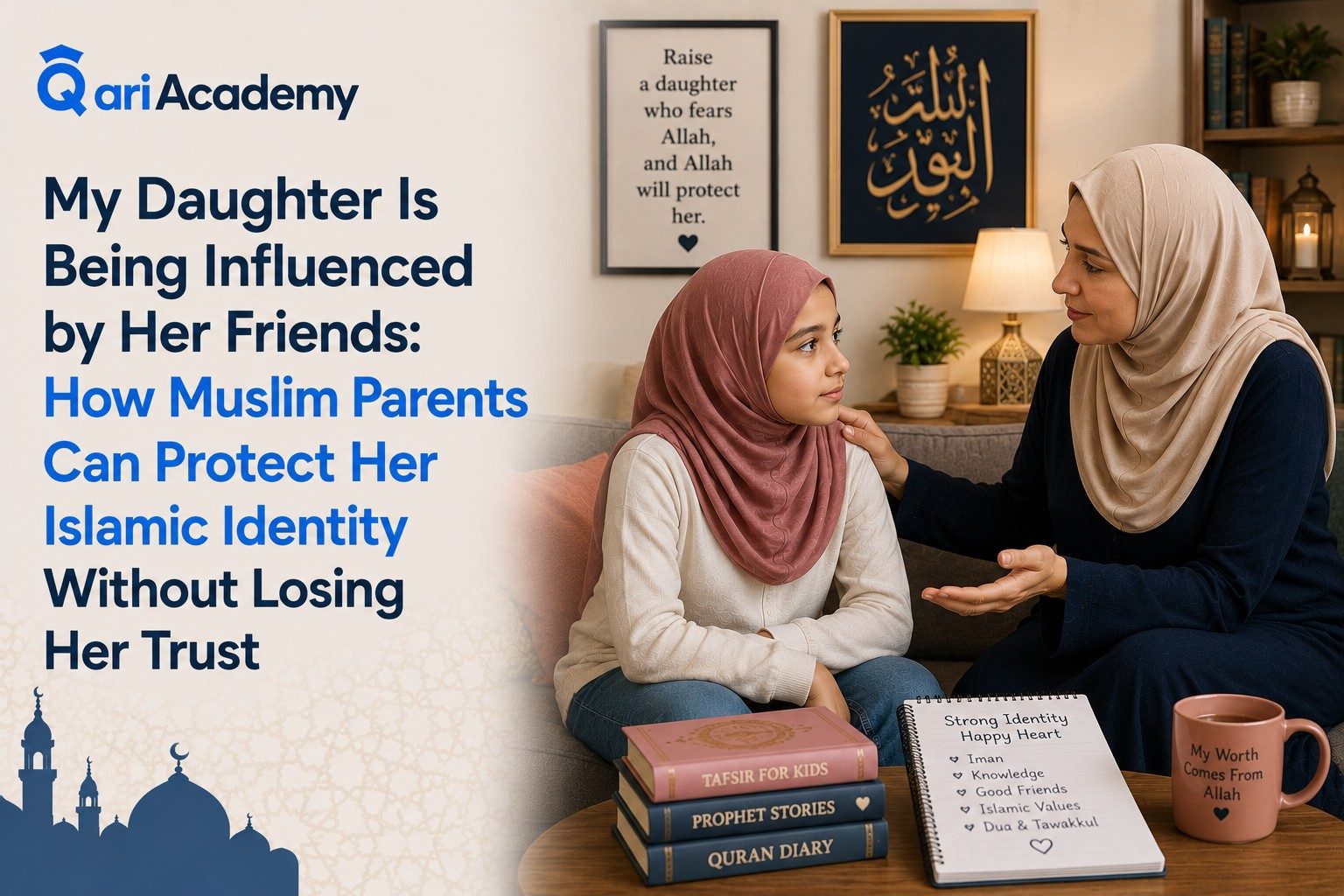
One of the most frightening moments for a Muslim parent is realizing that your daughter is beginning to change because of her friends.
Maybe she used to pray regularly.
Now she says:
“My friends don’t pray.”
Maybe she used to dress modestly.
Now she says:
“Nobody at school dresses like this.”
Maybe she used to enjoy Quran.
Now she says:
“Quran is boring.”
Maybe she has started using words you have never heard from her before.
Maybe she spends hours messaging a new group of friends.
Or perhaps she has started saying:
“Everyone thinks this is normal.”
“You’re too strict.”
“My friends’ parents allow it.”
“Why can’t I be like everyone else?”
At that point, many parents become frightened.
And fear often produces one immediate reaction:
“You’re not allowed to see those friends anymore.”
Sometimes parents genuinely need to intervene in a friendship.
But there is a bigger question that should come first:
Why is your daughter so strongly influenced by them?
And what can you do to strengthen her Islamic identity without destroying the relationship between you?
If your daughter is influenced by friends, the answer isn’t simply to control every friendship.
Your long-term goal should be to raise a young Muslim woman who can interact with different people, recognize unhealthy influence, maintain her Islamic values, and make wise decisions even when her parents aren’t present.
That requires more than rules.
It requires trust, communication, Islamic knowledge, boundaries, and a strong relationship between parent and child.
Why Friends Have Such a Strong Influence on Children
As children grow, their friends become increasingly important.
A child may begin to care deeply about:
- “What will my friends think?”
- “Will they accept me?”
- “Will they think I’m weird?”
- “Will they invite me next time?”
- “Will they laugh at me?”
This is especially powerful during adolescence.
Your daughter may know what you taught her at home.
But she may also desperately want to fit in at school.
That doesn’t automatically mean she has rejected your values.
Sometimes she is simply trying to figure out how to belong.
Your job is to help her understand:
You can belong without becoming someone else.
1. Don’t Panic at the First Sign of Change
Suppose your daughter suddenly starts dressing differently.
Don’t immediately assume:
“Her friends have ruined her.”
Ask:
- “What’s changed?”
- “Where did you get this idea?”
- “What do you like about it?”
- “How do your friends dress?”
You’re trying to understand the influence before deciding what to do.
Sometimes a change is temporary.
Sometimes it’s harmless.
Sometimes it is a genuine warning sign.
You need information before making a judgment.
2. Don’t Attack Her Friends Immediately
This is one of the fastest ways to make your daughter defensive.
If you say:
“I hate those girls.”
“Those friends are bad.”
“They’re destroying you.”
your daughter may respond:
“You don’t understand them.”
And now she may start defending them.
Even worse, she may stop telling you anything about them.
Instead, ask questions:
- “What do you like about your friend?”
- “What do you usually do together?”
- “How does she treat you?”
- “Does she respect your beliefs?”
- “Does she pressure you to do things?”
You’re learning about the friendship rather than declaring war on it.
3. Separate the Friend From the Influence
This is an important distinction.
Your daughter’s friend may be a perfectly kind person.
But some of the things they discuss or do may not be appropriate for your daughter.
You can say:
“Your friend may be a nice person. I’m concerned about some of the things you’re being encouraged to do.”
That’s much more precise than:
“Your friend is bad.”
4. Look for Patterns
One disagreement doesn’t mean a friendship is dangerous.
Look for patterns.
Is your daughter:
- Becoming increasingly secretive?
- Hiding conversations?
- Changing her behavior dramatically?
- Losing interest in family?
- Becoming hostile whenever you mention her friends?
- Spending excessive amounts of time messaging?
- Adopting inappropriate language?
- Losing interest in Salah?
- Rejecting previously held values?
- Hiding social media accounts?
- Becoming afraid to tell you things?
One sign doesn’t prove that something is wrong.
A pattern deserves attention.
5. Ask the Most Important Question
Instead of asking:
“Who are you hanging out with?”
ask:
“How do you feel when you’re around your friends?”
That’s a powerful question.
Does she feel:
- Accepted?
- Respected?
- Pressured?
- Anxious?
- Afraid of being excluded?
- Forced to pretend?
- Encouraged to do things she doesn’t want?
The emotional experience of the friendship matters.
6. Teach Your Daughter What a Healthy Friendship Looks Like
Don’t only tell her which friendships you don’t like.
Teach her how to recognize a good friend.
A healthy friend:
- Respects boundaries
- Doesn’t force secrets
- Doesn’t pressure her
- Doesn’t insult her religion
- Doesn’t demand constant attention
- Doesn’t manipulate her
- Doesn’t encourage dangerous behavior
- Allows her to say no
- Celebrates her success
- Doesn’t humiliate her
Once your daughter understands these qualities, she can evaluate friendships herself.
That is much more powerful than simply having her depend on you to approve or reject every person she meets.
7. Teach Her That Friendship Isn’t About Approval
Teenagers can become desperate for approval.
They may change:
- Clothing
- Language
- Interests
- Beliefs
- Behavior
simply because they want to belong.
Teach your daughter:
“You don’t have to become someone else to be accepted.”
That’s a message she needs to hear repeatedly.
Her worth isn’t determined by whether a group of teenagers approves of her.
8. Build Her Confidence Before She Needs It
Confidence isn’t created during the crisis.
It is built over years.
Give your daughter opportunities to:
- Make appropriate decisions
- Solve problems
- Speak for herself
- Practice saying no
- Try new activities
- Develop skills
- Help others
- Lead age-appropriate projects
A child who develops confidence at home may find it easier to resist pressure outside the home.
9. Don’t Make Obedience the Only Measure of Success
Parents sometimes think:
“My daughter obeys me, so everything is fine.”
But what happens when you’re not around?
Your goal should eventually be internal responsibility.
You want your daughter to think:
“I know what is right.”
“I know what my values are.”
“I can make a good decision.”
That’s more powerful than:
“Mom will be angry.”
The goal is to raise a daughter who understands why she makes certain choices, not simply one who is afraid of punishment.
10. Teach Her to Say No Without Feeling Guilty
Many girls struggle with saying no because they don’t want to hurt someone else’s feelings.
Teach simple responses:
“No, thank you.”
“I’m not comfortable with that.”
“That’s not something I want to do.”
“My family has different values.”
“I’d rather not.”
Then teach her that she doesn’t need to keep explaining.
“No” is enough.
11. Practice Difficult Situations at Home
Role-playing can be extremely effective.
You can pretend to be her friend.
Say:
“Everyone is going to this party. You have to come.”
Let your daughter respond.
Then increase the pressure:
“Why are you so strict?”
“Your parents don’t have to know.”
“Everyone else is doing it.”
“You’ll lose your friends if you don’t come.”
Help her practice responding calmly.
This prepares her before she faces the real situation.
12. Don’t Turn Every Conversation Into a Lecture About Islam
If every difficult conversation ends with:
“Because Islam says so.”
your daughter may eventually stop bringing questions to you.
Islamic teachings matter.
But children also need explanations.
Ask:
- “Why do you think Islam teaches this?”
- “What do you think the benefit is?”
- “What would happen if everyone followed the opposite?”
This encourages deeper understanding.
Your daughter needs to know what Islam teaches, but she should also gradually understand why those values matter.
13. Make Quran Part of Her Identity
Quran shouldn’t only be something your daughter studies because her parents demand it.
Help her develop a personal relationship with it.
Ask:
- “What did you learn today?”
- “Which verse did you like?”
- “What does this mean?”
- “How could this apply to your life?”
This makes Quran relevant to real experiences.
Instead of being something disconnected from school, friendships, and everyday life, the Quran can become part of how she understands the world around her.
14. Give Her a Consistent Quran Teacher
Sometimes children listen differently to a teacher than they do to their parents.
That’s normal.
A teacher can provide:
- Structure
- Encouragement
- Accountability
- Islamic knowledge
- A positive role model
QariAcademy offers live one-on-one online Quran learning for children and teenagers, including Quran Reading, Tajweed, Hifz, Quranic Arabic, and Islamic Studies.
One-on-one learning can be particularly useful because the teacher can work with the child’s individual level and needs.
For busy families, online learning can also fit around school, sports, friendships, and family activities.
Explore QariAcademy Quran Programs
15. Don’t Expect Quran Class to Fix Everything
This is important.
Don’t assume:
“If my daughter studies Quran, she will never be influenced by friends.”
That’s unrealistic.
Children need Islamic education.
But they also need:
- Parenting
- Communication
- Good role models
- Healthy friendships
- Digital awareness
- Boundaries
- Emotional support
Quran learning is one part of a larger foundation.
16. Know What Your Daughter Watches Online
Friend influence doesn’t stop when school ends.
It continues through:
- TikTok
- YouTube
- Snapchat
- Group chats
- Gaming communities
Your daughter’s friends may send her content at any time.
That’s why parents need to understand the digital environment.
The American Academy of Pediatrics provides guidance for families on children’s media use and creating healthy digital habits.
American Academy of Pediatrics — Media and Children
17. Don’t Let Social Media Define What’s Normal
Your daughter may say:
“Everyone on TikTok does this.”
That’s not necessarily true.
Social media algorithms show people content based on what they interact with.
The result can create the illusion that:
“Everyone thinks this way.”
Teach your daughter to question that assumption.
Ask:
“Is everyone really doing this?”
Or:
“Are you seeing more of it because the algorithm knows you watched similar videos?”
This is an important digital-literacy skill.
18. Teach Her to Question Online Influence
Teach her to ask:
- “Who created this?”
- “Why did they create it?”
- “What are they trying to make me feel?”
- “Are they selling something?”
- “Are they trying to get attention?”
- “Is this actually true?”
Critical thinking can protect your daughter from many forms of manipulation.
19. Don’t Make Your Daughter Afraid of Everyone
If you tell your daughter:
“All your friends are dangerous.”
she may eventually stop trusting your judgment.
Instead:
“Some friendships are healthy and some aren’t. Let’s learn how to tell the difference.”
That teaches a skill rather than creating fear.
The goal is not to make your daughter suspicious of every person around her.
The goal is to teach her how to recognize healthy and unhealthy influence.
20. What If Her Friends Are Not Muslim?
A non-Muslim friend isn’t automatically a bad friend.
Your daughter may have classmates who are:
- Christian
- Jewish
- Hindu
- Atheist
- Agnostic
- From different cultures
Teach her to be respectful.
At the same time, she should understand her own Islamic values.
She can say:
“My family believes differently.”
That is enough.
The Quran teaches Muslims to act with justice and good conduct toward those who do not fight them because of their faith.
Quran — Surah Al-Mumtahanah 60:8
21. Evaluate Character
When deciding whether a friendship is healthy, look at character.
Ask:
- Is this friend honest?
- Does she respect boundaries?
- Does she encourage good behavior?
- Does she make my daughter feel secure?
- Does she pressure her?
- Does she encourage secrecy?
- Does she mock Islam?
- Does she encourage inappropriate content?
These questions are more useful than simply asking:
“Is she Muslim?”
Character and influence deserve attention regardless of someone’s religious background.
22. Teach Your Daughter That Good People Can Make Bad Choices
This is a mature lesson.
Someone can be:
- Kind
- Funny
- Helpful
- Intelligent
and still make choices that aren’t good for your daughter.
You don’t have to label the entire person as bad.
You can simply say:
“I like many things about this friend, but I’m concerned about this particular behavior.”
This helps your daughter learn to evaluate actions rather than reducing people to simple labels.
23. Don’t Publicly Humiliate Your Daughter
If you discover something you don’t like, don’t embarrass her in front of siblings or relatives.
Avoid:
“Look what your daughter is doing!”
“She has become like her friends.”
“She doesn’t care about Islam anymore.”
Correct privately.
Your daughter needs to know that home remains emotionally safe.
24. Don’t Compare Her to Other Girls
Avoid:
“Look at your cousin.”
“Your sister never behaved like this.”
“Other Muslim girls dress properly.”
Comparison can create resentment.
Focus on your daughter’s own growth.
Ask:
“What can we do better this month?”
This keeps the focus on progress rather than humiliation.
25. Don’t Make Every Friendship a Battle
If you oppose every friend, your daughter may eventually conclude:
“My parents hate everyone I like.”
Then your warnings lose their power.
Save strong intervention for genuine concerns.
Not every difference is a danger.
Sometimes your daughter simply has a friend with different interests or opinions.
The important question is whether that friendship is actually harming her values, behavior, safety, or relationship with her family.
26. When Should Parents Become More Concerned?
Parents should pay closer attention when a friendship involves:
- Sexual content
- Substance use
- Dangerous behavior
- Persistent lying
- Pressure to hide things
- Self-harm content
- Criminal activity
- Serious bullying
- Grooming
- Manipulation
- Extreme emotional dependency
- Pressure to abandon family relationships
These are situations where parents may need to intervene more directly.
The important point is that intervention should be based on genuine concerns rather than simply disliking a friend.
27. Teach Her the Difference Between Privacy and Secrecy
Teenagers need some privacy.
But secrecy can become dangerous.
Tell your daughter:
“You are allowed to have personal conversations with friends.”
But:
“No one should pressure you to hide dangerous or inappropriate things from your parents.”
This gives her room to develop independence while maintaining a safety boundary.
28. Don’t Automatically Take Her Phone Away
Sometimes removing the phone is necessary.
But don’t make it the only response.
Ask:
- “What happened?”
- “Who was involved?”
- “What did you learn?”
- “What needs to change?”
If the phone is taken away without addressing the underlying problem, the same issue may return later.
The goal is not simply to remove the device.
It’s to help your daughter develop better judgment.
29. Create a Family Technology Agreement
Agree on:
- Which apps are allowed
- When devices can be used
- Whether phones stay outside bedrooms at night
- Who can contact your daughter
- What happens if inappropriate content appears
- What information should never be shared
- What your daughter should do if someone pressures her
Write the rules down if necessary.
The goal is clarity.
Clear expectations are easier for both parents and children to follow.
30. Teach Her That She Can Tell You About Mistakes
This is crucial.
Tell her:
“If you make a mistake, tell me.”
“If someone pressures you, tell me.”
“If someone sends you something inappropriate, tell me.”
“If you don’t know what to do, tell me.”
And most importantly:
“You won’t lose my love because you made a mistake.”
This doesn’t mean there are no consequences.
It means your daughter knows that honesty will not destroy the relationship between you.
31. Don’t Confuse Love With Approval
You can love your daughter completely while disagreeing with a decision she makes.
Tell her:
“I love you regardless.”
“But I also have a responsibility to guide you.”
This distinction helps preserve the relationship while maintaining parental authority.
A parent doesn’t have to approve of every decision in order to make the child feel deeply loved.
32. Build a Strong Relationship Before the Teenage Years
If you wait until your daughter is 15 to suddenly start talking about:
- Friends
- Modesty
- Relationships
- Social media
- Peer pressure
- Islam
she may resist.
Start earlier.
Make these conversations normal.
Then adolescence becomes an extension of the relationship rather than a sudden intervention.
33. Make Home a Place She Wants to Return To
This doesn’t mean allowing everything.
It means your home should contain:
- Warmth
- Conversation
- Humor
- Family meals
- Respect
- Religious practice
- Emotional safety
A child who feels connected to home is more likely to come home when something goes wrong.
Your home should be a place where your daughter feels guided, loved, and understood.
34. Teach Her That Islam Gives Her an Identity
Your daughter doesn’t have to borrow her identity from social media.
She doesn’t have to become whatever her friends think is popular.
She can know:
“I am Muslim.”
“My values matter.”
“My relationship with Allah matters.”
“I can be confident without copying everyone.”
That confidence can become extremely important when she faces social pressure.
35. Don’t Make Her Feel That Being Muslim Is Embarrassing
If your daughter feels embarrassed about:
- Praying
- Hijab
- Halal food
- Islamic boundaries
- Quran
she may begin hiding these parts of herself.
Help her understand that being Muslim is not something she needs to apologize for.
She can be respectful without being ashamed.
The goal is not arrogance.
It is confidence.
36. Help Her Find Positive Muslim Role Models
Children need people they admire.
Look for:
- Muslim women in education
- Muslim athletes
- Female Quran teachers
- Muslim professionals
- Community leaders
- Positive older Muslim girls
Your daughter should see that being a successful Muslim woman is possible.
She needs examples of women who combine faith, character, education, ambition, and confidence.
37. Don’t Make Her Entire World Islamic
This may sound surprising.
But children need variety.
They can enjoy:
- Sports
- Science
- Art
- Reading
- Travel
- Nature
- Friends
Islam doesn’t require children to stop being children.
The goal is integration.
Faith should become part of a full and meaningful life.
A strong Islamic identity doesn’t require isolating your daughter from every non-Islamic environment.
38. Help Her Develop Her Own Interests
A child who has no hobbies may depend heavily on friendships for identity.
Encourage:
- Sports
- Art
- Reading
- Coding
- Cooking
- Writing
- Volunteering
- Languages
- Entrepreneurship
The more areas in which your daughter develops confidence, the less likely one friendship group is to define her entire identity.
39. Teach Her That Losing a Friend Isn’t the End of the World
Sometimes a friendship needs to end.
That can hurt.
Your daughter may feel:
“I have nobody.”
Help her understand:
“Some friendships last for years. Some don’t.”
“Losing a friendship doesn’t mean you’re unlovable.”
“Choosing healthy boundaries is sometimes painful.”
This is an important life lesson.
Not every friendship is meant to last forever, and learning to walk away from an unhealthy relationship can be a sign of maturity.
40. The Ultimate Goal
The ultimate goal isn’t:
“My daughter only does the right thing when I’m watching.”
It’s:
“My daughter understands why certain choices are right and can make those choices independently.”
That requires years of preparation.
It requires Islamic knowledge.
It requires trust.
It requires boundaries.
It requires mistakes and learning.
And it requires parents who are willing to guide rather than simply control.
Conclusion
If your daughter is influenced by friends, don’t immediately assume that you’ve lost her.
Don’t panic.
Don’t attack every friend.
Don’t turn your home into a battlefield.
Instead, understand what is happening.
Ask questions.
Listen.
Look for patterns.
Evaluate the actual behavior.
Teach your daughter what healthy friendship looks like.
Teach her how to say no.
Teach her how to recognize manipulation.
Teach her how to use social media responsibly.
Teach her that she can respect people without copying them.
And most importantly, build an Islamic foundation strong enough that she eventually learns to make decisions because she understands her values, not simply because she is afraid of her parents.
This is where Quran education can become an important part of the bigger picture.
QariAcademy provides live one-on-one Quran learning for children and teenagers, including Quran Reading, Tajweed, Hifz, Quranic Arabic, and Islamic Studies.
The purpose isn’t to isolate your daughter from the world.
It is to help her develop the knowledge and confidence to navigate that world.
She will meet people who believe differently.
She will have friends who make different choices.
She will encounter ideas you don’t control.
You cannot remove all of that.
But you can help her become a young Muslim woman who knows:
- What she believes
- Why she believes it
- How to treat people
- How to establish boundaries
- How to recognize unhealthy influence
- And when to come home and ask for help
That’s a much stronger form of protection than simply controlling her friendships.
If you’d like to strengthen your daughter’s Quranic and Islamic education, you can explore QariAcademy’s programs and start with a free trial:
Start a Free Trial at QariAcademy
Remember:
You cannot choose every friend your daughter will ever have.
You cannot control every conversation she will hear.
You cannot remove every idea she will encounter.
But you can help her develop something far more valuable:
The ability to choose wisely.
The confidence to say no.
The knowledge to recognize right from wrong.
The character to treat people respectfully.
And the faith to remain connected to Allah even when nobody is watching.
That is the daughter every Muslim parent should hope to raise.
Primary Keyword: daughter influenced by friends