Table of Contents
Introduction
“Mom, if we’re supposed to respect everyone, does that mean we have to agree with them?”
It’s a simple question.
But behind it is one of the most important lessons Muslim parents can teach their children.
Your child is growing up in a world where people have different religions, beliefs, values, lifestyles, family structures, and ideas about right and wrong.
At school, your child may meet someone who doesn’t believe in God.
Another student may have a different religion.
Someone else may have completely different ideas about relationships.
Another child may challenge something your family considers important.
And eventually, your child may ask:
“Are we supposed to respect them?”
The answer requires an important distinction.
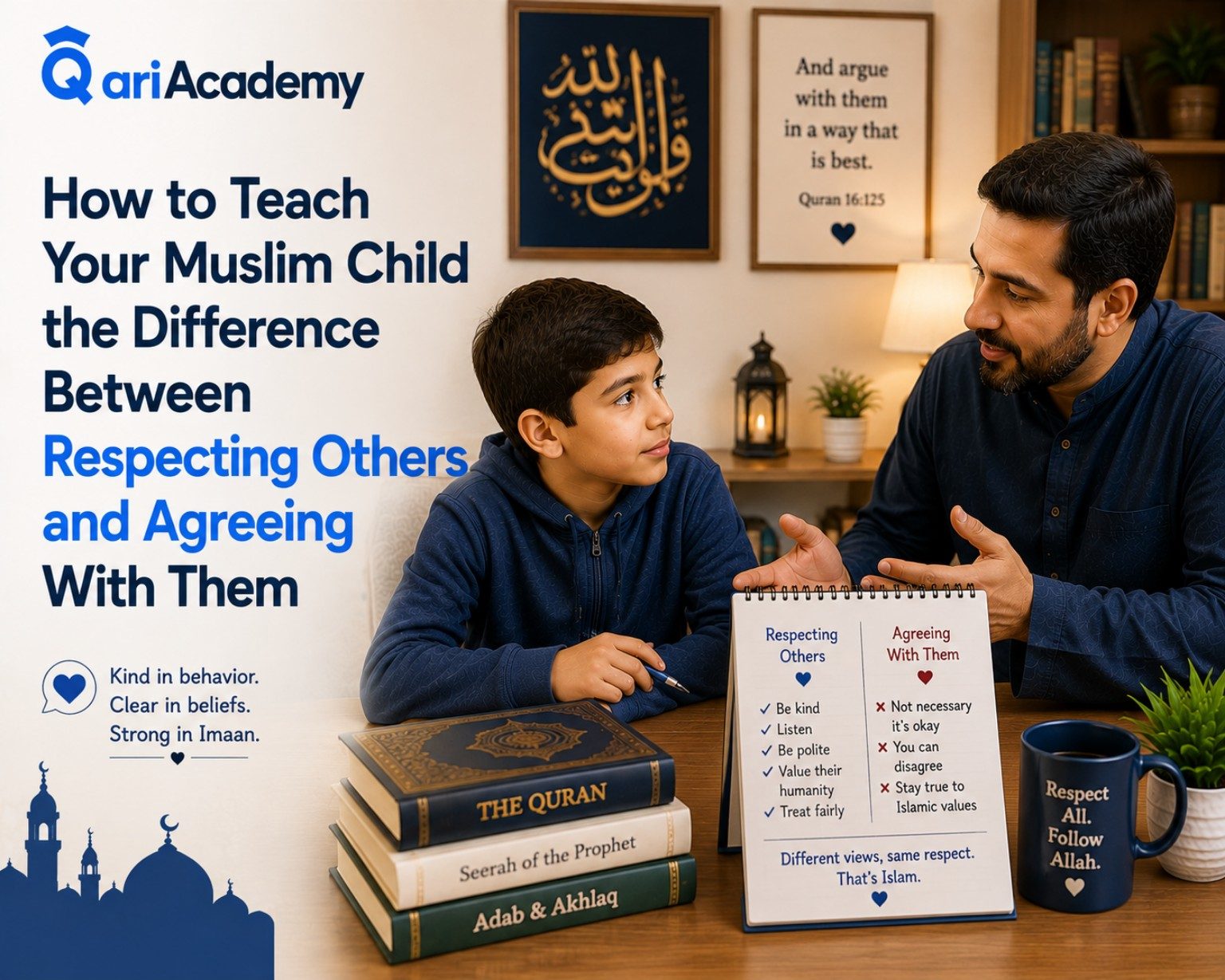
Your child can respect a person without agreeing with everything that person believes.
They can be kind without copying someone’s behavior.
They can listen without accepting an argument.
They can disagree without becoming hateful.
And they can remain firmly Muslim without treating everyone who thinks differently as an enemy.
Learning how to teach your Muslim child respect without agreeing is therefore much more than a lesson about manners.
It is preparation for life.
Your child will eventually study, work, travel, and live alongside people who don’t share every Islamic belief.
The goal isn’t to isolate them from those differences.
The goal is to teach them how to navigate them with faith, confidence, wisdom, and good character.
What Does Respect Actually Mean?
Children often misunderstand the word “respect.”
They may think:
“If I respect someone, I have to agree with them.”
That’s not correct.
Respect can mean:
- Speaking politely
- Not insulting someone
- Not humiliating them
- Listening when appropriate
- Treating them fairly
- Respecting their rights
- Not bullying them
Respect does not automatically mean:
- “I believe what you believe.”
- “I approve of everything you do.”
- “I will follow your lifestyle.”
- “I think every opinion is correct.”
That’s an important distinction for children to understand.
1. Teach Your Child That People Are Not Their Opinions
This is one of the most useful lessons you can give your child.
A person can have a belief you strongly disagree with while still possessing other good qualities.
Someone may be:
- Kind
- Honest
- Helpful
- Hardworking
- Funny
- Respectful
And still believe something you don’t accept.
Teach your child to evaluate people fairly rather than reducing an entire person to one disagreement.
2. Explain That Islam Has Its Own Moral Standards
Respecting others doesn’t mean abandoning Islamic principles.
Your child should know that Muslims have beliefs about:
- Worship
- Marriage
- Family
- Modesty
- Relationships
- Food
- Alcohol
- Morality
- Gender
- Personal responsibility
These beliefs don’t disappear simply because another person disagrees with them.
You can tell your child:
“Other people may believe differently. We respect them as people, but our family follows Islam.”
3. Teach Your Child That Truth Isn’t Determined by Popularity
Children can easily think:
“Everyone at school believes this, so it must be right.”
But popularity doesn’t determine truth.
Something isn’t automatically correct because millions of people believe it.
And something isn’t automatically wrong because only a small number of people believe it.
Teach your child to ask:
- “What does Islam teach?”
- “What evidence supports this?”
- “Where did this idea come from?”
- “Is this actually true?”
These questions build intellectual confidence.
4. Respect Does Not Mean Approval
This distinction should be repeated often.
Suppose your child meets someone whose lifestyle conflicts with Islamic teachings.
You can teach:
“You don’t have to insult them.”
“You don’t have to participate.”
“You don’t have to pretend you agree.”
“You should still behave respectfully.”
That is mature disagreement.
5. Give Your Child Simple Language
Children need practical words they can use.
Teach them:
“I respect you, but I have different beliefs.”
“My family believes differently.”
“I don’t agree, but I don’t want to argue.”
“That’s not something I follow.”
“I’d rather talk about something else.”
These sentences can prevent unnecessary conflict.
6. Teach Your Child That They Don’t Have to Debate Everyone
Your child doesn’t need to defend Islam in every conversation.
If someone says:
“Islam is wrong.”
Your child doesn’t need to immediately start an argument.
They can say:
“That’s your opinion. I’m Muslim and I believe differently.”
Then move on.
Knowing when not to argue is a form of wisdom.
7. Teach Them That Silence Can Be a Good Response
Sometimes children believe they have to answer every question.
They don’t.
If someone asks a provocative question, your child can simply say:
“I don’t want to discuss that.”
Or:
“I don’t know enough to answer.”
Or:
“Ask my parents.”
That is perfectly acceptable.
8. Don’t Teach Your Child to Mock People
This is especially important.
If your child encounters someone with different beliefs, they should not:
- Make jokes about them
- Imitate them
- Give them insulting nicknames
- Share embarrassing pictures
- Encourage others to exclude them
- Spread rumors
The Quran warns believers against ridiculing others.
Quran — Surah Al-Hujurat 49:11
Teach your child that disagreement doesn’t give them permission to become cruel.
9. Explain the Difference Between a Person and a Behavior
This can be difficult for children.
Suppose your child sees someone doing something Islam prohibits.
You can say:
“We believe that behavior is not allowed in Islam.”
That’s different from saying:
“That person is worthless.”
Your child needs to understand that moral disagreement doesn’t require personal hatred.
10. Teach Justice Even When You Disagree
One of the strongest principles in Islamic character is justice.
The Quran commands believers to stand firmly for justice.
This means your child shouldn’t lie about someone simply because they dislike their beliefs.
They shouldn’t accuse someone falsely.
They shouldn’t participate in bullying.
They shouldn’t treat someone unfairly because they are different.
Justice matters even when emotions are strong.
11. Teach Your Child That Kindness Is Not Agreement
Your child may ask:
“But if I’m kind to them, doesn’t that mean I agree?”
No.
You can be kind to someone because Islam teaches good character.
You can help someone who needs help.
You can share school supplies.
You can work together on a project.
You can hold the door open.
You can be polite.
None of those actions require you to abandon your beliefs.
12. Teach Them That Boundaries Are Compatible With Respect
Your child can be respectful and still say:
“No.”
“I’m not comfortable with that.”
“My family doesn’t allow it.”
“I don’t want to participate.”
“I’m going to leave.”
This is especially important when dealing with peer pressure.
Respecting someone doesn’t mean allowing them to control you.
13. Explain What a Healthy Friendship Looks Like
Your child should learn that friendship involves influence.
A healthy friend:
- Respects boundaries
- Doesn’t pressure you
- Doesn’t demand secrets
- Doesn’t insult your religion
- Doesn’t encourage dangerous behavior
- Doesn’t force inappropriate content on you
- Allows you to say no
A child can respect a classmate without making that classmate their closest friend.
That’s an important distinction.
14. Don’t Tell Your Child That Every Non-Muslim Is Dangerous
This can create unnecessary fear.
Your child may have classmates who are:
- Christian
- Jewish
- Hindu
- Atheist
- Agnostic
- From another cultural background
The Quran establishes principles of justice and good treatment toward those who are not fighting Muslims because of their faith.
Quran — Surah Al-Mumtahanah 60:8
Your child can maintain Islamic beliefs while treating others fairly.
15. Don’t Go to the Opposite Extreme
There is another mistake.
Some parents become so worried about appearing intolerant that they stop explaining Islamic beliefs clearly.
They may say:
“Everyone is right in their own way.”
But that isn’t what Muslims believe.
Islam teaches Muslims to believe that the Quran is revelation from Allah and that Islam has objective moral teachings.
Your child doesn’t need to be taught that every belief is equally true.
Instead, teach:
“Other people have different beliefs. We respect their right to be treated fairly, but we follow what Islam teaches.”
16. Teach Your Child Confidence Without Arrogance
There is a difference between:
“I know what I believe.”
and:
“Everyone who disagrees with me is stupid.”
The first is confidence.
The second is arrogance.
Your child needs the first.
Islamic confidence should produce humility, not superiority.
17. Teach Your Child to Ask Questions
Suppose your child hears:
“Why don’t Muslims believe this?”
Instead of saying:
“Don’t listen to them.”
say:
“What exactly did they ask?”
Then discuss it.
If you don’t know the answer, say:
“Let’s find out.”
This teaches your child that Islam isn’t threatened by honest questions.
18. Don’t Let the Internet Become the Teacher
Today, children can search almost any question instantly.
They may find:
- Short videos
- Influencers
- Debates
- Clips taken out of context
- Anti-Islamic content
- Religious misinformation
- Extreme opinions
Your child needs to know that confidence doesn’t equal expertise.
Someone speaking confidently on social media doesn’t automatically mean they understand Islam, history, psychology, or any other subject.
19. Teach Digital Respect
The same rules apply online.
Your child shouldn’t:
- Insult people
- Join bullying campaigns
- Share private information
- Post humiliating pictures
- Mock someone’s religion
- Participate in hate speech
- Send inappropriate messages
Teach:
“If you wouldn’t say it respectfully face-to-face, don’t type it online.”
20. Teach Your Child How to Handle Religious Questions
Your child may eventually be asked:
“Why do Muslims pray?”
“Why do you fast?”
“Why do Muslim girls wear hijab?”
“Why can’t Muslims drink alcohol?”
“Why do Muslims have certain rules?”
Teach your child that they don’t need to know every answer.
They can say:
“I’m still learning.”
Or:
“I don’t know. I’ll ask my parents.”
That’s not weakness.
That’s honesty.
21. Give Your Child a Strong Quran Foundation
A child who understands the Quran and Islamic teachings has a stronger foundation from which to evaluate outside ideas.
This doesn’t mean memorizing verses without understanding them.
It means gradually learning:
- Who Allah is
- Why Muslims worship Him
- What the Quran teaches
- How the Prophet Muhammad behaved
- What Islamic manners look like
- How Muslims treat others
- How Muslims handle disagreement
This creates a much stronger identity.
22. Make Quran Learning Positive
If Quran is always associated with punishment, children may eventually disconnect from it emotionally.
Instead, make learning meaningful.
Ask:
“What did you learn?”
“What does this verse teach us?”
“How could you use this lesson at school?”
“What does good character look like here?”
This connects Quran to real life.
23. QariAcademy Can Support Your Child’s Islamic Foundation
For parents who want consistent Quran education alongside school and family life, QariAcademy offers live one-on-one online lessons for children and teenagers.
Programs include:
- Quran Reading
- Tajweed
- Hifz
- Quranic Arabic
- Islamic Studies
QariAcademy — Online Quran Programs
One-on-one learning gives children the opportunity to learn according to their level and ask questions in a more personal environment.
For many families, consistent Quran learning can become one part of a larger effort to strengthen their child’s Islamic identity.
24. Don’t Expect Quran Classes to Solve Every Problem
This is important.
A Quran teacher can teach.
But parents still need to:
- Talk
- Listen
- Supervise
- Guide
- Set boundaries
- Answer questions
- Model good behavior
Islamic education works best when it continues beyond the lesson.
25. Show Your Child What Respect Looks Like
Children learn respect by watching adults.
If you constantly insult people who disagree with you, your child will probably copy you.
If you discuss differences calmly, your child learns calm disagreement.
If you mock people, your child learns mockery.
If you listen respectfully, your child learns listening.
Your behavior is part of your child’s education.
26. Teach Through Your Own Conversations
Imagine you’re watching the news.
Someone says something you strongly disagree with.
Instead of:
“What an idiot.”
try:
“I strongly disagree with that argument. Let’s see why.”
Your child learns something important:
You can reject an argument without humiliating the person.
27. Teach Your Child That Good Character Is Always Relevant
Your child doesn’t only need good manners with Muslims.
Good character matters with:
- Teachers
- Classmates
- Neighbors
- Coaches
- Workers
- Strangers
- People of different religions
- People with different opinions
The goal is consistent character.
28. What If Someone Is Rude to Your Child?
Respect doesn’t mean tolerating abuse.
Teach your child:
“Walk away.”
“Set a boundary.”
“Tell a teacher.”
“Tell your parents.”
If someone repeatedly bullies or harasses them, adult intervention may be necessary.
Your child should never feel that Islamic manners mean they must accept mistreatment.
29. Teach Them That Forgiveness Doesn’t Mean Trusting Everyone
Your child may be hurt by someone.
Teach forgiveness when appropriate.
But also teach boundaries.
You can forgive someone and still decide:
“I don’t want to be close friends with them.”
That’s healthy.
30. Don’t Force Your Child Into Every Friendship
Some parents worry:
“If I tell my child not to be friends with someone, they will become curious.”
Sometimes that happens.
But parents still have a responsibility to intervene when there are serious risks.
The key is to explain why.
Instead of:
“Because I said so.”
try:
“I’ve noticed that whenever you’re around this person, you’re pressured to do things that conflict with our family values. Let’s talk about that.”
31. Teach Your Child How to Evaluate Influence
Ask:
- “How do you feel after spending time with this person?”
- “Do you feel more confident or less confident?”
- “Do they respect your boundaries?”
- “Do they encourage you to make good choices?”
- “Can you say no?”
- “Do you feel like you have to pretend to be someone else?”
These questions teach your child to evaluate relationships.
32. Explain That Respect Doesn’t Require Friendship
This is another important distinction.
Your child can say:
“I respect you.”
without saying:
“You are my best friend.”
Respect is a basic standard.
Friendship is a deeper relationship.
Children should learn that they can be polite without becoming close to everyone.
33. Teach Your Child That They Don’t Need Everyone’s Approval
This may be one of the most valuable lessons of adolescence.
Your child will eventually encounter:
“Everyone thinks this.”
“Everyone is doing this.”
“Everyone has this.”
“Everyone believes this.”
Teach:
“Your decisions shouldn’t be controlled by the need for approval.”
For Muslim children, that includes remembering that their ultimate accountability is to Allah.
34. Help Your Child Develop Confidence Outside Social Approval
Encourage:
- Sports
- Reading
- Art
- Science
- Languages
- Volunteering
- Leadership
- Quran
- Creative projects
- Healthy hobbies
The more areas in which your child develops genuine competence, the less likely they are to depend entirely on one social group for self-worth.
35. Teach Them That Mistakes Don’t Define Them
Your child may eventually make a poor decision.
Don’t turn one mistake into:
“You are a bad Muslim.”
Instead:
“That was a poor choice. Let’s understand what happened and how you can make a better choice next time.”
This teaches accountability without destroying confidence.
36. Don’t Make Your Child Afraid to Tell You the Truth
This is crucial.
Imagine your child tells you:
“My friend showed me something inappropriate.”
If your response is explosive anger, your child may hide the next incident.
Instead:
“Thank you for telling me.”
Then:
“Let’s deal with what happened.”
You can still establish consequences.
But honesty should be reinforced.
37. Create a Family Rule: Questions Are Welcome
Tell your child:
“You can ask us anything.”
That doesn’t mean:
“We will agree with everything.”
It means:
“We will listen and explain.”
This makes the home a place where your child’s beliefs can grow through understanding rather than fear.
38. Teach Your Child How to Disagree Respectfully
Give them a simple formula:
“I understand what you’re saying.”
“I believe differently.”
“Here’s why.”
“I don’t want to argue.”
Then move on.
This is useful far beyond childhood.
It prepares your child for university, work, relationships, and adult life.
39. The Biggest Mistake: Confusing Protection With Isolation
Parents naturally want to protect their children.
But if protection means:
“Never talk to anyone different.”
“Never hear another opinion.”
“Never ask questions.”
“Never leave the family environment.”
then the child may be completely unprepared when they become independent.
Real protection is preparation.
Teach your child how to think.
Teach them how to choose.
Teach them how to communicate.
Teach them how to maintain boundaries.
Teach them how to remain Muslim in a diverse world.
40. The Muslim Child You Want to Raise
Imagine your child at 20 years old.
They meet people with completely different beliefs.
They hear arguments against Islam.
They work with people who live differently.
They encounter social pressure.
But they remain calm.
They know what they believe.
They know why they believe it.
They don’t hate people who disagree.
They don’t blindly follow them either.
They can say:
“I respect you, but I disagree.”
That’s maturity.
Conclusion
Teaching your Muslim child respect without agreeing is not about weakening Islamic values.
It is about teaching your child how to live those values intelligently.
Your child should understand that respect does not mean approval.
Kindness does not mean agreement.
Friendship does not mean copying someone.
Listening does not mean accepting every argument.
And confidence does not mean arrogance.
Your child can be firmly Muslim while living in a diverse society.
They can have classmates from different religions.
They can work with people who have different beliefs.
They can be polite to people whose choices they don’t agree with.
They can maintain boundaries.
They can ask difficult questions.
They can say no.
And they can remain connected to Allah.
That is why Islamic education matters.
QariAcademy can support your child’s Islamic foundation through live one-on-one Quran and Islamic learning for children and teenagers.
Through Quran Reading, Tajweed, Hifz, Quranic Arabic, and Islamic Studies, your child can develop a stronger relationship with the Quran while you continue teaching character and decision-making at home.
If you’re looking for a structured Quran program for your child, you can explore QariAcademy’s programs and start with a free trial:
Start a Free Trial at QariAcademy
Remember:
Your child doesn’t need to agree with everyone.
Your child doesn’t need to hate everyone who disagrees.
Your child doesn’t need to debate everyone.
Your child doesn’t need to copy everyone.
What your child needs is stronger:
Faith.
Knowledge.
Character.
Confidence.
Wisdom.
And the ability to say:
“I respect you as a person, but I follow what I believe is right.”
That is not weakness.
That is maturity.
And it may become one of the most valuable lessons you ever teach your child.
Primary Keyword: Muslim child respect without agreeing