Table of Contents
Introduction
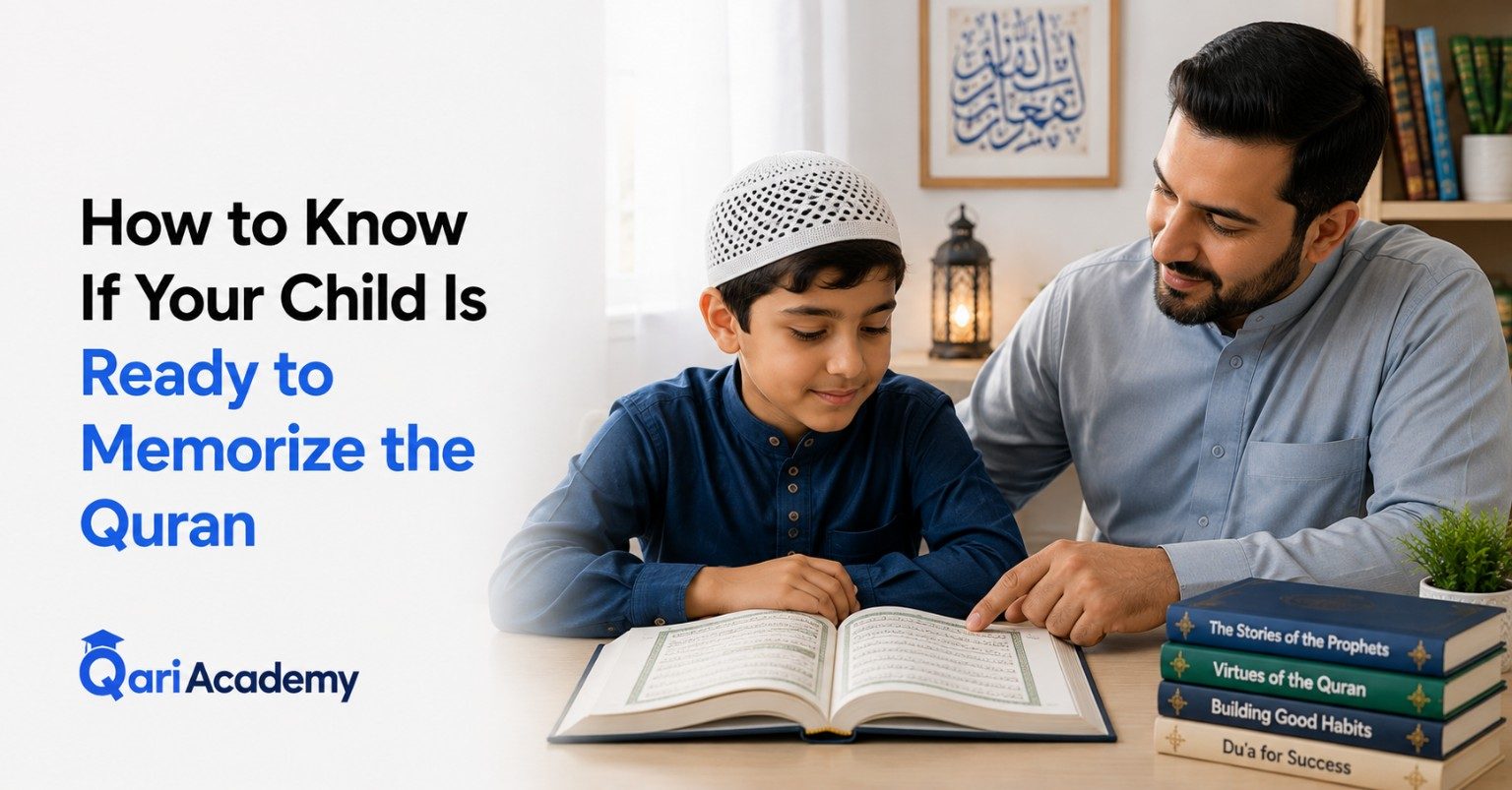
Is your child ready to memorize the Quran?
This is an important question for Muslim parents considering a Hifz journey for their child. Some parents worry that they are starting too early, while others wonder whether they have waited too long. It is also easy to compare your child with another child who seems to be memorizing much faster.
The truth is that Quran memorization readiness is not determined by age alone.
A six-year-old may be ready to memorize short surahs because they have strong listening skills and genuine interest. A ten-year-old may need more time to strengthen Quran reading before beginning a demanding Hifz schedule. A teenager who has never studied Quran seriously may still be ready if the program matches their ability.
For children growing up in the USA, UK, Canada, Australia, and other English-speaking countries, the situation can be more complex. English may be their primary language, while Arabic is used mainly during Quran lessons.
That is why parents should look beyond age and ask:
- Can my child read basic Quranic text?
- Can they pronounce Arabic letters reasonably well?
- Can they retain short passages?
- Can they concentrate during a lesson?
- Are they willing to practice?
- Can our family maintain a consistent routine?
If several answers are yes, your child may be ready to begin Hifz gradually.
What Does It Mean to Be Ready for Hifz?
Being ready does not mean your child must read the Quran fluently or have an extraordinary memory.
Readiness is better understood as a combination of:
- Basic Quran reading
- Pronunciation
- Memory and retention
- Attention
- Motivation
- Consistency
- Family support
A child may be ready for small amounts of memorization without being ready for an intensive Hifz program.
This distinction prevents parents from thinking they have only two choices: start intensive Hifz or wait completely.
A child can memorize Al-Fatihah and short surahs from Juz Amma while continuing to develop Quran reading, Qaida, Tajweed, Makharij, and Quranic vocabulary.
The goal is progress without unnecessary pressure.
Six Signs Your Child May Be Ready to Memorize the Quran
There is no single test that determines readiness, but these six signs provide a useful starting point.
| Readiness Sign | What You May Notice | What It Suggests |
|---|---|---|
| Basic Quran reading | Reads simple words with support | Can connect memory to text |
| Pronunciation | Produces most letters clearly | Can learn with correction |
| Retention | Remembers short passages | Has a foundation for Hifz |
| Attention | Focuses for an age-appropriate period | Can participate effectively |
| Motivation | Enjoys repeating Quran | Supports long-term learning |
| Consistency | Can follow a routine | Makes Hifz sustainable |
Your child does not need to demonstrate every sign perfectly. Readiness can also develop over time.
1. Your Child Can Read Basic Quranic Text
Your child does not need to read quickly.
Ideally, they should recognize Arabic letters, understand common harakat, and decode simple Quranic words.
Accuracy matters more than speed at the beginning.
A child who reads slowly but accurately may be better prepared than a child who reads quickly but repeatedly makes mistakes.
Reading and memorization can also develop together:
Read → Listen → Repeat → Memorize → Review → Read Again
This helps the child connect memorized sounds with the written Mushaf.
If your child still struggles significantly with the Arabic alphabet or basic harakat, focus more heavily on Quran reading and Qaida before increasing the Hifz workload.
2. Your Child Can Pronounce Arabic Letters
Memorization is not simply remembering sounds.
If a child repeatedly memorizes words with incorrect pronunciation, those mistakes may become part of their memorized recitation.
They do not need perfect Tajweed before starting. However, important pronunciation problems should be corrected early.
Early priorities can include:
- Arabic letter pronunciation
- Basic Makharij
- Harakat
- Clear recitation
- Basic Madd
- Appropriate stopping
The Quran instructs believers to recite with measured recitation in Surah Al-Muzzammil 73:4.
The practical lesson is not to demand perfection from beginners, but to make accurate recitation part of the learning process.
3. Your Child Can Retain Short Passages
A strong memory is helpful, but retention is more important than memorization speed.
Try a simple test at home. Choose a short passage your child does not already know. Read it together several times, then ask your child to recite what they remember.
Test the same passage again the following day.
A child who memorizes ten lines but forgets most of them the next day may need a slower pace. A child who memorizes three lines and retains them accurately may be progressing very well.
| Memorization Pattern | What It May Mean | Better Strategy |
|---|---|---|
| Fast and retained | Strong current fit | Gradually increase |
| Fast but quickly forgotten | Workload may be too high | Increase revision |
| Slow but accurate | Sustainable learning | Keep manageable goals |
| Strong with teacher prompts | Independence developing | Practice recall |
4. Your Child Can Focus During Lessons
Hifz requires repetition, and repetition requires attention.
A young child does not need to sit perfectly still for an hour. A six-year-old may learn better through several short activities, while an older child may handle a longer structured session.
Signs of healthy learning attention include the ability to:
- Listen to a short recitation
- Repeat after the teacher
- Correct an error
- Return to a verse several times
- Recite familiar material independently
If your child becomes distracted quickly, the solution may be to shorten or restructure the lesson rather than abandon Hifz.
5. Your Child Shows Genuine Interest
Motivation can make a significant difference.
Perhaps your child hears a surah at the mosque and wants to memorize it. Maybe they enjoy reciting with you or want to learn what an older sibling has learned.
These are useful opportunities.
However, motivation does not mean your child will always be excited. Every learner experiences boredom and resistance.
Avoid comparisons such as:
- “Your cousin has memorized more.”
- “Your sister reads better.”
- “Other children your age are ahead.”
Instead, compare your child’s current performance with their own previous progress.
Ask:
Is reading improving? Is retention getting stronger? Are pronunciation mistakes decreasing? Does my child need fewer prompts?
Those are much better measures of progress.
6. Your Family Can Support Consistency
Hifz does not happen only during the teacher’s lesson.
Children need some review between lessons, but parents do not need to become Quran teachers.
A simple routine might include:
- 5–15 minutes of daily review
- Listening to the assigned passage
- Reading from the Mushaf
- Reciting the previous lesson
- Weekly revision
If the family’s schedule is already overloaded with school, sports, homework, and other commitments, an intensive Hifz target may not be realistic.
A smaller sustainable routine is often better than an ambitious plan that lasts two weeks.
Is Age the Most Important Factor?
No.
Age matters, but it should never be the only criterion.
Younger children may have strong imitation and memory skills but shorter attention spans. Older children may have better reading and self-management skills but less free time.
| Age | Possible Strength | Common Challenge |
|---|---|---|
| 5–6 | Strong imitation | Short attention span |
| 7–8 | Developing reading | Needs encouragement |
| 9–10 | Better independence | School workload |
| 11–12 | Stronger comprehension | Social comparison |
| 13–15 | Greater independence | Busy schedule |
| Teenagers | Better self-management | Motivation and time |
These are general observations, not strict rules.
The better question is:
What type of Quran learning can my child realistically handle at this stage?
Should Reading and Hifz Develop Together?
In many cases, yes.
A child does not necessarily need to reach advanced Quran reading fluency before memorizing short surahs.
A practical progression can look like:
Arabic Alphabet → Qaida → Quran Reading → Short Hifz + Reading → Tajweed Development → Expanded Hifz
But this is not a rigid sequence.
A child may memorize Juz Amma while improving reading fluency. Another may spend several months strengthening Qaida before increasing memorization.
The teacher should adjust the balance according to the child’s needs.
A Simple Home Readiness Test
Parents can perform an informal assessment without turning Quran learning into an exam.
Choose a short passage and ask your child to:
- Identify Arabic letters.
- Read simple words.
- Recognize harakat.
- Read a short Quranic phrase.
- Repeat it after you.
- Follow the Mushaf while listening.
- Recite without looking.
- Repeat the same passage the next day.
Observe the difference between reading, listening, memorizing, and retaining.
If your child memorizes beautifully but cannot recognize familiar text in the Mushaf, reading deserves more attention.
If your child reads accurately but slowly and retains short passages, modest Hifz may be appropriate.
What If Your Child Is Not Ready Yet?
Not being ready is not failure.
Your child may simply need stronger foundations.
Consider prioritizing Quran reading before increasing Hifz if your child:
- Cannot recognize most Arabic letters
- Struggles with basic harakat
- Has major pronunciation difficulties
- Cannot retain very short passages
- Becomes distressed during Quran lessons
- Has no realistic opportunity for revision
- Depends entirely on teacher prompts
This does not necessarily mean stopping memorization completely.
Very short surahs can still be memorized while the teacher strengthens reading, pronunciation, and Tajweed.
How Much Should a Child Memorize?
There is no universal weekly target.
Instead of asking, “How many pages should my child memorize?” ask:
“How much can my child memorize accurately while maintaining previous Hifz?”
A sustainable routine should balance new material with revision.
| Practice Area | Example Frequency | Purpose |
|---|---|---|
| New Hifz | 3–5 days | Add manageable material |
| Recent revision | Daily | Strengthen new learning |
| Older revision | 2–4 days | Protect previous Hifz |
| Quran reading | Several days | Build fluency |
| Tajweed | Throughout lessons | Improve accuracy |
The exact schedule should be adapted to the child’s age, school workload, reading ability, and retention.
How QariAcademy Can Help
QariAcademy offers one-on-one Online Quran Classes for children, allowing lessons to be adapted to the student’s current level.
For a child beginning Quran learning, the immediate priority might be:
- Arabic Alphabet
- Qaida
- Quran Reading
- Tajweed
- Hifz
- Quranic Arabic
A child who already reads comfortably may be ready for more structured memorization. Another child may need to strengthen reading first.
This individualized approach can be especially useful for Muslim families in the USA, UK, Canada, Australia, and other countries where children may have limited daily exposure to Arabic.
A Free Trial can also help parents see how their child responds to the teacher and identify an appropriate starting point.
The objective should not be to start Hifz as quickly as possible.
It should be to find the right starting point for the individual child.
A Beginner-Friendly Hifz Routine
Once your child is ready, start smaller than you think.
A simple routine could be:
Before the lesson: Listen briefly to the assigned passage.
During the lesson: Learn new material with the teacher.
After the lesson: Recite the new material once or twice.
Later that day: Review it again.
The next day: Review before adding new material.
At the end of the week: Review recent memorization.
Remember:
Do not measure Hifz only by what your child has memorized. Measure it by what they can still recite accurately.
Frequently Asked Questions
What is the best age to start Quran memorization?
There is no universal best age. Readiness depends on reading ability, pronunciation, retention, attention, motivation, and family support.
Does my child need to read Quran fluently before starting Hifz?
No. A child may begin modest memorization while reading fluency develops. However, reading should continue alongside Hifz.
How can I test my child’s memory?
Use a short unfamiliar passage, practice it together, and test retention the following day. Retention is more useful than memorization speed.
Does my child need perfect Tajweed before Hifz?
No. Advanced Tajweed is not required, but significant pronunciation errors should be corrected from the beginning.
Can an English-speaking child learn Hifz?
Absolutely. English-speaking children can learn Quran successfully. They may simply need more structured Arabic reading practice and regular exposure to Quranic Arabic.
Should I force my child to memorize?
Parents should provide structure and encouragement, but excessive pressure can harm motivation. Age-appropriate goals and consistent positive support are usually more sustainable.
Can Quran reading and Hifz be learned together?
Yes. For many children, developing reading, Tajweed, and modest memorization together is an effective approach.
Conclusion
Is your child ready to memorize the Quran?
The answer is not found in a particular age.
Look at the whole child.
Can they read basic Quranic text? Can they pronounce Arabic letters reasonably well? Can they retain short passages? Can they concentrate for an age-appropriate period? Are they willing to practice? Can your family maintain a consistent routine?
If most answers are yes, your child may be ready to begin Hifz gradually.
If several answers are no, your child is not “behind.” You simply have a clearer idea of where to begin.
Perhaps the next step is Arabic alphabet practice or Qaida. Perhaps your child needs stronger Quran Reading and Tajweed. Or perhaps they already have the foundation for a structured Hifz program.
The most important thing is to avoid both extremes: waiting for perfection and rushing into intensive memorization.
A balanced approach allows Quran Reading, Tajweed, Hifz, and Quranic Arabic to develop together according to the child’s needs.
The Quran reminds us that it has been made easy for remembrance in Surah Al-Qamar 54:17, while Surah Al-Muzzammil 73:4 emphasizes measured recitation.
For families raising Muslim children in English-speaking countries, personalized instruction can make this process more manageable. QariAcademy provides one-on-one Online Quran Classes that can be adapted to the student’s level, whether the immediate goal is Quran Reading, Tajweed, Hifz, or Quranic Arabic.
If you are unsure where your child should begin, a Free Trial can help you understand their current level and choose an appropriate learning path.
Book a Free Trial With QariAcademy:
QariAcademy Enrollment
Sources and Further Reading
- Quran.com — Surah Al-Qamar 54:17 — Quranic guidance concerning remembrance.
- Quran.com — Surah Al-Muzzammil 73:4 — Guidance concerning measured recitation.
- PubMed — Developmental Profiles of Reading Fluency — Research on reading development and foundational reading skills.