Table of Contents
Every child approaches Quran learning differently.
One child may recognize Arabic letters quickly but struggle with Harakat. Another may read Quran fluently but need significant Tajweed correction. A third child may memorize short Surahs easily but have difficulty reading independently.
When all three children are taught through exactly the same lesson, at exactly the same speed, at least one of them may not be learning efficiently.
This is one of the main reasons one-to-one Quran classes can be valuable for children.
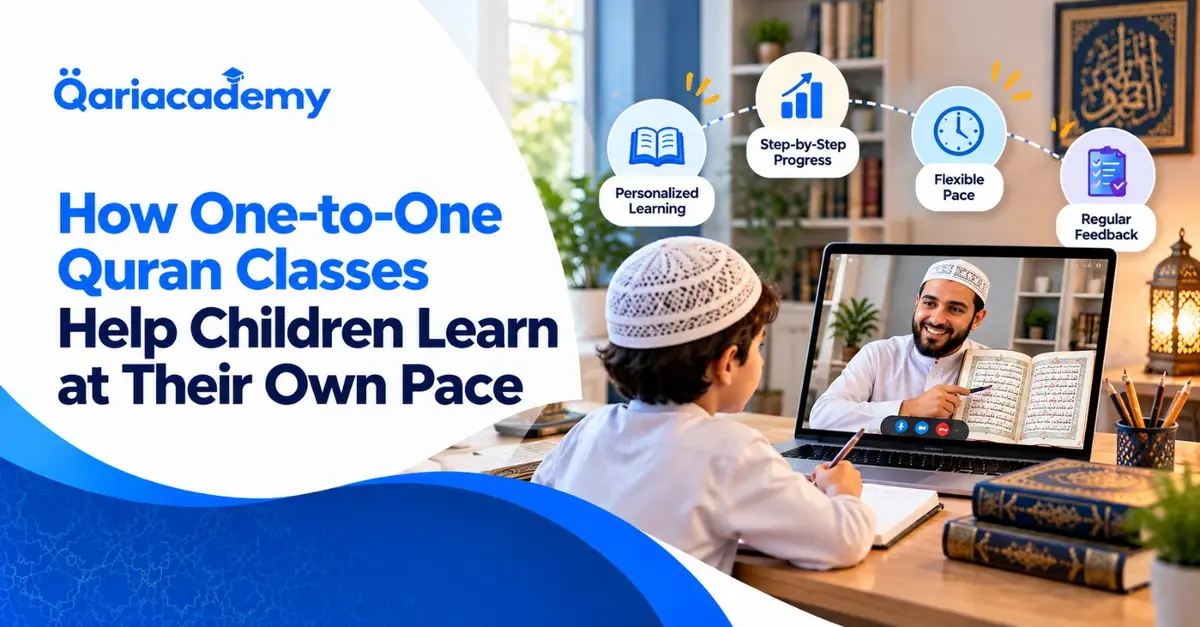
Instead of asking every child to follow the same pace, individual instruction allows the teacher to start from the child’s actual level, identify specific learning needs, and adjust the lesson accordingly.
At QariAcademy, children’s Quran lessons are built around this principle. The Quran for Kids program describes one-on-one live classes, gradual instruction, regular feedback, and lessons tailored to the child’s pace.
The goal is not simply to make lessons faster.
The goal is to make them appropriate for the child who is actually sitting in the lesson.
What Does “Learning at Their Own Pace” Really Mean?
Learning at a child’s own pace does not mean allowing the child to decide everything.
A teacher still needs to provide:
- A structured curriculum
- Clear learning goals
- Appropriate expectations
- Regular practice
- Correction
- Assessment
- Progress tracking
The difference is that the teacher can adjust how the child reaches those goals.
For example, imagine two six-year-olds.
Child A recognizes all Arabic letters and is already reading simple words.
Child B still confuses letters such as ب، ت، and ث.
Putting both children through the exact same activity may waste time for one child and overwhelm the other.
In an individualized lesson, Child A can move toward connected reading while Child B receives additional letter recognition and repetition.
That is the practical meaning of learning at an individual pace.
QariAcademy’s current course information describes its approach as structured but adapted to each student’s level, abilities, and goals.
Why Children Do Not All Learn Quran at the Same Speed
Parents sometimes compare their child’s Quran progress with a sibling, cousin, friend, or another child in the same age group.
But age alone does not determine Quran learning level.
Two children of the same age may have completely different backgrounds.
| Child | Previous Experience | Possible Starting Point |
|---|---|---|
| Child A | Knows Arabic letters | Qaida and reading |
| Child B | Reads Arabic but slowly | Quran fluency |
| Child C | Reads Quran already | Tajweed improvement |
| Child D | Memorizes by listening | Reading + memorization |
| Child E | Little Arabic exposure | Alphabet and foundational skills |
Other factors also matter:
- Previous Quran education
- Arabic exposure at home
- Ability to recognize Arabic letters
- Reading fluency
- Pronunciation
- Attention and concentration
- Memorization ability
- Confidence
- Previous learning experiences
- Consistency of practice
This is why QariAcademy’s article on how long it takes a child to learn to read the Quran focuses on actual indicators of progress rather than assuming every child should reach the same milestone at the same age.
One-to-One Quran Classes Start With the Child’s Actual Level

One of the biggest advantages of individual instruction is that the teacher can identify where the child actually needs to begin.
A child may be seven years old, for example, but that does not tell a teacher whether the child should start with:
Arabic letters → Qaida → Quran reading → Tajweed → Hifz
The teacher needs to assess the child’s existing skills.
A first assessment may consider:
- Arabic letter recognition
- Harakat
- Connecting letters
- Reading unfamiliar words
- Quran reading
- Pronunciation
- Tajweed
- Memorization
- Previous Quran experience
- Learning goals
QariAcademy’s First 90 Days of Quran Learning similarly emphasizes understanding the child’s starting point and using individualized instruction to address different combinations of strengths and weaknesses.
Why starting at the right level matters
If the lesson is too easy:
The child may become bored.
If the lesson is too difficult:
The child may become frustrated.
If the lesson is appropriately challenging:
The child has room to learn, practice, and succeed.
That balance is one of the most important parts of effective Quran teaching.
One Child May Need Repetition While Another Needs a Challenge
Consider a simple example.
A teacher introduces the Arabic letters:
ب — ت — ث
Child A identifies all three immediately.
Child B continues confusing them.
A group lesson may need to move forward because the majority of students have understood the activity.
But in a one-to-one lesson, the teacher can spend additional time with Child B without making Child A wait.
The teacher might use:
- Visual recognition
- Sound repetition
- Comparison
- Short reading exercises
- Review
- Reassessment
Once Child B demonstrates understanding, the lesson can move forward.
This is not “slowing the child down.”
It is giving the child the amount of practice needed to build the skill correctly.
QariAcademy’s article on teaching Quran to young children without expecting adult-level focus similarly recommends short activities, repetition, and adapting instruction to the child’s attention and ability.
One-to-One Classes Can Also Help Advanced Children
Personalization is not only useful for beginners.
A child who is already advanced can also benefit.
Imagine a nine-year-old who:
- Reads Quran fluently
- Knows basic Tajweed
- Has memorized several Surahs
- Can recognize common Quranic vocabulary
That child may become frustrated if every lesson repeatedly covers the alphabet or very basic reading.
A personalized teacher can instead focus on:
- More advanced Tajweed
- Fluency
- Makharij
- Memorization
- Revision
- Quranic vocabulary
- Self-correction
- Longer passages
This is one reason QariAcademy’s Quran for Kids course is designed for children at different levels rather than only absolute beginners.
The Teacher Can Focus on the Child’s Specific Weakness
One of the biggest differences between individualized and group learning is the amount of attention available for a specific problem.
Suppose a child reads Quran fluently but repeatedly makes the same pronunciation error.
The teacher can identify the pattern and devote part of the lesson to it.
For example:
Problem: Confusing ق and ك
Instead of continuing to read an entire page incorrectly, the teacher can:
- Isolate the two letters
- Demonstrate the difference
- Ask the child to repeat them
- Practice them in words
- Return to the Quranic passage
- Check whether the child can apply the correction
The same principle applies to:
- ح and ه
- ص and س
- ط and ت
- ع and ء
- ض and ظ
- Madd
- Ghunnah
- Qalqalah
- Heavy and light letters
This is particularly important in Tajweed because the child needs to apply the rule while reading, not merely know its definition.
Immediate Feedback Matters
Another important feature of one-to-one Quran classes is immediate feedback.
The child reads.
The teacher listens.
The teacher identifies the issue.
The child tries again.
This creates a direct learning cycle:
Read → Correct → Repeat → Apply
Instead of allowing the same mistake to continue for several lessons, the teacher can address it when it appears.
QariAcademy’s Learn Quran Online page describes its one-on-one lessons as being tailored to the student’s pace and level, with teachers providing individualized instruction and feedback.
External education evidence points in a similar direction, while also emphasizing that quality matters. The Education Endowment Foundation reports that one-to-one tuition can provide targeted support because the teacher can focus closely on a learner’s specific needs and provide feedback. Its evidence review also notes that outcomes vary and that implementation and teacher quality matter.
A Child Does Not Have to Repeat What They Already Know
Imagine a child who has already mastered:
- Arabic letters
- Harakat
- Basic connected reading
but is placed in a class where the whole group is still learning the alphabet.
That child may spend considerable lesson time reviewing something already mastered.
In one-to-one instruction, the teacher can recognize mastery and move to the next skill.
For example:
Alphabet mastered → Qaida → connected words → Quran reading → Tajweed
This does not mean skipping foundations.
It means avoiding unnecessary repetition once the foundation is secure.
QariAcademy’s Should Children Learn Arabic Before Learning to Read the Quran? discusses this difference directly: children may need very different amounts of repetition for Arabic letters, Harakat, and early reading skills.
One-to-One Learning Can Build Confidence
A child who repeatedly struggles in front of other students may eventually begin thinking:
“I’m bad at Quran.”
That can turn a learning problem into a confidence problem.
Individual lessons create a different environment.
The child can make mistakes without worrying about classmates watching.
The teacher can correct the mistake privately.
The child can repeat the same exercise several times.
And when the child finally succeeds, the success is directly connected to their own effort.
QariAcademy’s content on helping children love the Quran emphasizes avoiding comparisons and creating a peaceful learning environment where children can receive correction without feeling constantly judged.
Personalized Learning Does Not Mean Lower Expectations
This is an important distinction.
Some parents hear “learn at your own pace” and worry that it means the teacher will make everything easier.
It should mean something different.
The standard remains clear.
The path toward the standard becomes more individualized.
For example:
A child may need three weeks to master a particular reading skill.
Another child may need one week.
The teacher does not necessarily lower the expectation of correct reading.
Instead, the teacher adjusts:
- Practice time
- Number of examples
- Lesson activities
- Review frequency
- Homework
- Amount of teacher support
The objective remains progress.
What a Personalized Quran Lesson Can Look Like
A one-to-one lesson does not need to be completely different every day.
A predictable structure can actually help children.
For example:
| Lesson Stage | Purpose |
|---|---|
| 5 minutes | Review previous material |
| 5 minutes | Correct recurring mistakes |
| 10 minutes | Introduce new material |
| 5 minutes | Guided Quran practice |
| 5 minutes | Independent reading and feedback |
The exact timing should change according to the child’s age, level, attention, and lesson goals.
QariAcademy’s guidance for young children recommends breaking lessons into shorter focused activities rather than expecting a child to maintain the same level of concentration throughout a long continuous activity.
The Pace Can Change From Week to Week
A child’s learning pace is not always constant.
A child may progress quickly one month and need more review the next.
That can happen because of:
- School workload
- Travel
- Holidays
- Missed classes
- New and more difficult material
- A challenging Tajweed concept
- Changes in confidence
- Reduced home practice
One-to-one teaching makes it easier to respond to these changes.
Instead of assuming:
“We must finish this amount every week.”
the teacher can ask:
“What does this child need to master next?”
That is a much more useful question.
One-to-One Quran Classes Can Support Different Learning Goals
Not every family has the same objective.
Some parents want their child to learn basic Quran reading.
Others want strong Tajweed.
Some want memorization.
Others want Quranic Arabic alongside Quran reading.
Some children are beginners.
Others already read Quran and need refinement.
QariAcademy’s programs reflect these different goals, including Quran for Kids, Quran Hifz for Kids, and Arabic for Kids.
That means personalization is not only about how fast the child learns.
It is also about what the child needs to learn next.
One-to-One Quran Learning for Children Growing Up Outside the Arab World
For children growing up in the USA, UK, Canada, or other non-Arabic-speaking environments, Quran learning can involve an additional challenge.
Arabic may not be part of their daily environment.
They may speak English at school and with friends, while hearing a different Arabic dialect at home or having limited Arabic exposure altogether.
As a result, two children of the same age can arrive at Quran class with completely different Arabic foundations.
QariAcademy’s About Us explains that the academy was created partly to support Muslim families living outside the Arab world who may have difficulty finding consistent Quran education that fits their children’s needs.
This makes individualized placement especially relevant.
What Parents Should Look For in a One-to-One Quran Program
Not every service advertised as “one-to-one” necessarily provides meaningful personalization.
Parents should ask:
| Question | Why It Matters |
|---|---|
| Does the teacher assess my child’s level? | Prevents starting too high or too low |
| Can the lesson pace change? | Allows more or less repetition |
| Does the teacher correct pronunciation immediately? | Prevents repeated mistakes |
| Is there a clear curriculum? | Keeps learning structured |
| Are progress updates provided? | Helps parents understand development |
| Can goals change as the child develops? | Keeps instruction relevant |
| Is the teacher experienced with children? | Supports age-appropriate teaching |
One-to-one teaching is most useful when the individual attention actually changes the instruction.
How Parents Can Tell Whether Their Child Is Progressing
Progress should not be measured only by how many pages or Surahs a child completes.
Look for changes such as:
- Recognizing letters more confidently
- Reading unfamiliar words
- Making fewer repeated pronunciation mistakes
- Needing fewer prompts
- Reading longer passages
- Applying Tajweed more consistently
- Memorizing with better retention
- Correcting some mistakes independently
- Showing greater confidence
QariAcademy’s How Long Does It Take a Child to Learn to Read the Quran? highlights indicators such as decoding unfamiliar words, reading longer passages, increased confidence, and reduced dependence on teacher prompting.
These are often more informative than simply asking:
“How many pages did my child finish?”
One-to-One Does Not Mean the Teacher Does Everything
Personalized instruction works best when teacher, child, and parent each have a clear role.
| Person | Main Responsibility |
|---|---|
| Teacher | Teach, correct, assess, and set learning goals |
| Child | Listen, practice, participate, and improve |
| Parent | Support routine, encourage practice, and communicate with teacher |
The parent does not need to become the child’s second Quran teacher.
Instead, the parent can create the environment in which learning continues between lessons.
This fits QariAcademy’s broader approach to parent support and progress tracking, where families can stay informed while the teacher remains responsible for instruction.
What If My Child Is Learning Slowly?
Slow progress does not automatically mean something is wrong.
The first question should be:
What exactly is the child struggling with?
For example:
| Difficulty | Possible Response |
|---|---|
| Letter recognition | More visual repetition |
| Harakat | Shorter focused drills |
| Reading fluency | Guided reading |
| Pronunciation | Targeted correction |
| Tajweed | Rule + Quran application |
| Memorization | Smaller portions + revision |
| Attention | Shorter activity changes |
A good teacher should be able to identify the specific skill rather than simply describing the child as a “slow learner.”
What If My Child Is Learning Very Quickly?
The opposite problem can also occur.
If a child demonstrates mastery quickly, the teacher can increase the challenge.
That might mean:
- Longer passages
- More independent reading
- More advanced Tajweed
- Additional memorization
- Quranic vocabulary
- Self-correction
- More challenging revision
The goal is not to keep the child at the same level simply because the curriculum has a fixed sequence.
The goal is to maintain appropriate challenge without creating unnecessary pressure.
Why One-to-One Quran Classes Are About More Than Convenience
Online learning is sometimes viewed primarily as a scheduling solution.
But the bigger advantage of one-to-one instruction can be personalization.
A child does not have to:
- Wait for other students
- Hide a weakness
- Keep repeating mastered material
- Feel embarrassed by mistakes
- Rush through something they do not understand
Instead, the teacher can focus directly on the child.
QariAcademy’s course platform describes this model as personalized one-on-one learning with flexible scheduling, progress tracking, assignments, and lessons adapted to the student’s pace.
External evidence also supports the underlying educational principle, while cautioning that one-to-one tuition works best when the teaching is well targeted, appropriately structured, and monitored.
A Simple Example: Three Children, Three Learning Paths
Consider three children starting Quran classes.
Child A — Beginner
Knows a few Arabic letters.
Focus: alphabet → sounds → Harakat → Qaida
Child B — Developing Reader
Knows the alphabet and can read simple words.
Focus: connected reading → fluency → Quran reading → basic Tajweed
Child C — Confident Reader
Reads Quran but has pronunciation and Tajweed weaknesses.
Focus: Makharij → Tajweed → fluency → self-correction
All three children are learning Quran.
But they should not necessarily receive the same lesson.
That is the central argument for individualized Quran education.
The Goal Is Progress, Not Competition
Parents naturally want their children to progress.
But Quran learning should not become a competition between:
- Siblings
- Cousins
- Friends
- School classmates
One child may memorize faster.
Another may develop stronger reading skills.
Another may need more time but eventually build a very solid foundation.
The more useful question is:
Is my child progressing from their own starting point?
That is the standard parents can actually use.
Final Thoughts
Children do not learn Quran at identical speeds.
Some need more repetition. Others need more challenge. Some need help with Arabic letters, while others are ready for Tajweed or Hifz.
This is why one-to-one Quran classes can help children learn at their own pace.
The value is not simply having a teacher available for one child.
It is the ability to make the lesson responsive to that child’s:
- Current level
- Strengths
- Weaknesses
- Learning goals
- Pronunciation
- Reading ability
- Confidence
- Progress
A personalized Quran lesson should still be structured and purposeful. The difference is that the structure serves the child rather than forcing every child into exactly the same path.
At QariAcademy, one-on-one Quran classes are designed around the student’s level and pace, with live instruction, feedback, flexible scheduling, and progress tracking.
If you’re unsure where your child should begin—or whether they need Quran reading, Tajweed, memorization, or a stronger foundation—a free QariAcademy trial can help identify their current level and the appropriate next step.
Frequently Asked Questions
Are one-to-one Quran classes better for every child?
Not necessarily. Different teaching formats can work for different children. The important question is whether the teaching approach matches the child’s needs, level, goals, and learning style. Evidence on one-to-one tuition suggests positive average effects, but also shows variation depending on implementation and teaching quality.
Can a beginner start one-to-one Quran classes?
Yes. QariAcademy’s Quran for Kids program states that no prior experience is required and supports absolute beginners as well as children at other levels.
Can advanced children benefit from one-to-one Quran lessons?
Yes. An advanced child can use individualized lessons to focus on areas such as Tajweed, fluency, pronunciation, memorization, and self-correction rather than repeating material they have already mastered.
How does a teacher know what pace is right for my child?
The teacher can observe the child’s performance, identify learning gaps, monitor progress, and adjust the amount of repetition or difficulty accordingly.
Will my child be able to progress faster in one-to-one classes?
Potentially, but speed should not be the only goal. The objective is appropriate, accurate progress. Moving quickly while developing pronunciation or reading errors can create problems later.
How often should children take Quran classes?
There is no single schedule that works for every child. Frequency should take into account the child’s age, level, goals, availability, and ability to practice between lessons. QariAcademy offers flexible scheduling options for children’s programs.
Can one-to-one classes help a child who is struggling?
They can be particularly useful when the teacher can identify a specific learning gap and provide targeted practice and feedback. This is one of the main strengths identified in research on one-to-one tuition.
What should parents do between Quran lessons?
Parents can support the child’s routine by encouraging short practice, reviewing assigned material, and communicating recurring difficulties to the teacher. They do not need to become the child’s Quran teacher.