Table of Contents
Introduction
One question comes up frequently among Muslim parents raising children in English-speaking countries:
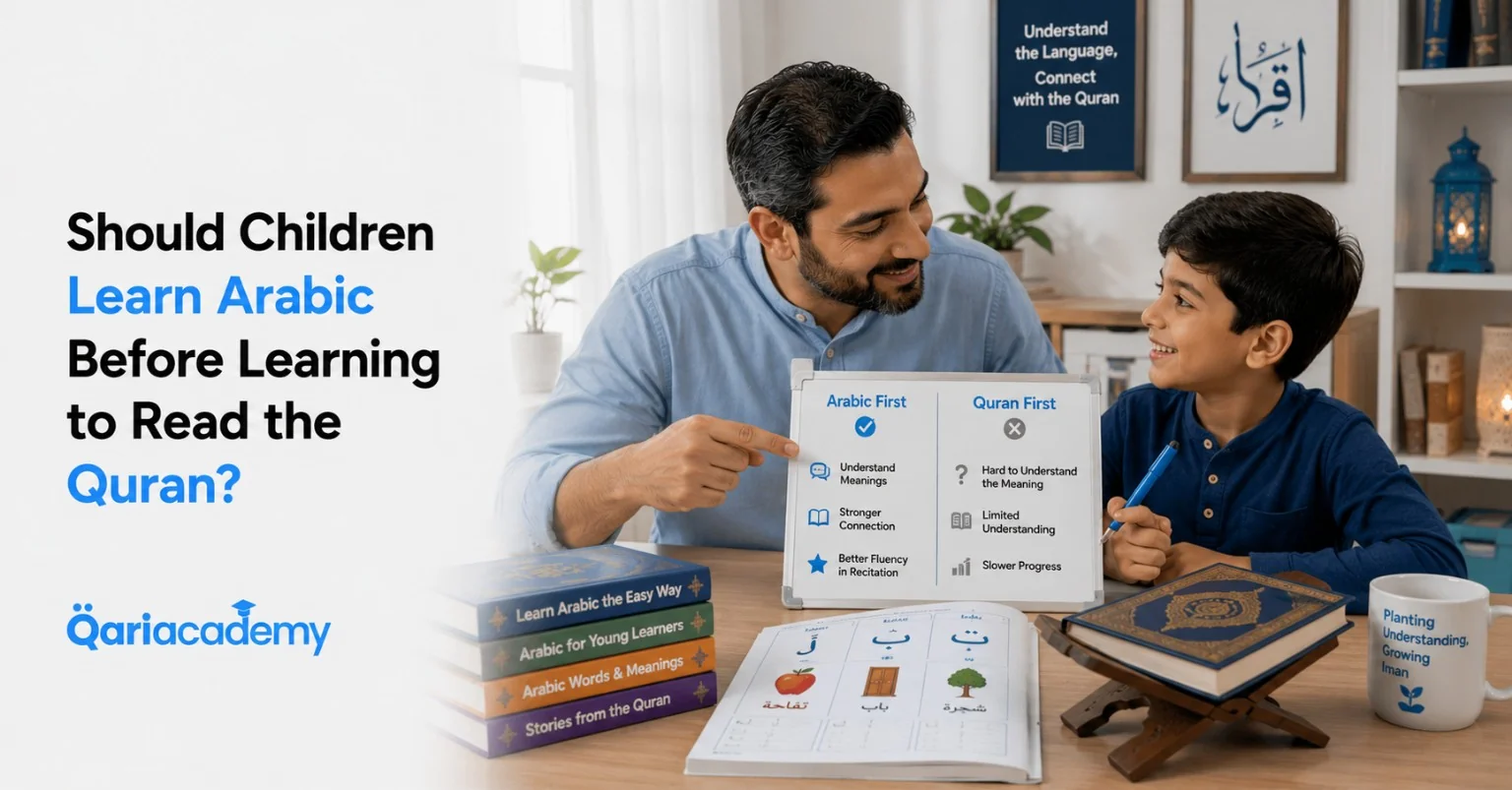
Should children learn Arabic before learning to read the Quran?
At first, the answer may seem obvious. The Quran was revealed in Arabic, so perhaps a child should first learn Arabic as a complete language—vocabulary, grammar, conversation, reading, and writing—and only then begin learning to read the Quran.
But that approach can create an unnecessary delay.
The more accurate answer is that children do not need to become fluent Arabic speakers before they can learn to read the Quran. They do, however, need to learn the Arabic script, its sounds, Harakat, and the reading patterns necessary for accurate Quranic recitation.
These are two different goals.
For Muslim children growing up in the USA, UK, Canada, Australia, and other non-Arabic-speaking environments, understanding this distinction can make Quran education much more practical.
The goal is not to choose between Arabic and Quran.
The goal is to understand which Arabic skills your child needs now and which can develop alongside Quran learning.
This distinction is especially important because Arabic language development and Quran reading are connected, but they are not identical educational processes.
A child may learn to decode Quranic Arabic without being able to hold an Arabic conversation. At the same time, learning Arabic vocabulary and comprehension can eventually help that child understand and connect more deeply with what they recite.
So the real question is not:
“Should my child learn Arabic first?”
It is:
“What Arabic skills does my child need before beginning Quran reading, and what can we teach alongside it?”
The Short Answer: No, Not Necessarily
If your child’s immediate goal is to read and recite the Quran, they do not need conversational Arabic first.
They need the foundations of Arabic literacy, including:
- Arabic letter recognition
- Letter sounds
- Harakat
- Connected letters
- Basic Quranic reading patterns
- Correct pronunciation
- Gradual Tajweed development
A child can therefore begin learning Quran reading while gradually developing Arabic vocabulary and comprehension.
| Goal | What the Child Needs | Arabic Fluency Required? |
|---|---|---|
| Read the Quran | Arabic script and reading skills | No |
| Recite with Tajweed | Reading and pronunciation | No |
| Understand the Quran | Vocabulary and language knowledge | Increasingly helpful |
This distinction is important because reading Arabic is not the same as understanding Arabic.
A child can learn to pronounce a Quranic verse accurately without understanding every word. Later, Arabic vocabulary and comprehension can deepen that experience.
Reading the Quran and Understanding Arabic Are Different Skills
Consider two separate abilities.
The first is decoding written Arabic: recognizing letters, vowels, combinations, and words.
The second is understanding the language: knowing vocabulary, grammar, sentence structure, and meaning.
They support each other, but they do not have to be mastered simultaneously.
A useful way to think about Quran learning is as three connected tracks:
| Learning Track | Main Objective | Examples |
|---|---|---|
| Quran Reading | Decode the written text | Letters, Harakat, words |
| Quran Recitation | Read accurately | Makharij, Tajweed |
| Quran Understanding | Understand meaning | Vocabulary, grammar |
This means you do not need to tell a six-year-old:
“First become fluent in Arabic, then you can learn Quran.”
Instead, you can start with the Arabic reading system while gradually adding language skills.
For parents who want to explore the broader relationship between Arabic and Quran learning, QariAcademy’s Arabic learning for kids explains how Arabic instruction can be combined with Quran education rather than treated as a prerequisite.
What Arabic Does a Child Actually Need to Read the Quran?
A beginner does not need thousands of Arabic words before opening the Mushaf.
They need foundational reading skills such as:
- Recognizing Arabic letters
- Distinguishing similar letters
- Understanding letter sounds
- Reading Fathah, Kasrah, and Dammah
- Recognizing Sukoon
- Reading Tanween
- Understanding basic Madd patterns
- Recognizing Shaddah
- Developing correct pronunciation
This is Arabic literacy, not conversational fluency.
For example, a child can learn:
بَ — بِ — بُ
without knowing how to construct an Arabic sentence.
As these patterns become familiar, the child can progress toward Quranic words and passages.
This is why parents should avoid making the mistake of thinking that a child must complete a full Arabic language curriculum before beginning Quran reading.
The child needs the Arabic skills relevant to the immediate task.
Why the Arabic Alphabet Should Come First
For a complete beginner, Arabic letters are the natural starting point.
Children need to recognize letters such as:
ا، ب، ت، ث، ج، ح، خ
But memorizing the alphabet in order is not enough.
A child might confidently recite:
Alif, Ba, Ta, Tha…
but still struggle when shown:
ث
on its own.
That means the child knows the sequence but has not developed automatic letter recognition.
This is why recognition matters more than simply memorizing the alphabet.
Similar letters also require repeated practice:
ب — ت — ث
and:
ج — ح — خ
Children need to recognize the visual differences and eventually connect those differences with the correct sounds.
Parents who want a more detailed explanation of this foundation can also read QariAcademy’s Teaching Kids Arabic Letters with Tajweed Precision, which focuses on letter recognition, pronunciation, repetition, and connecting Arabic letters to Quranic reading.
Should Children Learn Arabic Sounds Before Quran Reading?
Yes—but this still does not mean conversational Arabic.
A child needs to learn the sounds required to decode Quranic Arabic accurately.
Some Arabic sounds may be unfamiliar to children who primarily speak English, including:
ح، خ، ع، غ، ص، ض، ط، ظ، ق
The child does not need to know Arabic grammar to pronounce these letters.
They need repeated exposure, demonstration, and correction.
This is one reason pronunciation should be developed from the beginning rather than treated as something to fix years later.
A child who learns incorrect pronunciation repeatedly may eventually develop habits that are harder to correct.
That does not mean beginners need advanced Tajweed theory.
It means the teacher should establish correct pronunciation habits while the child is learning the basics.
What About Harakat?
Harakat are essential to Quran reading.
Children need to understand the basic short vowels:
Fathah ـَ
Kasrah ـِ
Dammah ـُ
For example:
بَ — بِ — بُ
The child learns that the same letter can produce different sounds depending on the vowel marking.
A gradual progression might look like this:
| Stage | Example | Skill |
|---|---|---|
| Letter | ب | Recognize the letter |
| Fathah | بَ | Read the vowel |
| Kasrah | بِ | Distinguish the sound |
| Dammah | بُ | Read another vowel |
| Combination | بَتَ | Combine sounds |
Once these patterns become familiar, the child can begin decoding more complex Quranic words.
This is a major transition because the child is no longer simply identifying symbols. They are beginning to read.
Why a Structured Qaida Can Help
Starting immediately with full Quran pages can overwhelm a beginner.
A structured Qaida-based approach creates a bridge between the alphabet and the Mushaf.
Depending on the teacher and curriculum, children may progressively learn:
Letters → Harakat → Connected Letters → Sukoon → Tanween → Madd → Shaddah → Quranic Words → Quranic Passages
The exact book is less important than whether the curriculum builds transferable reading skills.
The goal is not for the child to simply “finish the Qaida.”
The goal is for the child to understand how to decode Arabic text.
This distinction is important.
A child could finish an entire beginner book while still relying heavily on the teacher to read unfamiliar words.
Another child might progress through fewer pages but develop much stronger independent decoding skills.
The second child may actually have the stronger foundation.
Quranic Arabic Is Not the Same as Conversational Arabic
Another source of confusion is the word Arabic.
When parents say their child needs to learn Arabic, they may mean very different things:
- Quranic reading
- Quranic vocabulary
- Modern Standard Arabic
- Conversational Arabic
- Arabic writing
- Arabic grammar
- A regional dialect
These are not identical goals.
| Arabic Goal | Main Purpose | Relevance to Quran |
|---|---|---|
| Quranic reading | Read and recite | Direct |
| Quranic Arabic | Understand Quranic vocabulary and grammar | Very high |
| Modern Standard Arabic | Broader formal literacy | Helpful |
| Conversational Arabic | Everyday communication | Indirect but valuable |
| Arabic writing | General literacy | Helpful |
| Grammar | Deeper language understanding | Important later |
So if your child’s immediate goal is Quran reading, conversational Arabic does not need to come first.
A child can learn to decode Quranic text without first learning how to order food in Arabic, hold a conversation, or study advanced grammar.
Those skills can come later or develop alongside Quran education.
Why Learning Arabic Alongside Quran Can Be Better
Although children do not need full Arabic fluency before learning Quran reading, there is a strong reason to teach Arabic alongside Quran education.
Understanding makes recitation more meaningful.
When a child begins recognizing recurring Quranic words, the Quran becomes more than a sequence of sounds.
They start connecting:
Sound → Written Word → Meaning
That can increase engagement and encourage curiosity.
Therefore, the better approach is not:
Arabic first → Quran later
and it is not:
Quran reading only → Arabic never
A stronger long-term approach is:
Quran reading + Arabic language development
at an age-appropriate level.
QariAcademy’s Learn Arabic for Kids program is relevant for families who want to develop broader Arabic skills alongside Quran education.
A Two-Track Learning Model
Parents can think about the journey as two parallel tracks.
Quran Track
Letters → Harakat → Words → Quranic Passages → Tajweed → Fluency
Arabic Track
Vocabulary → Simple Phrases → Comprehension → Grammar → Deeper Understanding
Over time, these tracks reinforce each other.
| Quran Track | Arabic Track | Combined Benefit |
|---|---|---|
| Learn letters | Hear Arabic sounds | Better recognition |
| Read words | Learn vocabulary | Connect text with meaning |
| Recite verses | Study simple meanings | Deeper engagement |
| Learn Tajweed | Improve pronunciation | Stronger language awareness |
| Read passages | Study grammar gradually | Better comprehension |
This is usually more practical than making the child wait until one entire track is “finished.”
What If the Child Is Very Young?
Young children generally do not need formal Arabic grammar lessons before starting Quran education.
A five- or six-year-old may benefit more from:
- Arabic letters
- Simple sounds
- Short Quran lessons
- Repetition
- Basic vocabulary
- Quran listening
- Visual activities
- Short practice sessions
The objective is to build familiarity without creating unnecessary pressure.
At this age, the learning experience should be developmentally appropriate.
Parents should not expect the same concentration, reading speed, or abstract understanding from a five-year-old that they would expect from a teenager.
For practical strategies on maintaining children’s attention during Quran learning, see QariAcademy’s Effective Techniques to Enhance Children’s Focus During Quran Classes.
What If the Child Is Older?
Older children can often handle a more integrated approach.
For example, a ten-year-old might study:
Quran reading + Tajweed + Quranic vocabulary
while a teenager might add:
Grammar + morphology + translation + Tafsir
The important thing is that the program develops with the child.
A child should not remain at the level of mechanically pronouncing words forever.
As reading improves, understanding should gradually become a larger part of the learning experience.
Why This Matters for Children Growing Up in the West
For children growing up in the USA, UK, Canada, or Australia, English is often the language of:
- School
- Friends
- Entertainment
- Books
- Technology
- Social interaction
Arabic may be limited to Quran lessons, mosque visits, or conversations with family members.
Parents therefore should not assume that Arabic will develop naturally.
A structured learning environment can make a major difference.
The child may be highly intelligent and academically successful but still need systematic Arabic instruction because they simply have not had enough exposure to the language.
This is not a weakness.
It is a language-exposure issue.
The Problem With Making Children Wait
There is an important blind spot here.
If parents insist:
“My child must learn Arabic first.”
they may unintentionally delay Quran reading for months or years.
If the immediate goal is Quran reading, the child can start learning the Arabic script and Quranic reading system now.
At the same time, the family can gradually introduce Arabic vocabulary and comprehension.
This gives the child progress in both areas without requiring complete mastery of one before starting the other.
Imagine a six-year-old who spends two years studying general Arabic before being allowed to begin Quran reading.
If the family’s primary objective during those two years was Quran literacy, that sequence may not be the most efficient one.
The better solution is usually to identify the specific prerequisite skills and begin them immediately.
But Don’t Make the Opposite Mistake
There is also an opposite problem.
Some children spend years learning to pronounce Quranic text without developing any understanding of what they are reading.
A child may eventually recite beautifully but know very little of the vocabulary appearing repeatedly in the verses.
That is why Arabic language education should not be ignored.
A healthy long-term progression can look like:
- Learn to recognize Arabic letters.
- Learn to decode Quranic words.
- Read independently.
- Improve Tajweed.
- Build Quranic vocabulary.
- Understand simple verses.
- Develop deeper Arabic comprehension.
The goal is to move from reading toward understanding.
How Tajweed Fits Into the Journey
Tajweed does not require complete Arabic fluency.
Children can begin learning correct pronunciation while developing their reading skills.
Important early areas include:
- Correct letter pronunciation
- Makharij
- Basic Harakat
- Madd
- Clear recitation
- Appropriate stopping
More advanced Tajweed rules can be introduced progressively.
For parents looking for a structured introduction, QariAcademy’s Tajweed for Kids: A Parent’s Guide explains how Tajweed can be introduced without overwhelming young learners.
Families can also use the 30-Day Tajweed Plan for Kids as a supplementary resource for structured practice.
The important principle is simple:
Build correct pronunciation early, then gradually expand the technical understanding of Tajweed.
How Parents Can Combine Arabic and Quran at Home
You do not need a complicated home curriculum.
Try small activities throughout the week.
During Quran practice: Ask your child whether they recognize a familiar word.
During meals: Introduce one or two simple Arabic words.
During Quran listening: Ask them to notice a word they already know.
During family time: Use simple Arabic greetings.
During reading: Point out familiar Quranic vocabulary.
The objective is not to turn every family moment into an Arabic lesson.
It is simply to increase exposure.
Parents looking for additional strategies can read QariAcademy’s How to Support Your Child’s Quran Learning Online, which covers creating a learning environment, establishing routines, encouraging children, and communicating with teachers.
A Practical Weekly Model
A realistic routine might include:
| Activity | Suggested Frequency | Main Purpose |
|---|---|---|
| Quran reading lesson | 2–3 times weekly | Build reading skills |
| Arabic vocabulary | Short daily practice | Build language familiarity |
| Quran practice | Most days | Reinforce reading |
| Quran listening | Regularly | Support pronunciation |
| Meaning review | 1–2 times weekly | Build comprehension |
The exact schedule should depend on the child’s age, school workload, and learning needs.
Consistency is more important than creating an impressive schedule that the family cannot maintain.
For families struggling to maintain consistency, QariAcademy’s How Busy Parents Can Keep Their Children Consistent With Quran Learning offers practical ideas for keeping Quran learning sustainable around a busy family schedule.
How to Know Which Path Your Child Needs
Ask these five questions:
1. Can my child recognize Arabic letters?
If not, begin with the alphabet.
2. Can my child read letters with Harakat?
If not, focus on foundational reading.
3. Can my child read connected words?
If not, continue structured reading practice.
4. Can my child read Quranic passages?
If yes, work toward fluency and Tajweed.
5. Does my child understand basic Quranic vocabulary?
If not, begin adding Quranic Arabic.
This prevents parents from forcing every child through the same curriculum.
| Child’s Current Ability | Recommended Focus |
|---|---|
| Does not recognize letters | Arabic alphabet |
| Recognizes letters but struggles with Harakat | Basic Quran reading |
| Reads Harakat but struggles with connections | Qaida |
| Reads basic words | Guided Quran reading |
| Reads Quran but has pronunciation issues | Tajweed |
| Reads Quran comfortably | Fluency + Quranic Arabic |
The most important principle is:
Start where the child actually is, not where you think they should be.
Why One-on-One Instruction Can Help
Children do not all need the same amount of time to master a particular skill.
One child may recognize Arabic letters almost immediately.
Another may confuse:
ب — ت — ث
for several weeks.
One child may move quickly through Harakat.
Another may need substantial repetition.
In a one-on-one environment, the teacher can adapt the lesson to the individual student rather than forcing every child through the same pace.
QariAcademy’s online Quran classes are structured around one-on-one instruction and different student levels.
Its Quran for Kids program states that no prior experience is required and that the program is designed for absolute beginners as well as children at other levels.
That kind of placement can prevent two common problems:
The child becomes frustrated because the material is too difficult.
or:
The child becomes bored because the material is too easy.
Why Learning Should Be Enjoyable
This does not mean every Quran lesson needs to become a game.
It means the child should not associate learning with constant pressure, embarrassment, or failure.
Short activities, repetition, visual material, questions, and encouragement can make difficult concepts more manageable.
QariAcademy’s article on making Quran learning fun for kids online discusses interactive activities, active participation, short focused sessions, storytelling, and positive reinforcement.
The objective is not entertainment for its own sake.
The objective is to create enough engagement for meaningful learning to happen.
Don’t Turn Every Mistake Into a Problem
Parents sometimes become anxious when a child repeatedly makes pronunciation mistakes.
But mistakes are part of learning.
Instead of saying:
“You already learned this. Why did you forget?”
try:
“Let’s practice it one more time.”
Instead of comparing the child with another student, compare the child’s current ability with their previous ability.
For example:
- Does the child recognize more letters?
- Do they need fewer prompts?
- Are they reading faster?
- Are pronunciation errors decreasing?
- Are they more comfortable reading aloud?
These are much more useful indicators of progress.
What Parents Should Avoid
1. Waiting for Arabic Fluency
A child does not need conversational fluency before beginning Quran reading.
2. Teaching Only Alphabet Names
Knowing the alphabet sequence does not automatically create reading ability.
3. Starting Full Quran Pages Too Early
A weak foundation can make the child dependent on the teacher.
4. Keeping the Child in the Alphabet Stage Too Long
Once the child has mastered the letters, move toward decoding.
5. Treating the Qaida as the Final Goal
The Qaida is a bridge toward Quran reading.
6. Focusing Only on Memorization
Memorization and reading are separate skills.
7. Ignoring Meaning Forever
Once reading develops, gradually add vocabulary and understanding.
8. Comparing Children
Different children begin with different levels of Arabic exposure and reading experience.
How Parents Can Measure Real Progress
Parents often measure progress using:
“How many pages did my child finish?”
That is not always useful.
A better question is:
“What can my child do independently now that they could not do before?”
For example:
| Weak Progress Measure | Better Measure |
|---|---|
| Pages completed | Reading skills mastered |
| Lessons attended | Concepts retained |
| Surahs memorized | Independent reading |
| Time spent | Accuracy improved |
| Book pages finished | Fewer repeated mistakes |
| Teacher prompts | Increased independence |
A child who has completed fewer pages but can now decode unfamiliar words independently may have made more meaningful progress than a child who has rushed through many pages with constant teacher prompting.
Should Arabic and Quran Be Learned Together?
For many families, yes.
A child can learn:
Arabic letters + Quran reading
at the beginning.
Then:
Quran reading + Quranic vocabulary
as reading develops.
Then:
Quran reading + Tajweed + Arabic comprehension
at a more advanced stage.
This avoids creating an artificial separation between the two subjects.
The Quran becomes both a reading text and a source of meaningful Arabic exposure.
A Complete Roadmap for Parents
The ideal sequence is not:
Arabic first → Quran later
and it is not:
Quran reading only → Arabic never
A stronger model is:
Arabic literacy + Quran reading + Arabic understanding
from an appropriate starting point.
| Stage | Quran Goal | Arabic Goal |
|---|---|---|
| 1 | Recognize letters | Basic sounds |
| 2 | Read Harakat | Simple vocabulary |
| 3 | Connect letters | Basic phrases |
| 4 | Read Quranic words | Quranic vocabulary |
| 5 | Read short passages | Simple meanings |
| 6 | Tajweed and fluency | Grammar and comprehension |
This gives children the practical skill of reading while gradually building the language knowledge needed for deeper understanding.
A Simple Decision Guide
If you want the shortest possible answer:
Start With the Arabic Alphabet If:
Your child does not recognize Arabic letters.
Start With a Qaida If:
Your child knows the alphabet but cannot confidently read connected Arabic.
Start With Quran Reading If:
Your child can already decode basic Arabic words and is ready to apply those skills to Quranic text.
Add Tajweed If:
Your child can already read Quran but needs improvement in pronunciation and recitation.
Add Arabic Language If:
Your goal is for your child to understand the Quran rather than only recite it.
This is the most practical framework for parents.
How to Create a Quran-Friendly Home
Learning does not stop when the online lesson ends.
The home environment can either reinforce the child’s progress or make consistency difficult.
A Quran-friendly home does not need to be strict or complicated.
It can simply include:
- A regular Quran routine
- A quiet learning space
- Positive encouragement
- Regular Quran listening
- Short home practice
- Parents who model Quran engagement
QariAcademy’s guide to creating a Quran-friendly home environment emphasizes the importance of daily habits, parental involvement, positive reinforcement, and reducing unnecessary pressure.
This is particularly valuable for children who have limited exposure to Arabic outside their Quran lessons.
How QariAcademy Can Help
The right starting point depends on the child’s actual ability.
A child who cannot recognize Arabic letters may need a beginner Quran reading program.
A child who reads basic Quranic text may benefit from Tajweed.
Another child may be ready to combine Quran reading with Arabic vocabulary or Hifz.
QariAcademy provides one-on-one online Quran classes with instruction tailored to different student levels.
Its Quran for Kids program is designed for children ages 5–15 and states that no prior experience is required, making it relevant for complete beginners as well as children with previous Quran experience.
For families who want Arabic instruction alongside Quran education, QariAcademy also provides Arabic learning for kids.
This allows parents to build a learning pathway based on what the child actually needs rather than deciding that every child must complete a full Arabic course before starting Quran.
A Trial Lesson Can Remove the Guesswork
Parents sometimes spend weeks wondering:
“Is my child ready?”
A qualified assessment can answer that question much more effectively.
A teacher can observe:
- Letter recognition
- Pronunciation
- Harakat
- Connected reading
- Quran reading ability
- Attention
- Existing Arabic exposure
- Confidence
Instead of choosing a curriculum based purely on the child’s age, parents can identify the exact skill that needs attention.
This is particularly useful when the child has some previous experience but the parent is unsure whether that experience is sufficient for independent Quran reading.
Book a Free Trial With QariAcademy
Frequently Asked Questions
Should children learn Arabic before learning to read the Quran?
No. Children do not need conversational Arabic fluency before beginning Quran reading. They need the Arabic script, sounds, Harakat, and reading patterns required to decode Quranic text.
Can a child read Quran without speaking Arabic?
Yes. A child can learn to read and recite Quranic Arabic without being able to hold an Arabic conversation. Understanding the meaning requires additional vocabulary and language study.
Should Arabic and Quran be learned together?
For many children, yes. Quran reading can build Arabic literacy while Arabic vocabulary gradually helps children understand what they are reading.
What should a complete beginner learn first?
Usually, the child should begin with Arabic letters, their sounds, basic Harakat, and connected forms before moving into more complex Quranic reading.
Is learning the Arabic alphabet enough?
No. Alphabet recognition is only the beginning. Children need to learn sounds, Harakat, connected letters, and how to decode Quranic words.
Should children learn grammar before Quran reading?
Not necessarily. Basic Quran reading can begin before formal grammar. Grammar becomes more useful when the child’s goal expands toward deeper Arabic understanding.
Should children learn Tajweed before Arabic?
They do not need to choose between them. Basic pronunciation and Tajweed can develop alongside Quran reading, while broader Arabic language skills develop progressively.
How long does it take to learn Quran reading?
There is no universal timeline. It depends on the child’s age, starting level, lesson frequency, home practice, attention, previous Arabic exposure, and teaching approach. A complete beginner may need several months to develop basic reading skills, while fluency and Tajweed require continued practice.
Conclusion
So, should children learn Arabic before learning to read the Quran?
The best answer is:
Children should learn the Arabic reading skills necessary for Quran recitation, but they do not need to master Arabic as a complete spoken language first.
If the goal is Quran reading, begin with:
Arabic letters → sounds → Harakat → connected letters → reading patterns → Quranic words → Quran reading → Tajweed
At the same time, gradually introduce:
Arabic vocabulary → simple expressions → Quranic vocabulary → comprehension → grammar
This means parents do not have to choose between Arabic and Quran.
They can build both together.
The important distinction is between Arabic literacy and Arabic fluency.
A child can begin learning to read the Quran long before becoming conversationally fluent in Arabic.
At the same time, parents should think beyond simply teaching pronunciation. As reading develops, Arabic vocabulary and comprehension can help transform Quran recitation into a deeper learning experience.
For families raising Muslim children in English-speaking environments, this balanced approach is especially practical.
Your child does not need to speak Arabic perfectly before opening the Mushaf.
They need the right foundation, consistent practice, patient guidance, and a learning plan that grows with them.
The most effective approach is usually:
Assess → Start at the right level → Teach progressively → Practice consistently → Correct gently → Track skills → Adjust the plan
And don’t underestimate the importance of the teacher.
A complete beginner needs someone who can slow down without making the child feel behind, repeat without becoming frustrated, and turn difficult Arabic sounds and reading patterns into manageable steps.
For families looking for structured support, QariAcademy offers one-on-one online Quran learning for children at different levels, including absolute beginners. Its children’s program states that students can begin without prior experience and progress through Quran reading, Tajweed, fluency, and memorization.
The goal is not to force Arabic to come first.
The goal is to give the child the right Arabic skills at the right time.
Your child does not need to know Arabic before beginning the journey.
They simply need the right first step.
And for a child who has never learned Arabic, that first step may be as small as learning one letter correctly.
Then another.
Then one sound.
Then one word.
Then one verse.
Over time, those small steps can lead to something much bigger: the ability to open the Quran, read it independently, recite it correctly, and eventually begin understanding the words they have been reciting.
Start Your Child’s Quran Journey From the Right Level
If your child has never learned Arabic, you don’t need to guess whether they should begin with the alphabet, Qaida, Quran reading, or Arabic language.
A teacher can assess their current ability and help establish an appropriate starting point.
Book a Free Trial With QariAcademy
Start with reading.
Build Arabic alongside it.
Then gradually move from pronunciation to understanding.
That is a much more sustainable path toward a lifelong relationship with the Quran.