Table of Contents
Introduction
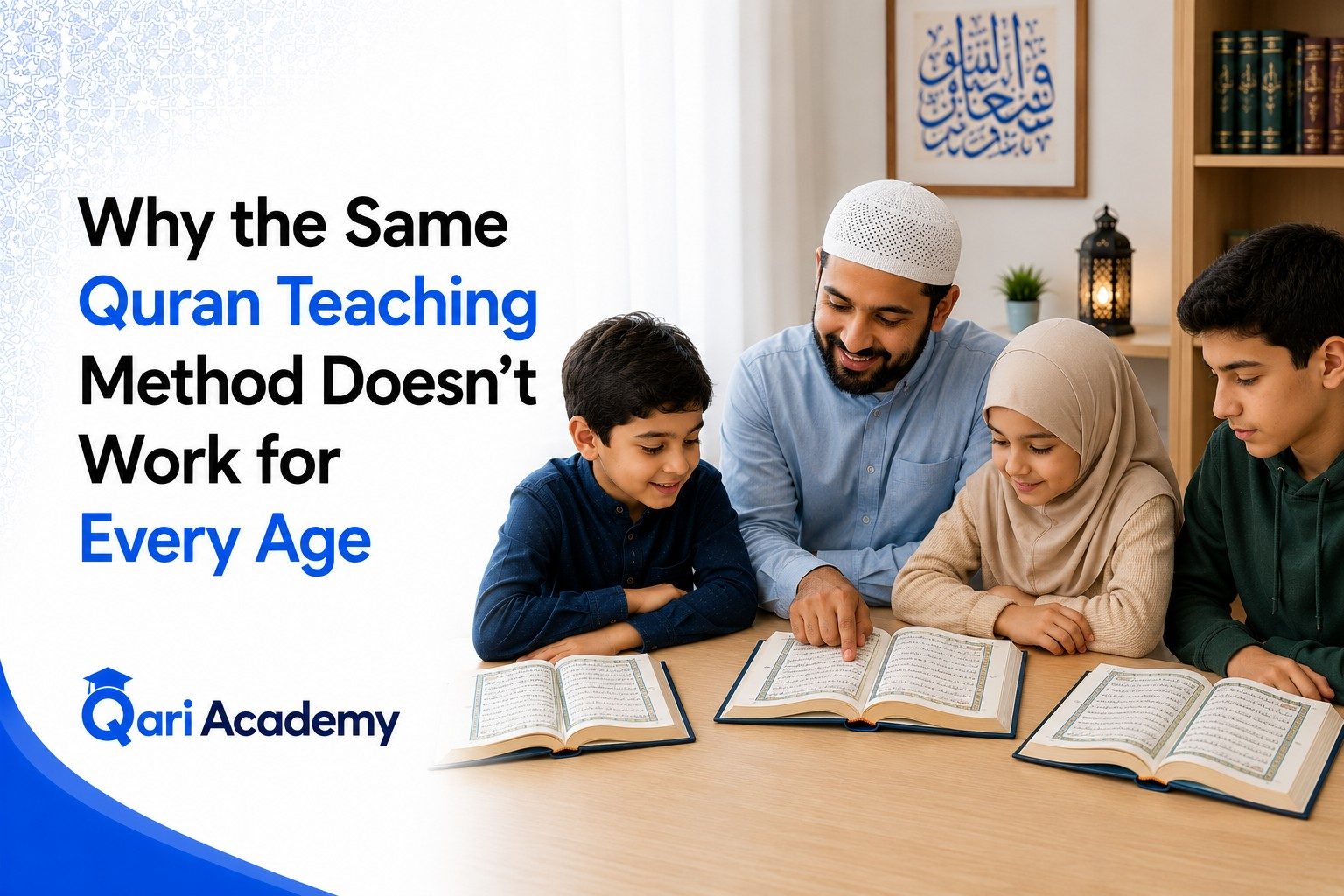
One of the biggest mistakes parents can make when choosing Quran education for their children is assuming that one teaching method should work equally well at every age.
A four-year-old, an eight-year-old, and a twelve-year-old may all be learning Quran.
But they are not the same type of learner.
They do not have the same attention span.
They do not process information in the same way.
They do not have the same emotional needs.
They do not necessarily have the same reading ability.
And they certainly do not have the same reasons for learning.
Yet many Quran programs unintentionally treat children as though age makes little difference.
The teacher follows the same lesson structure.
The child sits for the same amount of time.
The same type of explanation is used.
The same homework expectations are given.
The same correction style is applied.
And when one child struggles, parents may assume the problem is the child’s motivation or discipline.
Sometimes, however, the real problem is much simpler:
The teaching method does not match the child’s developmental stage.
This does not mean that every four-year-old needs a completely different Quran curriculum from every five-year-old, or that every teenager must learn in a particular way.
Children develop at different rates.
But age provides important clues about how instruction should be delivered.
A preschooler may learn best through short activities, repetition, movement, visual recognition, and positive interaction.
An elementary-age child may be ready for more structured reading practice, clear goals, and increasingly independent work.
A tween may need greater autonomy, meaningful explanations, measurable progress, and a teacher who understands that motivation is changing.
A teenager may respond better to respect, purpose, direct feedback, and opportunities to take ownership of their learning.
This is why effective Quran education should not simply ask:
“What should we teach?”
It should also ask:
“How should we teach this particular child at this particular stage?”
QariAcademy’s current children’s Quran programs are designed for ages 5–15 and state that lessons are one-on-one and adapted to the student’s level and pace.
That principle is important because personalization is not only about choosing what a child studies.
It is also about choosing how the child learns it.
The Core Principle: The Goal Can Stay the Same While the Method Changes
Parents sometimes misunderstand age-appropriate teaching.
They may think:
“If my child is learning Quran, shouldn’t the teacher simply teach Quran?”
Yes.
The objective can remain the same.
The method should change.
For example, the long-term goal might be:
Read the Quran accurately and confidently.
But the teaching method could look very different at different ages.
| Age | Same Goal | Different Method |
|---|---|---|
| 4–5 | Build Quran familiarity | Short, playful, highly interactive activities |
| 6–7 | Build reading foundation | Letters, sounds, Harakat, repetition |
| 8–10 | Develop reading ability | Structured practice and guided independence |
| 11–12 | Improve fluency and Tajweed | Explanation, goals, correction, self-practice |
| 13–15 | Build mature Quran learning | Autonomy, meaning, responsibility, deeper study |
The mistake is not having a consistent curriculum.
The mistake is confusing curriculum consistency with teaching-method rigidity.
A good program can have a clear progression while still adapting the lesson to the learner.
Why Age Changes the Way Children Learn
Children are not simply smaller versions of adults.
Their cognitive abilities, attention, emotional regulation, motivation, and independence develop over time.
This matters enormously in Quran education.
A young child may not understand why they need to repeat the same exercise twenty times.
An older child may become frustrated if the teacher explains something they mastered months ago.
A teenager may disengage if every interaction feels like an adult giving orders to a little child.
Therefore, the teacher must continuously balance:
Structure + age + ability + personality + learning goal
This is one reason individualized instruction can be valuable.
The child is not forced to fit perfectly into a predetermined teaching style.
What Works for Preschoolers?
Preschoolers are often enthusiastic but unpredictable learners.
One minute they may be completely engaged.
The next minute they may be looking at something outside the lesson.
That does not automatically mean they are undisciplined.
Their learning environment needs to account for their developmental stage.
What Young Children Usually Need
For preschool-aged children, Quran lessons often benefit from:
- Very short learning segments.
- Repetition.
- Visual material.
- Listening activities.
- Simple questions.
- Movement.
- Positive reinforcement.
- Familiar routines.
- Frequent changes of activity.
- A warm teacher-child relationship.
The objective should not be to make a four-year-old behave like a twelve-year-old.
Instead, the teacher should design learning around what the young child can realistically sustain.
For example, a lesson might move through:
Listen → Repeat → Identify → Recite → Activity → Review
rather than requiring the child to sit passively for the entire session.
QariAcademy’s guidance on children’s focus similarly recommends short manageable segments, interaction, movement, visual and auditory aids, and positive reinforcement.
Parents can also explore practical ideas in QariAcademy’s article on making Quran learning fun for kids online.
Why Long Lectures Usually Don’t Work for Very Young Children
Imagine asking a four-year-old to listen to a detailed explanation of Tajweed for twenty minutes.
The problem isn’t necessarily the child’s intelligence.
The teaching format is inappropriate.
A preschool child can learn a great deal.
But learning should be broken into manageable experiences.
Instead of explaining a complicated concept for a long time, the teacher might:
- Demonstrate.
- Let the child repeat.
- Ask the child to identify it.
- Correct gently.
- Repeat later.
The child learns through experience rather than through a long theoretical explanation.
What Changes Around Ages 6–7?
Around the early elementary years, many children can begin handling more structured Quran instruction.
This is often the stage where foundational Arabic reading becomes especially important.
The child may work on:
- Arabic letters.
- Letter sounds.
- Harakat.
- Connected letters.
- Sukoon.
- Tanween.
- Madd.
- Shaddah.
- Basic Quranic words.
But even at this age, instruction should remain interactive.
A six-year-old may understand a structured goal, but they still need repetition and encouragement.
The teacher might say:
“Today we’re going to learn how this letter changes when it connects.”
Then practice it repeatedly.
The child gets a clear objective without being overwhelmed by a large curriculum.
What Changes Between Ages 8 and 10?
This is an important transition.
Children around this age can often handle more deliberate skill-building.
They may be ready for:
- Longer reading exercises.
- More independent practice.
- Explicit explanations.
- Structured Tajweed instruction.
- Vocabulary.
- More detailed correction.
- Clear weekly goals.
This does not mean that games and interaction should disappear.
It means the balance can change.
Instead of:
80% activity + 20% direct instruction
the lesson might gradually move toward:
More direct learning + targeted practice + interaction.
The child can also begin understanding why a particular rule matters.
For example:
“Why do I need to pronounce this letter differently?”
That question can become an opportunity for deeper learning.
What Works for Tweens?
Tweens are often where parents notice a major change in Quran learning.
The child is no longer a little kid.
But they are not yet a teenager.
Their motivation may become more complicated.
They may begin asking:
“Why do I have to do this?”
“What’s the point?”
“Why am I still studying this?”
“Why is my friend learning something different?”
A teaching method that relies entirely on external authority may become less effective.
Tweens often benefit from:
- Clear goals.
- Measurable progress.
- Respectful communication.
- More independence.
- Meaningful explanations.
- Appropriate challenges.
- Teacher relationships.
- Opportunities to make choices.
The teacher should gradually move from:
“Do this because I told you.”
toward:
“Here’s what we’re trying to achieve, and here’s why this skill matters.”
That is a major developmental shift.
Why Motivation Changes With Age
A young child may be motivated by:
- Praise.
- Stickers.
- Games.
- Attention.
- Time with a favorite teacher.
An older child may care more about:
- Achievement.
- Independence.
- Understanding.
- Mastery.
- Personal goals.
- Relevance.
This does not mean rewards stop working.
It means rewards should not become the foundation of the entire learning system.
A teenager who has been studying Quran for years needs something deeper than:
“Finish this page and get a reward.”
They need to understand why the learning matters.
How Teaching Should Change for Teenagers
Teenagers require a particularly careful approach.
One major mistake is continuing to teach a fifteen-year-old exactly like a six-year-old.
That can feel disrespectful.
Teenagers are developing a stronger sense of identity and independence.
They want to be treated as people whose opinions matter.
This does not mean removing expectations.
It means changing the relationship.
Instead of:
“You must memorize this because I said so.”
a teacher can say:
“This is your target for this week. Let’s decide together how you’re going to reach it.”
Instead of:
“You’re not paying attention.”
try:
“What is making this lesson difficult to focus on?”
This approach does not eliminate accountability.
It makes accountability more mature.
QariAcademy’s approach to child-focused learning also emphasizes identifying the root cause behind resistance rather than simply labeling the behavior as a discipline problem.
The Same Lesson Length Does Not Work for Every Age
Another major mistake is assuming every child should receive the same lesson length.
A thirty-minute session may be very different for:
- A four-year-old.
- An eight-year-old.
- A twelve-year-old.
- A fifteen-year-old.
Even when the clock says “30 minutes,” the internal structure should change.
| Age | Lesson Structure |
|---|---|
| Preschool | Many short activities |
| 6–8 | Short learning blocks + repetition |
| 9–11 | Structured instruction + practice |
| 12–13 | Focused instruction + independent work |
| 14–15 | Deeper study + discussion + self-directed practice |
The issue is not simply how many minutes the child sits.
It is what happens during those minutes.
For additional practical guidance, see QariAcademy’s guide to improving children’s focus during Quran classes.
Why One Child May Need More Repetition Than Another
Age is important, but it is not the only variable.
Two eight-year-olds can have completely different learning needs.
Child A may:
- Speak Arabic at home.
- Already know the alphabet.
- Read simple words.
- Have attended Quran classes for two years.
Child B may:
- Speak only English.
- Never have studied Arabic.
- Have memorized several short surahs.
- Struggle to identify Arabic letters.
Treating both children identically would make little sense.
This is why ability should determine placement, while age helps determine teaching style.
That distinction is crucial.
Age Is Not the Same as Ability
This is one of the biggest blind spots parents should avoid.
Parents sometimes say:
“My child is ten, so they should be reading Quran fluently.”
But age does not tell you:
- How much instruction they received.
- Whether they practiced.
- Whether the previous teaching was effective.
- Whether they learned Arabic.
- Whether they memorized without reading.
- Whether they have pronunciation difficulties.
A better question is:
“What can my child actually do right now?”
Then build from there.
Why the Same Teaching Method Can Bore Advanced Children
There is another side to this problem.
Sometimes teachers adapt only when a child is struggling.
But advanced children also need adaptation.
Imagine a ten-year-old who already reads Quran fluently.
If every lesson begins with:
“Let’s practice the alphabet.”
the child will eventually disengage.
The material is too easy.
The child needs a new challenge.
Perhaps:
- Tajweed.
- Fluency.
- Makharij.
- Hifz.
- Quranic vocabulary.
- Meaning.
- Independent reading.
A good teacher must know when to slow down and when to accelerate.
The Importance of Differentiated Quran Teaching
The principle can be summarized like this:
Same destination. Different route.
A beginner may follow:
Alphabet → Harakat → Qaida → Quran reading
Another child may follow:
Qaida → Quran reading → Tajweed
Another:
Quran reading → Tajweed → Hifz
Another:
Tajweed → Fluency → Quranic Arabic → Deeper understanding
The curriculum should respond to the missing skill.
Teaching Method Should Also Change With the Child’s Emotional Development
Cognitive ability is only part of the picture.
Children’s emotional needs also change.
A preschooler may need constant reassurance.
An eight-year-old may respond strongly to praise.
A twelve-year-old may become sensitive to embarrassment.
A fifteen-year-old may reject an approach that feels childish.
Therefore, correction needs to evolve.
For Young Children
“Let’s try that sound again together.”
For Elementary Children
“Good effort. Let’s look at this letter carefully.”
For Tweens
“You’ve improved here, but this pronunciation still needs attention.”
For Teenagers
“You’re reading accurately overall. Let’s identify the two Tajweed areas that are limiting your fluency.”
The underlying objective is the same.
The communication is different.
Don’t Confuse Gentle Teaching With Low Standards
This is another important distinction.
An age-appropriate teaching method does not mean lowering expectations.
It means presenting appropriate expectations.
A four-year-old can have discipline.
A teenager can need correction.
A preschooler can have goals.
An older child can still benefit from encouragement.
The mistake is assuming that strictness automatically produces better Quran learning.
Sometimes it produces compliance.
But compliance is not the same as learning.
What Should Parents Expect From a Good Teacher?
A strong Quran teacher should be able to answer:
- What level is my child currently at?
- What is my child’s biggest weakness?
- What are we working on this month?
- Why are we using this teaching method?
- How will we know when the child is ready to move forward?
- What should we practice at home?
- What changes should we make if progress slows?
If the answer is always:
“Your child just needs to practice more.”
that may not be enough.
The teacher should be able to diagnose the learning problem.
The Teacher Should Adapt More Than the Child
This may sound obvious, but it is often overlooked.
Parents sometimes expect the child to adapt completely to the teacher.
A better educational model is:
Teacher + curriculum + environment adapt to the learner.
That does not mean allowing the child to dictate everything.
It means recognizing that effective instruction requires flexibility.
If a child doesn’t understand a concept after three explanations, repeating the fourth explanation in exactly the same way may not solve the problem.
Change the explanation.
Change the example.
Change the activity.
Change the pace.
How Online One-on-One Learning Can Support Different Ages
One-on-one instruction can make age-appropriate adaptation easier because the teacher is working with one student rather than trying to keep an entire group moving at the same pace.
For example:
A preschooler may need frequent activity changes.
An eight-year-old may need more reading drills.
A twelve-year-old may need more explanation and independence.
A fifteen-year-old may need deeper discussion and personal goals.
A one-on-one lesson allows the teacher to make those adjustments immediately.
QariAcademy’s Quran program describes its lessons as live one-on-one sessions tailored to the student’s pace and level.
You can also explore the broader structure of its online Quran classes.
What About Children Who Learn Quran Online?
Online learning creates another important consideration.
A young child may need more interaction to stay engaged.
An older child may be able to work independently for longer periods.
Parents should therefore avoid asking:
“Are online classes suitable for children?”
and instead ask:
“Is the online teaching method appropriate for my child’s age and learning style?”
QariAcademy’s resources on online Quran learning emphasize dedicated learning spaces, consistent routines, active participation, and reducing distractions at home.
For parents dealing specifically with distraction and boredom, QariAcademy’s article on improving focus in online Quran classes provides additional practical strategies.
How Parents Can Support Different Ages at Home
Parents also need to adapt.
You should not expect the same kind of home support from a five-year-old and a fourteen-year-old.
Ages 4–6
Parents may need to:
- Sit nearby.
- Help prepare the lesson.
- Encourage practice.
- Keep sessions short.
- Celebrate small achievements.
Ages 7–10
Parents can:
- Check assigned practice.
- Encourage independent attempts.
- Review difficult material.
- Ask about progress.
Ages 11–13
Parents can:
- Discuss goals.
- Ask the child what they find difficult.
- Encourage self-practice.
- Let the child take more responsibility.
Ages 14–15
Parents should increasingly move toward:
- Accountability.
- Goal-setting.
- Progress discussions.
- Independent practice.
- Long-term planning.
The parent gradually moves from manager to coach.
Consistency Still Matters at Every Age
Although teaching methods should change, one principle remains constant:
Consistency matters.
A four-year-old needs repetition.
A ten-year-old needs regular practice.
A teenager needs a sustainable routine.
The method changes.
The importance of consistency does not.
QariAcademy’s recent guide for busy parents emphasizes that the challenge is often not the child’s ability but maintaining a sustainable routine.
You can also read How Parents in the USA, UK, and Canada Can Create a Quran-Friendly Home Environment for practical ideas about making Quran part of the home environment.
Don’t Increase Pressure When the Method Is the Problem
This is perhaps the most important lesson for parents.
When progress slows, the natural reaction is often:
“Make the child practice more.”
But what if the problem isn’t practice?
What if:
- The lesson is too difficult?
- The explanation is confusing?
- The child is bored?
- The material is too easy?
- The child needs a different type of repetition?
- The teacher is not adapting?
- The schedule is exhausting?
Increasing pressure will not automatically solve these problems.
Sometimes the correct response is to change the method before increasing the workload.
A Better Way to Diagnose Slow Progress
When a child struggles, ask these questions:
1. Is the child attending consistently?
If not, consistency may be the problem.
2. Is the child practicing between lessons?
If not, reinforcement may be missing.
3. Does the child understand the material?
If not, the teaching approach may need adjustment.
4. Is the material too difficult?
If yes, step back temporarily.
5. Is the material too easy?
If yes, increase the challenge.
6. Is the child emotionally comfortable?
If no, investigate the relationship or environment.
7. Is the teaching method appropriate for the child’s age?
If no, change the method.
This is much more useful than automatically blaming motivation.
A Practical Age-Based Quran Teaching Framework
Here is a simple framework parents can use.
| Age | Primary Need | Teaching Approach |
|---|---|---|
| 4–5 | Familiarity and basic foundations | Playful, short, repetitive |
| 6–7 | Arabic reading foundation | Structured + interactive |
| 8–10 | Reading development | Practice + explanation |
| 11–12 | Fluency and responsibility | Goals + guided independence |
| 13–15 | Motivation and deeper learning | Autonomy + meaningful instruction |
This is not a rigid curriculum.
A six-year-old may be more advanced than a nine-year-old.
The framework simply provides a starting point for thinking about developmental differences.
How Quran Goals Should Change With Age
Teaching method is only one variable.
The actual goals can evolve as well.
| Stage | Possible Quran Goals |
|---|---|
| Preschool | Listening, familiarity, short surahs |
| Early elementary | Alphabet, reading, short surahs |
| Ages 8–10 | Quran reading, Tajweed foundations, memorization |
| Ages 11–12 | Fluency, Tajweed, Hifz, vocabulary |
| Teen years | Tajweed, Hifz, Arabic, understanding, independence |
Again, this does not mean every child must follow this exact sequence.
The child’s ability and family goals should determine the actual plan.
What If Your Child Is Behind?
Don’t automatically panic.
A twelve-year-old who is still struggling with Arabic reading may simply have a missing foundation.
The solution is not to pretend the child is at the level they “should” be.
Start from the actual level.
If necessary:
Alphabet → Qaida → Quran reading
Even if the child is older.
There is nothing shameful about learning a foundational skill later.
The shame comes from allowing embarrassment to prevent the child from learning.
What If Your Child Is Ahead?
Don’t hold them back.
If an eight-year-old is already reading Quran confidently, don’t keep them in beginner material simply because they are young.
Challenge them appropriately.
They may be ready for:
- Tajweed.
- Hifz.
- Fluency.
- Quranic vocabulary.
- Meaning.
- More independent reading.
Age should never become a ceiling.
The Biggest Mistakes Parents Make
Mistake 1: Using the Same Lesson Structure for Every Age
What works for preschoolers may bore teenagers.
Mistake 2: Choosing Material Based Only on Age
Ability matters more than the number on the child’s birthday.
Mistake 3: Assuming More Pressure Means More Progress
Sometimes the teaching method needs to change.
Mistake 4: Keeping Advanced Children at Beginner Levels
This can destroy motivation.
Mistake 5: Expecting Young Children to Have Adult-Level Focus
Attention develops gradually.
Mistake 6: Treating Teenagers Like Preschoolers
Older children need increasing autonomy and respect.
Mistake 7: Measuring Only Pages and Surahs
Skills matter more than page counts.
Mistake 8: Changing Teachers Too Quickly
First diagnose the problem.
The issue may be the curriculum, schedule, practice routine, or learning environment.
How to Make Quran Learning Age-Appropriate Without Losing Structure
You don’t need a completely different curriculum for every age.
Instead, change five things:
1. Lesson Structure
Shorter and more varied for young children.
More focused and independent for older students.
2. Explanation
Simple demonstrations for young children.
More detailed reasoning for older children.
3. Practice
Teacher-led for beginners.
Increasingly independent for older students.
4. Motivation
Praise and activities for young children.
Goals, achievement, meaning, and autonomy for older students.
5. Responsibility
Parents manage more when children are young.
Children gradually take responsibility as they mature.
A Simple Example: Teaching the Same Skill at Different Ages
Suppose the child is learning Surah Al-Fatihah.
A four-year-old might:
- Listen to the teacher.
- Repeat short portions.
- Use visual prompts.
- Practice one phrase at a time.
- Receive frequent encouragement.
An eight-year-old might:
- Read the words.
- Correct pronunciation.
- Memorize sections.
- Practice independently.
A twelve-year-old might:
- Review pronunciation.
- Study Tajweed.
- Learn vocabulary.
- Identify recurring mistakes.
A fifteen-year-old might:
- Refine recitation.
- Study meanings.
- Analyze vocabulary.
- Work toward independent revision.
Same Quran. Same Surah. Completely different learning experience.
That is what age-appropriate teaching actually means.
Why Meaning Becomes More Important as Children Get Older
For very young children, the immediate objective may simply be familiarity.
But as children mature, meaning becomes increasingly important.
A teenager who has been reciting Quran for years may reasonably ask:
“What does this verse actually mean?”
That question should not be treated as a distraction.
It can be the beginning of a deeper relationship with the Quran.
Arabic language learning can therefore become increasingly important as children grow.
QariAcademy’s Arabic for Kids program states that it develops reading, comprehension, Quranic vocabulary, and broader Arabic skills for children ages 5–15.
Quran Memorization Should Also Be Age-Appropriate
Memorization can begin young, but expectations should change.
A young child may memorize through:
- Listening.
- Repetition.
- Short portions.
- Frequent review.
An older child can gradually take greater responsibility for:
- Revision schedules.
- New memorization.
- Self-correction.
- Retention.
- Long-term Hifz planning.
QariAcademy’s Quran Hifz for Kids program describes a child-centered approach with structured revision and weekly goals for children ages 5–15.
The important principle is:
Do not turn memorization into a race.
Retention matters more than impressive short-term numbers.
How Parents Should Measure Progress by Age
The same progress indicator doesn’t work equally well for every child.
| Age | Useful Progress Indicators |
|---|---|
| 4–5 | Participation, recognition, repetition |
| 6–7 | Letter recognition, pronunciation, basic reading |
| 8–10 | Reading accuracy, independence, retention |
| 11–12 | Fluency, Tajweed, self-correction |
| 13–15 | Independence, understanding, long-term goals |
A four-year-old saying:
“I know this letter!”
may represent significant progress.
A fourteen-year-old improving one recurring Tajweed error may represent equally significant progress.
The metric must match the learner.
How QariAcademy Can Support Different Ages
For families looking for a structured online Quran program, the advantage of one-on-one instruction is that the teacher can adjust both what the child learns and how the lesson is delivered.
QariAcademy’s current Quran course is designed for children ages 5–15 and describes a structured progression toward Quran reading, Tajweed, and memorization, with one-on-one teaching and level-based support.
The broader QariAcademy Quran platform also highlights:
- One-on-one live lessons.
- Certified teachers.
- Flexible scheduling.
- Interactive learning.
- Different Quran learning goals.
- Progress tracking.
- Parent updates.
This matters because the right question is not simply:
“Does this academy teach Quran?”
Almost every Quran program will say yes.
The better questions are:
Can the teacher identify my child’s actual level?
Can the method change as my child develops?
Can the pace be adjusted?
Can the teacher recognize when the child needs more challenge?
Those questions are much more useful.
A Practical Parent Checklist
Before choosing or evaluating a Quran program, ask:
For Young Children
- Is the lesson interactive?
- Are activities short enough?
- Does the teacher use repetition?
- Is the environment positive?
For Elementary Children
- Is there a structured progression?
- Are reading skills being measured?
- Is the child becoming more independent?
For Tweens
- Does the teacher explain the purpose behind tasks?
- Does the child have clear goals?
- Is the child treated with respect?
For Teenagers
- Is there meaningful discussion?
- Is the child developing independence?
- Is Arabic understanding included when appropriate?
- Can the student participate in setting goals?
These questions can reveal much more than simply asking how many years the teacher has been teaching.
The Best Quran Teaching Method Is Not One Method
This is the conclusion parents should remember.
There is no universally perfect Quran teaching method.
There is only a method that is:
appropriate or inappropriate for a particular learner at a particular stage.
A young child may need:
Play + repetition + interaction
An elementary student may need:
Structure + practice + encouragement
A tween may need:
Challenge + goals + independence
A teenager may need:
Purpose + autonomy + deeper understanding
The Quran itself does not change.
The responsibility of the teacher is to help the learner reach it in a way they can actually sustain.
Frequently Asked Questions
Why doesn’t the same Quran teaching method work for every age?
Because children’s attention, cognitive development, motivation, emotional needs, reading abilities, and independence change as they grow. The Quran curriculum can remain structured while the teaching method adapts.
Should preschoolers learn Quran differently from teenagers?
Yes. Preschoolers generally benefit from shorter, interactive, repetitive activities, while teenagers can handle greater independence, deeper explanation, and more responsibility.
Does age matter more than ability?
No. Age can help guide teaching style, but demonstrated ability should determine the student’s actual learning level.
Should older children still use games?
Yes, when appropriate. The mistake is assuming that “fun” only means childish games. Older children can engage through challenges, goals, discussion, quizzes, problem-solving, and meaningful activities.
What if my child is older but still at a beginner Quran level?
Start at the missing foundation. An older beginner should not be forced into advanced Quran reading simply because of their age.
What if my child is younger but already advanced?
Allow them to progress. Age should not unnecessarily limit a child who has already mastered foundational skills.
How long should Quran lessons be for different ages?
There is no single ideal duration. Younger children often benefit from more varied lesson segments, while older children may sustain longer periods of focused work. The structure of the lesson matters as much as the total time.
Should parents use the same practice routine for every child?
No. A five-year-old may need short guided practice, while a teenager can gradually take responsibility for their own revision schedule.
Can Quran and Arabic be taught together?
Yes. Quran reading can develop alongside Arabic language learning. As children grow, Arabic vocabulary and comprehension can become increasingly important for understanding what they recite.
Is one-on-one Quran learning useful for different ages?
It can be particularly useful when children have different starting levels because the teacher can adjust the pace, material, correction, and lesson structure to the individual learner.
Conclusion
Why doesn’t the same Quran teaching method work for every age?
Because children change as they grow.
The four-year-old who needs movement and repetition will eventually become an eight-year-old who can handle structured reading practice.
That eight-year-old may become a twelve-year-old who needs greater independence.
And that twelve-year-old may become a fifteen-year-old who wants to understand the meaning behind what they have spent years reciting.
If the teaching method never changes, the child may eventually outgrow the method even though they have not outgrown Quran learning.
That is why effective Quran education should develop alongside the child.
For preschoolers, prioritize:
Familiarity + interaction + short activities + positive reinforcement
For younger school-age children:
Arabic literacy + structured reading + repetition + confidence
For older elementary students:
Reading + Tajweed + independence + measurable goals
For tweens:
Challenge + purpose + responsibility + meaningful feedback
For teenagers:
Autonomy + deeper understanding + personal goals + mature instruction
But there is one principle that should remain constant:
Start from the child’s actual level.
Do not assume that every child of the same age should study the same material.
Do not assume that more pressure will solve every learning problem.
Do not assume that a child who is struggling needs more lessons.
And do not assume that a child who is progressing quickly should remain at the same level simply because of their age.
Instead, ask:
What does this child know?
What are they struggling with?
What motivates them?
What can they realistically handle?
What should they learn next?
Those questions lead to much better Quran education.
QariAcademy’s current approach reflects this principle through one-on-one Quran instruction, level-based learning, flexible scheduling, and progress tracking.
Parents can also learn more about supporting children at home through How To Support Your Child’s Quran Learning Online and about creating a sustainable routine through How Busy Parents Can Keep Their Children Consistent With Quran Learning.
The goal is not to find one magical Quran teaching method.
The goal is to build a learning system that grows with your child.
And that is ultimately what good Quran education should do.
Give Your Child a Learning Method That Grows With Them
If you’re unsure whether your child’s current Quran lessons are appropriate for their age and level, an individual assessment can help identify what they actually need next.
QariAcademy offers one-on-one online Quran classes for children, with level-based instruction and flexible scheduling. Families can begin with a free trial and have the child’s current level assessed before choosing a regular learning plan.
Book a Free Trial With QariAcademy
Related QariAcademy Articles
If you’re building a Quran learning plan around your child’s age, these verified QariAcademy articles are useful next reads:
- Effective Techniques to Enhance Children’s Focus During Quran Classes
- My Child Gets Bored Quickly! 5 Quick Steps to Improve Your Child’s Focus in Online Quran Class
- How To Support Your Child’s Quran Learning Online
- How to Make Quran Learning Fun for Kids Online
- How Parents in the USA, UK, and Canada Can Create a Quran-Friendly Home Environment for Kids
- Why Modern Interactive Quran Learning Works Better for Kids in the USA, UK, and Canada
مهم: الروابط الستة أعلاه تم التحقق من وجود صفحاتها على موقع QariAcademy، ولم أعتمد على تخمين الـ slug.