Key takeaways
- Start with the 28 letters and their sounds, then the vowel marks and reading symbols.
- Join letters into words with a primer such as the Noorani Qaida before reading from the Mushaf.
- You do not need to understand Arabic to learn to read the Quran.
- Short daily practice with a teacher’s correction works for children and adults.
Table of Contents
Introduction
Learning to read the Quran is one of the most rewarding goals a Muslim can set – whether you are a parent helping a child take the first steps, or an adult starting from zero. The good news: the Arabic script is logical and very regular. Once you know the letters, the vowel marks and a few symbols, you can read almost any word in the Mushaf.
This guide walks you through the whole path in order: the 28 letters, the vowel marks, the reading symbols, joining letters into words, and finally reading from the Mushaf – with charts, a realistic timeline, and tips for children and adults.
Quick answer – can a beginner learn to read the Quran? Yes. Most beginners learn the 28 Arabic letters first, then the vowel marks and symbols, then joining letters into words – usually with a primer such as the Noorani Qaida. With short daily practice and a teacher’s correction, both children and adults can move on to reading the Mushaf. You do not need to understand Arabic to start.
وَلَقَدۡ يَسَّرۡنَا ٱلۡقُرۡءَانَ لِلذِّكۡرِ فَهَلۡ مِن مُّدَّكِرٍ
Al-Qamar 54:17 — “And We have certainly made the Quran easy to remember. So is there anyone who will be mindful?”
What Makes the Arabic Script Different
- Right to left. Arabic is read from right to left, and a Mushaf opens from what English readers think of as the back.
- Joined letters. Most letters connect to the next one in a word, like joined-up handwriting.
- Letters change shape. A letter can look slightly different at the start, middle or end of a word – for example بـ ـبـ ـب.
- Short vowels are marks. The short vowels are small signs above or below the letters, and the Mushaf prints all of them – which makes the Quran easier to read for beginners than everyday Arabic.
The 5-Step Path to Reading the Quran
Every good primer follows the same order. Take one step at a time; each builds on the one before.
Step 1: Learn the 28 Arabic Letters
Learn each letter’s shape, name and sound. Several sounds do not exist in English, so listening and repeating after a teacher matters from day one.
| Letter | Name | Sound |
|---|---|---|
| ا | Alif | Carries the long “aa” (and the Hamzah) |
| ب | Ba | b |
| ت | Ta | t |
| ث | Tha | “th” as in think |
| ج | Jeem | j |
| ح | Ha | A breathy “h” from the middle of the throat |
| خ | Kha | Like “ch” in Scottish loch |
| د | Dal | d |
| ذ | Dhal | “th” as in this |
| ر | Ra | A rolled r |
| ز | Zay | z |
| س | Seen | s |
| ش | Sheen | sh |
| ص | Sad | A heavy, full s |
| ض | Dad | A heavy d – unique to Arabic |
| ط | Ta | A heavy t |
| ظ | Dha | A heavy “th” as in this |
| ع | Ayn | A deep throat sound with no English equivalent |
| غ | Ghayn | Like a gargled or French r |
| ف | Fa | f |
| ق | Qaf | A deep k from the back of the tongue |
| ك | Kaf | k |
| ل | Lam | l |
| م | Meem | m |
| ن | Noon | n |
| ه | Ha | A light h as in hat |
| و | Waw | w (or a long “oo”) |
| ي | Ya | y (or a long “ee”) |
Letters that look alike – such as ب ت ث – differ only in their dots, so count the dots. For children, see teaching kids the Arabic letters with Tajweed; if letters keep slipping away, read why a child keeps forgetting the Arabic letters.
Tip: Say each letter out loud while you point at it. Reading with your eyes alone does not train your tongue.
Step 2: Learn the Short and Long Vowels
Arabic has three short vowels, written as small marks, and three long vowels made with ا و ي:
| Mark | Name | Sound | Example |
|---|---|---|---|
| ـَ | Fatha | short “a” | بَ |
| ـِ | Kasra | short “i” | بِ |
| ـُ | Dhamma | short “u” | بُ |
| ـَا | Fatha + Alif | long “aa” | بَا |
| ـِي | Kasra + Ya | long “ee” | بِي |
| ـُو | Dhamma + Waw | long “oo” | بُو |
Practise them with every letter: بَ بِ بُ – تَ تِ تُ. More ideas in Fatha, Kasra and Dhamma made simple.
Common mistake: Mixing up short and long vowels. بَ is “ba”, but بَا is “baa” and is held for two counts.
Step 3: Learn the Reading Symbols
| Symbol | Name | What it does | Example |
|---|---|---|---|
| ـۡ | Sukoon | No vowel – the sound stops | مِنۡ |
| ـّ | Shaddah | The letter is doubled | رَبِّ |
| ـً ـٍ ـٌ | Tanween | Adds an “n” sound at the end of a word | كِتَابٌ |
| ـٓ | Madd sign | Stretch the vowel longer | جَآءَ |
| ء | Hamzah | A short catch in the throat | سَأَلَ |
Tip: In the Madinah Mushaf the sukoon is not a small circle – it looks like a small head of the letter خ without its dot, as in مۡ. It is the same sign.
Step 4: Join Letters into Words
Now read letters joined together. Two things help: knowing the shapes a letter takes inside a word, and knowing that six letters – ا د ذ ر ز و – never join to the letter after them, which creates small gaps inside words. Start with short words, then two- and three-word phrases, and build speed slowly. Fluency is a skill of its own – see the hidden skill behind fluent Quran reading.
Common mistake: Spelling out each letter one by one without joining them. Read syllable by syllable, then the whole word, so the sounds blend as they do in recitation.
Step 5: Start Reading the Mushaf
Begin with Surah Al-Fatiha and the short Surahs at the end of Juz ‘Amma, which you may already know by heart – that makes them ideal for checking your reading. Read slowly, one line at a time, and build towards reading new pages without help: helping learners read the Quran independently.
Tip: Mushafs are printed in two common scripts – the Madinah (Uthmani) script and the Indo-Pak script. They use slightly different marks, so practise with the same script your primer and teacher use.
Choosing a Primer: Noorani Qaida and Others
A primer (Qaida) is a step-by-step book that takes you from letters to Quranic words. Any good primer works; consistency matters more than the choice.
| Primer | Best for | Style |
|---|---|---|
| Noorani Qaida | Most beginners – children and adults | Letters → vowels → symbols → Quranic words, with Tajweed habits built in |
| Iqra | Young children | Short pages and quick wins |
| Noor Al-Bayan | Children | Colourful, phonics-style lessons |
| Qaida Baghdadiyah | Traditional learners | Classic letter-by-letter method |
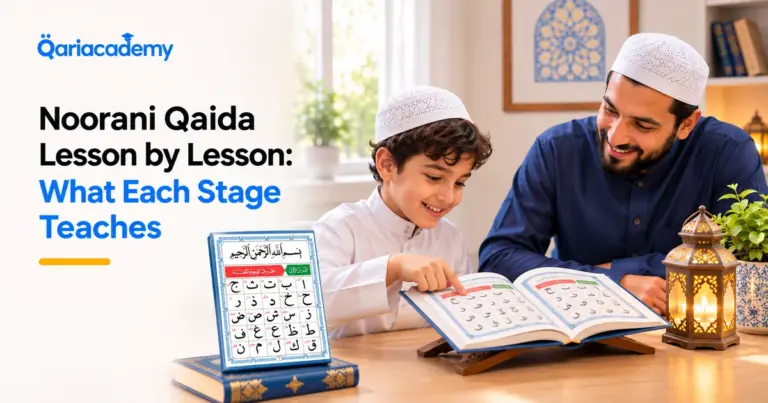
Learn more in Noorani Qaida course online: a beginner’s guide, or study it 1-on-1 in our Noorani Qaida course.
How Long Does It Take to Learn to Read the Quran?
It depends on age, how often you practise and whether a teacher corrects you. With two or more short lessons a week and a few minutes of daily practice, these are typical ranges:
| Starting point | Letters and vowels | Reading from the Mushaf |
|---|---|---|
| Young child (4–6) | about 3–6 months | about 9–18 months |
| Older child (7–12) | about 2–4 months | about 6–12 months |
| Adult beginner | about 1–3 months | about 3–9 months |
Every learner is different – these are guides, not deadlines. For more detail see how long it takes a child to learn to read the Quran, Quran learning by age and what a 7-year-old should know about Quran reading.
Teaching a Child to Read the Quran
- Short and often: 10–15 minutes a day beats one long weekly session.
- Start with sounds, not names: young children learn “b-a-ba” faster than “Ba with Fatha”.
- Praise effort: celebrate every new page, not only perfect reading.
- Keep a routine: same time, same place, same Mushaf.
Helpful reading: teaching Qaida Noorania to toddlers, my child can’t read Arabic yet – where to start and motivating kids to read Quran regularly.
Learning to Read the Quran as an Adult or New Muslim
Adults often learn faster than children because they can practise deliberately and understand the system behind the script. You do not need any Arabic background – just 15–20 minutes of practice a day and someone to check your pronunciation. Many adults and reverts learn privately and at their own pace in 1-on-1 lessons; see online Quran and Tajweed for reverts and our Quran for Adults course.
Common Beginner Problems (and How to Fix Them)
- Mixing up similar letters – count the dots: one below is ب, two above is ت, three above is ث.
- Reading very slowly or losing your place – follow the line with a finger and read whole words, not letter by letter. See why a child reads the Quran slowly.
- Knowing the letters but not reading words – go back to joining practice (Step 4). See my child knows the letters but can’t read the Quran.
- Guessing words – especially with memorized Surahs. Cover the next word and read only what is on the page.
- Forgetting between lessons – use micro-practice: five minutes a day keeps letters fresh far better than one long session a week.
- Starting late – it is never too late; see starting Quran lessons late.
Learn Quran Reading Online or at a Weekend School?
| Weekend or group class | Online 1-on-1 lessons | |
|---|---|---|
| Pace | Set by the group | Set by the learner |
| Correction | Shared between many students | Every word can be heard and corrected |
| Schedule | Fixed day and place | Times that fit your week |
| Community | Meeting other Muslim children | Less social – add family or mosque activities |
Both can work; many families combine a weekend school for community with 1-on-1 lessons for reading progress.
Next Step: Tajweed
Once you can read words smoothly, start learning the rules of correct recitation – one rule at a time. Our complete guide explains every rule with examples: Tajweed rules for beginners.
Learn to Read the Quran with a Teacher
Reading the Quran is learned by listening, repeating and being corrected. At Qari Academy, lessons are live, 1-on-1 and 30 minutes long, with male and female teachers, starting from the very first letter. Plans start from $36 per 28 days, and your first class is a free trial.
Courses: Noorani Qaida course · Quran for Kids · Quran for Adults · book a free trial class
FAQ
Can an adult learn to read the Quran from zero?
Yes. Many adults in their 30s, 40s and older learn to read the Quran from scratch. With 15–20 minutes of daily practice and regular correction, adults often progress quickly because they can practise deliberately.
How long does it take to learn to read the Quran?
Typical ranges with regular lessons and daily practice: young children about 9–18 months to read from the Mushaf, older children about 6–12 months, and adults about 3–9 months. Every learner is different.
Do I need to understand Arabic to read the Quran?
No. Reading the Quran and understanding Arabic are separate skills. You can learn to read correctly first and study the meaning later.
Do I need to learn Arabic grammar before reading the Quran?
No. Grammar (Nahw) helps with understanding, but it is not needed to read correctly. Beginners only need the letters, vowel marks and reading symbols.
What age can a child start learning to read the Quran?
Many children start around 4 to 6 years old, with short and playful lessons. Older children and teenagers can start at any time.
Can my children learn alongside me?
Yes. Learning as a family keeps everyone motivated. Children and adults usually progress at different speeds, so separate lessons with shared practice at home often work best.
Can I learn to read the Quran online?
Yes. Live 1-on-1 online lessons let a teacher hear every word and correct it straight away, which is what beginners need most.
Conclusion
Reading the Quran is a journey of small, steady steps: letters, vowels, symbols, joining, then the Mushaf. Keep lessons short, practise every day, and get your reading checked – and before long you, or your child, will be reading the words of Allah with confidence.
Quran Reading Guides in This Series
Each guide below goes deeper into one part of learning to read the Quran.
 Quran for KidsNorani Qaida Course Online: A Beginner’s Guide
 Quran for KidsTeaching Qaida Noorania to Toddlers
 Arabic Learning for KidsWhat a 7-Year-Old Should Know About Quran Reading
 Quran ReadingHow Long It Takes a Child to Learn to Read the Quran
 Learning QuranThe Hidden Skill Behind Fluent Quran Reading
 Quran for KidsHelping Children Read the Quran Independently
 Quran for KidsMotivating Kids to Read Quran Regularly