
Table of Contents
For many Muslim parents, raising a child today means managing a demanding schedule. School assignments, exams, sports, music, clubs, social activities, family responsibilities, and screen time can quickly fill the week.
At the same time, parents want their children to develop a strong relationship with the Quran.
This creates an important question:
How can Muslim parents balance Quran learning, school, and extracurricular activities without making the child feel overwhelmed?
The answer is not necessarily to add more hours to an already busy schedule. In many cases, the better approach is to build a consistent, realistic Quran routine that fits naturally into the child’s life.
Islam itself encourages consistency and moderation. The Prophet ﷺ taught that the deeds most beloved to Allah are those that are done consistently, even if they are small.
That principle is particularly valuable when planning Quran learning for children.
Why Balancing Everything Can Be Difficult
Children today often have more structured activities than previous generations.
A typical weekday might include:
| Part of the Day | Possible Responsibility | Common Challenge |
|---|---|---|
| Morning | School preparation | Limited time |
| Afternoon | Homework | Mental fatigue |
| Evening | Sports or activities | Competing schedules |
When Quran lessons are simply added on top of everything else, children may begin to associate Quran learning with pressure rather than connection.
The goal should therefore be integration rather than competition.
Quran learning does not have to compete with school or extracurricular activities. With the right schedule, each can have its own place.
1. Put the Child’s Overall Routine First
Before deciding how many Quran classes your child should take each week, look at the child’s entire schedule.
Ask:
- What time does school finish?
- How much homework does the child normally have?
- When does the child have the most energy?
- Which extracurricular activities are essential?
- When does the child need downtime?
- What time does the family normally eat and sleep?
This prevents parents from creating a Quran schedule based only on their religious goals while ignoring the child’s actual capacity.
A good Quran routine should be sustainable.
The Quran reminds us that Allah does not burden a soul beyond its capacity.
This does not mean lowering expectations. It means setting expectations intelligently.
2. Choose Consistency Over Intensity
One of the biggest mistakes parents can make is assuming that more Quran hours automatically mean better Quran learning.
They don’t.
A child who attends several exhausting lessons but struggles to concentrate may make less progress than a child who has shorter, focused lessons and regular revision.
The Prophet ﷺ emphasized the value of actions that are maintained consistently, even when they are small.
For children, this principle can translate into:
Small + consistent + enjoyable = sustainable progress.
Instead of asking:
“How many hours can my child study Quran?”
Ask:
“What Quran routine can my child realistically maintain for months and years?”
That is a much better question.
3. Build the Quran Schedule Around School
School should not automatically be treated as the obstacle to Quran learning.
Instead, parents can use the school schedule to determine the best Quran-learning windows.
For example, a child who is exhausted immediately after school may not be ready for a lesson at 4:00 PM.
Another child may prefer a lesson before dinner.
A third child may concentrate better on weekend mornings.
There is no universal schedule.
| Child’s Situation | Possible Quran Schedule |
|---|---|
| Busy weekdays | 2–3 shorter weekly sessions |
| Moderate activities | 3–4 weekly sessions |
| Flexible schedule | More frequent structured lessons |
The important factor is not copying another family’s schedule.
It is finding the schedule that works for your child.
4. Don’t Schedule Quran at the Worst Time of the Day
This sounds obvious, but it is one of the most overlooked factors.
Imagine a child who spends seven hours at school, comes home exhausted, completes homework, attends football practice, and then has a Quran lesson at 9:00 PM.
Technically, the child is “attending Quran class.”
But is the child actually learning?
Probably not as effectively as they could.
Parents should pay attention to signs such as:
- frequent yawning
- poor concentration
- frustration
- repeatedly forgetting previously learned material
- rushing through the lesson
- complaining before every class
- losing interest in Quran activities
These signs may indicate that the schedule needs adjustment, rather than that the child has suddenly lost interest in the Quran.
5. Protect Time for Rest
Parents sometimes try to optimize every available hour.
That can be a mistake.
Children need time to relax, play, talk with their parents, and simply be children.
A balanced schedule should include:
School + Quran + activities + family + rest
—not simply:
School + Quran + activities + homework.
Rest is not wasted time.
A child who has enough mental and physical space is generally better positioned to concentrate during learning.
6. Let Extracurricular Activities Teach You Something
Sports, clubs, hobbies, and other activities do not necessarily have to be viewed as distractions from Islamic education.
They can help children develop qualities that also support Quran learning.
For example:
| Activity | Potentially Developed Skill | Quran Learning Connection |
|---|---|---|
| Sports | Discipline | Regular practice |
| Team activities | Cooperation | Learning with others |
| Art | Creativity | Engagement and expression |
| Academic clubs | Concentration | Focused study |
The challenge is not extracurricular activities themselves.
The challenge is over-scheduling.
If a child participates in so many activities that there is no room for rest or family life, something may need to be reduced.
7. Give the Child a Voice in the Schedule
Parents should lead the process, but children should not feel completely powerless.
Ask questions such as:
- “Which day feels easiest for your Quran lesson?”
- “Would you rather have your lesson before or after dinner?”
- “Which activity do you enjoy the most?”
- “Is there a day when your schedule feels too busy?”
This doesn’t mean allowing the child to decide whether Quran learning happens at all.
It means involving them in how the routine works.
That small difference can dramatically improve cooperation.
8. Separate Quran Learning From Punishment
One of the worst approaches is using Quran lessons as a punishment.
For example:
“Because you misbehaved, you have to do extra Quran.”
This can unintentionally create a negative emotional association with Quran learning.
The Quran should be presented as something valuable, meaningful, and connected to the child’s relationship with Allah.
Parents should aim for the child to eventually think:
“Quran is part of my life.”
rather than:
“Quran is another obligation my parents force me to complete.”
9. Choose a Quran Teacher Who Understands Children
A good Quran teacher does more than correct pronunciation.
Children need teachers who understand:
- different learning speeds
- age-appropriate communication
- motivation
- attention spans
- encouragement
- constructive correction
- individual learning needs
This becomes particularly important when a child is balancing school and several activities.
A flexible teacher can recognize when a child needs more revision rather than simply pushing forward.
10. Consider Individualized Online Quran Classes
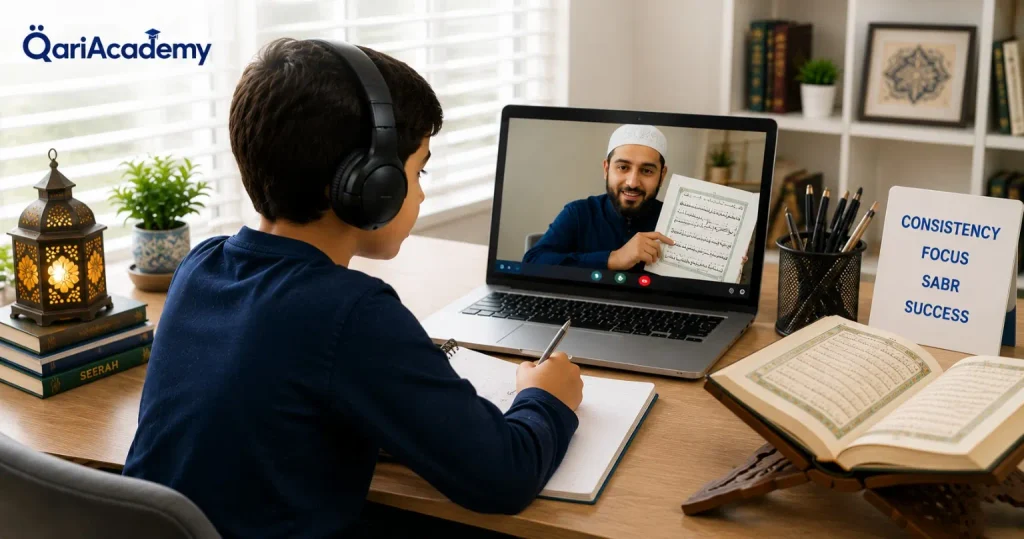
One-to-one online Quran learning can be particularly useful for busy families because the schedule can often be organized around the child’s existing commitments.
Instead of traveling to a Quran center at a fixed time, families can potentially choose lesson times that fit around:
- school
- homework
- sports
- family commitments
- weekends
- vacations
For a child with a busy schedule, this flexibility can make the difference between maintaining Quran learning and gradually abandoning it.
This is one reason many families consider structured online Quran programs such as QariAcademy.
11. Create a Weekly Family Schedule
A simple weekly schedule can make everything easier.
For example:
| Day | Main Focus | Quran |
|---|---|---|
| Monday | School + homework | Quran lesson |
| Wednesday | School + sports | Quran lesson |
| Saturday | Family + activities | Quran lesson/revision |
The exact schedule should depend on the child.
The objective is to make Quran learning predictable.
When everyone knows what happens on which day, there are fewer last-minute arguments and missed lessons.
12. Use Short Daily Revision
Formal Quran classes do not have to carry the entire responsibility of Quran learning.
Parents can encourage small amounts of revision at home.
For example:
- 5–10 minutes reviewing memorized verses
- listening to a Surah during a car ride
- reading a few verses before bedtime
- reviewing difficult Tajweed rules
- discussing the meaning of a verse
This makes Quran part of everyday life rather than something that exists only during the teacher’s lesson.
The Quran itself teaches us to ask Allah for increased knowledge: “My Lord, increase me in knowledge.” (Quran 20:114).
13. Adjust During Exam Seasons
A child’s schedule does not have to remain identical throughout the entire year.
During normal school weeks, the child might manage three Quran lessons.
During major exams, parents may temporarily reduce additional commitments or adjust lesson times.
During school holidays, the family may increase Quran practice.
This is not inconsistency.
It is responsive planning.
The long-term goal is maintaining the relationship with the Quran rather than forcing the exact same schedule regardless of circumstances.
14. Don’t Compare Your Child With Other Children
One child may memorize quickly.
Another may excel in Tajweed.
Another may read fluently but struggle with memorization.
Another may need more repetition.
Comparing them can create unnecessary pressure.
Instead of asking:
“Why isn’t my child progressing like that child?”
ask:
“Is my child progressing compared with where they were before?”
That is a much healthier measure of success.
15. Look at Progress Over Months, Not Days
Quran education is a long-term journey.
A child might have an excellent week and then struggle the following week because of school exams, illness, travel, or other responsibilities.
That doesn’t mean the program has failed.
Parents should look for trends.
Is the child:
- reading more accurately?
- making fewer Tajweed mistakes?
- memorizing consistently?
- becoming more independent?
- developing better pronunciation?
- showing greater confidence?
- understanding more of what they read?
These are meaningful indicators of progress.
A Practical Weekly Quran Balance
For many families, a simple model can work well:
During normal school weeks
2–4 structured Quran lessons per week
plus
short home revision sessions.
During busy exam periods
Reduce unnecessary pressure while maintaining a small, consistent Quran connection.
During school holidays
Use the additional free time for:
- extra revision
- memorization
- Arabic practice
- Islamic studies
- longer Quran sessions when appropriate
The key principle is flexibility without abandoning consistency.
A Realistic Family Example
Consider a fictional example of a 10-year-old Muslim boy.
He attends school Monday through Friday, plays football twice a week, has homework most evenings, and spends weekends with extended family.
His parents initially schedule Quran lessons four evenings per week.
After two weeks, they notice that he becomes tired and distracted during the final lesson of the day.
Instead of concluding that he dislikes Quran, they change the routine.
They move the lessons to three days when he has more energy and introduce short revision sessions on the remaining days.
The result is a schedule that demands less from the child while maintaining regular Quran practice.
The lesson is important: when a routine isn’t working, change the routine before assuming the child is the problem.
The Goal Is a Lifelong Relationship With the Quran
Parents should think beyond the next Surah or the next level.
The ultimate goal is not simply:
“My child completed Quran lessons.”
It is:
“My child grew up knowing how to read the Quran, understanding its importance, and feeling connected to it.”
That takes time.
It requires teaching, repetition, patience, encouragement, and a realistic routine.
The Prophet ﷺ’s guidance about consistent deeds provides a powerful principle for this journey: sustainable effort matters, even when the amount is small.

How QariAcademy Can Help
For families trying to balance Quran learning with school and extracurricular activities, flexibility matters.
QariAcademy provides live one-on-one Quran learning designed to give children individualized attention while allowing families to organize lessons around their existing schedules.
Rather than forcing every child into exactly the same routine, parents can choose a learning frequency that fits their child’s age, level, school workload, and other commitments.
Ready to Build a Quran Routine That Fits Your Family?
Your child doesn’t need an overloaded schedule to grow in Quran learning.
They need:
- a qualified and supportive teacher
- a realistic schedule
- consistent practice
- regular revision
- encouragement at home
- patience from parents
Give your child a Quran learning routine that can grow with them—not one that overwhelms them.
👉 Book a free trial with QariAcademy and explore a Quran learning schedule that fits your family’s routine.
Frequently Asked Questions
How many Quran classes should a child take each week?
There is no single number that works for every child. The appropriate frequency depends on age, Quran level, school workload, extracurricular activities, and concentration. Consistency is generally more important than creating an overly demanding schedule.
Should Quran lessons come before extracurricular activities?
Not necessarily. The best time depends on the individual child. Some children concentrate better before activities, while others prefer lessons on quieter days.
What if my child is too tired after school?
Consider moving the lesson to another time or day. A shorter, focused lesson when the child is alert can be more productive than a longer lesson when the child is exhausted.
Can online Quran classes help busy families?
Yes. One-to-one online learning can provide scheduling flexibility and eliminate travel time, which can make Quran learning easier to integrate into a busy family routine.
Should parents reduce Quran learning during exams?
Parents can adjust the routine during particularly demanding periods rather than abandoning Quran completely. Maintaining a small amount of consistent revision can help preserve the habit.
Final Thoughts
Balancing Quran, school, and extracurricular activities is not about finding a perfect timetable.
It is about finding a sustainable rhythm.
Your child’s Quran journey should have room for learning, practice, rest, school, friendships, family, and personal growth.
The most successful routine may not be the one with the most Quran hours.
It may be the one your child can maintain consistently, happily, and for years to come.
And that is ultimately what parents should aim for: not simply a child who completes Quran lessons, but a young Muslim who carries a meaningful relationship with the Quran into adulthood.