Table of Contents
Introduction
One of the biggest concerns Muslim parents may have when their child reaches ten without consistent Quran lessons is:
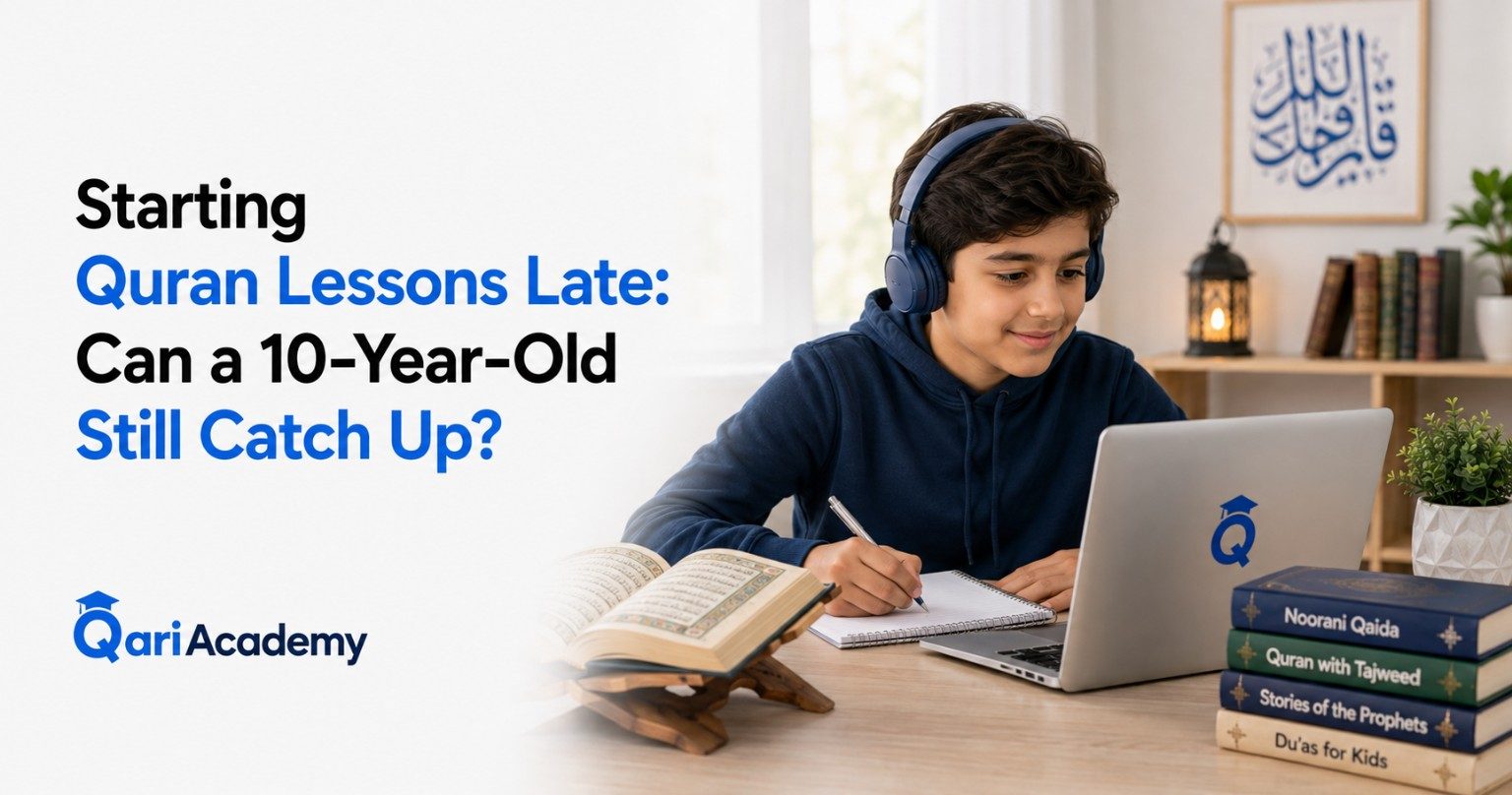
Starting Quran Lessons Late: Can a 10-Year-Old Still Catch Up?
The short answer is yes.
A ten-year-old can absolutely begin learning the Quran, develop Arabic reading skills, improve pronunciation, learn Tajweed, memorize surahs, and build a meaningful relationship with the Quran.
But parents need to challenge one assumption:
The child does not necessarily need to “catch up” with everyone else.
The more important question is:
Where is my child now, and what should they learn next?
This distinction can completely change the way parents approach Quran education.
A ten-year-old who has never learned Arabic may feel behind when they see younger children reading Quran fluently. But comparing ages alone can be misleading.
A five-year-old who started Quran lessons at three has already had several years of exposure.
A ten-year-old who starts today has had a completely different educational journey.
The ten-year-old is not necessarily less capable.
In fact, older children can have several advantages. They may understand explanations more easily, concentrate for longer periods, recognize patterns, ask questions, and take greater responsibility for home practice.
The challenge is usually not the child’s age.
The challenge is finding the correct starting level and building consistency.
When starting Quran lessons late, parents should avoid trying to compensate for lost time by overwhelming the child with extremely long lessons or unrealistic memorization targets.
That strategy can backfire.
Instead, the child needs a structured and individualized roadmap.
A typical progression may look like:
Arabic Alphabet → Letter Sounds → Harakat → Connected Letters → Qaida → Quran Reading → Tajweed → Fluency → Memorization → Understanding
A ten-year-old who already knows the alphabet may be able to skip some early stages.
A child who knows nothing about Arabic may need to begin from the beginning.
The correct starting point should be determined by ability, not embarrassment.
This article explains starting Quran lessons late, whether a ten-year-old can catch up, where to begin, how long Quran reading may take, how to approach Tajweed and Hifz, what parents should expect during the first year, and how to create a realistic Quran learning routine.
Can a 10-Year-Old Really Catch Up?
Yes, but parents first need to define what “catch up” actually means.
If “catch up” means:
“My ten-year-old must reach exactly the same level as another child who started at four within a few months.”
That is unrealistic.
If “catch up” means:
“My child can make significant progress and eventually become a confident Quran reader and memorizer.”
Absolutely.
A ten-year-old is still very young in terms of lifelong learning.
There may be many years ahead to develop:
- Quran reading
- Tajweed
- Hifz
- Arabic vocabulary
- Quranic understanding
- Independent Quran practice
Starting earlier can provide an advantage because the child receives more exposure and practice.
But starting later does not mean the opportunity has disappeared.
The better approach is to stop measuring progress by age and start measuring it by skills.
| Starting Point | Main Need | Realistic Next Step |
|---|---|---|
| Does not know Arabic letters | Alphabet foundation | Learn letter recognition |
| Knows letters only | Reading foundation | Learn Harakat |
| Reads basic combinations | Qaida progression | Build decoding skills |
| Reads simple words | Quran application | Begin Quran passages |
| Reads Quran slowly | Fluency | Guided reading practice |
| Reads Quran well | Refinement | Tajweed and Hifz |
The child does not need to repeat material they already know.
They need to identify the missing skills and work on them.
Why Starting Quran Lessons Late Is Not the End of the Journey
Parents sometimes feel guilty when they realize their child is ten and has not developed strong Quran reading skills.
That guilt rarely helps.
Instead of thinking:
“We should have started years ago.”
Try thinking:
“We can start now.”
The first statement focuses on the past.
The second focuses on the opportunity in front of you.
If a child starts at ten and studies consistently for the next several years, they can develop a strong level of Quran knowledge.
They may eventually learn:
- Quran reading
- Tajweed
- Hifz
- Arabic
- Quranic vocabulary
- Basic understanding of meanings
- Islamic studies
The starting age matters, but it does not determine the final destination.
What Advantages Does a 10-Year-Old Have?
Parents often focus only on the disadvantages of starting late.
That is a mistake.
A ten-year-old can actually have several advantages compared with a much younger beginner.
Older children can often:
- Understand explanations more easily.
- Remember instructions.
- Recognize patterns.
- Ask meaningful questions.
- Practice independently.
- Concentrate for longer periods.
- Understand learning goals.
- Take responsibility for assignments.
- Communicate when something is difficult.
A five-year-old may need games and very short activities.
A ten-year-old can often understand:
“Today we’re learning this Tajweed rule because it will help you pronounce these words correctly.”
That level of explanation can make learning more efficient.
What Should a 10-Year-Old Beginner Start With?
The answer depends entirely on the child’s current level.
If they cannot recognize Arabic letters, begin with the alphabet.
If they know the alphabet but cannot read Harakat, begin there.
If they can read basic Arabic but struggle with Quranic text, use a structured Qaida or Quran reading program.
If they already read Quran, focus on Tajweed and fluency.
This is why an initial placement assessment is so valuable.
The teacher should evaluate:
- Letter recognition
- Pronunciation
- Harakat
- Connected letters
- Basic reading
- Quran reading
- Tajweed
- Memorization
- Reading fluency
A ten-year-old should not automatically be placed in an advanced class simply because of their age.
At the same time, they should not be placed in a very basic class simply because they are considered a “beginner.”
The correct level depends on their actual skills.
What If the Child Knows Absolutely No Arabic?
This is one of the most common concerns among parents.
If the child knows no Arabic, don’t panic.
Start with the foundation:
Arabic Alphabet → Letter Sounds → Harakat → Connected Letters → Basic Words → Qaida → Quran Reading
The process may seem slow at first.
But once the child understands how Arabic reading works, progress can accelerate.
A ten-year-old who understands patterns and instructions may move through the beginner stages more efficiently than parents expect.
The important thing is not to skip necessary foundations simply because the child is older.
Why a Proper Placement Assessment Matters
A placement assessment can prevent two major problems.
Starting Too Low
If the child already knows Arabic letters and basic reading but is placed in an alphabet class, they may become bored.
Starting Too High
If the child struggles with Harakat but is immediately asked to read long Quranic passages, they may become frustrated.
The correct starting level should be based on what the child can actually do.
| Assessment Area | What the Teacher Checks | Why It Matters |
|---|---|---|
| Letters | Recognition and identification | Establishes the foundation |
| Harakat | Fathah, Kasrah, Dammah | Enables decoding |
| Connected text | Reading joined letters | Builds word reading |
| Quran reading | Actual Quranic passages | Shows readiness |
| Pronunciation | Arabic sounds | Prevents bad habits |
| Tajweed | Basic application | Improves recitation |
This is much more useful than simply asking:
“Is my child a beginner?”
How Long Does It Take a 10-Year-Old to Learn Quran Reading?
There is no universal timeline.
A child who already knows Arabic letters may progress much faster than a complete beginner.
A child who practices consistently may progress faster than one who only attends lessons without reviewing at home.
A general example might look like:
First 1–2 months:
Arabic foundations, pronunciation, Harakat, and basic reading patterns.
Months 3–4:
Connected letters, Qaida progression, and simple words.
Months 5–6:
Short Quranic passages and increased reading independence.
Months 7–12:
Fluency, pronunciation refinement, basic Tajweed, and continued Quran reading.
But this is only an example.
It should never be treated as a guaranteed deadline.
Some children will progress faster.
Others will need more repetition.
The meaningful measurement is improvement.
What Should Parents Expect During the First Six Months?
A late-starting student should have realistic expectations.
The first six months may focus heavily on building the foundation.
| Period | Main Focus | Expected Development |
|---|---|---|
| Month 1 | Letters and sounds | Stronger recognition |
| Month 2 | Harakat | Basic decoding |
| Month 3 | Connected letters | Better reading combinations |
| Month 4 | Qaida | Improved word recognition |
| Month 5 | Quran passages | Beginning independent reading |
| Month 6 | Fluency | More accurate recitation |
The child may not finish a large amount of Quran during this period.
That does not mean the program is failing.
They may be developing skills that will support Quran reading for many years.
Should a 10-Year-Old Learn Qaida?
Yes, if they need it.
Some parents feel embarrassed about giving a ten-year-old beginner material.
They may think:
“My child is ten. They should already be reading Quran.”
That mindset can actually delay progress.
If the child needs Qaida, use Qaida.
There is nothing embarrassing about strengthening a weak foundation.
A ten-year-old may even move through beginner material relatively quickly because they can understand patterns and instructions.
The important thing is to use the material that matches the child’s actual ability.
What If the Child Can Read Quran but Is Very Slow?
This is a different problem.
If the child can decode Quranic text but reads slowly, they may not need to restart from the alphabet.
They may need:
- Repeated reading
- Fluency exercises
- Familiar passage practice
- Pronunciation correction
- Guided reading
- Increased exposure to Quranic vocabulary
The goal is to move from:
Slow decoding
to:
Automatic recognition
to:
Fluent recitation
This requires regular practice.
What If the Child Reads Quickly but Makes Many Mistakes?
Then speed is not the priority.
Accuracy is.
A child who reads quickly but consistently:
- Skips letters
- Changes vowels
- Mispronounces letters
- Ignores Shaddah
- Misses Madd
- Guesses unfamiliar words
needs correction.
Parents should not celebrate speed at the expense of accuracy.
The better progression is:
Correct reading → Consistent reading → Fluent reading
not:
Fast reading → Repeated mistakes
What About Tajweed for a 10-Year-Old Beginner?
A ten-year-old can begin learning Tajweed effectively.
However, Tajweed should be introduced progressively.
Start with practical recitation skills such as:
- Correct Makharij
- Correct vowel sounds
- Madd
- Ghunnah
- Shaddah
- Sukoon
- Basic stopping rules
- Common pronunciation mistakes
More advanced terminology can be introduced as the child becomes ready.
The objective is not to overwhelm the child with technical definitions.
The objective is to improve their recitation.
For additional guidance, parents can also explore QariAcademy’s dedicated Quran Tajweed for Kids program.
Should a Late Starter Focus on Reading or Memorization First?
This depends on the child’s current ability and goals.
For a child who cannot read Quran independently, reading should receive significant attention.
Memorization can still happen alongside reading, but the child should gradually learn to recognize the verses they have memorized in the Mushaf.
A balanced approach may include:
Reading: 50%
Memorization: 25%
Tajweed: 15%
Meaning and review: 10%
These percentages are only an example.
The actual balance should depend on the child.
Can a 10-Year-Old Catch Up in Hifz?
Yes.
But again, “catch up” should not mean competing with another child.
A ten-year-old can begin Hifz gradually and potentially memorize a significant amount of Quran over the coming years.
The important factors include:
- Consistency
- Strong reading ability
- Accurate pronunciation
- Regular revision
- Realistic targets
- Family support
- Teacher guidance
A child who memorizes a manageable amount consistently can make impressive progress.
How Much Should a 10-Year-Old Memorize?
There is no universal number.
One child might memorize three to five lines per day.
Another might memorize one or two lines.
Another may need to focus on revision before adding new material.
The right amount depends on:
- Reading ability
- Memory
- School workload
- Attention
- Practice consistency
- Family routine
A strong Hifz program is not necessarily the one that introduces the most new material.
It is the one that preserves what has already been memorized.
New Memorization vs. Revision
This is one of the most important concepts parents need to understand.
Suppose a child memorizes:
One page today.
One page tomorrow.
One page the next day.
But never reviews.
After several weeks, much of the material may become weak.
Instead, a sustainable routine combines:
New lesson
with:
Recent revision
and:
Older revision
This keeps memorization stable.
The goal is not simply to add more Quran.
The goal is to preserve what has been learned.
Why Parents Should Not Force a 10-Year-Old to “Catch Up”
The phrase “catch up” can create unnecessary pressure.
Imagine telling a child:
“You’re already ten. You should know this by now.”
The child may hear:
“You failed.”
That is not productive.
A better message is:
“We are starting now, and we’re going to improve step by step.”
This communicates responsibility without shame.
How to Motivate an Older Beginner
A ten-year-old is old enough to understand goals.
Use that.
Instead of simply saying:
“You have to study Quran.”
explain:
“You are learning a skill that you will be able to use for the rest of your life.”
Set short-term goals.
For example:
Goal 1: Learn the Arabic letters.
Goal 2: Read basic Harakat.
Goal 3: Complete the required Qaida sections.
Goal 4: Read the first short surah independently.
Goal 5: Improve pronunciation.
Goal 6: Memorize selected short surahs.
Small wins create momentum.
The Psychology of Starting Late
A ten-year-old may compare themselves with younger children.
They may think:
“Why can that six-year-old read Quran better than me?”
Parents should address this directly.
Explain:
“Everyone starts at a different time. What matters is how much you improve from today.”
The objective is to move the child’s attention away from embarrassment and toward progress.
Don’t Hide the Child’s Level
Some parents feel uncomfortable telling a teacher:
“My ten-year-old cannot read Arabic.”
There is nothing embarrassing about it.
The teacher needs accurate information.
If parents hide the problem, the teacher may prepare the wrong lesson.
Honest assessment leads to better teaching.
What Should the First Quran Lesson Look Like?
For a late-starting ten-year-old, the first lesson should not necessarily involve memorizing a new surah.
The teacher may begin by assessing:
- Arabic letters
- Sounds
- Harakat
- Reading ability
- Pronunciation
- Quran familiarity
- Memorization
- Learning goals
Then the teacher can explain the learning roadmap.
This gives the child a clear understanding of what they are working toward.
Why One-on-One Lessons Can Be Especially Useful for Late Starters
A late-starting child may have an unusual combination of strengths.
For example:
They may know the alphabet but have weak pronunciation.
They may memorize quickly but read slowly.
They may read well but know little Tajweed.
They may know many surahs but have weak Arabic literacy.
One-on-one instruction allows the teacher to work directly on the missing skills.
QariAcademy’s Quran for Kids program uses one-on-one online instruction, making it possible to adapt lessons to the student’s current level and learning needs.
This can be particularly useful when a child does not fit neatly into a standard age-based curriculum.
How QariAcademy Can Support a 10-Year-Old Beginner
For parents who are unsure where to begin, QariAcademy can help determine the appropriate level instead of assuming that every ten-year-old should follow the same curriculum.
Depending on the child’s level, the learning path may include:
- Arabic alphabet
- Qaida
- Quran reading
- Tajweed
- Hifz
- Quranic Arabic
A child who needs beginner reading skills can start there.
A child who already reads Quran can focus on Tajweed and fluency.
A child who reads well and wants to memorize can gradually move toward Hifz.
This flexibility is important.
The goal is not simply to enroll the child in Quran classes.
The goal is to establish the correct learning path.
Parents can learn more about QariAcademy’s children’s Quran classes and use a trial lesson to determine whether the teaching approach and starting level are appropriate.
What Should Parents Look for in a Quran Teacher?
When starting Quran lessons late, the teacher matters.
Parents should look for someone who is:
- Patient
- Experienced with children
- Knowledgeable in Quran and Tajweed
- Encouraging
- Clear
- Able to adapt the curriculum
- Comfortable teaching beginners
- Skilled at correcting pronunciation
- Able to communicate progress to parents
A teacher who only knows how to teach advanced students may not be the best choice for a beginner.
The ability to simplify is a teaching skill.
A Good Teacher Should Not Shame a Late Beginner
This is extremely important.
A ten-year-old beginner should never be made to feel embarrassed about their level.
The teacher should communicate:
“You are learning.”
not:
“You should already know this.”
A safe learning environment encourages questions and mistakes.
If the child is afraid of mistakes, they may avoid attempting difficult words.
If they are comfortable making mistakes, they can learn from them.
How Often Should a 10-Year-Old Have Quran Lessons?
For many children, two or three lessons per week can be a practical starting point.
Some families may prefer more frequent classes.
If the child has ambitious goals, four or five shorter lessons may be appropriate if the schedule and child can handle them.
The important question is:
What schedule can we maintain consistently?
A realistic routine is better than an ambitious routine that collapses after a month.
How Long Should Each Lesson Be?
For a ten-year-old, 30-minute lessons can work well for many students.
Some children may benefit from 45-minute or 60-minute sessions, particularly if they are working on multiple areas such as:
- Quran reading
- Tajweed
- Memorization
- Arabic
- Islamic studies
But longer does not automatically mean better.
A focused 30-minute lesson can be more valuable than a distracted one-hour lesson.
A Sample 45-Minute Quran Lesson
A lesson could be structured like this:
10 minutes: Review
15 minutes: Quran reading
10 minutes: Tajweed
5 minutes: Memorization
5 minutes: Homework and feedback
The exact structure should be adapted to the child.
Home Practice for a 10-Year-Old Beginner
Parents should expect some home practice.
But it should be realistic.
A child may practice for approximately:
15–20 minutes per day
depending on the teacher’s recommendation.
A simple routine could include:
5 minutes — Reading review
5 minutes — Current lesson
5 minutes — Memorization
5 minutes — Older revision
The exact routine should follow the child’s ability and teacher’s guidance.
Why Consistency Matters More Than Intensity
Consider two students.
Student A
Studies Quran for two hours every Saturday.
Student B
Studies for 20 minutes five days per week.
Student B receives much more frequent exposure.
Reading is a skill.
Skills improve through repeated practice.
That is why short, regular practice can be extremely effective.
A Practical Weekly Routine
A ten-year-old beginner might follow:
| Activity | Frequency | Approximate Time |
|---|---|---|
| Quran lesson | 2–3 times weekly | 30–45 minutes |
| Reading practice | 4–6 days weekly | 10–20 minutes |
| Memorization | 4–6 days weekly | 5–15 minutes |
| Revision | Daily or near-daily | 5–10 minutes |
| Quran listening | Several times weekly | Flexible |
| Meaning/vocabulary | 1–2 times weekly | 5–10 minutes |
The exact routine should depend on the child’s goals and school schedule.
How School Affects Quran Learning
A ten-year-old may already have:
- School homework
- Sports
- Clubs
- Tests
- Family commitments
- Weekend activities
Parents need to account for this.
The Quran routine should fit into the child’s life rather than competing with everything else.
Choose consistent times such as:
- After Maghrib
- Before bedtime
- After school
- Weekend mornings
The best time is the time the family can consistently protect.
What If the Child Is Embarrassed About Learning With Younger Children?
This is a legitimate concern.
A ten-year-old may feel uncomfortable being placed in a class with much younger children.
One-on-one learning can solve this problem.
The child can learn at their own level without being publicly compared with anyone else.
This can make starting Quran lessons late much less emotionally difficult.
How to Build Confidence Quickly
Give the child achievable goals.
For example:
“Today we’re going to master these five letters.”
Then:
“You learned them. Great. Tomorrow we’ll build on them.”
Avoid overwhelming the child with:
“You have years of Quran to catch up on.”
Focus on today’s target.
Confidence grows from repeated successful experiences.
Don’t Use Guilt as Motivation
Statements such as:
“You are ten and still can’t read Quran.”
may create shame rather than motivation.
Instead say:
“We’re going to work on this together.”
The difference is significant.
The first message focuses on failure.
The second focuses on growth.
Can a Ten-Year-Old Become Fluent?
Yes.
Fluency develops through:
- Correct foundations
- Regular reading
- Repetition
- Listening
- Vocabulary
- Teacher correction
- Independent practice
The child should gradually move from sounding out every letter to recognizing common patterns automatically.
This takes time.
But consistent practice can produce substantial improvement.
Reading Fluency Should Be Built Gradually
A useful progression is:
Stage 1: Letter-by-letter reading
Stage 2: Syllable and combination reading
Stage 3: Word reading
Stage 4: Short verse reading
Stage 5: Passage reading
Stage 6: Fluent Quran reading
The child does not need to jump directly to Stage 6.
Each stage builds the next.
What About Pronunciation and Makharij?
Pronunciation should be addressed from the beginning.
A child who develops incorrect sounds may carry those habits into later Quran reading.
Important Arabic sounds may require specific attention.
The teacher should identify weaknesses and work on them gradually.
The goal is not to embarrass the child.
It is to build accurate habits.
What If the Child Speaks English Only?
This is common among Muslim families living in English-speaking countries.
The child may have:
- Strong English
- Limited Arabic vocabulary
- Little or no Arabic reading ability
This does not prevent Quran learning.
The child can learn Quran reading systematically while gradually developing Arabic vocabulary.
Families who want to develop broader Arabic skills can also consider QariAcademy’s Arabic for Kids program.
Quran reading and Arabic language learning are related, but they are not exactly the same skill.
Quran Reading and Arabic Are Related but Not Identical
A child can learn to read the Quran without becoming conversationally fluent in Arabic.
Quran reading primarily requires:
- Letter recognition
- Sounds
- Harakat
- Reading patterns
- Tajweed
Arabic language learning involves:
- Vocabulary
- Grammar
- Listening
- Speaking
- Reading
- Writing
- Comprehension
The two can support each other, but parents should not assume that Quran reading automatically means conversational Arabic fluency.
What Should a 10-Year-Old Know About Quran by the End of the First Year?
A realistic first-year goal might include:
- Stronger Arabic reading
- Better Quran fluency
- Improved pronunciation
- Basic Tajweed
- Several short surahs
- Regular revision habits
- Increased independence
- Basic Quranic vocabulary
- Greater confidence
Some children will progress beyond this.
Others may still be strengthening their foundations.
The important thing is measurable progress.
Six Progress Indicators Parents Should Track
| Progress Area | Early Stage | Developing Stage |
|---|---|---|
| Letter recognition | Needs frequent help | Recognizes independently |
| Reading | Sounds out letters | Reads words more smoothly |
| Pronunciation | Frequent corrections | Fewer repeated errors |
| Tajweed | Teacher demonstrates | Child applies basics |
| Memorization | Needs prompts | Recites independently |
| Confidence | Hesitates often | Attempts unfamiliar words |
These indicators provide a better picture than simply counting pages.
What If Progress Seems Slow?
Ask why.
Maybe the child needs more practice.
Maybe the lessons are too infrequent.
Maybe the material is too difficult.
Maybe the teacher is moving too quickly.
Maybe the child struggles with concentration.
Maybe home practice is inconsistent.
Maybe the child needs more encouragement.
Do not automatically assume the child lacks ability.
Find the obstacle.
Then address it.
How Parents Can Help Without Taking Over
Parents should create the environment.
The teacher should provide technical instruction.
Parents can:
- Maintain the schedule.
- Encourage practice.
- Reduce distractions.
- Ask about progress.
- Celebrate improvement.
- Communicate with the teacher.
- Make Quran part of family life.
Parents do not need to become Quran teachers themselves.
Read Quran in Front of Your Child
This is one of the most powerful forms of encouragement.
If children see their parents reading Quran, they understand that Quran is not merely a subject children study.
It is part of Muslim life.
Even a short period of family Quran time can create a strong association.
The child sees:
“My parents value this.”
That message can be more powerful than repeated instructions.
Make Quran a Normal Part of the Home
Create a simple routine.
For example:
After Maghrib:
10 minutes Quran reading.
Then:
5 minutes memorization.
Or:
Weekend morning Quran session.
The exact routine matters less than consistency.
Don’t Compare Siblings
One sibling may learn quickly.
Another may need more time.
Avoid:
“Your brother learned this faster.”
Instead say:
“You improved compared with last week.”
That is a healthier measurement.
Don’t Compare Your Child With Younger Children
This is especially important for late starters.
A ten-year-old may see a six-year-old reading Quran fluently and feel embarrassed.
Explain:
“That child started earlier. You are starting now. Your job is to improve from where you are.”
The goal is progress.
Can a Late Starter Eventually Memorize Large Portions?
Yes.
A late start does not prevent serious Hifz goals.
However, Hifz should be built on strong reading and pronunciation.
A child who can read accurately can approach memorization more effectively because they can connect the memorized words with the written Quranic text.
A good long-term path may be:
Reading Foundation → Tajweed → Short Surahs → Consistent Hifz → Revision → Larger Portions
The Importance of Revision in Hifz
Parents should never underestimate revision.
A child may memorize quickly but forget quickly without review.
A sustainable Hifz routine should include:
New Lesson
Recent Revision
Older Revision
This creates stability.
The goal is not merely to add more Quran.
The goal is to preserve what has been learned.
What Should Parents Do If Their Child Resists Lessons?
Don’t immediately increase pressure.
Ask:
Why?
Possible reasons include:
- Difficulty
- Boredom
- Fear of mistakes
- Teacher mismatch
- Long lessons
- Poor schedule
- Lack of sleep
- Too much schoolwork
- Feeling embarrassed
Once the reason is understood, the solution becomes easier to identify.
Choosing the Right Teacher for a Late Starter
The teacher should understand that the student may need both academic support and confidence-building.
Look for:
- Patience
- Clear explanations
- Experience with children
- Strong Quran and Tajweed knowledge
- Beginner teaching ability
- Encouraging communication
- Personalized pacing
- Regular feedback
A good teacher does not make the child feel behind.
They make the child feel capable of improving.
A Sample 12-Month Roadmap for a Late Starter
The following is an example rather than a fixed promise.
| Period | Main Goal | Supporting Practice |
|---|---|---|
| Months 1–3 | Arabic reading foundation | Daily letter practice |
| Months 4–6 | Quran reading | Short daily reading |
| Months 7–9 | Tajweed foundations | Guided recitation |
| Months 10–12 | Fluency and Hifz | Reading + revision |
A child who already knows the basics can move through the early stages more quickly.
A complete beginner may need longer.
What If the Child Has School Exams?
Don’t abandon Quran completely.
Instead, reduce the workload temporarily.
For example:
Normal week:
20 minutes daily.
Exam week:
5–10 minutes of revision.
This protects the habit without overwhelming the child.
Consistency does not mean identical workload every day.
It means maintaining the connection.
What If the Family Travels Frequently?
Create a minimum Quran routine.
For example:
10 minutes of reading.
5 minutes of memorization.
Even during travel, a short routine can help maintain continuity.
Online lessons can also provide flexibility for families whose schedules change.
The Difference Between Catching Up and Growing
This may be the most important lesson in the entire article.
Your child does not need to “catch up” with another child.
They need to grow.
Growth means:
Today they know five letters.
Next month they know twenty-five.
Later they read words.
Then they read verses.
Then they read independently.
Then they improve Tajweed.
Then they memorize.
That is success.
A Ten-Year-Old Can Make Significant Progress
Do not underestimate the next twelve months.
If a ten-year-old begins with no Arabic reading ability and studies consistently, the change after one year can be substantial.
They may move from:
“I cannot read Arabic.”
to:
“I can read Quran with guidance.”
and eventually:
“I can open the Mushaf and read independently.”
That is a major transformation.
What Should Parents Expect Emotionally?
The child may experience:
- Excitement
- Frustration
- Embarrassment
- Curiosity
- Pride
- Boredom
- Motivation
All of these can be normal.
Parents should not expect motivation to remain constant.
The goal is to create a routine that continues even when motivation fluctuates.
Encourage Effort, Not Just Results
Instead of:
“You are so smart.”
say:
“You practiced consistently.”
Instead of:
“You read perfectly.”
say:
“You improved that pronunciation.”
This teaches the child that progress comes through effort and practice.
A Practical Checklist for Parents
Before Starting
- Assess the child’s level.
- Identify goals.
- Choose a suitable teacher.
- Set a realistic schedule.
- Prepare a quiet learning space.
During the First Months
- Attend consistently.
- Practice at home.
- Review old material.
- Communicate with the teacher.
- Celebrate small improvements.
After Several Months
- Evaluate reading progress.
- Check pronunciation.
- Review memorization.
- Adjust lesson frequency if necessary.
- Set the next goal.
Six Things Parents Should Prioritize
| Priority | Why It Matters | What Parents Can Do |
|---|---|---|
| Consistency | Builds long-term habits | Protect lesson times |
| Accuracy | Prevents bad reading habits | Encourage careful reading |
| Confidence | Encourages participation | Praise improvement |
| Revision | Preserves memorization | Review old material |
| Patience | Supports long-term progress | Avoid comparison |
| Understanding | Gives Quran meaning | Discuss simple vocabulary |
The Biggest Mistake to Avoid
The biggest mistake when starting Quran lessons late is trying to compensate for lost time by rushing.
Parents may think:
“We are already late, so we need five classes a week and huge memorization goals.”
That may work for some children.
But for others, it can create burnout.
A better strategy is:
Assess → Plan → Practice → Review → Adjust
This is more sustainable.
Can a 10-Year-Old Still Catch Up?
Yes.
But redefine “catch up.”
Your child does not need to erase the years they did not study.
They need to build the skills they need now.
A ten-year-old can learn the alphabet.
A ten-year-old can learn Qaida.
A ten-year-old can learn Quran reading.
A ten-year-old can learn Tajweed.
A ten-year-old can memorize Quran.
A ten-year-old can learn Arabic.
A ten-year-old can develop a lifelong relationship with the Quran.
Starting today is more valuable than continuing to worry about when you should have started.
Frequently Asked Questions
Is 10 too old to start Quran lessons?
No. Ten is not too old to begin Quran lessons. A child can still develop Quran reading, Tajweed, memorization, and understanding with consistent instruction.
Can a 10-year-old learn Quran from zero?
Yes. The child can begin with Arabic letters and gradually progress through Harakat, connected letters, Qaida, Quran reading, Tajweed, and memorization.
How long will it take a 10-year-old to learn Quran reading?
There is no universal timeline. A child who already knows Arabic letters may progress much faster than a complete beginner. Consistency and starting level are major factors.
Should a 10-year-old start with Noorani Qaida?
If the child needs foundational reading skills, Noorani Qaida or another structured beginner curriculum can be appropriate. The teacher should determine the correct material based on the child’s actual level.
Can a 10-year-old learn Tajweed?
Yes. Ten-year-olds can learn basic and increasingly advanced Tajweed with age-appropriate instruction.
Should Quran reading or Hifz come first?
If the child cannot read Quran independently, reading should receive significant attention. Memorization can develop alongside reading, but strong reading and pronunciation foundations are extremely valuable.
How many Quran classes should a 10-year-old take each week?
Two or three classes per week can be a practical starting point for many children. More frequent classes may be appropriate for specific goals if the child can handle the schedule.
How much should a 10-year-old practice at home?
A focused 15–20 minutes on most days can be a useful starting point, depending on the child’s ability and teacher’s recommendations.
What if my child feels embarrassed because younger children read better?
Explain that everyone starts at a different time. Focus on personal progress rather than comparing ages.
Can online Quran classes work for a 10-year-old beginner?
Yes. One-on-one online lessons can be particularly useful because the teacher can adapt the pace and material to the child’s actual level.
How can I know where my child should start?
A qualified teacher can assess Arabic letter recognition, pronunciation, Harakat, reading ability, Tajweed, and memorization. A trial lesson can be a useful first step.
Conclusion
Starting Quran Lessons Late: Can a 10-Year-Old Still Catch Up?
Yes.
But the most important thing is to stop thinking of Quran education as a race.
Your ten-year-old does not need to become exactly like another child who started years earlier.
They need:
- A clear starting point
- A qualified teacher
- Consistent practice
- Realistic goals
- Regular revision
- Patience
- Encouragement
If your child does not know the Arabic alphabet, begin there.
If they know the alphabet but cannot read Harakat, work on Harakat.
If they can read basic Arabic, move into Qaida and Quranic words.
If they can already read Quran, focus on fluency and Tajweed.
If their reading is strong, gradually increase memorization.
The roadmap should follow the child.
One of the advantages of starting at ten is that the child is old enough to understand the purpose of what they are learning.
They can understand goals.
They can ask questions.
They can practice independently.
They can take greater responsibility.
They can recognize their own progress.
This means that starting later does not necessarily mean learning more slowly.
In some cases, an older beginner can move through foundational skills surprisingly quickly once the right teaching method is established.
The key is not to rush.
A child who spends the first few months strengthening their Arabic reading foundation is not wasting time.
They are building the foundation for years of Quran reading.
Parents should also remember that the goal is much bigger than finishing a certain number of pages.
The real goal is to help the child become someone who can:
Read the Quran.
Recite it correctly.
Understand its basic meanings.
Memorize portions of it.
Review what they have learned.
And eventually continue learning independently.
That is why starting Quran lessons late should never become an excuse to delay any further.
If your ten-year-old has not started yet, today is a better starting point than next year.
If they have started but are struggling, reassess their level.
If they are progressing slowly, identify the obstacle.
If the current program is not working, change the approach.
The important thing is movement.
Not comparison.
Not guilt.
Not panic.
Movement.
QariAcademy can support families who are unsure where to begin by providing one-on-one online Quran instruction tailored to the student’s current level. The learning path can begin with Arabic reading foundations and progress toward Qaida, Quran reading, Tajweed, fluency, Hifz, and deeper Quranic understanding.
The advantage of an individualized approach is that your child does not have to fit into someone else’s timetable.
The teacher can work with the skills your child actually has today.
For parents who are worried that their ten-year-old has started too late, the most useful question is not:
“Why didn’t we start earlier?”
It is:
“What can we do consistently from today?”
That is the question that leads to progress.
And the answer can be simple:
Start at the right level.
Choose a qualified teacher.
Create a realistic weekly schedule.
Practice consistently.
Review regularly.
Celebrate progress.
Then keep going.
A year from now, your child will not be the same learner they are today.
And that is what matters.
Give Your Child the Right Start
If your ten-year-old has not yet developed strong Quran reading skills, you do not need to guess whether they should begin with the Arabic alphabet, Qaida, Quran reading, Tajweed, or Hifz.
A proper assessment can identify the right starting point.
QariAcademy offers one-on-one online Quran classes for children, with programs that can include Quran reading, Tajweed, Hifz, and Quranic Arabic.
A trial lesson can give your child the opportunity to meet the teacher, experience the learning environment, and help determine the appropriate starting level before beginning regular classes.
Starting Quran lessons late does not mean your child’s Quran journey is too late.
It simply means the journey starts today.
Book a Free Trial With QariAcademy:
QariAcademy Enrollment
QariAcademy:
QariAcademy
Reliable Quran Reference:
Quran.com