Introduction
One of the most common questions Muslim parents ask when beginning Quran education is:
What should a 5-year-old know about the Quran?
At five years old, children are at an important stage of development. They can begin recognizing Arabic letters, remembering short passages, following simple instructions, listening attentively, and developing positive associations with routines and learning.
But they are still young.
That means Quran learning for a 5-year-old should look very different from Quran education for a ten-year-old or teenager.
A five-year-old does not need to master advanced Tajweed terminology, read long Quranic passages independently, memorize large portions of the Quran, or understand complicated Arabic grammar.
The more important goal is to establish a strong and positive foundation.
A five-year-old can gradually learn:
- What the Quran is
- Why Muslims love and respect the Quran
- How to listen to Quranic recitation
- Some or most Arabic letters
- Basic Arabic reading skills
- Short surahs and verses
- Simple Quranic vocabulary
- Basic Quran manners
- Simple Islamic values
- A positive daily Quran routine
The better question is therefore not:
“How much Quran should my five-year-old finish?”
A much better question is:
“What foundation can I build now that will make Quran learning easier and more meaningful in the years ahead?”
This distinction matters.
Parents can unintentionally turn early Quran education into a competition. They compare memorization, reading levels, lesson frequency, or the number of surahs their children know.
But children develop at different speeds.
A five-year-old who recognizes Arabic letters confidently, enjoys listening to the Quran, and willingly practices for a few minutes each day may be building a stronger long-term foundation than a child who memorizes large amounts under intense pressure but begins to associate Quran lessons with anxiety.
For young children, the quality of the foundation matters more than the quantity of content.
The Quran itself emphasizes measured recitation: “and recite the Quran properly in a measured way.”
This principle is valuable when teaching young children: careful, gradual learning is more important than rushing through material.
For families looking for structured support, QariAcademy provides one-on-one online Quran lessons tailored to a child’s level and pace, with programs covering Quran reading, Tajweed, Hifz, and Quranic Arabic.
This guide explains what a five-year-old can realistically work toward, what parents should avoid expecting, how to introduce Quran reading and memorization, how much home practice may be appropriate, and how to build a positive Quran routine that can grow with the child.
What Is a Realistic Quran Goal for a 5-Year-Old?
There is no universal checklist that every five-year-old must complete.
One child may already recognize the Arabic alphabet.
Another may have never seen Arabic letters.
One child may know Al-Fatihah.
Another may only know a few short duas.
One child may be ready for a Qaida.
Another may need several months of basic letter recognition first.
Therefore, the appropriate goal depends on the child’s starting level, learning environment, previous exposure, and individual development.
However, there are several areas that parents can reasonably work toward.
| Area | Age-Appropriate Goal | Why It Matters |
|---|---|---|
| Quran familiarity | Enjoy listening to Quran | Builds a positive association |
| Arabic letters | Recognize letters gradually | Builds reading foundation |
| Quran reading | Begin basic decoding | Develops literacy |
| Memorization | Learn short surahs or verses | Builds retention |
| Understanding | Learn simple meanings | Connects words with ideas |
| Manners | Respect the Quran | Builds lifelong habits |
These are goals to develop gradually, not requirements that must all be completed by a specific birthday.
1. A Five-Year-Old Should Know What the Quran Is
Before worrying about reading speed or memorization, a child should gradually understand the basic idea:
The Quran is the Book of Allah.
At five, this does not need to become a complicated theological lesson.
You can use simple statements such as:
- Allah gave us the Quran.
- Muslims love the Quran.
- We listen to the Quran.
- We read the Quran.
- The Quran teaches us about Allah.
- We try to follow what Allah teaches us.
The objective is familiarity.
A child should begin seeing the Quran as something meaningful and beautiful rather than simply another subject they have to study.
Use Simple Language
Instead of giving a long explanation, you might say:
“This is the Quran. It is the Book of Allah, and it teaches us how to worship Him and live in a good way.”
Then allow the child to ask questions.
At five, curiosity is valuable.
If the child asks, “Who sent the Quran?” answer simply.
If they ask, “Why do we read it?” give them an age-appropriate explanation.
The goal is not to give a five-year-old an advanced lesson in theology.
The goal is to establish a clear and positive foundation.
2. A Five-Year-Old Should Develop Love and Respect for the Quran
This may be more important than the number of pages a child can read.
A five-year-old can gradually learn that the Quran is special.
Age-appropriate Quran manners can include:
- Handling the Mushaf respectfully.
- Listening when Quran is being recited.
- Keeping Quran materials organized.
- Treating Quran time seriously.
- Avoiding deliberate inappropriate behavior around the Quran.
- Understanding that the Quran is something Muslims honor and love.
Parents should teach these manners calmly.
Respect should not be created primarily through fear.
The child should gradually associate Quran with:
love + peace + family + learning + worship
rather than:
pressure + shouting + punishment
That emotional association can influence the child’s relationship with Quran learning for many years.
3. Should a Five-Year-Old Know the Arabic Alphabet?
A five-year-old can certainly begin learning the Arabic alphabet.
But there is an important distinction between:
“A five-year-old should begin learning the alphabet.”
and:
“Every five-year-old must already know the entire alphabet.”
The first is a reasonable educational goal.
The second is an unnecessary benchmark.
A child who has never encountered Arabic should not automatically be considered behind.
The alphabet can be introduced gradually:
ا
ب
ت
ث
and then progressively more letters.
The child should eventually learn to recognize the letters visually and connect them with their sounds.
Recognition Matters More Than Reciting the Alphabet
A child may be able to say:
“Alif, Ba, Ta, Tha…”
but still struggle to recognize:
ث
when it appears randomly.
That means the child has memorized the sequence but has not yet developed strong visual recognition.
A better question is:
“Can my child recognize the letters independently?”
rather than:
“Can my child recite the alphabet?”
4. What Arabic Reading Skills Can a Five-Year-Old Begin Learning?
If the child is ready, basic Quran reading instruction can gradually include:
- Arabic letters
- Letter sounds
- Fathah
- Kasrah
- Dammah
- Simple combinations
- Basic connected letters
For example:
بَ
بِ
بُ
The child begins understanding that the same letter can produce different sounds depending on the Harakah.
This is an important step toward actual Arabic reading.
Don’t Rush to Full Quran Pages
A five-year-old who is just learning Arabic should not be expected to open a full Mushaf and read long passages independently.
Instead, the progression can be:
Letter → Sound → Harakah → Combination → Word → Short Quranic passage
This gradual sequence helps prevent frustration.
5. Should a Five-Year-Old Learn Qaida?
For many children, yes.
A structured Qaida can provide a bridge between Arabic letters and Quranic reading.
Different teachers may use different beginner resources, including Noorani Qaida and other structured Arabic reading materials.
The name of the book is less important than the progression.
A young learner may gradually work through:
Arabic letters → Harakat → Connected letters → Sukoon → Tanween → Madd → Quranic words
However, a five-year-old does not necessarily need to master every reading rule immediately.
The teacher should introduce skills progressively according to the child’s readiness.
If your child is ready for structured beginner reading, QariAcademy’s curriculum options include Quran reading for beginners and other children’s Quran programs.
6. How Much Quran Should a Five-Year-Old Memorize?
There is no universal number of surahs that every five-year-old should memorize.
One child may memorize several short surahs.
Another may need considerably more repetition.
The most important factors are:
retention + accurate recitation + positive learning experience
A child who memorizes three short surahs accurately and enjoys reviewing them is making meaningful progress.
There is limited value in forcing a child to memorize ten surahs rapidly if most of them are forgotten soon afterward.
Good Beginner Memorization Goals
Depending on the child’s readiness, early memorization may include:
- Al-Fatihah
- Al-Ikhlas
- Al-Falaq
- An-Nas
- Al-Kawthar
- Al-Asr
- An-Nasr
The exact sequence should depend on the child and the teacher’s plan.
The key is to balance:
New memorization + regular revision
QariAcademy also emphasizes the importance of routine, review, and positive reinforcement when introducing Quran memorization to children.
7. Why Al-Fatihah Is an Important Early Goal
For many Muslim children, Surah Al-Fatihah is an important early memorization goal because it is recited in salah.
But it should not become a source of unnecessary stress.
A five-year-old may need repeated listening, repetition, and correction.
Focus on:
- Correct words
- Basic pronunciation
- Memorization
- Confidence
- Gradual improvement
The child does not need an advanced theoretical explanation of every Tajweed rule.
The focus should be on learning to recite correctly and confidently.
8. Should a Five-Year-Old Learn Tajweed?
Yes, but age-appropriately.
There is a major difference between teaching a child correct recitation and asking them to memorize advanced Tajweed terminology.
A five-year-old can begin learning:
- Correct pronunciation
- Basic Makharij
- Simple Madd
- Basic Ghunnah
- Shaddah awareness
- Appropriate stopping habits
The teacher can correct the child naturally:
“Let’s try that sound again.”
rather than giving a long technical explanation.
As the child grows older, more formal Tajweed rules can be introduced.
Tajweed Should Grow With the Child
Think of Tajweed as a staircase.
At five:
Correct sounds + simple recitation habits
Later:
Rules + terminology + application
Eventually:
Detailed Tajweed + fluency + refinement
This is more realistic than trying to teach the entire science of Tajweed to a young child at once.
For parents who want a structured progression, QariAcademy also provides a step-by-step Tajweed resource for children.
9. A Five-Year-Old Should Learn to Listen to Quran
Listening is often overlooked.
Parents sometimes focus entirely on:
“Can my child read?”
But listening develops familiarity with Quranic sounds, rhythm, pronunciation, and recurring passages.
A child can listen during:
- Quiet family time
- Car journeys
- Quran review
- Morning routines
- Bedtime routines
The goal is not to keep Quran playing constantly in the background.
Intentional listening is more useful.
Choose a short passage and encourage the child to listen attentively.
10. Listening Can Support Memorization
Children naturally learn through repetition.
A short surah heard regularly can become familiar before the child can fully recognize its written form.
That familiarity can support memorization.
But listening should not replace reading instruction.
A useful progression is:
Listen → Repeat → Memorize → Recognize → Read → Understand
Each skill supports the next.
11. A Five-Year-Old Can Begin Learning Simple Quranic Vocabulary
At five, children can begin learning simple Quranic words.
For example:
الله — Allah
رب — Lord
جنة — Paradise
رحمة — Mercy
كتاب — Book
نور — Light
You do not need to teach grammar.
The goal is simply to help the child realize:
“The Quran has meanings, not just sounds.”
This can transform Quran learning from mechanical repetition into the beginning of understanding.
12. Teach Through Stories
Stories can be particularly effective for young children.
Age-appropriate Islamic stories can introduce children to lessons from:
- Prophet Nuh
- Prophet Ibrahim
- Prophet Musa
- Prophet Yusuf
- Prophet Yunus
- Prophet Muhammad ﷺ
The goal is not to overwhelm the child with historical detail.
Instead, focus on simple lessons:
- We should tell the truth.
- We should be patient.
- We should trust Allah.
- We should be kind.
- We should be thankful.
- Allah helps and guides His servants.
QariAcademy also has resources for helping parents teach Islamic stories to children in an age-appropriate way.
13. What Islamic Values Should a Five-Year-Old Learn From the Quran?
Quran education should eventually connect with behavior.
If a child learns about kindness, ask:
“How can we be kind to your brother today?”
If they learn about gratitude:
“What are you thankful for today?”
If they learn about patience:
“How can we practice patience when something doesn’t go our way?”
This creates a bridge between Quran and everyday life.
The goal is not simply:
“My child can recite Quran.”
The bigger goal is:
“My child is learning how Quranic values shape everyday behavior.”
14. What Should a Five-Year-Old Know About Salah and the Quran?
The Quran can gradually become connected with worship.
A child can learn:
- Muslims pray five times a day.
- Quran is recited during salah.
- Al-Fatihah is recited in prayer.
- Short surahs can be used in prayer.
- Salah is an act of worship.
- Quran is part of a Muslim’s daily life.
At five, the emphasis should be on familiarity and love rather than creating a stressful checklist.
15. Don’t Expect Perfect Quran Reading at Five
This deserves emphasis.
A five-year-old learning Arabic for the first time is learning a completely different writing system.
That takes time.
Parents should not become frustrated when a child:
- Confuses similar letters
- Forgets Harakat
- Reads slowly
- Needs repeated correction
- Loses concentration
- Makes the same mistake more than once
These are normal parts of learning.
The important question is:
Is the child gradually improving?
That is a much more meaningful measure than perfection.
16. What Should a Five-Year-Old Not Be Expected to Know?
A five-year-old generally should not be pressured to master:
- Advanced Tajweed terminology
- Complex Arabic grammar
- Long Quranic passages independently
- Large amounts of Hifz
- Perfect reading fluency
- Detailed Tafsir
- Advanced Arabic vocabulary
If the child is capable of learning some of these things, that is wonderful.
But they should not become universal expectations.
A Better Standard
Instead of:
“My child must finish Juz Amma by age five.”
think:
“My child should develop a strong relationship with the Quran and steadily improve their reading and memorization.”
That is a healthier and more sustainable goal.
17. How Long Should a Five-Year-Old Study Quran?
Young children have limited attention spans.
A 30-minute one-on-one lesson can work well for many five-year-olds when the lesson is varied and interactive.
But the structure matters.
Thirty minutes should not mean thirty minutes of continuous reading from one page.
A lesson could include:
| Activity | Approximate Time |
|---|---|
| Review | 5 minutes |
| New reading skill | 5 minutes |
| Guided practice | 5 minutes |
| Memorization | 5 minutes |
| Story or meaning | 5 minutes |
| Review and encouragement | 5 minutes |
The teacher should adapt the structure to the child’s attention, ability, and goals.
18. How Many Quran Lessons Should a Five-Year-Old Have Each Week?
There is no single perfect number.
For many young children, two or three structured lessons per week can provide a useful rhythm.
More frequent lessons may be appropriate for some children, while fewer sessions may suit families with demanding schedules.
The bigger issue is consistency.
Two lessons every week for a year can be more valuable than five lessons per week for one month followed by a long break.
QariAcademy’s current enrollment options include different weekly frequencies and lesson durations, allowing families to choose a schedule around their child’s needs.
19. Home Practice Is More Important Than Parents Think
The teacher cannot do all the work.
If a child attends two Quran lessons each week, most reinforcement still happens at home.
But home practice does not need to be long.
For many five-year-olds, 5–10 focused minutes can be a useful starting point.
For example:
- 2 minutes: Review letters
- 3 minutes: Practice the current reading exercise
- 2 minutes: Review a memorized surah
- 2 minutes: Listen and repeat
The exact routine should follow the teacher’s recommendations.
20. Don’t Turn Home Practice Into a Battle
If every Quran practice session ends in shouting, the child may begin associating Quran with stress.
Parents should protect the relationship.
If the child is tired, shorten the practice.
If the child is frustrated, switch temporarily to something they already know.
If the child is distracted, try a different time.
Consistency matters, but so does maintaining a positive learning environment.
21. Use Games Strategically
Games can be useful when they reinforce the actual learning objective.
For example:
Letter Hunt
Ask the child to find:
ب
among several letters.
Sound Game
Make a sound and ask the child to identify the corresponding letter.
Matching
Match Arabic letters with their names.
Memory Game
Match two identical letters.
Quran Word Hunt
Ask the child to find a familiar word in a short passage.
The game should support learning rather than replace it.
22. Make the Child Feel Successful
Five-year-olds often respond strongly to encouragement.
Instead of:
“You got it wrong again.”
say:
“Let’s try that sound one more time.”
Instead of:
“You forgot the letter.”
say:
“Let’s look at it together and see if you remember it.”
The goal is not empty praise.
The goal is to make mistakes feel like a normal part of learning.
A child who is comfortable making mistakes is more willing to attempt difficult material.
23. Avoid Comparing Your Child With Other Children
This is one of the most damaging habits in early Quran education.
You may see another five-year-old who has memorized ten surahs.
That child may have:
- Started earlier
- Practiced more
- Heard Arabic at home
- Had more exposure to Quran
- Followed a different curriculum
Your child may have a completely different starting point.
Comparison does not tell you whether your child is progressing.
Instead, compare:
Today vs. three months ago.
24. The Right Starting Point Depends on the Child
Consider three five-year-olds.
Child A
Does not recognize Arabic letters.
Start with:
Alphabet recognition
Child B
Knows the alphabet but cannot read Harakat.
Start with:
Basic reading patterns and Qaida
Child C
Reads basic Arabic words.
Start with:
Quran reading + basic Tajweed
All three children are five.
Yet they need completely different lessons.
This is why individualized Quran instruction can be so valuable.
25. A Practical Quran Learning Roadmap for Age Five
A general roadmap might look like:
Stage 1: Quran familiarity
Stage 2: Arabic alphabet
Stage 3: Letter sounds
Stage 4: Harakat
Stage 5: Simple combinations
Stage 6: Qaida
Stage 7: Quranic words
Stage 8: Short Quran passages
Stage 9: Basic Tajweed
Stage 10: Continued memorization and understanding
The child does not need to complete every stage at age five.
The purpose of the roadmap is to show parents the direction of development.
26. Six Important Goals for Age Five
| Goal | What It Looks Like | Parent Focus |
|---|---|---|
| Quran familiarity | Enjoys listening | Positive environment |
| Letter recognition | Identifies Arabic letters | Short practice |
| Basic reading | Reads simple patterns | Consistency |
| Memorization | Learns short passages | Regular review |
| Understanding | Knows simple meanings | Conversations |
| Manners | Respects Quran | Gentle guidance |
These goals are more useful than measuring a child by pages alone.
27. What Does Progress Look Like?
Parents should look for small improvements.
For example:
Month 1: Recognizes several Arabic letters.
Month 2: Recognizes most or all letters.
Month 3: Begins reading basic Harakat.
Month 4: Reads simple combinations.
Month 5: Reads basic Arabic or Quranic words.
Month 6: Begins attempting short Quranic passages.
This is only an example.
Some children will move faster.
Others will need more repetition.
The important thing is measurable improvement.
28. What If My Five-Year-Old Doesn’t Want Quran Lessons?
Don’t immediately assume the child is lazy.
Ask:
Why?
Possible reasons include:
- The lesson is too difficult.
- The lesson is too long.
- The child is tired.
- The teacher is not a good match.
- The child feels embarrassed.
- The child does not understand the activity.
- There is too much pressure.
- The child needs more interaction.
The correct solution depends on the cause.
Diagnose the problem before increasing the pressure.
29. Choosing the Right Quran Teacher for a Five-Year-Old
Teaching a five-year-old requires more than Quran knowledge.
The teacher should also understand young children.
Look for someone who is:
- Patient
- Warm
- Clear
- Encouraging
- Experienced with children
- Comfortable repeating concepts
- Able to simplify explanations
- Skilled at correcting pronunciation gently
- Able to maintain attention through varied activities
A teacher who is excellent with adults may not necessarily be excellent with five-year-olds.
Teaching style matters.
QariAcademy describes its children’s Quran approach as one-on-one, personalized, and designed around the student’s level and pace.
30. Why One-on-One Lessons Can Help at This Age
Five-year-olds develop at very different speeds.
One child may recognize letters immediately.
Another may need many repetitions.
One may learn better through listening.
Another may respond better to visual activities.
One may concentrate for 25 minutes.
Another may need frequent changes of activity.
One-on-one instruction gives the teacher room to adjust.
This can be particularly useful when the child’s level does not match a standard group curriculum.
31. What About Online Quran Classes for a Five-Year-Old?
Online Quran learning can work well for young children when the teacher, environment, and lesson structure are appropriate.
The child needs:
- A quiet learning space
- Reliable internet
- A suitable device
- Parent support when necessary
- An experienced children’s Quran teacher
- Interactive lessons
The biggest mistake is assuming that online means a five-year-old can simply sit in front of a screen without support.
At this age, parents should help establish the routine, prepare the learning materials, and reduce distractions.
QariAcademy provides live one-on-one online Quran lessons with interactive instruction and flexible scheduling.
32. How QariAcademy Can Support a Five-Year-Old
QariAcademy provides children’s Quran programs that can be adapted to a student’s current level.
For a five-year-old who has never learned Arabic, the path might begin with:
Arabic alphabet → Qaida → Quran reading → Tajweed
For another child who already knows Arabic letters, the teacher can begin further ahead.
The academy’s online Quran program includes one-on-one lessons and a trial process in which the student’s level and needs are assessed before a learning plan is established.
This removes much of the guesswork for parents.
Families can also choose different lesson schedules through QariAcademy’s enrollment options.
33. Don’t Expect the Teacher to Do Everything
Parents sometimes think:
“We pay for Quran lessons, so the teacher should handle everything.”
That’s only half true.
The teacher handles technical instruction.
The parent helps create consistency.
Parents can:
- Get the child to lessons on time.
- Prepare the learning materials.
- Support short home practice.
- Encourage the child.
- Communicate with the teacher.
- Protect the child’s motivation.
- Maintain a predictable routine.
A teacher cannot build a strong habit if the family environment constantly interrupts it.
34. Create a Simple Quran Space at Home
A dedicated space can help establish a routine.
It might contain:
- Mushaf
- Qaida
- Children’s Quran books
- Arabic letter cards
- A notebook
- Simple Islamic books
It does not need to be elaborate.
The message is simply:
“Quran has a special place in our home.”
That can make Quran learning feel like a normal part of family life.
35. Read Quran in Front of Your Child
This is one of the most powerful forms of modeling.
If your child sees you:
- Reading Quran
- Listening attentively
- Making dua
- Speaking respectfully about Quran
- Making time for worship
they learn that Quran is not merely something children are required to study.
It is part of Muslim life.
Your example can sometimes communicate more than another worksheet or instruction.
36. Connect Quran to Daily Life
If your child learns:
Allah is Merciful
talk about mercy.
If they learn about gratitude:
“What are you thankful for today?”
If they learn about patience:
“How can we practice patience right now?”
The child begins to understand that Quran is connected to everyday behavior.
This is where early Quran education becomes meaningful rather than mechanical.
37. Should a Five-Year-Old Learn Arabic Alongside Quran?
Yes, when the family wants broader Arabic development.
Quran reading and Arabic language learning are related, but they are not identical.
Quran reading focuses heavily on:
- Arabic letters
- Pronunciation
- Harakat
- Reading patterns
- Tajweed
- Recitation
Arabic language learning can include:
- Vocabulary
- Listening
- Speaking
- Reading
- Writing
- Comprehension
They can complement each other.
QariAcademy offers Arabic programs for children that include Arabic reading, writing, pronunciation, speaking, and Quran-related language development.
38. What Should a Five-Year-Old Understand About Allah?
This should be kept simple, positive, and age-appropriate.
Children can learn:
- Allah created us.
- Allah created the world.
- Allah hears our duas.
- Allah sees what we do.
- Allah is Merciful.
- We should thank Allah.
- We worship Allah.
At this age, parents should prioritize love, trust, gratitude, and basic awareness.
39. What About Jannah and Jahannam?
These concepts can be introduced carefully.
Children can learn that:
- Jannah is a beautiful reward from Allah.
- Muslims hope for Jannah.
- We try to do good.
- Allah is Just.
- We should avoid wrongdoing.
However, fear should not become the central theme of early Quran education.
A five-year-old should not leave Quran lessons thinking that Allah is primarily someone they should be terrified of.
Early Islamic education should help children understand Allah’s mercy, guidance, justice, and care in an age-appropriate way.
40. What Should a Five-Year-Old Know About the Prophet ﷺ?
Children can learn simple facts about Prophet Muhammad ﷺ:
- His name is Muhammad ﷺ.
- He was Allah’s Messenger.
- He taught people about Allah.
- He was truthful.
- He was kind.
- He was patient.
- Muslims love and follow his example.
Stories from his life can help children connect Quranic teachings with real behavior.
41. How Should Reading and Memorization Be Balanced?
A five-year-old does not necessarily need a long reading session followed by another long memorization session.
The two can be integrated.
For example:
10 minutes: Reading practice
5 minutes: Memorization
5 minutes: Revision
5 minutes: Story or meaning
The exact balance depends on the child.
If reading is the main weakness, dedicate more time to reading.
If the child already reads well, memorization can receive more attention.
42. Six Priorities That Matter More Than Speed
| Priority | Why It Matters | Parent Action |
|---|---|---|
| Correct pronunciation | Builds good habits | Encourage careful recitation |
| Consistency | Supports retention | Protect the routine |
| Confidence | Encourages participation | Praise effort |
| Understanding | Adds meaning | Discuss simple ideas |
| Review | Prevents forgetting | Practice old material |
| Love of Quran | Supports lifelong learning | Keep the environment positive |
This is a better framework than measuring the child by speed alone.
43. What If My Child Is Behind?
First ask:
Behind whom?
There is no universal Quran timetable for five-year-olds.
A child who begins at five with no Arabic exposure is not behind a child who has heard Arabic at home since birth.
Establish a baseline.
Then measure progress.
If the child started knowing five letters and now knows twenty-five, that is progress.
If they could not read Harakat and now can, that is progress.
If they needed constant prompting and now attempt words independently, that is progress.
44. The Biggest Mistake Parents Can Make
The biggest mistake may not be teaching too little.
It may be turning Quran into a source of pressure.
Parents naturally want their children to love and memorize the Quran.
But pushing too hard too early can produce the opposite result.
The long-term goal should not simply be:
“My child memorized Quran at five.”
A better goal is:
“My child continues to love and engage with the Quran as they grow.”
That requires patience.
45. What Should a Five-Year-Old Know About the Quran by the End of the Year?
There is no universal standard.
But a strong year might include:
- Familiarity with the Quran
- Growing respect for the Mushaf
- Arabic letter recognition
- Basic reading skills
- Al-Fatihah
- Several short surahs or selected passages
- Basic Tajweed habits
- Simple Quranic vocabulary
- Age-appropriate Islamic stories
- Understanding of simple Quranic values
- A consistent Quran routine
Some children will achieve more.
Others will still be strengthening their foundation.
The important thing is meaningful progress.
46. A Flexible Year-Long Development Framework
| Period | Reading | Memorization | Understanding |
|---|---|---|---|
| Months 1–3 | Alphabet and basics | Short passages | Simple Quran concepts |
| Months 4–6 | Qaida progression | Short surahs | Basic vocabulary |
| Months 7–9 | Quranic words | Revision + new material | Stories and values |
| Months 10–12 | Short Quran passages | Consolidation | Simple meanings |
This is a framework, not a deadline.
A child’s starting point should determine the actual pace.
47. What Does Success Look Like at Age Five?
A successful five-year-old Quran learner may:
- Get excited when Quran time begins.
- Recognize Arabic letters.
- Attempt to read.
- Memorize short passages.
- Listen attentively to Quran.
- Know that the Quran is Allah’s Book.
- Understand simple Islamic values.
- Respect the Mushaf.
- Practice regularly.
- Feel comfortable making mistakes.
- Become more independent over time.
That is a strong foundation.
48. What Should Parents Ask the Teacher Every Month?
Instead of asking:
“How many pages did my child finish?”
ask:
“What can my child do now that they couldn’t do last month?”
Then ask:
“What should we practice at home?”
And:
“What is the next skill we should work toward?”
These questions provide much more useful information.
| Question | Why Ask It? |
|---|---|
| What improved? | Measures progress |
| What is difficult? | Identifies weaknesses |
| What should we practice? | Guides home support |
| What is the next goal? | Provides direction |
| Is the pace appropriate? | Prevents rushing |
| How is motivation? | Protects long-term engagement |
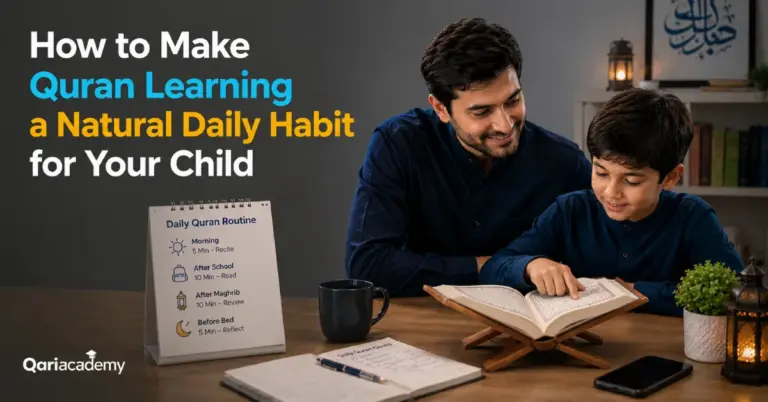
49. A Simple Weekly Quran Routine for a Five-Year-Old
A realistic routine might look like this:
| Activity | Frequency | Suggested Time |
|---|---|---|
| Teacher-led Quran lesson | 2–3 times weekly | 30 minutes |
| Reading review | 4–6 days weekly | 5–10 minutes |
| Memorization | 4–6 days weekly | 5 minutes |
| Revision | Most days | 3–5 minutes |
| Quran listening | Several times weekly | 5–15 minutes |
| Quran story or vocabulary | 1–2 times weekly | 5–10 minutes |
This does not mean the child must complete every activity every day.
The purpose is to create a sustainable rhythm.
50. What If the Child Has a Busy Schedule?
Five-year-olds may already have:
- Preschool
- School activities
- Sports
- Family commitments
- Playtime
- Sleep routines
Quran learning should fit into the child’s life rather than competing with every other activity.
Choose a predictable time.
For example:
After Maghrib → short Quran review
or:
Before bedtime → Quran listening
or:
Weekend morning → longer family Quran activity
The best routine is the one the family can actually maintain.
51. The Right Goal Is Not Perfection
At five, the goal is not perfect Quran recitation.
The goal is:
Steady development.
One correctly recognized letter matters.
One correctly pronounced sound matters.
One memorized verse matters.
One new Arabic word matters.
One short practice session matters.
These small steps accumulate over time.
52. Frequently Asked Questions
What should a 5-year-old know about the Quran?
A five-year-old can gradually learn that the Quran is Allah’s Book, develop respect for it, listen to recitation, memorize short surahs, recognize Arabic letters, begin basic Quran reading, and learn simple Quranic values and meanings.
Should a five-year-old be able to read Quran?
Not necessarily. Some five-year-olds can already read basic Quranic text, while others are still learning Arabic letters or Qaida. The child’s starting level matters more than age.
How much Quran should a five-year-old memorize?
There is no universal amount. Al-Fatihah and short surahs can be appropriate goals, but retention and accurate recitation matter more than the number of surahs memorized.
Should my five-year-old learn Tajweed?
They can begin learning correct pronunciation and simple recitation habits. Advanced Tajweed theory does not need to be a priority at this age.
How long should Quran lessons be for a five-year-old?
Many young children can benefit from short, focused lessons, often around 30 minutes when appropriately structured. The teacher should adapt the lesson to the child’s attention span and ability.
How often should a five-year-old have Quran classes?
Two or three weekly lessons can be a practical starting point for many families. The ideal frequency depends on the child’s goals, schedule, and ability to practice.
Should a five-year-old learn Arabic and Quran together?
Yes. Quran reading and Arabic language development can complement each other, although they are not exactly the same skill.
What if my child doesn’t know any Arabic?
Start from the beginning. The child can learn Arabic letters, sounds, Harakat, and basic reading patterns before progressing to Qaida and Quranic text.
Is online Quran learning suitable for a five-year-old?
It can be effective when the teacher is experienced with young children and lessons are interactive and individualized. Parents should provide a suitable learning environment and help establish the routine.
How can I know what level my child should start at?
A teacher can assess Arabic letter recognition, pronunciation, Harakat, reading ability, Tajweed, and memorization. A trial lesson can help determine the appropriate starting point.
Conclusion
So, what should a 5-year-old know about the Quran?
The answer is not a fixed number of surahs, pages, or Tajweed rules.
At five years old, your child is building a foundation.
They should gradually learn:
- What the Quran is
- Why Muslims love it
- How to respect it
- How to listen to it
- How to recognize Arabic letters
- How to begin reading Arabic
- How to memorize short surahs
- How to understand simple Quranic ideas
- How to connect Quranic values with everyday behavior
And perhaps most importantly:
They should begin developing a positive relationship with the Quran.
If your child is five and cannot yet read Arabic, that does not mean they are behind.
If your child only knows a few surahs, that does not mean they are failing.
If your child needs months to develop basic reading skills, that does not mean the learning program is ineffective.
What matters is whether the child is receiving appropriate instruction and gradually becoming more capable and confident.
The strongest early Quran education follows a simple principle:
Start where the child is. Teach one step at a time. Practice consistently. Protect the child’s love for learning.
For some children, the first step will be the Arabic alphabet.
For others, it will be a Qaida.
For others, it may be Quran reading and basic Tajweed.
A personalized approach allows the child to progress without being held back by material they already know or overwhelmed by material they are not ready for.
QariAcademy provides one-on-one online Quran classes for children, with learning tailored to the student’s level and pace. Its current programs include Quran reading, Tajweed, Hifz, and Quranic Arabic, with flexible lesson options and a trial process to help determine an appropriate starting point.
For families who also want broader Arabic development, QariAcademy offers children’s Arabic programs covering reading, writing, pronunciation, speaking, and Quran-related Arabic skills.
The goal is not to turn a five-year-old into an advanced Quran student overnight.
The goal is to give them a beginning they can build upon.
One letter becomes a word.
One word becomes a verse.
One verse becomes a surah.
One surah becomes a habit.
And that habit can eventually become a lifelong relationship with the Quran.
Give Your Five-Year-Old the Right Beginning
If you’re wondering whether your child should start with the Arabic alphabet, Qaida, Quran reading, memorization, or a combination, you do not have to guess.
A proper assessment can identify the child’s current level and help determine the next appropriate skill.
QariAcademy offers one-on-one online Quran lessons for children and a free trial that allows families to experience the teaching approach and determine an appropriate learning path before starting regular lessons.
Start with the skill your child needs today—not the level you think they should already have reached.
Book a Free Trial With QariAcademy:
Start a Free Trial
Quran Reference:
Read and Study the Quran on Quran.com