Table of Contents
Introduction
How to Build a Lifelong Relationship Between Your Child and the Quran is about much more than helping a child memorize Surahs.
A child can memorize dozens of Surahs yet grow up seeing Quran lessons as an obligation that belongs to childhood. Another child may progress more slowly but gradually develop the habit of reading, listening to, understanding, and returning to the Quran without being reminded.
The second outcome is often the deeper success.
Allah describes the Quran as a blessed Book revealed so that people may contemplate its verses and take heed from them: ﴿كِتَابٌ أَنزَلْنَاهُ إِلَيْكَ مُبَارَكٌ لِّيَدَّبَّرُوا آيَاتِهِ وَلِيَتَذَكَّرَ أُولُو الْأَلْبَابِ﴾ (Quran 38:29).
And the Prophet ﷺ said: “The best among you are those who learn the Quran and teach it.”
So the goal is not simply to create a child who can recite.
It is to help build a relationship that can continue when the parent is no longer standing beside the child saying, “Go read Quran.”
A Lifelong Relationship Is Built in Stages
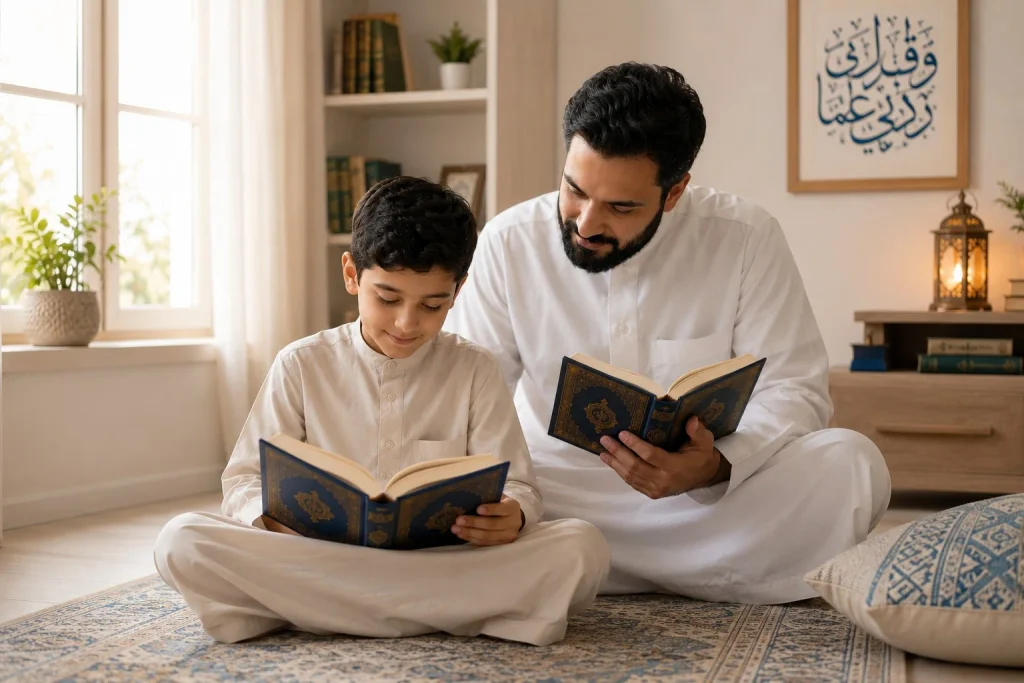
Children do not suddenly develop a deep connection with the Quran.
It develops through repeated experiences.
| Stage | Child’s Experience | Main Goal |
|---|---|---|
| Early childhood | Listening and repeating | Familiarity and love |
| Early reading | Learning letters and Quran reading | Confidence |
| Developing learner | Reading, Tajweed and memorization | Skill and consistency |
| Older child | Meaning and reflection | Understanding |
| Teenager | Independent practice | Ownership |
The method should change as the child grows.
A four-year-old may need short, playful activities.
A ten-year-old may benefit from Tajweed, Hifz, and Quranic vocabulary.
A teenager may need more discussion, independence, and personal responsibility.
QariAcademy’s Quran Learning by Age follows this developmental idea by connecting Quran reading, Tajweed, memorization, and understanding to the child’s stage and ability.
Start With Love, Not Pressure
Children remember how Quran learning felt.
If every interaction involves:
- “Did you memorize?”
- “Why did you forget?”
- “Your brother is ahead.”
- “You must finish this today.”
the child may eventually associate Quran with pressure.
That does not mean parents should remove discipline.
It means discipline should protect the relationship rather than damage it.
QariAcademy’s How to Make Your Child Love Daily Quran Recitation Without Pressure recommends achievable goals, positive reinforcement, meaning, consistency, and family participation rather than making Quran learning entirely about performance.
The goal is to create this association:
Quran = something meaningful that belongs in my life.
Not:
Quran = another task my parents force me to complete.
Let Your Child See the Quran at Home
Children learn from what they see.
If parents read Quran, listen to recitation, discuss its meanings, and treat Quran time naturally, children receive a powerful message without a lecture.
A Quran-friendly home does not require an elaborate Islamic room.
It can be as simple as:
- A regular family reading time
- Quran audio during a calm part of the day
- A quiet place for the child to read
- Parents occasionally reading alongside them
- Discussing one useful lesson from a Surah
QariAcademy’s How Parents in the USA, UK, and Canada Can Create a Quran-Friendly Home Environment emphasizes small daily habits, positive reinforcement, visible parental involvement, and reducing unnecessary pressure.
For families in the USA, UK, and Canada, this is particularly important because the child may have limited exposure to Arabic and Islamic learning outside the home.
Connect Quran Learning to Meaning
Allah says:
﴿أَفَلَا يَتَدَبَّرُونَ الْقُرْآنَ﴾
“Do they not then reflect on the Quran?” (Quran 47:24).
This does not mean a young child needs advanced Tafsir.
It means understanding should grow with the child.
For example:
Surah Al-Fil:
Discuss Allah’s power and how the story shows that worldly strength does not override Allah’s will.
Surah Al-Ma’un:
Talk about caring for others, helping people, and not treating worship as something disconnected from character.
Surah Al-Asr:
Ask the child what it means to use time well.
Surah Al-Ikhlas:
Explain in simple language that Allah is One and unlike His creation.
The point is not to turn every lesson into a lecture.
Sometimes one meaningful question is enough:
“What does this Surah teach us about how we should live?”
Use Technology Without Letting Technology Control the Routine
For Muslim families in the West, this is a real challenge.
A child may spend hours moving between:
- YouTube
- Gaming
- TikTok or other short-form content
- iPad apps
- TV
- Schoolwork
Then Quran practice is expected to compete for the final few minutes of attention.
That is not a fair competition.
Instead of simply saying “Put the iPad away,” create a predictable Quran routine.
For example:
After school → snack → short Quran review → free time
or:
Before gaming → 10 minutes of Quran
The objective is not to make Quran a punishment before entertainment.
It is to establish Quran as one of the normal parts of the child’s day.
QariAcademy’s Make Quran Learning Fun for Kids Online also recommends interactive tools, storytelling, short focused sessions, and active participation to keep digital Quran learning engaging without relying entirely on passive screen time.
Don’t Compete With School by Adding More Pressure
Children growing up in the USA, UK, or Canada often have demanding academic schedules.
School, homework, sports, clubs, and social activities can leave little mental energy.
The answer is not always to increase Quran workload.
Instead, protect consistency.
A 10-minute review on a difficult school night may be more sustainable than demanding a long session that creates conflict.
QariAcademy’s How Busy Parents Can Keep Their Children Consistent With Quran Learning recommends maintaining the rhythm of learning even when life becomes busy, rather than falling into an “all or nothing” routine.
Build Reading, Tajweed, Memorization, and Understanding Together
A lifelong relationship cannot depend on memorization alone.
A stronger model is:
Reading → Tajweed → Memorization → Understanding → Reflection → Application
| Area | What the Child Develops |
|---|---|
| Reading | Ability to access the Quran independently |
| Tajweed | Accurate recitation |
| Memorization | Familiarity and retention |
| Understanding | Connection to meaning |
| Reflection | Personal engagement |
| Application | Bringing lessons into life |
This is why QariAcademy’s How Children Really Learn Quran argues for looking beyond memorization toward reading, Tajweed, understanding, motivation, and eventual independence.
A Practical Example: What This Can Look Like
Here is a fictional composite example, created to illustrate a common educational pattern rather than describe a specific QariAcademy student.
Imagine a nine-year-old boy living in the UK.
At first, he memorized short Surahs well but resisted daily revision. His parents responded by increasing pressure, which made him even less willing to practice.
Instead of simply demanding more memorization, the learning plan was changed.
His teacher reduced the amount of new material, strengthened revision, explained the meaning of selected verses, and gave him small achievable goals.
At home, his parents stopped turning every interaction into a test.
They began asking:
“What did you learn from today’s Surah?”
After several weeks, the important change was not that he had suddenly memorized twice as much.
It was that he became more willing to open the Quran without being pushed.
That is the kind of progress parents should notice.
A lifelong relationship is often visible first in behavior, not in page count.
Let the Child Gradually Own the Relationship
A four-year-old needs reminders.
A seven-year-old needs structure.
A twelve-year-old should increasingly participate in setting goals.
Eventually:
Parent reminds → Child remembers
Teacher corrects → Child notices
Parent organizes → Child plans
Parent motivates → Child chooses to continue
QariAcademy’s Quran Learning for Tweens: How to Keep Kids Engaged highlights the importance of autonomy, meaningful challenges, specific feedback, and respecting older children’s growing independence.
This is one of the clearest signs of a maturing Quran relationship.
The Teacher’s Role Matters
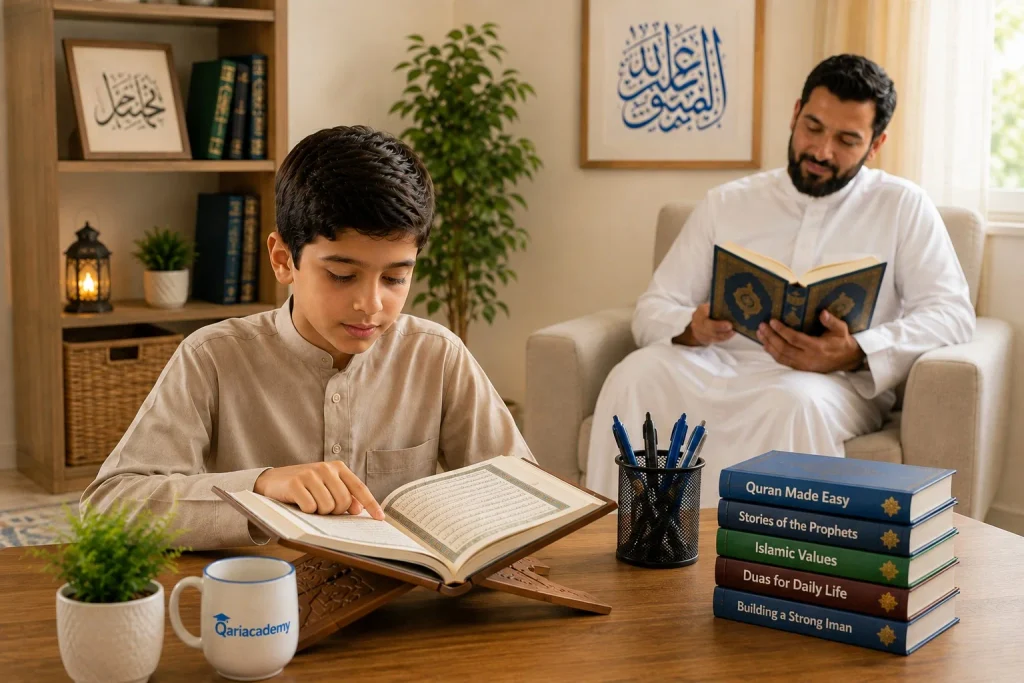
A good teacher does more than correct pronunciation.
They help the child experience:
- Progress
- Confidence
- Appropriate challenge
- Respect
- Meaning
- Consistency
For children who need personalized support, QariAcademy’s How to Support Your Child’s Quran Learning Online emphasizes communication between parents and tutors, consistent routines, encouragement, and individualized one-on-one instruction.
That can be particularly valuable when a child is balancing Quran with school and other responsibilities.
Three Steps You Can Start This Week
You don’t need to redesign your family’s entire routine.
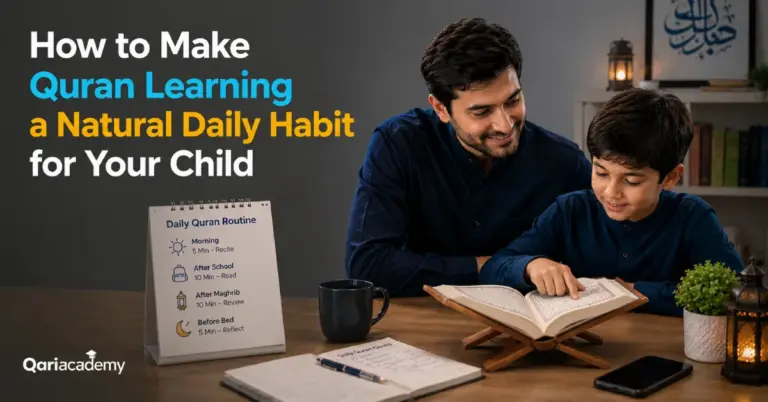
1. Create One Small Daily Quran Moment
Choose 5–15 minutes that can realistically happen most days.
Keep it predictable.
2. Add Meaning to One Surah
Choose a short Surah your child already knows.
Explain one idea from it and ask one simple question.
3. Stop Measuring Only Memorization
This week, notice one improvement in:
- Reading
- Tajweed
- Retention
- Understanding
- Confidence
- Independence
That gives you a much better picture of the child’s development.
What About Quran Apps and Digital Resources?
Digital tools can be useful when they support the learning goal.
Parents can consider:
- Quran apps with reliable recitations
- Audio repetition
- Digital flashcards
- Child-friendly Quran stories
- Color-coded reading materials
- A physical Mushaf alongside digital resources
But technology should remain a tool, not the center of the relationship.
The child should eventually be comfortable engaging with the Quran without needing a game, animation, or reward every time.
Encourage Memorization, But Protect Retention
Hifz is a beautiful goal.
But rapid memorization followed by rapid forgetting is not the same as sustainable progress.
QariAcademy’s Top Ways to Motivate Your Child to Continue Quran Memorization recommends achievable goals, consistency, reflection, encouragement, family support, and patience.
A healthier structure is:
New memorization → Recent revision → Older revision
The child should learn that returning to previously memorized Quran is not “going backward.”
It is part of preserving what they have learned.
Make Room for Difficult Seasons
There will be times when Quran learning becomes harder.
Exams.
Travel.
Sports seasons.
Moving house.
Teenage years.
Changes in school.
During these periods, protect the connection even if the routine temporarily becomes smaller.
Two minutes of listening may be better than abandoning Quran completely.
A short review may be better than turning the evening into a battle.
Consistency can be temporarily reduced without being abandoned.
What Parents Should Avoid
Don’t Compare Children
Different children have different starting points.
Don’t Make Quran a Punishment
Discipline should not create resentment.
Don’t Turn Every Interaction Into a Test
Children need moments to enjoy, listen, read, and reflect.
Don’t Focus Only on Numbers
Pages and Surahs matter, but they are not the whole journey.
Don’t Make Yourself the Only Source of Motivation
The long-term goal is internal motivation.
Don’t Ignore Understanding
Even simple age-appropriate meaning can transform how a child experiences the Quran.
Frequently Asked Questions
How can I make my child love the Quran?
Build positive associations, establish a manageable routine, avoid unnecessary pressure, model Quran engagement yourself, celebrate meaningful progress, and help the child understand what they are reciting.
Should children memorize Quran before understanding it?
They can memorize while gradually learning meaning. There is no need to treat memorization and understanding as competing goals.
How much Quran should a child read every day?
There is no universal amount. The appropriate routine depends on age, reading ability, school schedule, memorization goals, and attention. Consistency is generally more important than forcing an unrealistic amount.
What if my child prefers gaming to Quran?
Don’t treat the issue simply as disobedience. Establish a predictable routine, reduce distractions during Quran time, and make the learning experience meaningful. Quran should become part of the child’s normal daily rhythm rather than an enemy of entertainment.
How can parents help if they don’t speak Arabic?
Parents can still support consistency, listen, encourage, create a suitable environment, communicate with the teacher, and learn simple meanings alongside the child. QariAcademy’s Learning Arabic for Non-Arabic Speaking Kids also explains how children can gradually develop Quranic Arabic alongside their Quran education.
What is the most important sign that a child is developing a lifelong relationship with the Quran?
One of the strongest signs is increasing independence: the child gradually begins choosing to read, listen, revise, ask questions, or return to the Quran without constant parental prompting.
Conclusion
How to Build a Lifelong Relationship Between Your Child and the Quran is ultimately not about creating the fastest memorizer in the class.
It is about helping the child develop a relationship that survives childhood.
That requires more than Hifz.
It requires:
Love + Reading + Tajweed + Understanding + Consistency + Reflection + Independence
The Quran itself calls us toward reflection, not merely completion.
And the Prophet ﷺ connected excellence with learning and teaching the Quran.
So start small.
Read together.
Explain one verse.
Listen to a beautiful recitation.
Protect a short daily routine.
Reduce unnecessary pressure.
Let the teacher teach.
Let the parent model.
And as the child grows, gradually hand more of the responsibility to them.
The ultimate success is not simply hearing your child say, “I finished another Surah.”
It is one day hearing:
“I wanted to read Quran.”
That is when a lesson has started becoming a relationship.
For parents who want structured, personalized support as their child develops Quran reading, Tajweed, memorization, understanding, and independence, QariAcademy’s one-on-one Quran programs can provide a learning path adapted to the child’s level and goals.
Internal Articles Used — 10 Verified QariAcademy Articles
- How to Make Your Child Love Daily Quran Recitation Without Pressure — Open Article
- How Parents in the USA, UK, and Canada Can Create a Quran-Friendly Home Environment — Open Article
- How Busy Parents Can Keep Their Children Consistent With Quran Learning — Open Article
- How Children Really Learn Quran — Open Article
- How to Support Your Child’s Quran Learning Online — Open Article
- Top Ways to Motivate Your Child to Continue Quran Memorization — Open Article
- Make Quran Learning Fun for Kids Online — Open Article
- Learning Arabic for Non-Arabic Speaking Kids — Open Article
- Quran Learning by Age: What Should Kids Learn? — Open Article
- Quran Learning for Tweens: How to Keep Kids Engaged — Open Article
Reliable External Sources
- Quran 38:29 — Reflection and contemplation: Quran 38:29 on Quran.com
- Quran 47:24 — Reflecting on the Quran: Quran 47:24 on Quran.com
- Quran 73:4 — Measured recitation: Quran 73:4 on Quran.com
- Sahih al-Bukhari 5027 — Learning and teaching the Quran: Sahih al-Bukhari 5027 on Sunnah.com