Table of Contents
Introduction
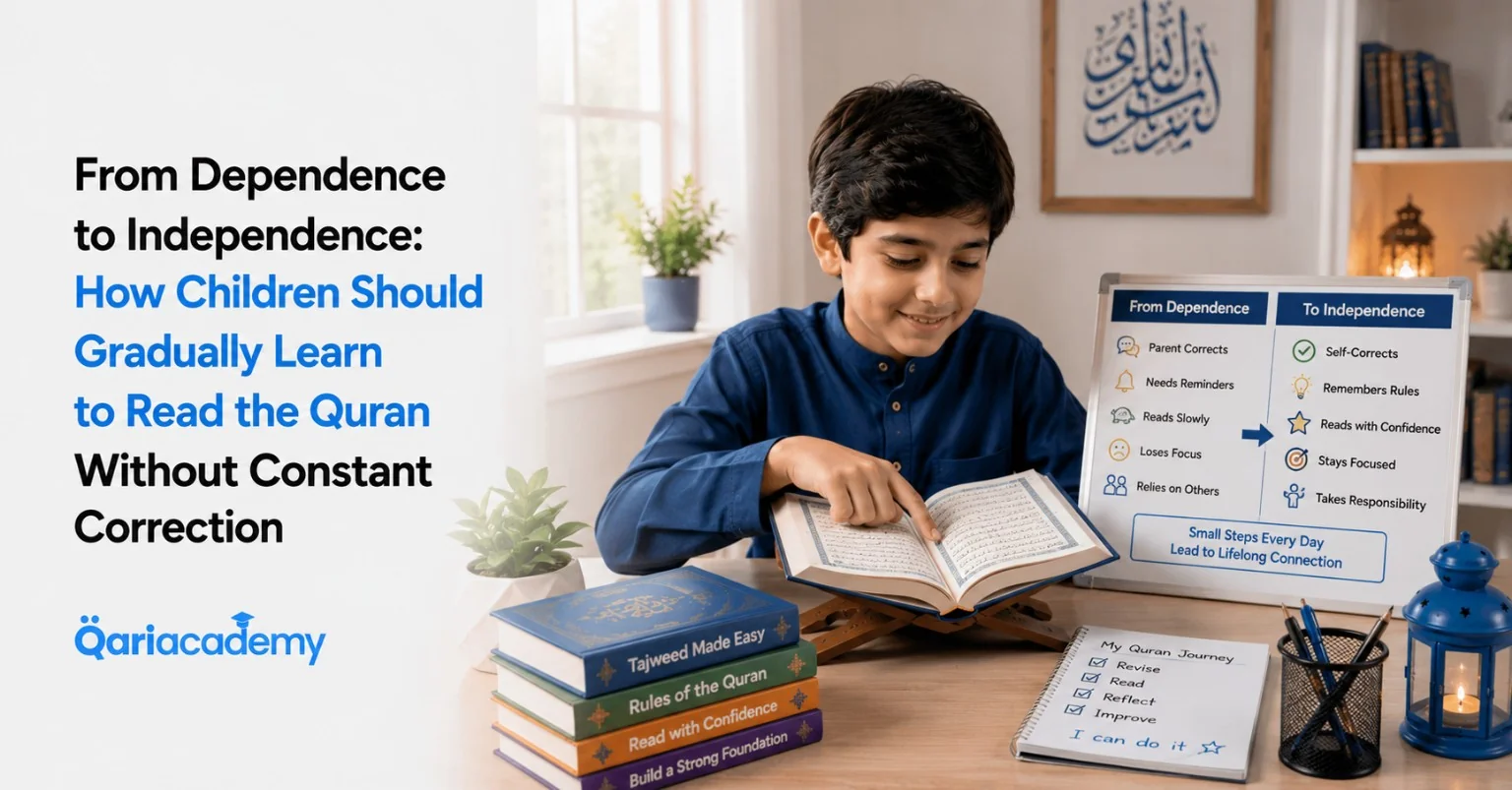
From Dependence to Independence is one of the most important transitions in a child’s Quran learning journey.
At the beginning, it is completely normal for a child to depend heavily on a teacher or parent.
The teacher reads a word.
The child repeats it.
The teacher corrects the pronunciation.
The child tries again.
The teacher points to the next word.
The child waits.
This is how beginners learn.
The problem begins when the child remains dependent on correction long after they have developed enough skills to start reading more independently.
A child who constantly waits for the teacher to provide every sound may appear to be progressing, but they may not actually be developing independent decoding skills.
The goal of Quran education is therefore not simply to make a child recite correctly with help.
It is to gradually help the child reach a point where they can open the Mushaf, recognize the text, attempt unfamiliar words, notice some of their own mistakes, and continue reading without needing someone to correct every line.
That transition should not happen suddenly.
It should be deliberately built through guided practice, appropriate correction, repetition, Tajweed development, confidence, and gradually reduced teacher support.
What Does Independent Quran Reading Actually Mean?
Independent reading does not mean that a child never makes mistakes.
Even strong readers need correction.
Independence means the child can increasingly:
- Recognize familiar words without prompting.
- Decode unfamiliar combinations.
- Attempt a word before asking for help.
- Continue reading after making a small mistake.
- Apply previously learned Tajweed rules.
- Notice some pronunciation problems.
- Correct themselves when given a reminder.
- Read a short passage without constant teacher intervention.
This distinction is important.
A child who reads perfectly only when the teacher says every word first is not yet an independent reader.
A child who occasionally makes mistakes but can read, think, attempt, and self-correct may actually be further along.
The Four Stages of Reading Independence
Children generally move through a progression rather than suddenly becoming independent.
| Stage | Child’s Behavior | Teacher’s Role |
|---|---|---|
| Dependent | Waits for almost every correction | Models and guides |
| Guided | Attempts but needs frequent support | Corrects and prompts |
| Developing | Reads independently but makes recurring mistakes | Gives targeted correction |
| Independent | Reads confidently and self-corrects some errors | Coaches and refines |
The purpose of teaching is to gradually move the child from the first stage toward the fourth.
That does not mean eliminating support.
It means changing the type of support.
Why Constant Correction Can Become a Problem
Correction is necessary.
But correcting every single word before allowing the child to attempt it can unintentionally create dependence.
Imagine a teacher immediately saying the pronunciation whenever the child pauses.
The child may learn:
“When I don’t know something, I should wait for the teacher.”
Instead, the teacher can sometimes allow the child to attempt the word first.
The process becomes:
See → Think → Attempt → Receive Feedback → Correct
rather than:
See → Wait → Teacher Says → Repeat
The second method may produce accurate repetition, but the first develops a more important long-term skill: independent reading.
The Teacher Should Not Disappear—The Teacher’s Role Should Change
As the child becomes stronger, the teacher’s job changes.
At the beginning, the teacher may need to provide substantial modeling.
Later, the teacher should increasingly provide prompts.
Eventually, the teacher becomes more of a coach.
For example:
Beginner
Teacher:
“Read after me: الْحَمْدُ.”
Child:
“الْحَمْدُ.”
Developing Reader
Teacher:
“Try this word.”
Child attempts it.
Teacher:
“Good. Check the vowel after ح.”
More Independent Reader
Teacher:
“Read this passage and tell me which part you think needs correction.”
The child begins participating in the correction process.
That is a major educational milestone.
Build Independence Through the Right Sequence
A useful progression is:
Model → Guided Practice → Independent Attempt → Feedback → Self-Correction
This sequence should appear repeatedly throughout Quran learning.
The teacher demonstrates a new skill.
The child practices with support.
The child tries independently.
The teacher provides targeted feedback.
The child attempts the same skill again.
Over time, the amount of assistance decreases.
This is more effective than simply telling a child:
“Read by yourself.”
Independence needs to be taught.
Reading Independence Starts With Strong Foundations
A child cannot become an independent Quran reader if the underlying reading skills are weak.
Depending on the child’s starting point, they may need:
- Arabic alphabet recognition
- Letter sounds
- Harakat
- Connected letters
- Sukoon
- Tanween
- Madd
- Shaddah
- Common Quranic word patterns
For children who are still developing letter recognition and pronunciation, QariAcademy’s The Secret to Teaching Kids Makharij Al-Huroof (Articulation Points) Easily explains how correct letter sounds and articulation can be developed from the beginning.
The important point is that independence is built on competence.
You cannot expect a child to read independently if they have never mastered the basic system required to decode the text.
Tajweed Should Support Independence
Tajweed is sometimes treated as a separate subject that begins after reading has been mastered.
In reality, Tajweed can support independent reading because it gives children a framework for recognizing and producing correct sounds.
For example, the child gradually learns that certain patterns require:
- A specific elongation
- A particular nasal sound
- A specific articulation
- A certain stopping pattern
- A different pronunciation depending on the surrounding letters
The child eventually stops relying entirely on the teacher to tell them what to do.
QariAcademy’s Tajweed for Kids: A Parent’s Guide emphasizes starting with sounds, keeping practice manageable, using repetition, and building correct pronunciation through child-friendly instruction.
The objective is not to make children memorize dozens of Tajweed definitions.
It is to help them apply what they have learned while reading.
Give the Child Time to Attempt the Word
One of the simplest ways to develop independence is to stop rescuing the child too quickly.
When a child pauses, give them a moment.
Ask:
“Try it.”
Or:
“Look at the Harakah.”
Or:
“What sound does this letter normally make?”
These prompts encourage the child to retrieve the information themselves.
The teacher is still helping—but the child is doing the thinking.
That difference matters.
Use Prompts Instead of Immediate Answers
There is a progression in the type of help a teacher can provide.
| Level of Help | Example | Independence |
|---|---|---|
| Full model | Teacher reads the entire word | Low |
| Partial prompt | Teacher gives the first sound | Developing |
| Rule reminder | “Check the Madd here.” | Higher |
| Self-check | “Does that sound right?” | Very high |
The goal is to move gradually down the table.
The child should receive enough help to succeed without receiving so much help that they stop thinking.
Teach Children to Notice Their Own Mistakes
Self-correction is one of the strongest signs of developing independence.
Suppose a child misreads a word.
Instead of immediately giving the correct pronunciation, the teacher might ask:
“Try that again.”
Then:
“Look at the letter carefully.”
Or:
“Check the vowel.”
The child gets another opportunity to analyze the mistake.
Eventually, they may stop and say:
“Oh, I read that wrong.”
That moment is more valuable than simply repeating the teacher’s correction.
The child is developing an internal monitoring system.
Don’t Expect Self-Correction Too Early
There is an important balance here.
A beginner cannot self-correct something they do not yet understand.
If a child has never learned a Tajweed rule, asking:
“What did you do wrong?”
may simply confuse them.
Independence should therefore follow instruction.
Teach → Practice → Apply → Self-monitor
not:
Teach nothing → Expect independence
The teacher must first provide the knowledge and tools that the child will later use independently.
Reading Confidence Matters
A child who is afraid of making mistakes may become excessively dependent on the teacher.
They may think:
“I shouldn’t read until I know I’m correct.”
That creates hesitation.
A healthier mindset is:
“I can try, make a mistake, receive feedback, and try again.”
QariAcademy’s Quran Learning Mistakes Parents Should Avoid with Kids warns against excessive strictness, rushing results, neglecting structure, and overloading children. It also emphasizes daily revision and professional guidance.
This matters because confidence does not mean pretending the child never makes mistakes.
It means the child is willing to attempt the reading despite the possibility of making one.
Praise the Process, Not Just Correctness
If parents only praise perfect recitation, children may become afraid of errors.
Instead, notice behaviors that build independence:
- “You tried that word by yourself.”
- “You noticed your mistake.”
- “You remembered the rule.”
- “You didn’t give up when the word was difficult.”
- “You corrected yourself.”
These are signs of learning maturity.
QariAcademy’s guidance on Make Quran Learning Fun for Kids Online emphasizes positive reinforcement, active participation, short focused practice, and celebrating milestones rather than focusing only on perfection.
Independence Requires Repetition
Children cannot become independent readers after seeing a rule once.
They need repeated exposure.
A child may learn a Tajweed rule on Monday and forget it on Thursday.
That does not necessarily mean the lesson failed.
The teacher should bring the rule back through different passages and contexts.
QariAcademy’s Quran Tajweed Step-by-Step: 30-Day Plan for Kids emphasizes structured progression, reinforcement, practice, revision, and tracking progress.
The goal is eventually to make the correct response increasingly automatic.
Revision Is What Makes Independence Stable
Reading independence is not built only by introducing new material.
It is also built by revisiting old material.
Revision allows the child to strengthen:
- Word recognition
- Pronunciation
- Tajweed application
- Reading fluency
- Confidence
- Memory
Without revision, the child may understand something during a lesson but struggle to retrieve it independently later.
That is why consistent review is not “going backward.”
It is what makes forward progress durable.
Parents Should Gradually Step Back
Parents often play a major role in the early stages.
They may sit beside the child.
Listen to every lesson.
Repeat words.
Correct mistakes.
Remind the child to practice.
That support can be valuable.
But eventually, parents should avoid becoming the child’s permanent second teacher.
The goal is:
Parent supports → Child practices → Teacher teaches → Child becomes independent
QariAcademy’s How to Support Your Child’s Quran Learning Online recommends parental involvement through routine, encouragement, communication with tutors, and a supportive learning environment.
That is different from correcting every word yourself.
Parents can support independence by asking:
“What did you practice today?”
rather than:
“Read the entire page again while I correct you.”
Measure Independence, Not Just Accuracy
Accuracy is important.
But it is only one dimension of progress.
Consider two children.
Child A: Reads perfectly when the teacher prompts every difficult word.
Child B: Makes three small mistakes but reads the entire passage independently and notices one of the mistakes without help.
Child A currently has better accuracy.
But Child B may be demonstrating stronger independence.
Parents should therefore track several dimensions.
| Progress Area | Question to Ask |
|---|---|
| Accuracy | Is the child making fewer mistakes? |
| Independence | Can they attempt more without help? |
| Fluency | Are pauses becoming less frequent? |
| Self-correction | Do they notice some mistakes? |
| Tajweed | Are learned rules being applied? |
| Confidence | Are they willing to attempt difficult words? |
QariAcademy’s 5 Smart Ways to Measure Your Childs Quran and Arabic Progress Without Traditional Tests recommends observing daily recitation, tracking consistency, looking at real-life application, using engaging challenges, and gathering regular teacher feedback.
What a Gradual Independence Plan Can Look Like
A teacher can deliberately reduce support over time.
Stage 1: Teacher Demonstrates
The child listens and repeats.
Stage 2: Teacher Guides
The child reads while receiving frequent prompts.
Stage 3: Child Attempts First
The teacher waits before correcting.
Stage 4: Child Self-Corrects With Prompts
The teacher asks questions rather than immediately supplying answers.
Stage 5: Independent Reading
The child reads a passage with only occasional correction.
Stage 6: Self-Monitoring
The child recognizes recurring mistakes and actively works on them.
This progression should happen gradually.
| Stage | Teacher Support | Child Responsibility |
|---|---|---|
| Demonstration | Very high | Listen and imitate |
| Guided reading | High | Attempt with help |
| Supported independence | Moderate | Read and respond to prompts |
| Developing independence | Low | Read and self-correct |
| Independent reading | Occasional | Monitor and improve |
Don’t Confuse Independence With “No Correction”
This is an important distinction.
Even advanced Quran students need teachers.
A child may read independently and still benefit from a teacher who notices:
- Subtle Makharij errors
- Recurring Tajweed mistakes
- Weak fluency
- Incorrect stopping
- Inconsistent Madd
- Pronunciation habits
Independence means the child can function without constant intervention.
It does not mean the child has reached the end of learning.
The relationship changes from:
“Tell me what to read.”
to:
“Help me improve how I read.”
That is a much healthier long-term relationship with a teacher.
How Age Changes the Goal
The amount of independence expected should also change with age.
A young child may naturally need more direct support.
An older child should gradually take more responsibility.
| Age/Stage | Appropriate Independence |
|---|---|
| Early beginner | Repeat after teacher |
| Developing beginner | Attempt simple words independently |
| Elementary reader | Read short passages with limited prompting |
| Strong reader | Self-correct common mistakes |
| Preteen | Manage some reading and revision independently |
These are not strict age requirements.
A twelve-year-old who starts from zero may still need intensive guidance.
A seven-year-old who already reads well may be ready for more independence.
Ability matters.
What Happens When Children Remain Dependent Too Long?
If a child becomes accustomed to constant correction, several problems can develop.
They may:
- Wait for the teacher instead of decoding.
- Lose confidence when reading alone.
- Avoid unfamiliar words.
- Depend on memorized sound patterns.
- Struggle when the teacher is unavailable.
- Have difficulty practicing independently.
This does not mean the teacher has done something wrong.
Dependence is a normal starting point.
The problem is failing to transition beyond it.
What Happens When Independence Is Pushed Too Early?
The opposite extreme is also harmful.
If a beginner is told:
“Read this whole page alone.”
before they have the necessary skills, they may guess words, develop pronunciation errors, or become frustrated.
The solution is not:
Maximum independence as quickly as possible.
It is:
The right amount of independence for the child’s current ability.
That is the central principle.
How One-on-One Learning Can Support This Transition
One-on-one teaching can be especially useful because the teacher can adjust the amount of support in real time.
For one child, the teacher may need to model every new pattern.
For another, the teacher can immediately ask the child to attempt it independently.
QariAcademy’s Quran programs describe one-on-one live lessons, personalized pacing, regular feedback, revision, and gradual instruction. Its children’s Quran program is available for ages 5–15 and all levels.
Its Tajweed program specifically describes consistent practice, revision, gentle correction, and personalized feedback as part of its approach.
That type of individualized instruction makes it easier to change the teacher’s role as the child becomes more capable.
A Practical Home Routine for Building Independence
Parents can reinforce this transition without becoming the teacher.
Try a simple routine:
Step 1: Ask the child to read a short familiar passage alone.
Step 2: Don’t interrupt every mistake.
Step 3: Mark one or two recurring issues to discuss with the teacher.
Step 4: Ask the child what they found difficult.
Step 5: Let the teacher provide the technical correction.
This gives the child space to develop confidence without sacrificing accuracy.
The Goal Is Not Perfect Reading
This is perhaps the most important message for parents.
The goal is not to create a child who never makes a mistake.
The goal is to create a child who knows how to respond when they make one.
A strong learner can say:
“I don’t know this.”
“I’ll try it.”
“I made a mistake.”
“Let me check.”
“I remember this rule.”
“I need help with this part.”
That is independence.
Frequently Asked Questions
How do I know if my child is becoming an independent Quran reader?
Look for fewer prompts, more willingness to attempt unfamiliar words, improved fluency, occasional self-correction, and the ability to apply previously learned Tajweed rules without being reminded every time.
Should I correct every Quran reading mistake immediately?
Not necessarily. Accuracy matters, but allowing the child to attempt a word before correcting it can help develop independent decoding and self-monitoring.
When should a child start reading Quran independently?
There is no fixed age. Independence should increase as the child develops sufficient letter recognition, decoding ability, pronunciation, Tajweed knowledge, and confidence.
Is it okay for my child to make mistakes while reading?
Yes. Mistakes are a normal part of learning. The important issue is whether they are being corrected appropriately and becoming less frequent over time.
Should parents correct their children’s Tajweed at home?
Parents can encourage practice and remind children of teacher-assigned goals. If they are not confident in Tajweed themselves, they should avoid repeatedly teaching technical corrections that may be inaccurate.
Does independent reading mean the child no longer needs a teacher?
No. Independence means the child no longer needs constant correction. A teacher remains valuable for refining Tajweed, fluency, pronunciation, and more advanced Quran skills.
Conclusion
From Dependence to Independence is not a single moment in a child’s Quran education.
It is a gradual transition.
At first, the child needs the teacher to model almost everything.
Then the child begins attempting words with guidance.
Later, the teacher provides prompts instead of answers.
Eventually, the child can read independently, recognize some mistakes, and actively participate in improving their recitation.
The most effective path is:
Model → Guide → Attempt → Correct → Self-Correct → Independently Read
Parents should not rush this process.
A child who is still developing the basic reading system needs support.
But once those foundations become stronger, the teacher should deliberately begin stepping back.
The ultimate goal is not simply a child who can recite correctly when someone is sitting beside them.
It is a child who can open the Quran and confidently make an attempt, recognize what they know, recognize what they do not know, and continue learning with less and less dependence on constant correction.
That is a much more valuable form of Quranic progress.
For families who want this kind of gradual, personalized development, QariAcademy offers one-on-one Quran learning with individualized pacing, Tajweed development, regular feedback, and structured progress.
Explore QariAcademy’s Online Quran Programs
Internal Articles Used — 10 Verified QariAcademy Articles
- The Secret to Teaching Kids Makharij Al-Huroof (Articulation Points) Easily
Open Article - Tajweed for Kids: A Parent’s Guide
Open Article - Quran Tajweed Step-by-Step: 30-Day Plan for Kids
Open Article - Quran Learning Mistakes Parents Should Avoid with Kids
Open Article - 5 Smart Ways to Measure Your Childs Quran and Arabic Progress Without Traditional Tests
Open Article - How to Support Your Child’s Quran Learning Online
Open Article - Make Quran Learning Fun for Kids Online
Open Article - Effective Techniques to Enhance Children’s Focus During Quran Classes
Open Article - Learning Arabic for Non-Arabic Speaking Kids
Open Article - How to Balance School Demands and Quran Study? A 3-Step Practical Guide for Busy Parents
Open Article
Reliable External Sources
Quran 12:2 — the Quran described as an Arabic revelation:
Quran 12:2 — Quran.com
Quran 73:4 — measured and deliberate recitation:
Quran 73:4 — Quran.com