Introduction
How can parents support their child’s Hifz without turning every Quran session into an argument?
This is a question many Muslim families quietly face.
You want your child to love the Quran. You want them to memorize it accurately, revise consistently, and develop a lifelong relationship with the Book of Allah.
But somewhere between:
“Have you revised today?”
and
“How can you forget something you memorized yesterday?”
the atmosphere can change.
Suddenly, the parent becomes the person checking every mistake, enforcing every practice session, counting every missed verse, and reminding the child about Quran every time they walk past the living room.
The child begins to associate Quran with correction.
The parent starts feeling like a supervisor.
And nobody is enjoying the process.
This does not mean parents should become passive.
Children need structure. They need expectations, encouragement, accountability, and adults who take their Quran education seriously.
The challenge is finding the balance between supporting Hifz and controlling every moment of it.
For families in the USA, UK, Canada, Australia, and other Western countries, this balance can be particularly challenging. Children may spend most of their day in English-speaking schools, have limited Arabic exposure, and already carry academic and extracurricular responsibilities. Quran lessons may happen after school, when the child is tired and ready to relax.
The answer is not to remove expectations.
It is to change the parent’s role.
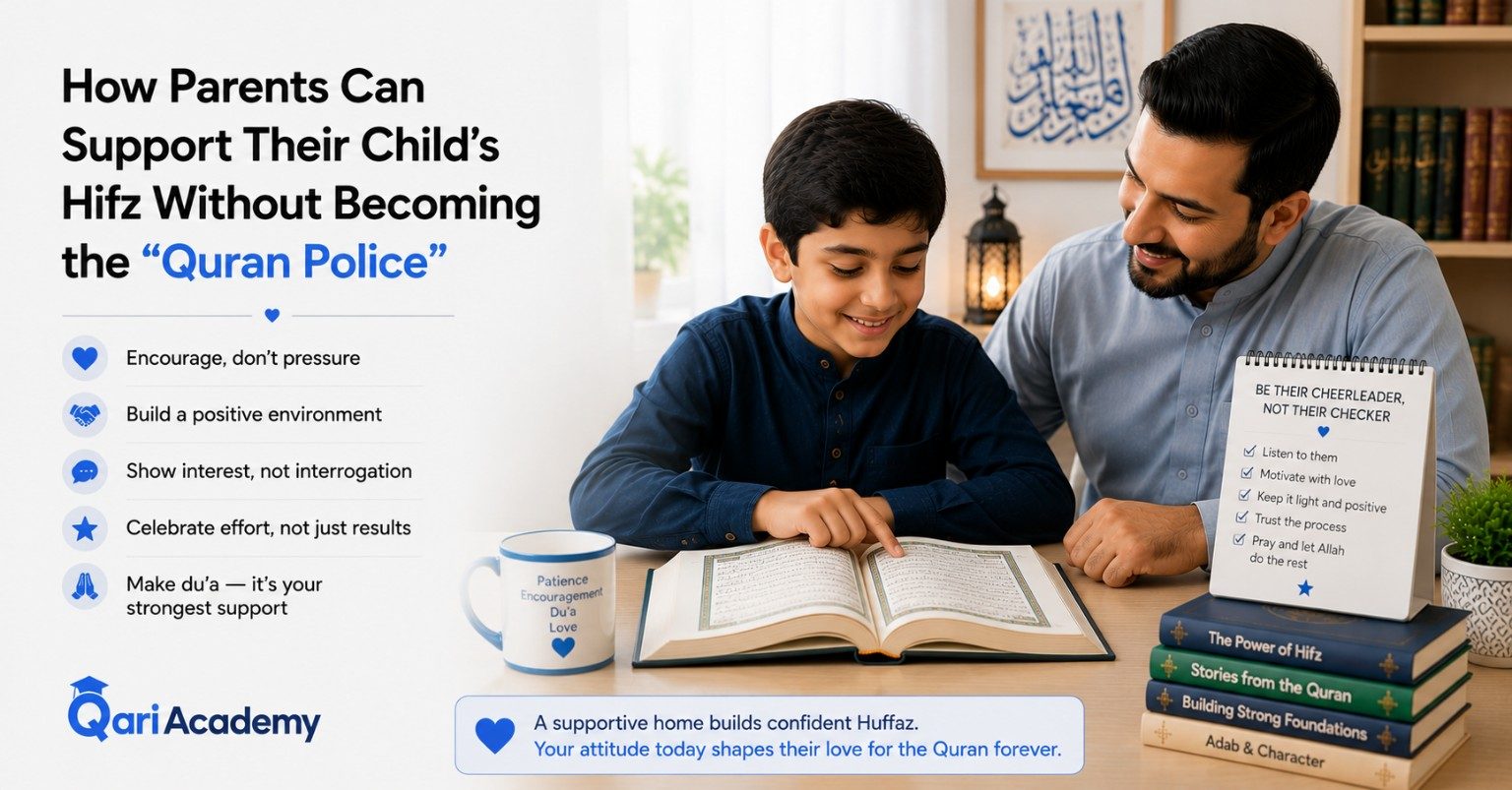
Instead of becoming the “Quran Police,” parents can become their child’s Quran support system.
That means creating the environment, protecting the routine, communicating with the teacher, encouraging revision, and helping the child recover from difficult days without making every mistake emotionally expensive.
This article explains how parents can support child Hifz without turning Quran learning into a constant source of pressure.
You will learn how to establish healthy expectations, create a realistic home routine, encourage revision, respond when your child forgets, communicate effectively with teachers, handle resistance, avoid comparison, and gradually build your child’s independence.
The ultimate goal is not simply to get your child through today’s lesson.
It is to help them develop a sustainable relationship with Quran learning that can continue long after they no longer need you to remind them.
What Does “Quran Police” Parenting Look Like?
The phrase “Quran Police” is not about parents who care deeply.
Caring is not the problem.
The problem begins when supervision becomes the dominant experience of Quran learning.
A parent may unintentionally become overly controlling by:
- Checking memorization constantly.
- Interrupting every mistake.
- Asking about Quran immediately after school every day.
- Comparing the child with siblings or friends.
- Increasing practice whenever the child performs well.
- Using guilt whenever the child forgets.
- Treating every missed practice session as a major failure.
- Repeating reminders so frequently that the child stops listening.
None of these behaviors necessarily comes from bad intentions.
Often, they come from love, fear, or frustration.
Parents may be thinking:
“If I don’t push them, they won’t continue.”
That concern is understandable.
But excessive pressure can create another problem: the child may begin to associate Quran primarily with parental monitoring rather than personal commitment.
| Parent Behavior | Supportive Approach | Controlling Approach |
|---|---|---|
| Reminders | One clear reminder | Repeated reminders |
| Revision | Create time for it | Constantly monitor it |
| Mistakes | Encourage correction | React with frustration |
| Progress | Notice improvement | Focus only on gaps |
| Teacher | Communicate constructively | Interfere constantly |
| Motivation | Build ownership | Use pressure as the main tool |
The goal is not to eliminate parental involvement.
It is to make that involvement more strategic.
Your Child Needs You—but Not as Their Teacher
One of the biggest mindset shifts parents can make is understanding that supporting your child is not the same as personally teaching every lesson.
If you are not trained in Tajweed, you do not need to become your child’s Tajweed instructor.
If you do not know how to diagnose Quran-reading problems, you do not need to determine why every mistake occurs.
If you are not responsible for the formal curriculum, you do not need to recreate the teacher’s lesson at home.
Your role can be much simpler.
The Parent’s Core Responsibilities
You can:
- Make sure your child attends lessons.
- Provide a suitable learning environment.
- Establish a regular practice time.
- Encourage short revision sessions.
- Listen when appropriate.
- Communicate important information to the teacher.
- Celebrate progress.
- Help your child recover from setbacks.
This allows the teacher to focus on teaching.
It also allows the child to have a healthy relationship with both the parent and teacher.
Why Parents Sometimes Become Overly Controlling
Understanding the cause can help you change the behavior.
Fear of Wasted Potential
You may think:
“My child has a good memory. We have to take advantage of it.”
That can lead to excessive workloads.
Comparison
You see another child memorizing quickly.
Suddenly your child’s pace seems inadequate.
Anxiety About Consistency
You may worry that if you relax, your child will stop practicing.
Unrealistic Expectations
Social media can make Hifz progress appear much faster and easier than it really is.
Previous Negative Experiences
Perhaps you struggled with Quran learning yourself and desperately want your child to have a better experience.
These emotions are understandable.
But they should not dictate the entire learning environment.
The Most Important Question: Who Owns the Hifz Journey?
When children are young, parents naturally carry much of the responsibility.
But the long-term goal should be increasing child ownership.
At first:
Parent reminds → Child practices
Later:
Parent supports → Child initiates
Eventually:
Child plans → Child practices → Parent supports
This transition matters.
A teenager who only memorizes when a parent is standing nearby has not yet developed the independence needed for a lifelong Hifz journey.
A child who gradually learns to say:
“I need to review this before my lesson.”
is developing a much more sustainable habit.
How to Build Ownership Gradually
Do not simply tell your child:
“You are responsible for your Quran now.”
They may not know what that means.
Instead, transfer responsibility in small steps.
Stage 1: Parent Leads
You establish the routine.
Stage 2: Child Participates
Let the child choose between two reasonable practice times.
Stage 3: Child Tracks
Give them a simple Hifz or revision checklist.
Stage 4: Child Initiates
Ask:
“When do you think you should revise today?”
Stage 5: Child Plans
Older children can help decide what needs review and when.
| Responsibility Stage | Parent Role | Child Role |
|---|---|---|
| Beginner | Set routine | Follow routine |
| Developing | Give reminders | Participate |
| Growing | Offer choices | Choose practice time |
| Independent | Check occasionally | Track revision |
| Advanced | Provide support | Plan and manage Hifz |
This is how accountability can gradually become self-discipline.
Create a Routine Instead of Constant Reminders
If you have to tell your child ten times every day to revise Quran, the problem may not be your child’s character.
The problem may be the system.
A predictable routine reduces the need for repeated verbal reminders.
For example:
After homework → Quran revision → dinner
Or:
After Maghrib → Quran reading/revision → family time
The exact sequence depends on your family.
The principle is simple:
Attach Quran practice to an existing routine.
When the activity becomes predictable, the parent does not need to negotiate it every day.
Make the Routine Realistic
A common mistake is creating an impressive schedule that cannot survive a normal school week.
For example:
- 45 minutes of Hifz
- 30 minutes of Quran reading
- 20 minutes of revision
- Daily Tajweed practice
It may look excellent on paper.
But if your child is already exhausted after school, homework, and extracurricular activities, the routine may collapse.
Start smaller.
A child who consistently practices for 10–15 focused minutes may develop a stronger habit than a child who is forced into an hour-long routine that repeatedly ends in conflict.
The “Minimum Viable Quran Routine”
A useful concept for busy families is to establish a minimum routine.
For example:
Minimum: 10 minutes of Quran contact.
On a normal day, you can do more.
On a very busy day, you protect the minimum.
This helps prevent the all-or-nothing mindset.
The child learns:
“Even on difficult days, we still make some time for Quran.”
That is much healthier than:
“If we cannot complete the full session, there is no point doing anything.”
How to Encourage Revision Without Nagging
Instead of repeatedly asking:
“Did you revise?”
change the environment.
Option 1: Scheduled Revision
Build it into the daily routine.
Option 2: Visible Checklist
Let the child mark completed revision.
Option 3: Teacher-Based Accountability
Ask the teacher to provide the week’s revision priorities.
Option 4: Child Choice
Let the child choose which older surah to review first.
Option 5: Short Parent Listening
Listen to one short passage and stop.
You do not have to monitor every second.
What to Do When Your Child Says, “I Don’t Want to Revise”
Do not immediately assume laziness.
Ask one question:
“What is making revision difficult today?”
The answer might be:
- “I’m tired.”
- “I don’t remember it.”
- “It’s boring.”
- “I have homework.”
- “I don’t understand this part.”
- “I’m worried I’ll make mistakes.”
- “It’s too much.”
Each answer requires a different response.
If the Child Is Tired
Reduce the session.
If They Are Confused
Ask the teacher for clarification.
If They Find It Boring
Add some variation without turning every Quran session into entertainment.
If the Workload Is Too High
Discuss reducing the new material.
If They Are Afraid of Mistakes
Change the emotional tone of correction.
The first step is always:
Diagnose before you discipline.
How to Respond When Your Child Forgets
This may be one of the most important moments in Hifz parenting.
Your child forgets a passage.
You know they learned it yesterday.
Your instinct may be:
“You knew this yesterday!”
Stop.
Take a breath.
Then ask:
“Which part feels difficult today?”
This changes the conversation from accusation to problem-solving.
Forgetting is a normal part of learning and memory. The objective should be to strengthen retrieval and revision rather than shame the child.
Research in education also supports retrieval practice as a useful learning strategy for children when it is appropriately guided and scaffolded.
Never Turn Forgetting Into a Character Judgment
Avoid statements such as:
- “You’re lazy.”
- “You don’t care about Quran.”
- “You’re not serious.”
- “You’re always forgetting.”
- “You never concentrate.”
These statements describe the child rather than the problem.
Instead say:
- “This section needs more revision.”
- “Let’s practice the difficult part.”
- “Maybe today’s target was too large.”
- “Let’s ask the teacher how to approach it.”
One approach attacks identity.
The other addresses behavior.
That difference matters.
How to Praise Your Child Properly
Praise is useful, but generic praise can become meaningless.
Instead of:
“You’re amazing!”
try:
“You remembered the whole passage without help.”
Or:
“You corrected that pronunciation yourself.”
Or:
“You remembered yesterday’s lesson even after a busy school day.”
Specific praise tells the child exactly what behavior is worth repeating.
Praise the Process
Notice:
- Consistency
- Effort
- Patience
- Revision
- Independent recall
- Accuracy
- Improvement
Do not praise only the number of pages memorized.
What About Rewards?
Rewards can sometimes help establish a routine, particularly for younger children.
But be careful.
If every Quran activity requires a prize, the child may learn:
“I do Quran because I get something.”
A better approach is to use external rewards lightly while gradually building internal motivation.
For example:
- A simple progress chart
- Celebrating meaningful milestones
- Choosing a family activity after reaching a realistic goal
- Verbal recognition
- Letting the child share their recitation with a loved one
The reward should support the habit rather than become the reason for learning.
Avoid Comparing Your Child With Other Children
Comparison is particularly dangerous in Quran memorization.
You may know a child who memorizes extremely quickly.
You may see children online who have memorized several Juz.
But you rarely know the complete context.
You do not know:
- Their daily practice time.
- Their Arabic background.
- Their Quran reading ability.
- Their teacher’s approach.
- Their family routine.
- Their revision habits.
- Their individual learning needs.
Comparison can turn another child’s achievement into your child’s perceived failure.
Instead, compare your child’s current ability with their own previous performance.
Ask:
“Is my child better than they were three months ago?”
That is a much more useful question.
The Difference Between High Standards and High Pressure
Parents sometimes fear that reducing pressure means lowering standards.
It does not.
You can maintain high standards for:
- Attendance
- Respect
- Consistency
- Accurate recitation
- Honest effort
- Revision
- Listening to the teacher
while maintaining a calm emotional environment.
Your child can understand:
“Quran matters in our family.”
without hearing:
“If you make a mistake, you have disappointed us.”
| High Standards | High Pressure |
|---|---|
| “Let’s practice consistently.” | “You must never forget.” |
| “Accuracy matters.” | “Mistakes are unacceptable.” |
| “Let’s review this again.” | “How can you still not know this?” |
| “Let’s improve gradually.” | “You should be much further by now.” |
| “Quran is important.” | “Your performance determines your worth.” |
High standards and high pressure are not the same thing.
What If Your Child Is Falling Behind?
First, define “behind.”
Behind whom?
Behind what target?
Behind which curriculum?
A child may be progressing perfectly well while simply moving at a different pace.
Before increasing pressure, examine:
- Quran reading ability
- Memorization retention
- Revision consistency
- School workload
- Teacher feedback
- Home environment
- Motivation
Then determine whether the issue is actually progress—or simply comparison.
Communicate With the Teacher
Parents and teachers should work as a team.
But communication should be strategic.
Instead of sending frequent messages about every small mistake, establish a useful communication system.
Ask the teacher:
- What should my child focus on this week?
- How much new Hifz should they learn?
- Which older material needs revision?
- What are the main pronunciation issues?
- Is the current workload appropriate?
- What should parents avoid doing at home?
These questions make parental involvement more effective.
Let the Teacher Handle Teacher-Level Problems
If the child consistently struggles with a particular Tajweed rule, do not invent your own correction method.
Ask the teacher:
“How would you like us to practice this at home?”
This keeps the instruction consistent.
It also prevents the child from receiving conflicting explanations.
| Topic | Parent Can Do | Teacher Can Do |
|---|---|---|
| Attendance | Ensure consistency | Track participation |
| Home practice | Create routine | Assign appropriate practice |
| Tajweed | Reinforce instructions | Teach and correct |
| Hifz target | Support schedule | Set and adjust workload |
| Motivation | Encourage | Adapt teaching approach |
| Progress | Observe at home | Assess learning |
This division of responsibility prevents parents from feeling that they must manage everything.
How to Handle a Bad Quran Day
Some days simply go badly.
The child forgets everything.
They are distracted.
They complain.
The lesson feels difficult.
Do not turn one bad day into a crisis.
Ask:
“Is this a pattern or just today?”
If it is one difficult day, move on.
If it happens repeatedly, investigate.
This is much healthier than changing the entire Hifz program every time your child has a difficult lesson.
How to Handle a Bad Week
Sometimes an entire week is difficult.
Maybe there are:
- School exams
- Family travel
- Poor sleep
- Illness
- Holiday activities
- An unusually demanding school schedule
During these periods, protect the habit rather than demanding normal performance.
A lighter week can still include:
- Listening
- Reading
- Short revision
- One familiar surah
- Teacher communication
The goal is to maintain the connection without creating unnecessary pressure.
When Your Child Is Ready for More Independence
Parents should actively look for opportunities to transfer responsibility.
Instead of:
“Go revise Surah Al-Mulk.”
say:
“You have ten minutes. What do you think you should review?”
For a younger child, provide two choices.
For an older child, let them decide.
This teaches planning.
Independence Progression
Parent tells → Child follows
then:
Parent asks → Child chooses
then:
Child plans → Parent checks
eventually:
Child manages → Parent supports
This is one of the most valuable long-term outcomes of Quran education.
How to Use a Hifz Tracker Without Becoming Controlling
A simple tracker can help children visualize progress.
Include:
- Current Hifz
- New material
- Recent revision
- Older revision
- Weak passages
- Teacher notes
But do not turn the tracker into a daily performance score.
The purpose is awareness, not surveillance.
For younger children, simple visual markers may work well.
For older children, a more detailed checklist can be useful.
A Sample Weekly Parent Routine
You do not need to monitor every lesson.
A practical weekly system might be:
Monday: Ask what the teacher assigned.
Tuesday: Provide time for practice.
Wednesday: Listen briefly to the newest lesson.
Thursday: Ask whether anything is difficult.
Friday: Review an older passage together.
Weekend: Check in with the teacher if necessary.
This keeps parents involved without creating constant oversight.
The Importance of a Calm Quran Environment
Think about the emotional atmosphere surrounding Quran learning.
Does your child associate Quran with:
- Peace?
- Encouragement?
- Growth?
- Reflection?
- Family connection?
Or mostly with:
- Pressure?
- Correction?
- Arguments?
- Comparison?
- Fear of mistakes?
You do not need to create a perfect environment.
But you should notice the pattern.
If Quran time is consistently associated with conflict, something needs to change.
What If Parents and Children Have Different Expectations?
This happens often.
The parent may want:
“One page every week.”
The child may struggle with half a page.
Or the teacher may recommend less.
Instead of making the child choose sides, discuss the target openly with the teacher.
Ask:
“Is this target realistic for our child right now?”
Use evidence:
- Retention
- Accuracy
- Revision
- Practice consistency
—not emotion.
How to Respond When Your Child Makes the Same Mistake Repeatedly
Repeated mistakes can be frustrating.
But repetition of the mistake is information.
Maybe the child does not hear the difference.
Maybe a particular letter is difficult.
Maybe the passage is being recited too quickly.
Maybe the child needs a different explanation.
Ask the teacher for a targeted exercise.
Then practice that specific issue.
Do not turn the entire Quran session into correction.
Why Children Need Space to Make Mistakes
If every mistake receives an immediate negative reaction, children may become afraid to attempt independent recitation.
That creates a paradox.
You want independence.
But your reactions teach the child to wait for help.
Allow the child some space to retrieve.
Let them struggle briefly.
Then help.
This teaches an important lesson:
“Mistakes are part of learning.”
Supporting Hifz in English-Speaking Homes
Children growing up in the West often experience a unique language environment.
They may speak English:
- At school
- With friends
- During entertainment
- During homework
Arabic may appear mainly during Quran and Islamic activities.
Parents can support this by creating small Arabic and Quran habits without expecting the entire home to become Arabic-speaking.
For example:
- Display simple Arabic words.
- Listen to Quran regularly.
- Learn selected Quranic vocabulary.
- Ask the child to identify familiar words.
- Encourage reading from the Mushaf.
- Discuss simple meanings.
The objective is to make Quranic Arabic feel familiar rather than completely foreign.
What About Children Who Are Still Learning to Read?
Do not force a large Hifz workload onto a child who is still struggling with basic Quran reading.
At the same time, modest memorization can sometimes continue alongside reading instruction.
The teacher can determine the appropriate balance.
For example, a lesson might include:
Quran Reading → Tajweed → Hifz → Revision
The exact timing should be individualized according to the child’s age and level.
How QariAcademy Can Support Parents Without Making Them Teachers
QariAcademy offers Online Quran Classes for children, including one-on-one lessons designed around the student’s current level.
This can help parents step out of the role of “daily Quran instructor.”
Instead of trying to teach every Tajweed rule or decide exactly how much Hifz to assign, parents can focus on creating the conditions for learning.
Depending on the child’s needs, lessons can include:
- Quran Reading
- Tajweed
- Hifz
- Quranic Arabic
The one-on-one format allows the teacher to pay attention to the child’s specific strengths and weaknesses.
For families in the USA, UK, Canada, Australia, and other Western countries, online learning can also make it easier to fit Quran education around school and family schedules.
A Free Trial with QariAcademy can give parents an opportunity to understand their child’s current level and see whether the teaching approach is a good fit.
The goal is not to transfer every responsibility to the teacher.
It is to create a healthy division of responsibility:
Teacher teaches.
Child learns.
Parent supports.
That is a much more sustainable model.
A 15-Minute Parent Support Routine
Parents often think supporting Hifz requires teaching.
It does not.
Try this instead:
Minutes 1–3
Ask the child what they learned.
Minutes 4–8
Let them recite without constant interruption.
Minutes 9–11
Identify one or two areas that need review.
Minutes 12–15
Encourage the child and help them plan the next practice.
You do not need to correct every Tajweed issue yourself.
You are supporting the habit.
A 30-Day Plan to Reduce Quran Conflict
If Quran practice has become a source of tension, do not try to fix everything overnight.
Week 1: Observe
Notice when conflict happens.
Is it:
- Before lessons?
- During revision?
- When the child is tired?
- When you correct mistakes?
- When you ask for too much?
Week 2: Simplify
Reduce unnecessary reminders.
Create one predictable practice time.
Week 3: Transfer Responsibility
Let your child make small choices.
Week 4: Review
Ask:
- Is resistance lower?
- Is the child more independent?
- Is revision more consistent?
- Is the emotional atmosphere better?
| Week | Parent Focus | Child Focus |
|---|---|---|
| Week 1 | Observe patterns | Participate normally |
| Week 2 | Simplify routine | Follow predictable schedule |
| Week 3 | Give choices | Take more responsibility |
| Week 4 | Evaluate | Reflect on progress |
| Month 2 | Maintain support | Increase independence |
| Month 3 | Step back gradually | Manage more of the routine |
When Parents Should Be Firm
Healthy support does not mean allowing children to avoid Quran whenever they do not feel like it.
Children need structure.
You can calmly say:
“Quran practice is part of our routine. Let’s decide how we are going to do it.”
The question is not whether there should be expectations.
It is how those expectations are communicated.
Be Firm About the Routine
But:
Be Flexible About the Details
For example:
Firm: Quran practice happens today.
Flexible: You can choose whether we practice before dinner or afterward.
This gives the child some autonomy without removing responsibility.
When Parents Should Step In More Strongly
There are situations where parental intervention is appropriate.
For example:
- The child repeatedly skips lessons.
- The child refuses all practice.
- The teacher reports serious disengagement.
- The schedule is consistently impossible.
- Pronunciation issues are not being addressed.
- The child is experiencing significant distress.
In these cases, parents should not simply “step back.”
They should investigate the underlying issue and work with the teacher.
What Long-Term Success Actually Looks Like
A successful Hifz journey is not necessarily the child who memorizes fastest.
Long-term success looks more like:
- The child continues learning.
- They maintain previous memorization.
- They can revise independently.
- They recognize their own weak areas.
- They know how to recover after forgetting.
- They can accept correction.
- They see Quran as part of their life rather than merely a parental requirement.
This is why independence matters so much.
The ultimate goal is not to produce a child who needs a parent to say:
“Go revise Quran.”
The goal is to help develop a young Muslim who eventually says:
“I need to revise this.”
FAQ: Parents Supporting Child Hifz
How involved should parents be in their child’s Hifz?
Parents should provide structure, encouragement, and accountability without necessarily becoming the child’s primary teacher. Their involvement should gradually decrease as the child’s independence increases.
How can I motivate my child to memorize Quran without forcing them?
Create a consistent routine, set realistic goals, recognize effort and progress, and provide age-appropriate choices. Motivation is more sustainable when children experience progress and ownership rather than constant pressure.
Should I test my child’s Quran memorization every day?
Not necessarily. Regular listening and retrieval can be helpful, but daily testing can make the child feel constantly monitored. Build normal revision into the routine instead.
What should I do when my child forgets something they memorized?
Stay calm and treat forgetting as information. Identify the weak section, review it, and determine whether the child needs more revision or a smaller amount of new material.
Should I correct every Quran mistake my child makes?
No. If you are not trained to teach Tajweed, allow the teacher to handle detailed correction. At home, reinforce the teacher’s instructions and encourage careful recitation.
Is it okay to use rewards for Hifz?
Small rewards can sometimes support younger children’s routines, but they should not become the primary reason for learning Quran. Over time, encourage internal motivation and personal responsibility.
What if my child says Quran is boring?
Ask what they mean. The workload, lesson style, tiredness, or difficulty may be the real issue. Understanding the cause is more useful than immediately demanding more effort.
How do I stop comparing my child with other Hifz students?
Focus on your child’s own progress. Compare current reading, retention, accuracy, and consistency with their previous performance rather than another child’s pace.
Should parents set the weekly Hifz target?
The teacher should generally determine the appropriate academic workload based on the child’s level. Parents can provide information about home practice, school demands, and the child’s overall schedule.
How can I encourage revision without nagging?
Create a predictable practice time, use a simple checklist, keep sessions manageable, and give the child increasing responsibility. A routine reduces the need for repeated verbal reminders.
What if my child is falling behind?
First determine whether they are actually behind or simply progressing at a different pace. Speak with the teacher and examine retention, reading ability, revision, and workload before increasing pressure.
Can online Quran classes reduce the pressure on parents?
They can help clarify the division of responsibilities because a qualified teacher handles the formal lesson while parents support practice and consistency at home. One-on-one instruction can also allow the lesson to be adapted to the child’s level.
Conclusion
Supporting your child’s Hifz does not require becoming the person who checks every verse, corrects every mistake, and reminds them about Quran twenty times a day.
If your goal is long-term success, your role should gradually become less controlling and more supportive.
Your child needs you to create the environment.
They need you to protect the routine.
They need you to make practice possible.
They need you to communicate with the teacher.
They need you to encourage them when they forget.
And, perhaps most importantly, they need you to help them develop ownership.
The goal is not:
“My child memorizes because I constantly make them memorize.”
The better goal is:
“My child learns how to memorize, revise, correct mistakes, and eventually manage their own Quran journey.”
That requires patience.
It also requires parents to resist the temptation to measure success only through pages, Juz, or speed.
For children growing up in the USA, UK, Canada, Australia, and other Western countries, the challenge can be even greater because Quran learning often competes with school, English-language environments, extracurricular activities, and busy family schedules.
A sustainable approach therefore matters.
Keep expectations clear.
Keep routines realistic.
Let teachers teach.
Let children make mistakes.
Protect revision.
Praise specific progress.
Transfer responsibility gradually.
And remember:
A peaceful Quran environment does not mean an undisciplined one.
You can maintain high standards without creating high pressure.
QariAcademy offers one-on-one Online Quran Classes for children, allowing lessons to be adapted to the child’s current level and needs. Depending on the student’s stage, learning can include Quran Reading, Tajweed, Hifz, and Quranic Arabic.
For parents, this can create a healthier division of responsibility: the teacher provides specialized instruction, while the family provides consistency and encouragement.
A Free Trial can give your family an opportunity to see how the child responds to the teacher and determine what kind of support they need.
The best Hifz environment is not one where a child is constantly watched.
It is one where a child gradually learns to watch over their own learning.
Book a Free Trial With QariAcademy: QariAcademy Enrollment
Sources and Further Reading
- Quran.com — Surah Al-Muzzammil 73:4 — the Quranic instruction to recite with measured recitation.
- Quran.com — Surah Al-Qamar 54:17 — the Quranic statement concerning the Quran being made easy for remembrance.
- Institute of Education Sciences — Guided Retrieval Practice for Elementary School Children — research on retrieval practice and long-term learning in elementary-school students.
- Institute of Education Sciences — Retrieval Practice and Spacing — overview of retrieval practice, spacing, and related learning strategies.