Table of Contents
Introduction
Many parents notice a worrying change as their children enter the teenage years.
A child who once enjoyed Quran lessons may suddenly become less interested. They may start saying:
- “I’m tired.”
- “I have homework.”
- “Can I skip today?”
- “I already know this.”
- “Why do I have to keep memorizing?”
- “I’ll do it later.”
At first, parents may assume that the problem is laziness.
But that explanation is often too simple.
When teenagers lose interest in Quran learning, the issue may have less to do with the Quran itself and more to do with how the learning experience fits—or fails to fit—the teenager’s changing needs, interests, confidence, schedule, and sense of independence.
Teenagers are entering a stage where they naturally want more ownership over their decisions. Their academic workload increases, friendships become more influential, technology competes for their attention, and they begin asking deeper questions about identity, purpose, and faith.
This means that the approach that worked beautifully at age eight may not work at age fourteen.
The answer is not necessarily to make Quran lessons longer, stricter, or more frequent.
Sometimes, the better solution is to make the learning experience more meaningful, appropriately challenging, interactive, and connected to the teenager’s real life.
Research on student motivation consistently points toward the importance of autonomy, competence, and positive relationships. In particular, a large meta-analysis found that supportive learning environments are associated with stronger autonomous motivation, while the relationship between motivation and psychological needs becomes especially important as students get older.
The Islamic perspective also gives Quran learning a much larger purpose than simply completing memorization targets. Allah says:
“Are those who know equal to those who do not know?”
And the Prophet ﷺ said:
“The best among you are those who learn the Qur’an and teach it.”
So the goal is not merely to make teenagers finish more pages.
The goal is to help them develop a relationship with the Quran that can continue when parents are no longer reminding them every day.
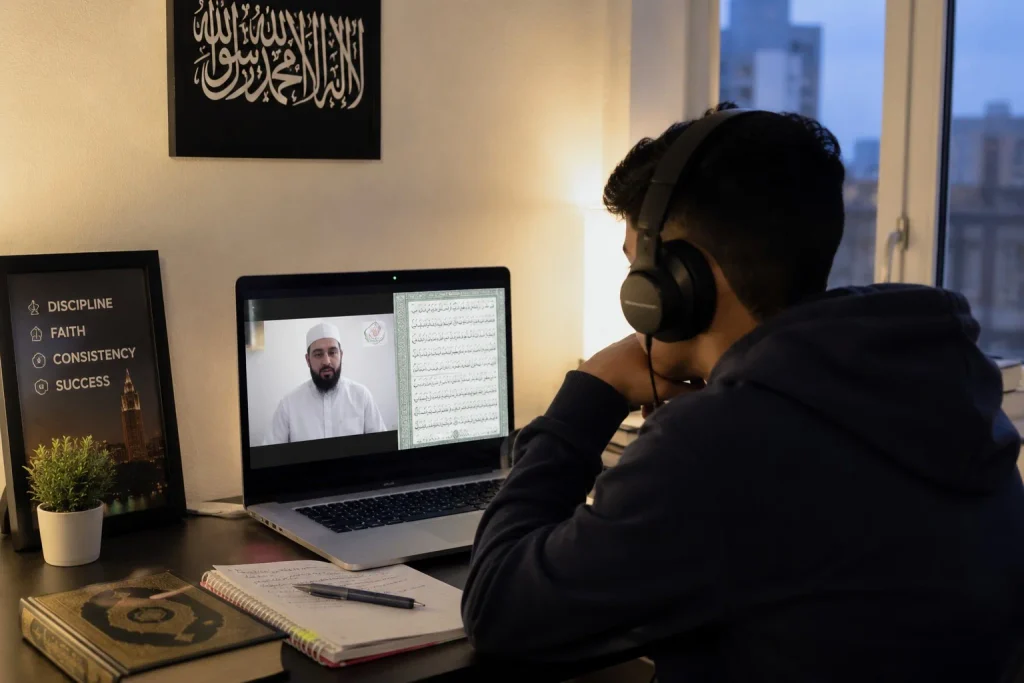
Why Do Teenagers Lose Interest in Quran Learning?
There is no single reason.
Different teenagers disengage for different reasons. However, several patterns appear repeatedly.
1. The Learning Method Has Not Changed as the Child Has Grown
This is one of the biggest blind spots parents can have.
A child at seven may happily accept:
“Repeat this verse five times.”
At fourteen, the same instruction may feel childish.
The teenager has developed intellectually and emotionally, but the learning experience may still be designed for a much younger child.
That creates a mismatch.
A teenager may need:
- More explanation
- More discussion
- Greater independence
- More challenging material
- Connections between verses and real-life situations
- Opportunities to ask questions
- A teacher who understands teenagers
- More responsibility for their own learning
The Quran itself has not become less relevant.
The presentation may simply need to mature.
The important question
Instead of asking:
“Why doesn’t my teenager want to learn Quran anymore?”
ask:
“Has our approach to Quran learning evolved with my teenager?”
That question can completely change the conversation.
2. Quran Learning Has Become Associated With Pressure
Parents naturally want their children to succeed.
But repeated pressure can unintentionally change the emotional meaning of Quran lessons.
The teenager may begin to associate Quran learning with:
- Arguments
- Criticism
- Missed targets
- Comparison with siblings
- Punishment
- Disappointment
- Constant reminders
Eventually, the child may not be rejecting the Quran.
They may be trying to escape the negative experience surrounding the learning process.
This distinction matters.
A teenager who says:
“I don’t want Quran today.”
may actually be communicating:
“I don’t enjoy the way I am experiencing Quran learning.”
Those are two very different problems.
3. They Don’t See Why the Quran Matters to Their Life
Memorizing a page can feel abstract.
But understanding how a Quranic principle relates to friendship, honesty, anxiety, family relationships, social media, responsibility, patience, or decision-making can make the Quran feel immediately relevant.
Teenagers are constantly asking questions about real life:
- How should I deal with peer pressure?
- What makes someone a good friend?
- How do I control anger?
- What should I do when I feel jealous?
- Why should I be honest when lying would be easier?
- How should Muslims behave online?
- How do I handle failure?
- Why should I trust Allah?
If Quran lessons only focus on pronunciation and memorization, an important opportunity may be missed.
The teenager needs to see:
“This isn’t just something I study. This is something that helps me live.”
4. The Lessons May Be Too Easy—or Too Difficult
Loss of motivation does not always mean a teenager needs easier lessons.
Sometimes the opposite is true.
If lessons are repetitive and require little thinking, the teenager may become bored.
If lessons are consistently beyond the teenager’s ability, the child may become frustrated.
Both situations can lead to disengagement.
| SituationWhat the Teenager May FeelPossible Result | ||
|---|---|---|
| Material is too easy | “I already know this.” | Boredom |
| Material is too difficult | “I can’t do this.” | Frustration |
| Material is appropriately challenging | “I can improve.” | Engagement |
This is why personalized learning matters.
A good teacher should know where the student currently is and create the next achievable challenge.
5. They Are Becoming More Independent
This is a major developmental change.
Teenagers increasingly want to have a voice in decisions that affect them.
If every Quran-related decision is made for them, they may begin to resist simply because they feel they have no ownership.
This does not mean parents should stop setting expectations.
It means they can give teenagers reasonable choices inside those expectations.
For example:
Instead of:
“You have to memorize this tonight.”
Try:
“Would you rather review the previous surah first or start the new verses?”
Instead of:
“You must study Quran every day at 7 PM.”
Try:
“Which time works better for you on school days?”
The difference is subtle but powerful.
Research on motivation identifies autonomy, competence, and relatedness as important psychological needs for sustained engagement. Autonomy means having some meaningful ownership over one’s actions; competence means feeling capable of making progress; and relatedness involves feeling connected and supported.
6. School and Other Responsibilities Are Increasing
Teenagers often have significantly more competing demands than younger children.
They may have:
- School assignments
- Exams
- Sports
- Clubs
- Friends
- Family responsibilities
- Extracurricular activities
- Travel
- Technology and social media
- Sleep challenges
If Quran lessons are simply added on top of an already overloaded schedule, the teenager may perceive them as another obligation.
That doesn’t mean Quran learning should disappear.
It means the schedule should become realistic.
Consistency is more valuable than creating a schedule that looks impressive on paper but is impossible to maintain.
7. They May Feel That They Are Always Being Corrected
Correction is essential in Quran learning.
But correction needs balance.
Imagine a teenager reads a page and hears:
“Wrong.”
“Again.”
“You forgot this.”
“You should know this already.”
“Why didn’t you revise?”
Even if every correction is technically justified, the overall experience can damage confidence.
A better learning environment combines correction with recognition of progress.
For example:
“Your pronunciation of these letters is much better than last week. Let’s work on this one sound now.”
The teenager hears both:
“I am improving.”
and
“There is still something I can work on.”
That creates a healthier learning mindset.
8. They Are Comparing Themselves With Other Students
Teenagers are highly aware of how they compare with others.
If they constantly hear:
“Your cousin has memorized more than you.”
or:
“Look at your brother. He never misses a lesson.”
the teenager may develop shame rather than motivation.
Comparison can make Quran learning feel like a competition.
But Quran learning should be personal.
The more useful question is:
“Is my child progressing compared with where they were before?”
not:
“Are they ahead of another child?”
9. The Teacher-Student Relationship Matters
A teenager may love the Quran but dislike the lesson.
This distinction is important.
The teacher’s personality, communication style, patience, expectations, and ability to understand adolescents can dramatically affect the learning experience.
A teenager may respond much better to a teacher who:
- Listens
- Explains rather than simply commands
- Allows questions
- Encourages discussion
- Recognizes progress
- Understands teenage interests
- Corrects respectfully
- Creates an atmosphere of trust
Research on motivation consistently highlights the role of supportive teachers and relationships in student engagement.
10. Technology Has Changed Their Attention Environment
Teenagers live in an environment designed to capture attention.
Short videos, games, notifications, social media, messaging, and entertainment provide immediate stimulation.
A traditional lesson that consists of repeating the same activity for a long period may therefore feel especially difficult.
This does not mean Quran learning needs to become entertainment.
That would be another mistake.
The solution is to make learning active rather than passive.
For example:
- Ask the teenager to explain a verse.
- Let them identify a Tajweed rule.
- Ask them to compare two recitation examples.
- Let them track their own progress.
- Discuss the meaning of a passage.
- Use short revision challenges.
- Ask them to prepare a question before class.
The objective is not to make the Quran compete with TikTok.
The objective is to help the teenager become an active learner.
What Can Parents Do When Teenagers Lose Interest in Quran Learning?
1. Stop Treating Every Loss of Motivation as Disobedience
This is perhaps the most important change.
A teenager losing interest does not automatically mean they have become careless about Islam.
Sometimes it means:
- The schedule is unrealistic.
- The lesson is repetitive.
- The teacher is not a good fit.
- The material is too difficult.
- The student feels embarrassed.
- They don’t understand the purpose.
- They want more independence.
- They are exhausted.
Before increasing pressure, diagnose the problem.
Ask:
“What part of Quran lessons do you find hardest?”
Then:
“What part do you actually enjoy?”
And:
“If you could change one thing about your lessons, what would it be?”
You may learn more from those three questions than from another month of arguments.
2. Give Them Ownership Without Removing Structure
Teenagers need boundaries.
But they also need appropriate independence.
You can establish a clear expectation:
“Quran learning remains part of our family routine.”
Then give the teenager choices about:
- Lesson time
- Revision method
- Which surah to study next when appropriate
- How to track progress
- Whether to review aloud or independently
- Which goals to focus on
This turns the teenager from someone who is simply being taught into someone who is participating in their education.
3. Set Smaller, More Meaningful Goals
Huge targets can become psychologically overwhelming.
Instead of:
“You need to memorize five pages this month.”
consider:
“Let’s master this section properly this week.”
A goal should be:
- Specific
- Realistic
- Measurable
- Appropriate for the student’s ability
For example:
Goal: Improve Surah Al-Mulk recitation.
Weekly target: Master 8–10 verses with correct Tajweed.
Daily practice: 10–15 minutes.
Review: Previous verses before new memorization.
This creates visible progress.
4. Focus on Understanding Alongside Memorization
Memorization has tremendous value.
But teenagers are increasingly capable of understanding ideas, making connections, and discussing concepts.
Use that ability.
After studying a passage, ask:
“What do you think this verse is teaching us?”
or:
“Where could someone apply this lesson today?”
or:
“What would this look like at school?”
This can transform Quran learning from a memory exercise into an intellectual and spiritual experience.
5. Connect Quran Learning to Real Life
A teenager may not immediately care about memorizing another page.
But they may care deeply about friendship, confidence, identity, fairness, relationships, and purpose.
Use appropriate Quranic passages to explore these themes.
| Teen ConcernQuran Learning OpportunityDesired Outcome | ||
| Peer pressure | Discuss values and accountability | Stronger decision-making |
| Anger | Explore patience and self-control | Better emotional responses |
| Friendship | Study guidance about relationships | Healthier friendships |
The Quran becomes more meaningful when teenagers see that its guidance is not disconnected from their lives.
6. Praise Effort and Progress—Not Just Results
Avoid making praise dependent only on memorizing a certain number of verses.
Instead, notice:
- Consistency
- Improved pronunciation
- Better revision
- Asking thoughtful questions
- Returning after a difficult week
- Correcting previous mistakes
- Becoming more independent
Try saying:
“I noticed you remembered that mistake from last week and corrected it yourself.”
That communicates something powerful:
“You are becoming capable.”
That feeling of competence is an important part of sustained motivation.
7. Choose a Teacher Who Understands Teenagers
This can make a major difference.
A teacher working with a six-year-old cannot necessarily use the same approach with a sixteen-year-old.
For teenagers, look for a teacher who can combine:
- Strong Quran knowledge
- Tajweed expertise
- Patience
- Respectful communication
- Age-appropriate discussion
- Structured goals
- Positive feedback
- Appropriate challenge
The teacher should not try to become the teenager’s friend in an inappropriate way.
But the teenager should feel:
“My teacher understands me and wants me to succeed.”
That sense of relatedness can support engagement.
8. Reconsider the Schedule
More lessons do not automatically mean better results.
For some teenagers, frequent short sessions may work well.
For others, fewer live classes combined with structured independent revision may be more sustainable.
The right schedule depends on:
- Age
- Current level
- Memorization goals
- School workload
- Attention span
- Family schedule
- Motivation
- Learning speed
The key is consistency.
A sustainable routine is usually better than an ambitious routine that constantly collapses.
A Practical Quran Learning Schedule for Teenagers
Here is an example—not a universal prescription.
| DayMain ActivityApproximate Focus | ||
| Monday | Live Quran lesson | New learning |
| Tuesday | Independent revision | Previous material |
| Wednesday | Live Quran lesson | New learning + correction |
| Thursday | Short revision | Retention |
| Friday | Flexible review | Recitation/meaning |
| Saturday | Live lesson or deeper study | Progress |
| Sunday | Light review | Consolidation |
The exact number of lessons should be adjusted to the teenager.
The purpose of the example is to demonstrate an important principle:
Quran learning does not have to mean a formal lesson every single day.
Learning, practice, revision, reflection, and rest can all have different roles.
9. Create a Teenager-Specific Progress System
Teenagers often appreciate seeing evidence of improvement.
Create a simple progress tracker.
It could include:
- Surahs completed
- Current memorization
- Tajweed skills
- Recitation accuracy
- Revision consistency
- Personal goals
- Areas to improve
But don’t turn it into a punishment chart.
The purpose is to answer:
“Where am I now, and where am I going?”
10. Let the Teenager See Their Long-Term Identity
One of the most powerful questions is:
“What kind of relationship do you want to have with the Quran when you’re an adult?”
This changes the conversation.
Instead of:
“Finish your homework.”
it becomes:
“We’re helping you build a relationship with the Quran that you can carry with you.”
That is a much bigger vision.
The Prophet ﷺ described learning and teaching the Quran as a great virtue.
Parents can help teenagers understand that Quran learning is not simply a childhood requirement that disappears when they become adults.
It is preparation for lifelong faith.
What Parents Should Avoid
Sometimes knowing what not to do is just as important.
Avoid constant threats
Threats may produce short-term compliance but can damage intrinsic motivation.
Avoid comparing siblings
Your teenager has a different personality, learning speed, and developmental journey.
Avoid making every conversation about Quran
Your relationship with your teenager should be larger than their performance.
Avoid public criticism
Correcting a teenager harshly in front of siblings or relatives can create embarrassment and resistance.
Avoid assuming that more hours equal more love for the Quran
Quantity does not automatically create connection.
Avoid turning every mistake into a moral failure
A pronunciation mistake is a learning problem—not evidence that your child is a bad Muslim.
A Better Parent–Teenager Conversation
Instead of:
“Why don’t you care about Quran anymore?”
Try:
“I’ve noticed Quran lessons haven’t felt easy for you recently. I want to understand why.”
Then listen.
Don’t immediately defend the teacher.
Don’t interrupt.
Don’t turn their answer into an argument.
If they say:
“The lessons are boring.”
Ask:
“What makes them boring?”
If they say:
“I’m too busy.”
Ask:
“Which days are actually realistic?”
If they say:
“I don’t understand why I’m memorizing this.”
Ask:
“Would you like to spend more time understanding the meaning?”
If they say:
“I don’t like my teacher.”
Ask:
“What specifically isn’t working?”
You are not giving the teenager control over everything.
You are gathering information.
That is good parenting.

A Simple 4-Step Reset Plan
If your teenager has already become disengaged, don’t try to fix everything in one week.
Step 1: Listen
Have a calm conversation without immediately correcting them.
Step 2: Identify the problem
Is it:
- Teacher?
- Schedule?
- Difficulty?
- Boredom?
- Pressure?
- Lack of understanding?
- Confidence?
- School workload?
Step 3: Change one or two variables
Don’t completely redesign everything at once.
Try changing the schedule or teaching approach first.
Step 4: Rebuild consistency
Once the experience becomes manageable, establish a sustainable routine.
The Goal Is Not to Make Teenagers Fear Losing Their Quran Routine
The deeper goal is to help them develop the ability to continue without constant parental supervision.
That means gradually moving from:
Parent reminds → teenager complies
to:
Parent supports → teenager participates
and eventually:
Teenager chooses → teenager continues
This is a much stronger long-term outcome.
Research on motivation supports the importance of helping students internalize the value of learning rather than relying only on external control. Supportive environments that meet needs for autonomy, competence, and relatedness can help students develop more self-determined forms of motivation.
How QariAcademy Can Support Teenagers
For teenagers, Quran education should not be treated exactly like early childhood Quran education.
A teenager needs a learning experience that respects their growing maturity while maintaining strong Quranic foundations.
A personalized 1-on-1 Quran program can help address differences in:
- Current Quran level
- Memorization ability
- Tajweed
- Recitation
- Revision needs
- Learning pace
- Schedule
- Personal goals
At QariAcademy, the aim should not simply be to increase the number of lessons a student completes.
The more meaningful objective is to help students develop confidence, consistency, correct recitation, and a lasting connection with the Quran.
For parents whose teenagers are becoming disengaged, the first step does not have to be “more pressure.”
Sometimes the better first step is finding out why the teenager is disengaged and then adjusting the learning experience accordingly.
Frequently Asked Questions
Why do teenagers lose interest in Quran learning?
Teenagers can lose interest for many reasons, including increased school responsibilities, repetitive lessons, lack of autonomy, low confidence, inappropriate difficulty, poor teacher fit, or difficulty seeing how Quran learning connects to their lives. Motivation research suggests that autonomy, competence, and supportive relationships can strongly influence engagement.
Should parents force teenagers to attend Quran classes?
Parents should maintain appropriate expectations around Islamic education, but relying entirely on pressure can create negative associations with learning. A better approach is to maintain structure while giving teenagers appropriate choices and helping them understand the purpose behind what they are learning.
Should teenagers memorize Quran or focus on understanding?
Both can have an important place. Memorization develops a strong relationship with the text, while understanding can help teenagers recognize its relevance and meaning. The balance should depend on the student’s goals and level.
How often should teenagers take Quran classes?
There is no single schedule that works for every teenager. The appropriate frequency depends on the student’s age, level, goals, school schedule, and ability to maintain consistent revision.
What if my teenager refuses Quran classes completely?
Avoid immediately turning the situation into a confrontation. Start by finding out why. The problem could involve the teacher, schedule, difficulty, confidence, or learning method. Once the underlying issue is identified, parents can make targeted changes.
Can online Quran classes work for teenagers?
Yes. One-on-one online learning can offer flexibility and personalized instruction, particularly when the teacher adapts the lesson to the teenager’s level and learning style. The quality of the teacher-student interaction matters more than simply whether the class takes place online or in person.
How can I motivate my teenager to revise Quran?
Keep revision manageable and consistent. Set small goals, track progress, recognize improvement, and allow the teenager to participate in choosing the revision method. Avoid making every revision session a source of criticism.
Should I reward my teenager for learning Quran?
Rewards can be used carefully, but they should not become the only reason a teenager learns. The long-term goal is for the teenager to value Quran learning itself and understand its spiritual and personal importance.
What is the most important thing parents can do?
Protect the relationship.
A teenager should be able to struggle with Quran learning without feeling that their parents’ love or respect depends on their performance.
When parents combine clear expectations with patience, listening, encouragement, and appropriate independence, they create a much healthier environment for long-term learning.
Final Thoughts
When teenagers lose interest in Quran learning, parents understandably worry.
But the first response should not always be to increase pressure.
Sometimes the real issue is not that the teenager has stopped caring about the Quran.
The issue may be that the learning experience has stopped meeting the needs of the person they are becoming.
Teenagers are no longer little children.
They need greater responsibility, deeper conversations, meaningful challenges, supportive teachers, and opportunities to see how the Quran relates to the questions they are already asking about life.
The goal is not simply to get them through another lesson.
The goal is to help them reach a point where the Quran remains part of their lives even when nobody is standing beside them telling them to open the Mushaf.
That is the kind of relationship worth building.
And sometimes, the best way to help a teenager love learning Quran again is not to push harder—but to teach smarter, listen better, and give them a meaningful reason to continue.
Sources: Self-Determination Theory – Education · Meta-analysis on student motivation · Quran 39:9 · Sahih al-Bukhari 5027
Monitor new Quran-parenting topics