Table of Contents
Introduction
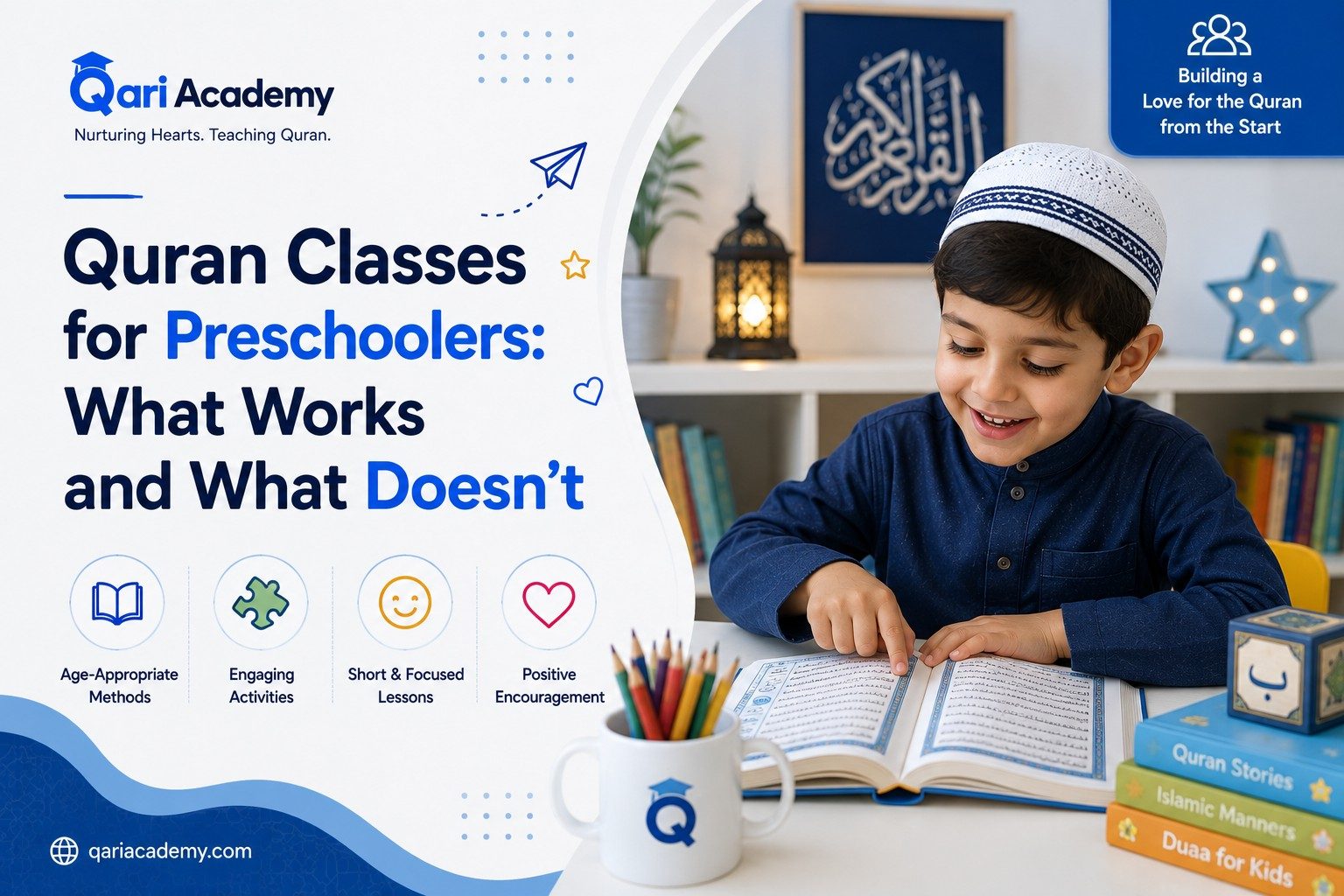
Quran classes for preschoolers can be incredibly rewarding, but they can also become frustrating when the teaching approach does not match the child’s age.
A four-year-old is not simply a smaller version of a ten-year-old.
Preschool children are still developing their attention span, memory, language abilities, emotional regulation, and ability to follow structured instructions. They often learn best through repetition, listening, movement, visual activities, and short periods of focused practice.
Yet parents sometimes expect a preschooler to sit through a traditional Quran lesson, memorize several verses, repeat corrections for a long period, and remember everything perfectly the next day.
That is usually unrealistic.
The better question is not:
“How much Quran can my preschooler learn?”
It is:
“What kind of Quran learning is appropriate for my child’s stage of development?”
For most preschoolers, successful Quran education should focus on building familiarity with the Quran, listening skills, simple memorization, pronunciation, early Arabic exposure, positive learning habits, and gradually developing reading skills when the child is ready.
Some children may be ready to recognize Arabic letters.
Others may benefit more from listening and memorizing short surahs before beginning formal reading.
There is no single correct starting point.
This is especially important for Muslim families raising children in the United States, Canada, the United Kingdom, and other English-speaking environments, where children may have limited exposure to Arabic outside Quran lessons.
The goal should be to create a Quran experience that is age-appropriate, consistent, meaningful, and sustainable.
If you are also thinking about how Quran education should evolve as your child grows, our guide on Quran Learning by Age: What Should Children Learn at 4, 6, 8, 10, and 12? can help you understand how expectations should change across childhood.
Why Quran Classes for Preschoolers Are Different
Preschool children are still developing several abilities that directly affect how they learn.
These include:
- Attention span
- Memory
- Language skills
- Ability to follow instructions
- Fine motor skills
- Emotional regulation
- Ability to sit still
- Understanding of abstract concepts
This means Quran classes for preschoolers should be structured differently from Quran lessons for older children.
A preschooler may learn effectively through:
Listen → Repeat → Move → Identify → Practice → Celebrate
An older child may be more capable of:
Explain → Practice → Analyze → Correct → Apply
The difference matters.
| Preschool Child | Older Child |
|---|---|
| Short activities | Longer focused activities |
| Frequent repetition | Increasing independent practice |
| Listening | Reading |
| Simple memorization | Structured memorization |
| Visual learning | More analytical learning |
| Frequent encouragement | Increasing self-motivation |
| Basic Arabic exposure | Arabic literacy and comprehension |
The objective is not to lower expectations.
It is to use appropriate expectations.
What Works in Quran Classes for Preschoolers?
Several teaching principles tend to work particularly well with young children.
1. Short and Focused Activities
One of the biggest mistakes parents can make is assuming that a preschooler needs a long lesson to make meaningful progress.
They don’t.
A short, focused activity can be much more productive than a long session where the child becomes distracted or mentally tired.
A lesson might include:
- Quran listening
- Memorization
- Arabic letters
- Reading practice
- Review
- A short interactive activity
The exact structure should depend on the child.
The important principle is variety within a predictable routine.
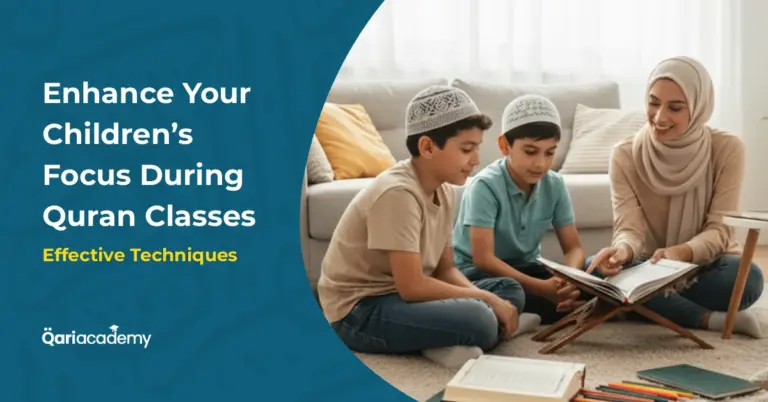
Research and practical guidance on children’s Quran learning also emphasize breaking lessons into manageable segments and using interactive methods to maintain attention. QariAcademy’s guide on Effective Techniques to Enhance Children’s Focus During Quran Classes provides additional strategies for maintaining concentration during lessons.
2. Repetition
Preschoolers need repetition.
A child may learn a verse today and forget part of it tomorrow.
That does not necessarily mean the lesson failed.
Young children often need to encounter the same material many times before it becomes stable.
A teacher can repeat a surah through:
- Listening
- Teacher recitation
- Child repetition
- Parent review
- Short home practice
The key is to repeat without making the child feel that they are being punished for forgetting.
3. Listening Before Expecting Independent Recitation
For some preschoolers, listening is a natural first step.
The child hears Quran regularly.
Then they begin repeating familiar phrases.
Eventually, they may memorize short passages.
This can create a foundation for later reading.
A useful progression is:
Listen → Repeat → Memorize → Recognize → Read
A child does not need to begin by decoding an entire Quran page.
4. Familiar Short Surahs
Preschoolers often respond well to short surahs they hear regularly.
These may include:
- Surah Al-Fatihah
- Surah Al-Ikhlas
- Surah Al-Falaq
- Surah An-Nas
- Other short surahs appropriate to the child’s level
Familiarity makes learning feel achievable.
The child may already recognize the sounds before understanding how those sounds appear in written Arabic.
That creates an important bridge:
Memory → Sound → Written Word
5. Visual Learning
Young children often respond well to visual material.
A teacher can use:
- Arabic letter cards
- Matching exercises
- Letter recognition games
- Digital whiteboards
- Simple illustrations
- Highlighting
- Interactive exercises
The objective is not to turn Quran learning into entertainment.
It is to make abstract symbols easier for a young child to process.
6. Positive Correction
Preschoolers are still developing confidence.
Correction should therefore be clear but gentle.
Instead of:
“No, that’s wrong.”
a teacher can say:
“Let’s try that sound again.”
Then demonstrate it.
The child learns that mistakes are part of learning rather than evidence that they are “bad at Quran.”
For additional ideas on making online Quran lessons more engaging, see How to Make Quran Learning Fun for Kids Online.
What Doesn’t Work Well in Quran Classes for Preschoolers?
Understanding what doesn’t work is just as important as understanding what does.
1. Expecting a Preschooler to Sit Still for a Long Lesson
A young child may struggle to remain focused for an extended period.
If the teacher repeatedly says:
“Sit still.”
“Pay attention.”
“Don’t move.”
the lesson can become a behavior battle rather than a learning experience.
Movement and short activity changes can sometimes improve attention.
Normal preschool movement should not automatically be interpreted as a lack of interest.
2. Teaching Too Much at Once
A preschooler does not need to learn several Tajweed rules, multiple Harakat, long passages, Arabic grammar, and large vocabulary lists in one lesson.
The child needs a manageable learning target.
For example:
Today: recognize three Arabic letters.
That can be enough.
The next lesson can review those three letters and introduce one or two more.
Progress becomes more sustainable when the child is allowed to master one small skill before moving to the next.
3. Making Memorization a Competition
Parents sometimes compare children:
“Your cousin already memorized five surahs.”
“Your brother learned this faster.”
This rarely creates healthy motivation.
Children develop at different rates.
A better question is:
“Is my child improving compared with where they started?”
That is the comparison that actually matters.
4. Correcting Every Mistake Immediately
Correction matters.
But constant interruption can make a young child afraid to speak.
If the teacher interrupts every few seconds, the child may eventually stop attempting the answer.
A better approach is to prioritize the most important errors and give the child enough opportunity to practice.
5. Starting Advanced Tajweed Too Early
Preschoolers absolutely need correct pronunciation.
But there is a difference between:
correct pronunciation
and:
advanced Tajweed theory.
A four-year-old may need to learn how to pronounce a letter correctly without needing a detailed explanation of technical Tajweed terminology.
Teach the skill first.
Introduce the theory when the child is developmentally ready.
For parents who want to understand how Tajweed can be introduced appropriately, see Tajweed for Kids: A Parent’s Guide.
6. Using Fear as Motivation
This is one of the most damaging approaches.
A child may comply because they fear punishment.
But the long-term goal should be much more positive.
You want the child to gradually develop:
“I love Quran.”
“I enjoy learning.”
“I want to improve.”
Discipline is necessary.
Fear should not be the foundation.
Should Preschoolers Learn the Arabic Alphabet?
Sometimes.
It depends on the child’s age, interest, previous exposure, and developmental readiness.
A four-year-old who has never seen Arabic may benefit from simply becoming familiar with letters.
Another child may be ready for more structured letter recognition.
The key is not to force formal reading before the child is ready.
A useful early progression is:
See the letter → Hear the sound → Repeat the sound → Recognize the letter → Connect it to a simple word
For example:
ب → /b/ → بَ → simple combination
This prepares the child for later reading instruction.
If you are unsure whether your child should begin with the alphabet, Qaida, or Quran reading, see Qaida, Arabic Alphabet, or Quran Reading: What Should Your Child Start With?
What About Qaida for Preschoolers?
A structured Qaida can be useful, but it should not become a race to finish a book.
For some preschoolers, beginning basic Qaida exercises may be appropriate.
For others, the child first needs more work with:
- Letter recognition
- Sounds
- Visual discrimination
- Basic pronunciation
The Qaida should be viewed as a tool, not the goal.
The ultimate goal is to help the child develop the skills needed to read the Quran independently.
If the child is ready, a teacher can gradually introduce:
- Harakat
- Connected letters
- Sukoon
- Tanween
- Madd
- Shaddah
- Simple Quranic words
But the pace should remain appropriate for the child.
Should Preschoolers Start Reading the Quran?
Some can.
Others should wait until their foundational reading skills are stronger.
A preschooler who already recognizes Arabic letters and basic Harakat may be ready to begin reading simple Quranic words.
A child who has never learned Arabic may need more foundational instruction first.
This is why the question should not be:
“Is four too young to read Quran?”
Instead ask:
“What reading skill is this child ready to learn?”
That is a much more useful question.
Memorization vs. Reading for Preschoolers
Parents often assume that Quran education means memorization.
Memorization is valuable.
But it is only one part of Quran learning.
A preschool child can memorize Surah Al-Fatihah through listening and repetition without knowing how to read it.
That is completely possible.
However, if parents want the child to become an independent Quran reader, reading skills need to be developed separately.
Think of the learning journey as several connected skills:
| Quran Skill | How It Develops | Long-Term Benefit |
|---|---|---|
| Listening | Repeated exposure | Familiarity |
| Memorization | Repetition | Retention |
| Reading | Arabic literacy | Independence |
| Pronunciation | Teacher correction | Accuracy |
| Tajweed | Structured practice | Better recitation |
| Understanding | Vocabulary and explanation | Deeper connection |
Eventually, these skills should reinforce one another.
A Better Preschool Quran Learning Model
For many young children, a balanced model looks like:
Quran listening + short memorization + Arabic exposure + early reading + positive routine
rather than:
Long memorization + long reading + constant correction
The first approach builds a foundation.
The second can create resistance.
Parents should think about what will help the child continue learning for years, not simply what can be completed this month.
How Long Should a Preschool Quran Lesson Be?
There is no universal ideal duration.
A preschooler’s age, personality, attention span, and learning level all matter.
Some children can remain productively engaged longer than others.
A 30-minute one-on-one lesson can work when it is divided into varied activities rather than treating the entire period as one continuous reading exercise.
For example:
| Time | Activity |
|---|---|
| 5 minutes | Greeting and review |
| 5 minutes | Quran listening |
| 5 minutes | Memorization |
| 5 minutes | Arabic letters |
| 5 minutes | Reading activity |
| 5 minutes | Review and encouragement |
This is only an example.
The teacher should adjust the structure based on the child.
For more discussion of age-appropriate lesson duration, parents can also read The Ideal Quran Lesson Length for Different Ages.
What Should Parents Expect After Three Months?
Parents should be realistic.
A preschooler may not be reading the Quran fluently after three months.
That does not mean the program is not working.
Instead, look for improvements such as:
- Recognizing more Arabic letters
- Remembering short surahs
- Pronouncing sounds more accurately
- Participating more comfortably in lessons
- Repeating verses with greater confidence
- Becoming familiar with Quranic vocabulary
- Beginning to read simple Arabic patterns
- Developing a regular Quran routine
- Looking forward to Quran lessons
These are meaningful achievements.
Our guide The First 90 Days of Quran Learning: What Parents Should Expect explains why the first three months should be evaluated through measurable skill development rather than simply counting pages.
The Importance of Consistency
Preschoolers benefit enormously from predictable routines.
The child should know:
“This is when I have Quran class.”
“This is when we practice.”
“This is when we listen to Quran.”
The routine should be realistic.
A family that schedules five intense practice sessions and abandons them after two weeks is not creating a sustainable habit.
A shorter routine maintained consistently is usually more useful.
A Simple Home Routine for Preschoolers
Parents can begin with a few minutes at a time.
For example:
2 minutes: Listen to a familiar surah.
3 minutes: Repeat the current memorization.
3 minutes: Review Arabic letters or reading.
2 minutes: Finish with something familiar and enjoyable.
The entire routine can be around ten minutes.
The exact duration should be adjusted to the child’s age and attention.
The goal is not to reproduce the teacher’s lesson.
It is to reinforce what the teacher taught.
Parents looking for more guidance can read How to Support Your Child’s Quran Learning Online, which covers creating a learning environment, establishing routines, encouraging children, and communicating with tutors.
Don’t Become the “Quran Police”
This deserves special attention.
Parents can unintentionally turn every interaction into a Quran test.
The child gets in the car:
“Did you memorize your surah?”
At breakfast:
“What is this letter?”
Before bed:
“Recite your lesson.”
Eventually, the child can begin to feel that Quran is an examination that never ends.
Instead, create moments of positive connection.
You might listen to a familiar surah together.
You might ask the child what word they remember.
You might celebrate when they recognize a letter.
The objective is to make Quran part of family life rather than a constant performance test.
How Parents Can Encourage Without Pressuring
Try replacing pressure with specific encouragement.
Instead of:
“You need to memorize this.”
say:
“Let’s learn the first two lines together.”
Instead of:
“Why did you forget?”
say:
“That’s okay. Let’s review it again.”
Instead of:
“You are not paying attention.”
say:
“Let’s take a quick break and try again.”
Small changes in language can make a significant difference.
How to Teach Arabic Sounds to Preschoolers
Some Arabic sounds may be unfamiliar to English-speaking children.
Examples include:
ح
خ
ع
غ
ص
ض
ط
ظ
ق
A preschooler may not produce these sounds accurately immediately.
That is normal.
The teacher can use:
Listen → Watch → Repeat → Compare → Practice
rather than simply telling the child:
“Say it correctly.”
For example, the child may need to hear the difference between:
ه / ح
or:
س / ص
The teacher can work gradually.
The goal is accurate habit formation, not instant perfection.
What About Children Who Cannot Sit Still?
Don’t automatically assume movement means poor learning.
A preschooler may be able to listen while moving slightly.
The teacher can also use activity transitions.
For example:
Letter game → Quran repetition → Reading → Listening
Changing the task can restore attention.
A good teacher should distinguish between:
normal preschool movement
and:
a lesson that is genuinely failing to engage the child.
If your child becomes bored quickly during online Quran lessons, My Child Gets Bored Quickly! 5 Quick Steps to Improve Your Child’s Focus in Online Quran Class offers practical strategies for improving engagement.
Online Quran Classes for Preschoolers
Online Quran classes can work for preschoolers, particularly when the class is one-on-one and the teacher understands how to work with young children.
The teacher can:
- Adjust the pace
- Change activities
- Use visual resources
- Give immediate feedback
- Repeat difficult concepts
- Adapt to the child’s attention level
One-on-one learning can also prevent a preschooler from feeling behind other children.
If the child needs more repetition, the teacher can slow down.
If the child already knows the material, the teacher can move forward.
QariAcademy offers one-on-one Quran classes for kids with instruction adapted to different learning levels.
What Makes a Good Preschool Quran Teacher?
For preschoolers, Quran knowledge alone is not enough.
The teacher should also understand how to teach young children.
Look for someone who can:
- Keep activities short
- Repeat patiently
- Use simple explanations
- Correct gently
- Maintain attention
- Celebrate progress
- Avoid overwhelming the child
- Communicate with parents
- Adjust the pace
A teacher who is excellent with teenagers may not necessarily be excellent with preschoolers.
The teaching style matters.
What Should a Preschool Quran Curriculum Include?
A balanced curriculum can include several components.
| Component | Preschool Priority | Purpose |
|---|---|---|
| Quran listening | High | Familiarity |
| Short surah memorization | High | Retention |
| Arabic letters | Gradual | Reading foundation |
| Pronunciation | High | Correct habits |
| Qaida | As ready | Reading development |
| Tajweed theory | Low initially | Introduce gradually |
| Quranic vocabulary | Basic | Meaning |
| Islamic manners | High | Broader connection |
The emphasis should shift according to the individual child.
What Should Preschoolers NOT Be Expected to Do?
Parents should be cautious about expecting:
- Perfect pronunciation
- Long periods of concentration
- Advanced Tajweed knowledge
- Large amounts of memorization
- Independent Quran reading immediately
- Perfect recall every day
- Adult-level discipline
These expectations can create unnecessary pressure.
Instead, expect:
Progress.
Consistency.
Participation.
Growing familiarity.
Gradual improvement.
How Quran Lessons Should Change After Preschool
Preschool Quran education is only the beginning.
As the child grows, the teaching approach should evolve.
A useful progression is:
Preschool: Familiarity + listening + early literacy
Early school years: Alphabet + Qaida + Quran reading
Middle childhood: Reading + Tajweed + memorization
Older children: Tajweed + Hifz + Arabic + understanding
Preteen years: Fluency + understanding + independence
This connects naturally with How Quran Lessons Should Change as Your Child Gets Older.
The objective is continuity.
The child should not feel as though they are starting over every few years.
What If a Preschooler Has Never Learned Arabic?
Don’t panic.
Many Muslim children growing up in English-speaking countries begin Quran lessons with little or no Arabic knowledge.
They may need to start with:
Arabic letters → sounds → Harakat → connected letters → Qaida
rather than immediately reading Quranic pages.
For a detailed step-by-step approach, see How to Teach Quran to a Child Who Has Never Learned Arabic.
The most important thing is to start at the child’s actual level.
What If the Preschooler Already Knows Some Quran?
Then use that knowledge.
If the child already knows Al-Fatihah or several short surahs, don’t ignore that achievement.
Use familiar material to build confidence.
For example:
“You already know how this sounds. Now let’s learn how it looks on the page.”
This creates a powerful bridge between memorization and reading.
What If the Child Is Not Interested?
This is where parents should investigate instead of immediately forcing more effort.
Ask:
- Is the lesson too long?
- Is the material too difficult?
- Is it too repetitive?
- Does the child like the teacher?
- Is the child tired?
- Is the schedule inconvenient?
- Is the child associating Quran with criticism?
The answer may have nothing to do with the Quran itself.
Sometimes the solution is simply changing the lesson structure or teacher.
How to Know if a Preschool Quran Program Is Working
Don’t judge the program by how quickly the child completes pages.
Instead, look for:
1. Better Recognition
Does the child recognize more Arabic letters?
2. Better Pronunciation
Are difficult sounds improving?
3. Better Memory
Can the child retain familiar surahs?
4. Better Attention
Can the child participate more consistently?
5. Better Confidence
Does the child attempt answers without fear?
6. Better Routine
Is Quran becoming a normal part of the week?
These are meaningful indicators.
A Preschool Quran Progress Tracker
Parents can use a simple monthly review.
| Skill | Beginning | Developing | Stronger |
|---|---|---|---|
| Quran listening | Short exposure | Recognizes familiar surahs | Listens comfortably |
| Memorization | Repeats with help | Recites familiar passages | Recites more independently |
| Letters | Few recognized | Recognizes many | Recognizes most automatically |
| Pronunciation | Needs frequent correction | Improving | More consistent |
| Reading | Not yet ready | Basic patterns | Simple words/passages |
| Confidence | Hesitant | Participates | Enjoys attempting |
This prevents parents from evaluating the child based on one difficult lesson.
The Biggest Parent Mistake: Expecting Fast Results
This is where parents need to challenge their own expectations.
You may see another child who is already reading Quran at age five.
That does not mean your child is behind.
Perhaps that child started at age three.
Perhaps Arabic is spoken at home.
Perhaps they have an older sibling practicing with them.
Perhaps their learning style is different.
Your child’s starting point matters.
The better question is:
“Is my child making progress from their own starting point?”
Another Mistake: Waiting Too Long to Start
There is also an opposite problem.
Some parents worry:
“My child is too young.”
If the child is developmentally ready for gentle Quran exposure, there is no need to wait for some imaginary perfect age.
Early Quran education does not have to mean intense formal study.
It can simply mean:
- Listening
- Repeating
- Learning short surahs
- Becoming familiar with Arabic
- Building positive associations
Later, formal reading instruction can become more prominent.
The Goal Is Love Plus Skill
Preschool Quran education should not be reduced to:
Love without learning
or:
Learning without love.
Children need both.
They need to develop actual Quran skills.
But they should also gradually develop a positive relationship with the Quran.
The long-term objective is:
Love → Consistency → Skill → Understanding → Independence
If you sacrifice the first element completely, later learning can become difficult.
If you sacrifice skill entirely, the child may remain dependent on others.
A balanced approach is stronger.
How QariAcademy Can Support Preschool Quran Learning
For families looking for structured Quran classes for preschoolers, QariAcademy provides live one-on-one online Quran lessons designed for children at different levels.
A young beginner can start with foundational Quran learning rather than being placed into material that is too advanced.
Depending on the child’s level, lessons can include:
- Quran reading
- Arabic letters
- Qaida
- Memorization
- Tajweed
- Islamic Studies
You can explore QariAcademy’s Quran for Kids program to see how the program is structured.
The one-on-one format can be particularly useful for preschoolers because the teacher can adjust the pace when the child needs more repetition or move forward when the child demonstrates readiness.
Families can also combine Quran education with Arabic learning as the child grows through QariAcademy’s Arabic for Kids program.
A Practical Preschool Quran Lesson Model
A simple lesson might follow this pattern:
Step 1: Welcome
Create a positive beginning.
Step 2: Review
Revisit something familiar.
Step 3: New Skill
Introduce one manageable concept.
Step 4: Practice
Let the child try independently.
Step 5: Quran Connection
Connect the skill to a familiar Quranic word or verse.
Step 6: Memorization
Review a short passage if appropriate.
Step 7: Celebration
End with something the child can do successfully.
This creates a predictable structure without making the lesson monotonous.
A Simple Weekly Routine for Parents
A preschooler does not need hours of home study.
A family might use:
2–3 Quran lessons per week
plus:
5–10 minutes of home practice on most days
and:
regular Quran listening.
The exact schedule should be adjusted to the child.
The goal is consistency rather than intensity.
What Parents Should Do During Home Practice
Parents should mainly:
- Review assigned material
- Listen
- Encourage
- Help establish routine
- Celebrate improvement
- Communicate difficulties to the teacher
They don’t need to become Quran instructors.
In fact, parents should avoid introducing competing pronunciation methods if they aren’t confident in their own recitation.
The teacher should remain responsible for technical correction.
Frequently Asked Questions
Are Quran classes appropriate for preschoolers?
Yes. Preschoolers can benefit from Quran learning when lessons are age-appropriate and focus on listening, memorization, pronunciation, early Arabic exposure, and gradual reading development.
How long should a preschool Quran lesson be?
There is no universal duration. A short, varied lesson is often more effective than a long lesson that exceeds the child’s ability to remain engaged. The teacher should adjust the lesson according to the child’s attention and level.
Should a four-year-old learn the Arabic alphabet?
They can begin learning Arabic letters if they are ready, but there is no need to force formal reading before the child is developmentally prepared.
Should preschoolers memorize Quran?
They can memorize short surahs through listening and repetition. However, memorization should be balanced with pronunciation, early reading skills, and positive Quran exposure.
Should preschoolers learn Tajweed?
Correct pronunciation should be encouraged from the beginning, but advanced Tajweed theory does not need to be the focus of preschool lessons.
Should a preschooler learn Qaida?
Some preschoolers are ready for Qaida-based instruction, while others need more time with letters and sounds first. The starting point should depend on the child’s ability.
What if my child cannot sit still during Quran class?
Some movement is normal for preschoolers. A good teacher can use short activities, repetition, visual exercises, and changes in activity to maintain engagement.
What if my child refuses to practice Quran at home?
Investigate the reason before increasing pressure. The practice may be too long, too difficult, poorly timed, or associated with criticism. Shorter and more positive practice may work better.
Can preschoolers learn Quran online?
Yes. One-on-one online lessons can work well when the teacher has experience with young children and adapts activities to their attention span and developmental level.
Should Arabic be taught before Quran?
Not necessarily. A child can begin Quran education while gradually learning Arabic letters and reading skills. Broader Arabic language development can happen alongside Quran learning.
How can I tell whether my preschooler is making progress?
Look at skills rather than pages. Ask whether the child recognizes more letters, remembers more verses, pronounces sounds more accurately, participates more confidently, and requires less help.
Conclusion
Quran classes for preschoolers should not look like Quran classes for older children.
A four-year-old does not need the same curriculum, lesson structure, expectations, or teaching style as a ten-year-old.
At the preschool stage, the priority should be building a positive foundation.
That means:
Listen → Repeat → Memorize → Recognize → Read → Understand
over time.
What works?
- Short activities
- Repetition
- Familiar surahs
- Gentle correction
- Visual learning
- Simple Arabic exposure
- Age-appropriate memorization
- Consistent routines
- Positive encouragement
- Individualized instruction
What doesn’t work well?
- Long unfocused lessons
- Excessive pressure
- Constant correction
- Comparing children
- Advanced Tajweed theory too early
- Expecting immediate fluency
- Treating memorization as the only measure of success
- Making Quran feel like a punishment
The biggest lesson for parents is this:
Preschool Quran education is about building the foundation for future learning, not rushing a young child toward an adult level of performance.
Your child may spend months simply becoming comfortable with Arabic sounds and short surahs.
Another child may begin reading letters quickly.
Another may memorize several surahs but need much more time to develop reading skills.
All of these can be normal.
The question is whether the child is moving forward from their own starting point.
As the child grows, the learning journey can gradually develop from:
Familiarity → Arabic literacy → Quran reading → Tajweed → Memorization → Understanding → Independence
And that is why parents should think beyond the next lesson.
The goal is not simply to make a preschooler complete a certain number of surahs.
The goal is to give them a positive beginning that makes future Quran learning easier, deeper, and more sustainable.
For families looking for personalized support, QariAcademy offers one-on-one online Quran classes for children, with learning adapted to the student’s level and goals.
Explore QariAcademy’s Quran Classes for Kids
You can also combine Quran learning with Arabic development as your child grows through Arabic Classes for Kids.
The right preschool Quran class should not make a four-year-old feel like they are failing to keep up.
It should make them feel:
“I can learn this.”
“I know this surah.”
“I recognize this letter.”
“I want to try again.”
Those small moments are the foundation of something much bigger:
A lifelong relationship with the Quran.