
Table of Contents
Introduction
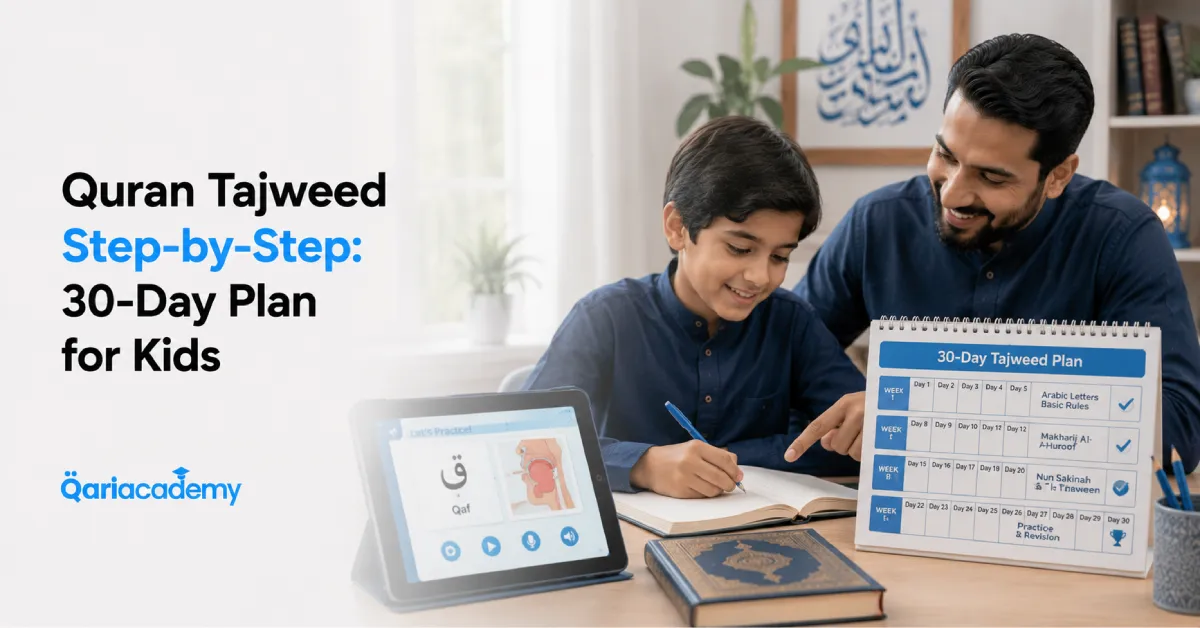
A structured plan is the fastest way for children to learn Tajweed effectively. Many parents struggle to create a routine that balances learning, revision, and fun. The 30-day plan for kids solves this problem, providing daily guidance that ensures steady progress while keeping children motivated and confident.
Before starting this plan, your child should be familiar with:
- Arabic Letters with Tajweed Precision
- Fun with Sounds
- 3 Simple Games to Teach Madd
- Makharij al-Huroof
- Tajweed Colors
- Tajweed Through Stories
- Noon Saakinah Mastery
- Common Tajweed Mistakes
- Smart Repetition
Step 1: Week 1 – Foundation of Letters and Sounds
Goal: Master the Arabic letters with proper Tajweed pronunciation.
- Daily Activity (10–15 minutes):
- Review 5–7 letters per day using Tajweed Colors and visual cards.
- Practice articulation points (Makharij al-Huroof).
- Short repetition session immediately after review.
Tip: Make learning playful by associating letters with characters or colors.
Step 2: Week 2 – Mastering Madd and Short Vowels
Goal: Understand and apply Madd (elongation) and Fatha, Kasra, Dhamma correctly.
- Daily Activity:
- Play 3 simple games to practice Madd (3 Simple Games to Teach Madd).
- Recite short verses applying proper vowels (Fun with Sounds).
- Use songs or rhymes to reinforce rules (Tajweed Song).
Example Verse: “بِسْمِ اللَّهِ الرَّحْمَنِ الرَّحِيمِ” – emphasize correct elongation and short vowels.
Step 3: Week 3 – Noon Saakinah and Other Special Rules
Goal: Apply Noon Saakinah rules, Idgham, Iqlab, and Ikhfa correctly.
- Daily Activity:
- Highlight Noon Saakinah in the verse using colors (Tajweed Colors).
- Repeat tricky verses multiple times for retention (Smart Repetition).
- Review common mistakes (Common Tajweed Mistakes).
Story Example: “Noon the Ninja” sneaks silently into letters without mistakes (Tajweed Through Stories).
Step 4: Week 4 – Fluency and Consolidation
Goal: Combine all learned rules for fluent and confident recitation.
- Daily Activity:
- Practice full short surahs using colors, pictures, and songs (Tajweed with Pictures).
- Self-correction: let children listen to their recitation and identify mistakes.
- Encourage storytelling: associate verses with stories or characters to improve memorization.
Bonus Tip: Reward daily achievements to boost motivation.
Step 5: Multi-Sensory Reinforcement
- Colors → visual differentiation of letters and rules.
- Pictures → help recognize letters and symbols.
- Songs → make rules memorable.
- Stories → contextualize rules in fun narratives.
This multi-sensory approach guarantees that children retain what they learn and enjoy the process.
Step 6: Tracking Progress and Motivation
- Create a 30-day progress chart for each rule: letters, Madd, Noon Saakinah, special rules.
- Use stickers or points to celebrate milestones.
- Keep notes of repeated mistakes and focus on them in short review sessions.
Internal Link: Combine with Smart Repetition and Common Tajweed Mistakes.
Step 7: Parental Involvement
- Actively participate in daily 5–10 minutes review sessions.
- Praise efforts, correct gently, and encourage independence gradually.
- Reinforce lessons with multi-sensory tools and positive storytelling.
The 30-day Tajweed plan ensures that your child develops:
- Accurate pronunciation
- Confidence in recitation
- Love for Quran learning
At QariAcademy, we make this journey fun, visual, and interactive, helping children master Quran Tajweed quickly and enjoyably.
Enroll your child today and start the 30-day Tajweed plan
FAQ: 30-Day Tajweed Plan for Kids
- Can children complete this plan in 30 days?
Yes, with consistent daily practice. - How long should each daily session be?
10–15 minutes is ideal for young learners. - What if my child misses a day?
Resume the next day and repeat the missed lesson. - Can siblings practice together?
Yes, practicing together makes learning more fun and engaging. - Should parents supervise every step?
Initially yes, but gradually encourage independence as your child becomes confident. - Can non-Arabic speakers follow this plan?
Absolutely! Using colors, stories, and songs makes it easy for non-Arabic speakers. - How do we track progress?
Use the 30-day chart and milestone stickers to mark achievements. - Can songs and stories replace repetition?
No, they supplement repetition and reinforce memory for better retention. - How should mistakes be handled?
Correct gently and repeat short sessions to avoid frustration. - Can this plan be applied after online Quran classes?
Yes, it perfectly complements online learning for reinforcement. - Is motivation necessary?
Very important—reward and praise are key to keeping children engaged. - How soon will fluency appear?
Typically by the end of 30 days if practiced consistently every day.