(Quick Summary)
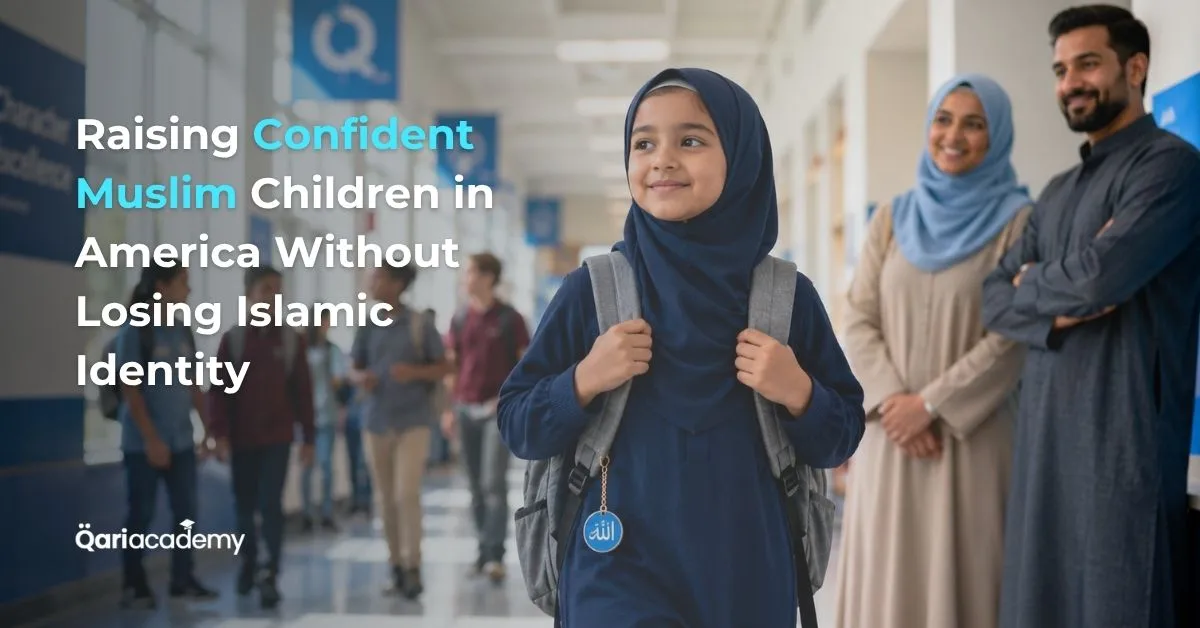
Qur’an learning is not only about reading or memorization—it is one of the strongest tools for building Muslim identity in children living in the USA, UK, and Canada. When children grow up with consistent and positive Qur’an learning, they develop confidence in their faith, clarity in identity, and emotional stability in non-Muslim environments. Without it, many children struggle with confusion, weak connection, and cultural disconnection. A structured and engaging learning approach helps transform Qur’an from a subject into a core part of who they are.
1. The Real Question Behind Every Parent’s Concern
When parents search for:
- online Quran classes for kids in USA
- Islamic education for Muslim kids in Canada
- best way to teach Quran to kids in UK
They are not just thinking about education.
They are thinking about something deeper:
“Who will my child become in this environment?”
Because raising a Muslim child in Western countries is not only about teaching information.
It is about building identity.
2. Identity Is Not Taught in One Lesson—It Is Built Over Time
A child does not “choose” their identity in one moment.
It is shaped slowly through:
- daily habits
- repeated experiences
- emotional connections
- and meaningful learning moments
And Qur’an learning plays a central role in this process.
Because it is not just knowledge.
It is connection to meaning.
3. The Challenge of Growing Up in the West
Children in the USA, UK, and Canada grow up in environments where:
- Islamic culture is not dominant
- peers may not share the same values
- school systems follow different worldviews
- media influences are constant
So the child is exposed to multiple identities at the same time.
Without a strong anchor, confusion naturally appears.
4. Why Qur’an Is More Than a Subject
Many people mistakenly treat Qur’an learning as:
- memorization
- pronunciation
- recitation practice
But in reality, Qur’an does something deeper:
It connects the child to a stable moral and spiritual framework.
This is what builds identity.
Not speed.
Not quantity.
But meaning.
5. When Qur’an Becomes Part of Daily Life
Children who consistently engage with Qur’an learning:
- develop emotional familiarity with Islam
- feel confident in religious identity
- are less influenced by confusion around them
This is especially important in Islamic education for Muslim kids in Canada and Western countries, where external influences are strong.
6. The Difference Between Knowledge and Identity
A child can:
- memorize Surah Al-Fatiha
- recite beautifully
- pass tests
But still feel:
disconnected from Islam internally
Why?
Because knowledge without emotional connection does not create identity.
Identity comes from:
- repetition
- emotional reinforcement
- lived experience
7. The Role of Emotional Safety in Learning
Children build identity only when they feel safe in learning.
If Qur’an learning feels:
- stressful → they disconnect
- judgmental → they withdraw
- encouraging → they engage
This is why teaching style matters more than content.
Especially in online Quran classes for kids in USA and UK, where attention and emotion must be carefully managed.
8. Why Many Children Struggle With Identity in the West
It is not because they reject Islam.
It is because:
- Islam is not consistently reinforced
- learning feels external instead of internal
- and identity is not emotionally anchored
So the child grows up knowing Islam…
But not fully feeling it as part of themselves.
9. Qur’an Learning as Identity Formation
When done correctly, Qur’an learning creates:
1. Belonging
“I am part of something meaningful.”
2. Stability
“My values are clear.”
3. Confidence
“I know who I am.”
4. Continuity
“This is part of my life, not just a class.”
10. Social Proof Insight (Important)
⭐ Real-world observation:
“Many children who initially struggled with consistency or interest in Qur’an learning developed a much stronger sense of Islamic identity once their learning experience became more structured, interactive, and emotionally positive.”
Parents often notice:
- improved attitude toward learning
- more willingness to attend classes
- stronger attachment to Islamic practices
This shift is not accidental.
It is structural.
11. Why Pressure Fails to Build Identity
Some parents try to strengthen identity through:
- strict discipline
- pressure to memorize
- constant correction
But pressure builds:
- resistance
- emotional distance
- and long-term avoidance
Because identity cannot be forced.
It must be internalized.
12. The Environment Matters More Than the Lesso
A child spends:
- hours in school
- time with friends
- time online
So Qur’an learning must compete with:
- attention systems
- emotional experiences
- identity influences
This is why consistency matters more than intensity.
Even 15 minutes daily can shape identity over time.
13. The Turning Point Most Parents Miss
There is a stage where:
- the child is still open
- still emotionally flexible
- still building identity foundations
This is the most powerful stage for shaping long-term connection.
If missed, rebuilding becomes slower later.
14. What Actually Works in Real Life
Children build strong identity when Qur’an learning is:
- consistent
- emotionally safe
- engaging
- and structured
Not when it is:
- rushed
- inconsistent
- or stressful
This is why modern online Quran classes for kids in USA, UK, and Canada are moving toward interactive and child-centered approaches.
15. A Better Way to Start
Instead of assuming what your child needs, start by observing:
- How do they respond to learning?
- Where do they lose focus?
- What makes them engaged?
A structured trial class can help answer these questions clearly.
It is not about commitment.
It is about understanding.👉 Try a free trial class here
16. Final Thought
Your child will not build a strong Muslim identity by accident.
It is shaped intentionally through:
- experiences
- environment
- and learning approach
Qur’an is not just part of that identity.
In many cases, it is the foundation of it.