Table of Contents
Introduction
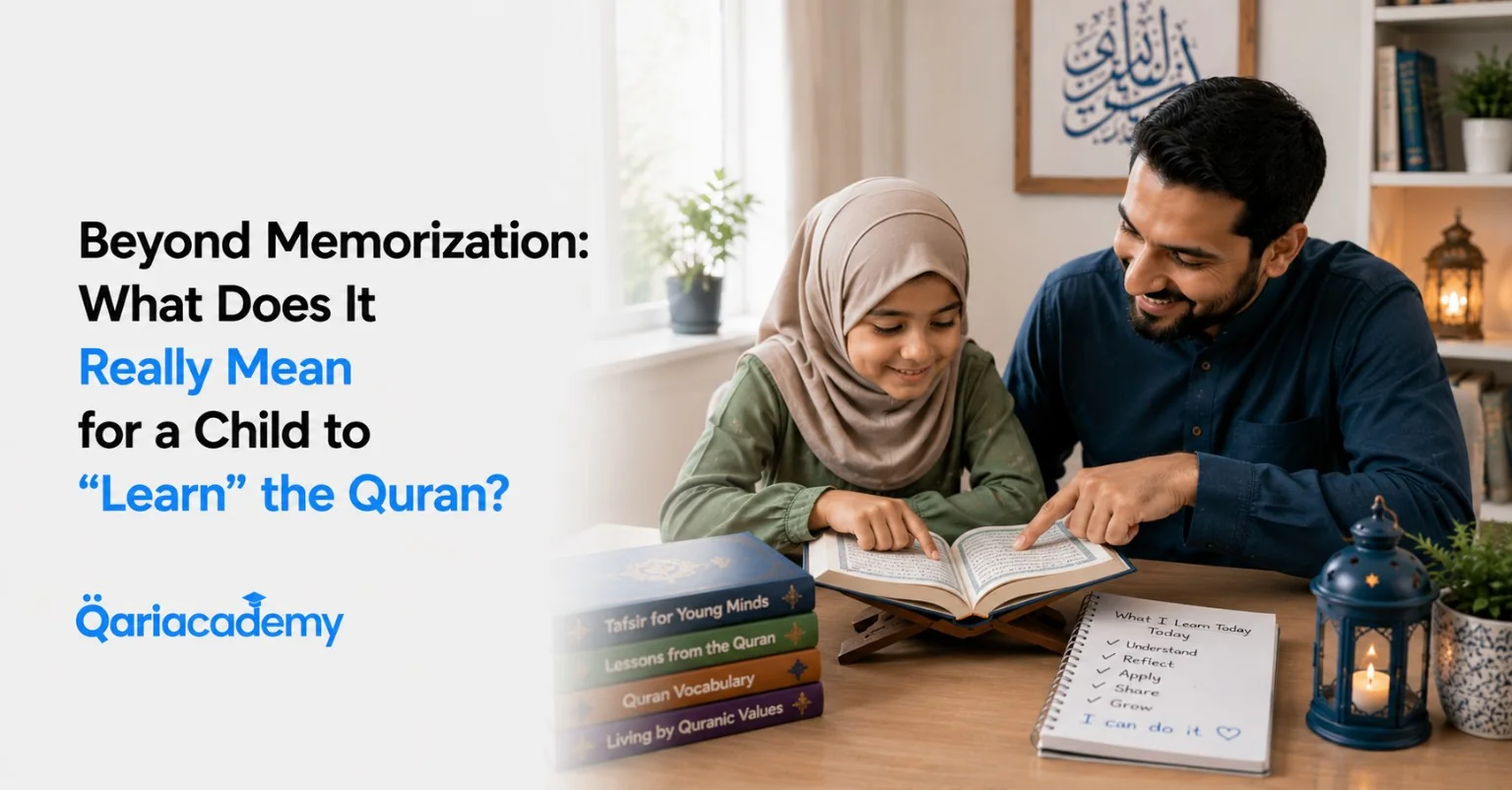
A child can memorize several surahs and still struggle to read the Quran independently.
They can recite beautifully from memory but make frequent pronunciation mistakes when reading from the Mushaf. They may know the words of a surah without knowing what those words mean. They may complete one memorization target after another while forgetting older portions just as quickly.
So when a parent says, “My child is learning Quran,” what exactly does that mean?
This is an important question because memorization is only one dimension of Quran learning.
A child can learn the Quran through reading, accurate recitation, Tajweed, memorization, understanding, reflection, practice, and gradually developing the ability to continue learning independently.
Memorization has tremendous value, but if it becomes the only measurement of progress, parents can miss important weaknesses—and important achievements.
A stronger definition of Quran learning is:
The child is gradually becoming able to read, recite, remember, understand, and engage with the Quran more independently and accurately.
That broader perspective changes how parents evaluate progress, choose lessons, and set expectations.
Memorizing the Quran Is Not the Same as Learning the Quran
Memorization is one skill.
Reading is another.
Tajweed is another.
Understanding is another.
They support one another, but they should not be treated as identical.
A child may memorize Surah Al-Ikhlas through listening and repetition without being able to recognize every word when it appears on the page.
Another child may read Quran fluently but have memorized very little.
A third child may have strong memorization but need significant work on Makharij and Tajweed.
None of these children should automatically be labeled as “good” or “bad” Quran learners.
They simply have different learning profiles.
| Area | What It Measures | Example of Progress |
|---|---|---|
| Reading | Ability to decode written Quranic text | Reads with fewer prompts |
| Recitation | Ability to pronounce and recite accurately | Fewer pronunciation errors |
| Tajweed | Application of recitation principles | Applies rules more consistently |
| Memorization | Ability to retain verses | Recites previously learned surahs |
| Understanding | Connection to meaning | Explains basic verse meanings |
This distinction is particularly important for parents of children growing up in non-Arabic-speaking environments.
A child may need considerable time to develop Arabic reading skills even if they are already memorizing short surahs.
What Does It Really Mean to “Learn” the Quran?
A more complete Quran education develops several connected abilities.
1. Reading
The child should gradually become able to look at Quranic text and decode it independently.
For beginners, that may begin with Arabic letters and Harakat.
Later, it develops into reading connected words and complete verses.
If your child is still developing basic reading skills, our guide on “How to Teach Kids the Arabic Letters with Tajweed Precision” can help explain why the foundation matters.
2. Accurate Recitation
Reading the words is not enough.
The child should increasingly pronounce Arabic letters correctly and develop accurate recitation habits.
This is where Makharij and Tajweed become important.
QariAcademy’s guide “Tajweed for Kids: A Parent’s Guide” emphasizes that Tajweed is not simply a collection of rules. It helps children develop clearer and more accurate Quran recitation.
3. Memorization
Hifz is an important part of Quran education for many families.
But effective memorization includes both new material and revision.
A child who memorizes ten new verses but forgets the previous twenty has not necessarily made better progress than a child who memorizes fewer verses and retains them strongly.
QariAcademy’s “Top Ways to Motivate Your Child to Continue Quran Memorization” also emphasizes achievable goals, consistency, revision, encouragement, and meaningful engagement.
4. Understanding
A child should gradually move beyond asking:
“How do I pronounce this?”
toward:
“What does this mean?”
Understanding does not have to begin with advanced Arabic grammar.
It can start with simple vocabulary, stories, translations, and age-appropriate explanations.
For children learning Arabic alongside Quran, QariAcademy’s “Learning Arabic for Non-Arabic Speaking Kids” provides a useful example of connecting Quranic vocabulary, reading, listening, and comprehension.
5. Reflection and Application
As children become older, understanding should increasingly connect to behavior.
If a child learns about honesty from the Quran, for example, the lesson becomes more meaningful when they can recognize what honesty looks like at school and at home.
This is where Quran education moves from:
Reciting words → Understanding guidance → Living by the guidance
That progression is far more significant than simply increasing the number of memorized pages.
The Five Dimensions of Real Quran Learning
A useful way for parents to evaluate their child’s development is to look at five dimensions together.
| Dimension | Beginner Stage | Developing Stage | Stronger Stage |
|---|---|---|---|
| Reading | Recognizes letters | Reads words and verses | Reads independently |
| Recitation | Copies teacher | Corrects common mistakes | Recites confidently |
| Memorization | Short surahs | Regular new material | Strong retention |
| Understanding | Simple vocabulary | Basic meanings | Deeper comprehension |
| Independence | Needs constant guidance | Needs reminders | Manages some practice |
This framework prevents one number—such as “number of surahs memorized”—from becoming the entire definition of success.
Why Memorization Alone Can Create a False Sense of Progress
Memorization is measurable.
A parent can easily say:
“My child memorized three surahs this month.”
Reading ability is harder to summarize.
So parents naturally gravitate toward the easier number.
But this can hide problems.
A child might memorize:
- Without understanding the words
- Without being able to read them
- Without strong Tajweed
- Without retaining older material
- Without developing independent study habits
That doesn’t make memorization meaningless.
It means memorization should be one measurement among several.
Reading and Memorization Should Support Each Other
The strongest approach is not to choose between reading and memorization.
They should reinforce each other.
When a child knows a surah orally, the teacher can use that familiarity to help the child recognize its written words.
The child begins connecting:
Sound → Memory → Written Text → Meaning
That connection can make Quran learning much more powerful.
For parents considering early memorization, QariAcademy’s “Start Quran Memorization Early: A Parent’s Guide” discusses building routines, listening, repetition, review, and meaning around memorization.
Tajweed Is More Than “Extra Rules”
Some parents treat Tajweed as something to add after the child has finished learning Quran.
That approach can be too simplistic.
Correct pronunciation should begin developing from the earliest stages.
A beginner does not need to memorize complicated Tajweed terminology, but they should be guided toward correct sounds.
Later, the child can learn the rules behind those sounds.
A useful progression is:
Hear → Imitate → Correct → Understand → Apply
QariAcademy’s “Quran Tajweed Step-by-Step: 30-Day Plan for Kids” illustrates this gradual approach through letters and sounds, Madd, pronunciation, practice, consolidation, and progress tracking.
Understanding Should Grow With the Child
A four-year-old and a twelve-year-old should not be expected to understand the Quran at the same level.
For younger children, understanding might mean:
- Knowing the meaning of a few familiar words
- Learning simple Quranic stories
- Understanding basic Islamic values
- Connecting a short surah to a simple lesson
For older children, it can gradually include:
- Vocabulary
- Word roots
- Basic grammar
- Verse context
- Themes of surahs
- Personal reflection
This is why Quran education should evolve as the child matures.
The goal isn’t to turn every Quran class into an Arabic lesson.
The goal is to gradually prevent recitation from becoming disconnected from meaning.
What Parents Should Measure Every Few Months
Instead of asking only:
“How many surahs did my child memorize?”
ask broader questions.
| Question | Why It Matters |
|---|---|
| Can my child read more independently? | Measures literacy |
| Are pronunciation mistakes decreasing? | Measures recitation quality |
| Is older memorization being retained? | Measures Hifz strength |
| Does my child understand more vocabulary? | Measures comprehension |
| Does my child practice with less prompting? | Measures independence |
These questions provide a much more accurate picture of development.
A Better Definition of Quran Progress
Consider two children.
Child A memorizes five new surahs but frequently forgets them, cannot read several of them independently, and relies entirely on the teacher for correction.
Child B memorizes two surahs, reads them independently, applies several Tajweed rules, understands their basic meaning, and regularly reviews them without being reminded.
Which child is progressing more?
The answer is not obvious if memorization is the only metric.
Child A has achieved more in one dimension.
Child B may be developing a much stronger overall Quran-learning foundation.
This is the blind spot parents should avoid.
The Role of Revision in True Learning
If a child is memorizing Quran, revision should not be treated as secondary work.
It is part of memorization itself.
A sustainable structure often looks like:
New Memorization → Recent Revision → Older Revision
The exact balance depends on the child’s level and goals.
QariAcademy’s “The 20-Minute Challenge: How to Memorize a Short Surah with Your Child Daily Without Stress or Boredom” also emphasizes beginning with review before introducing new material and keeping practice focused.
The principle is simple:
Retention matters more than accumulation.
Motivation Is Part of Learning
A child who memorizes Quran while developing resentment toward Quran lessons is facing a different problem from a child who progresses slowly but remains enthusiastic.
Long-term learning requires sustainability.
Parents should therefore pay attention to:
- Confidence
- Enjoyment
- Willingness to practice
- Relationship with the teacher
- Sense of achievement
- Ability to recover from mistakes
QariAcademy’s “Make Quran Learning Fun for Kids Online” discusses interactive activities, active participation, storytelling, short focused sessions, and positive reinforcement as ways to make learning meaningful rather than merely task-oriented.
Enjoyment is not the goal by itself.
But chronic frustration is not a good foundation for lifelong learning either.
Independence Is One of the Most Important Long-Term Outcomes
A young child naturally needs parental supervision.
An older child should gradually need less.
That progression might look like:
Parent reminds → Child remembers
Teacher demonstrates → Child attempts
Teacher corrects → Child notices mistakes
Parent organizes practice → Child begins managing practice
This is one of the clearest signs that Quran education is becoming internalized.
A child who can eventually say, “I need to review these surahs today,” has developed something much more valuable than another memorized page.
They have developed responsibility.
What Should Parents Expect at Different Stages?
| Stage | Main Priority | What “Learning” May Look Like |
|---|---|---|
| Early childhood | Familiarity | Listening, repetition, short surahs |
| Beginner reader | Literacy | Letters, Harakat, decoding |
| Developing reader | Accuracy | Quran reading and pronunciation |
| Hifz student | Retention | New memorization plus revision |
| Older learner | Understanding | Tajweed, Arabic, meaning, independence |
These are developmental directions, not rigid age requirements.
A twelve-year-old beginner may need alphabet instruction.
A six-year-old advanced reader may need Tajweed.
Ability should influence the plan.
What a Strong Quran Program Should Develop
A good Quran program should not simply answer:
“What page are we on?”
It should be able to answer:
- What can the child do now?
- What mistake are we trying to correct?
- What skill comes next?
- What should be reviewed?
- How well is previous memorization retained?
- Is the child understanding more?
- Is the child becoming more independent?
That requires assessment and adjustment.
QariAcademy’s Quran for Kids program, for example, describes development across Quran reading, Tajweed, memorization, confidence, and progression according to the child’s level.
Its Hifz program also specifically combines memorization with revision, pronunciation, Tajweed, and retention rather than treating memorization as simply accumulating surahs.
What Parents Can Do at Home
Parents don’t need to become Quran teachers.
Their most valuable role is creating an environment that supports learning.
Keep a Consistent Routine
Short, regular practice is usually easier to sustain than occasional intensive sessions.
Ask About Meaning
After a child memorizes a passage, ask:
“What do you think this verse is teaching us?”
Even a simple answer encourages understanding.
Listen to Older Memorization
Don’t focus only on the newest surah.
Ask the child to recite something learned weeks or months ago.
Celebrate Skill Development
Instead of saying:
“You memorized another page.”
try:
“You remembered that surah without help today.”
That celebrates retention and independence.
Stay Connected With the Teacher
Ask for specific feedback rather than a general:
“Is my child doing well?”
How QariAcademy Fits Into This Broader Approach
For families looking for structured Quran education, one advantage of a personalized program is that the child’s priorities can change over time.
A beginner may need reading foundations.
Later, the same child may need Tajweed.
Then Hifz may become the focus.
Eventually, Quranic Arabic and deeper understanding may become increasingly important.
QariAcademy’s approach includes one-on-one instruction, personalized learning, Tajweed, Quran reading, Hifz, progress tracking, and flexible scheduling. Its Tajweed program specifically combines guided explanation, practice, revision, and gentle correction.
The important point is not that every child needs every program.
It is that the learning path should evolve with the child.
A More Complete Quran Learning Scorecard
Parents can use this simple framework every three months.
| Area | Ask Yourself | Healthy Direction |
|---|---|---|
| Reading | Is my child becoming more independent? | Fewer prompts |
| Recitation | Are recurring errors decreasing? | Better accuracy |
| Hifz | Is previous memorization retained? | Stronger recall |
| Understanding | Does my child know more meanings? | Growing vocabulary |
| Motivation | Does my child remain willing to learn? | Stable engagement |
| Independence | Does my child take more responsibility? | Less supervision |
This gives parents a much clearer picture than counting completed pages.
Frequently Asked Questions
Is memorizing Quran enough for a child to be considered a Quran learner?
Memorization is a major part of Quran learning, but it is not the whole process. Reading, accurate recitation, Tajweed, retention, understanding, and eventually independent learning are also important.
Should my child learn Quran reading before Hifz?
Ideally, reading and memorization should support each other. A child can begin memorizing before becoming a fluent reader, but memorization should not permanently replace explicit reading development.
Does a child need to understand Arabic to learn Quran?
No. A child can learn to read and memorize Quran without conversational Arabic. However, developing Quranic vocabulary and Arabic comprehension can make the learning experience deeper as the child grows.
How can I tell whether my child’s Quran learning is progressing?
Look beyond the number of memorized surahs. Check reading independence, pronunciation, Tajweed, retention, understanding, consistency, confidence, and ability to practice with less supervision.
Should parents focus more on memorization or understanding?
The answer depends on the child’s stage and family goals. A balanced Quran education gradually develops both. Memorization without understanding can become disconnected, while understanding without accurate reading and recitation leaves another important part undeveloped.
What is the long-term goal of Quran education?
The goal should be more than producing a child who can recite a certain number of surahs. Ideally, the child develops the ability to read accurately, retain what they learn, understand increasingly more, practice independently, and maintain a meaningful relationship with the Quran.
Conclusion
So, what does it really mean for a child to “learn” the Quran?
It means more than memorizing.
Memorization matters. It can become a lifelong treasure and a central part of a child’s relationship with the Quran.
But real Quran learning is broader.
It means learning to read the words, pronounce them accurately, apply Tajweed, retain what has been memorized, understand their meaning, reflect on their guidance, and gradually take responsibility for continuing the journey.
That is why parents should stop asking only:
“How many surahs has my child memorized?”
and begin asking:
“What can my child do with the Quran that they could not do before?”
Maybe they can now read independently.
Maybe their Makharij have improved.
Maybe they remember older memorization more reliably.
Maybe they understand several Quranic words.
Maybe they have started asking questions about what they recite.
Maybe they no longer need a parent standing beside them to begin their practice.
Those are all forms of genuine progress.
The strongest Quran education does not rush children toward impressive numbers.
It builds skills that remain with them.
For families who want a structured and personalized approach, QariAcademy offers one-on-one Quran learning pathways that can develop reading, Tajweed, memorization, and broader Quranic learning according to the child’s level and goals.
The goal isn’t simply to help your child memorize more Quran. It is to help your child grow into someone who can continue learning from the Quran for life.
Start Building a Deeper Quran Learning Journey
If you’re unsure whether your child needs more focus on reading, Tajweed, memorization, revision, or understanding, a personalized assessment can help identify the next priority.
Explore QariAcademy’s Quran programs
Internal Articles Used — 10 Verified QariAcademy Articles
- Tajweed for Kids: A Parent’s Guide
- How to Teach Kids the Arabic Letters with Tajweed Precision
- Quran Tajweed Step-by-Step: 30-Day Plan for Kids
- Top Ways to Motivate Your Child to Continue Quran Memorization
- The 20-Minute Challenge: How to Memorize a Short Surah with Your Child Daily Without Stress or Boredom
- Start Quran Memorization Early: A Parent’s Guide
- Make Quran Learning Fun for Kids Online
- Learning Arabic for Non-Arabic Speaking Kids
- Is Your Child Too Young for Tajweed? The Surprising Truth Every Parent Should Know
- Why Children Struggle with Noon Saakinah – Common Challenges
Reliable External Sources
- Quran 12:2 — Quran.com — useful for the broader connection between Quranic Arabic and understanding.
- UNESCO — Literacy and language learning resources — useful broader educational context for literacy development.