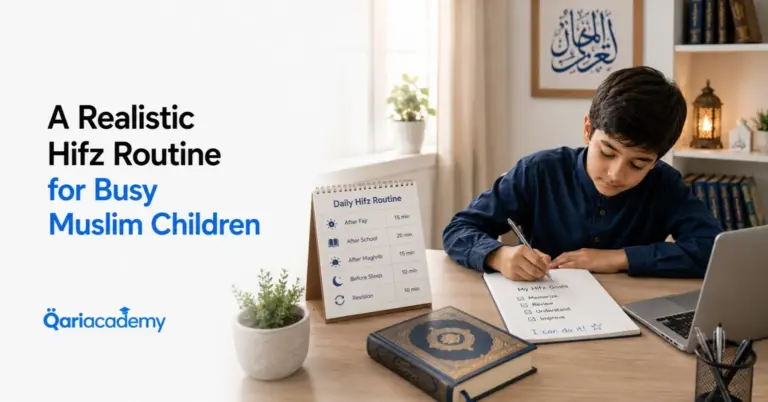

Introduction
Why does your child memorize a new surah beautifully today, only to forget parts of it a few days later?
This is one of the most frustrating experiences for parents supporting their children’s Quran education. A child may spend an entire lesson learning new verses, recite them confidently at the end, and appear to have mastered the material. Then, after a few days without proper revision, the same child struggles to remember verses they seemed to know perfectly.
Parents may naturally wonder:
- “Is my child not trying hard enough?”
- “Does my child have a weak memory?”
- “Are we memorizing too much?”
- “Should we stop adding new Quran until the old material is stronger?”
In many cases, the problem is not that the child has a poor memory. The problem is that memorization and retention are different stages of learning.
Learning something once does not guarantee that it will remain accessible weeks or months later. Children need repeated opportunities to retrieve what they have learned, preferably with increasing intervals between reviews. Research on learning supports the value of retrieval practice and spaced learning for long-term retention. The Institute of Education Sciences, for example, identifies spacing and retrieval as useful strategies for strengthening learning over time.
For Quran memorization, this has an especially practical implication.
A child should not spend all of their available Quran time learning new verses. A sustainable Hifz routine must also protect what has already been memorized.
This is particularly important for Muslim families in the USA, UK, Canada, Australia, and other Western countries. Children may attend full-time English-language schools, have limited Arabic exposure outside Quran lessons, and balance Quran learning with homework, sports, extracurricular activities, and family responsibilities.
The answer is not necessarily to make children study for longer hours.
In many cases, the better solution is to make revision more structured, more frequent, more active, and more realistic.
This guide explains why children forget Quran memorization, the most common revision mistakes parents make, how to build effective daily and weekly revision routines, how to balance new Hifz with old memorization, and how parents can help without turning Quran practice into a source of constant pressure.
The goal is simple:
Help children keep what they have memorized while developing a sustainable lifelong relationship with the Quran.
Why Do Children Forget What They Memorize?
Forgetting is a normal part of human memory.
When a child memorizes a new passage, the memory is initially relatively fresh. Without repeated retrieval, however, access to that information can become weaker.
This is not unique to Quran memorization.
Children forget:
- Vocabulary words
- School facts
- Spelling rules
- Multiplication tables
- Names
- Instructions
- Songs
- Historical dates
Quran memorization is no different in this basic respect.
The important question is not:
“How do I make my child never forget?”
A more realistic question is:
“How do I make forgetting less damaging by building regular retrieval into the learning process?”
Research on retrieval practice in school-age children has found that actively recalling information can improve later retention. This supports a practical principle for Hifz: asking a child to recite from memory is not merely a test; it can itself be part of learning.
Memorization Is Not the Same as Retention
Parents sometimes consider a passage memorized as soon as the child can recite it once without looking.
That is only the beginning.
There are several levels of mastery.
Level 1: Recognition
The child recognizes the passage when seeing or hearing it.
Level 2: Assisted Recall
The child can recite it with occasional prompts.
Level 3: Immediate Recall
The child can recite it shortly after learning.
Level 4: Delayed Recall
The child can recite it the next day without significant help.
Level 5: Stable Recall
The child can recite it accurately after several days or weeks.
Level 6: Long-Term Retrieval
The child can still retrieve it after substantial time has passed.
A strong Hifz routine should aim progressively toward the later stages rather than celebrating only immediate recall.
| Memory Stage | What the Child Can Do | Parent’s Main Goal |
|---|---|---|
| Recognition | Recognizes familiar verses | Build familiarity |
| Assisted recall | Recites with prompts | Reduce prompts gradually |
| Immediate recall | Recites after lesson | Reinforce new learning |
| Delayed recall | Recites the next day | Begin spaced revision |
| Stable recall | Recites after several days | Maintain through review |
| Long-term recall | Recites older Hifz | Protect through ongoing revision |
This distinction changes how parents interpret forgetting.
If your child remembers a passage perfectly at the end of a lesson but struggles with it three days later, that does not necessarily mean the original lesson failed.
It means the passage needs more retrieval opportunities.
The Biggest Hifz Mistake: Too Much New Material
One of the most common problems in children’s Hifz programs is an excessive focus on new memorization.
New verses are exciting.
They create visible progress.
Parents can count them.
Teachers can record them.
Children can feel that they are “moving forward.”
Revision is different.
Revision can feel repetitive.
A child may ask:
“Why do I have to read this surah again? I already memorized it.”
The answer is that memorization is not complete simply because the child remembers it today.
A strong Hifz program moves in two directions:
Forward: learning new material.
Backward: protecting old material.
If the forward movement is much faster than the backward review, the child can accumulate weak memorization.
The “More Is Better” Trap
Suppose a child memorizes ten verses in one week.
That sounds positive.
But imagine that by the end of the following week, the child remembers only six of those verses accurately.
Now the child begins another ten verses.
After another week, some of the earlier material is weaker.
The total amount of memorized Quran may continue to increase on paper while reliable recall decreases.
This is why parents should not measure Hifz progress exclusively by pages completed.
A better measurement includes:
- Accuracy
- Retention
- Independence
- Pronunciation
- Revision consistency
- Ability to connect verses
- Ability to recite older material
Why Passive Rereading Is Not Enough
Many children revise by looking at the Mushaf and repeatedly reading the same verses.
That can be useful, especially for developing reading fluency.
But it is not the same as retrieving the passage from memory.
If the child always has the text in front of them, they may feel that they know the material because the words look familiar.
Then, when the Mushaf is closed, the child discovers that the recall is weaker than expected.
This is why revision should include active retrieval.
Instead of:
“Read the surah five times.”
Try:
“Read it once, close the Mushaf, and recite it.”
Then check the Mushaf.
This forces the child to retrieve the information.
Research on retrieval practice has repeatedly found that actively recalling learned material can support later retention more effectively than simply restudying it.
For children, however, retrieval should be guided and age-appropriate. The objective is not to create a stressful examination.
A Better Revision Formula: Read, Close, Recite, Check
One of the simplest routines parents can introduce is:
Read
Look at the passage and read it carefully.
Close
Remove the visual support.
Recite
Ask the child to recite from memory.
Check
Open the Mushaf and identify mistakes.
Repeat
Correct the weak section and try again.
This process is simple enough for many children to understand.
It also gives the parent useful information.
Instead of saying:
“My child knows this.”
you can observe:
“My child can currently recite this independently but needs help at the transition between these two verses.”
That is much more actionable.
Spaced Revision: Why Reviewing Later Matters
If your child learns a passage today and reviews it ten times immediately, they may perform very well at the end of the session.
But that does not necessarily mean the memory will remain strong next week.
Spacing means distributing revision opportunities across time rather than concentrating everything into one session.
Research summarized by the Institute of Education Sciences supports spacing learning over time as a strategy for improving long-term retention.
For Quran memorization, the practical lesson is straightforward:
Do not put all revision on the same day.
Instead, revisit the passage:
- Later the same day
- The next day
- Several days later
- The following week
- Later in the month
- Periodically after that
The exact schedule should be adapted to the child.
A Simple Spaced Revision Pattern for Children
A beginner does not need a complicated scientific formula.
Try a simple pattern:
Day 1: Learn and review.
Day 2: Retrieve from memory.
Day 4: Retrieve again.
Day 7: Weekly review.
Day 14: Review again.
Day 30: Include it in older Hifz review.
If the child struggles at one stage, bring the passage back into more frequent review.
If the child recalls it comfortably, the interval can gradually increase.
| Review Point | Main Purpose | What to Do |
|---|---|---|
| Same day | Strengthen initial learning | Short repeated recall |
| Next day | Test delayed recall | Recite without looking |
| Day 4 | Strengthen retrieval | Recite and correct |
| Day 7 | Weekly consolidation | Include in weekly review |
| Day 14 | Test durability | Recite independently |
| Day 30 | Long-term maintenance | Add to older Hifz rotation |
This is not a rigid religious rule or a universal formula. It is a practical learning framework that parents and teachers can adapt.
Why Retrieval Can Feel Hard—and Why That Is Not Always Bad
Parents sometimes become concerned when a child struggles during recall.
They may think:
“Yesterday my child knew this perfectly. Today they are struggling.”
But a moderate amount of retrieval difficulty can be useful.
If the child always receives the answer immediately, they have fewer opportunities to strengthen independent recall.
Instead, give them a few seconds to think.
Try a gentle prompt:
“What comes next?”
Pause.
If necessary:
“Look at the beginning of the verse.”
Pause again.
Then provide the smallest amount of help needed.
This gradually teaches the child to retrieve rather than depend on constant prompting.
The Difference Between a Prompt and Giving the Answer
There is an important difference between helping and rescuing.
Too Much Help
Parent:
“Start with this word… then this one… then this phrase…”
The child follows the parent.
The parent may think the child knows the passage.
But the child may actually be relying heavily on external prompts.
Better Support
Parent:
“Try again.”
Pause.
“Think about the beginning.”
Pause.
“Can you remember the next phrase?”
Only after the child genuinely cannot continue should the parent provide the answer.
This gives the child’s memory an opportunity to work.
How to Build a Daily Revision Habit
The best revision system is one that the family can actually maintain.
You do not need a two-hour evening routine.
For many children, a short daily practice period can be more realistic.
A 15-Minute Example
Minutes 1–3: Listen to the assigned passage.
Minutes 4–7: Recite today’s lesson.
Minutes 8–11: Review yesterday’s lesson.
Minutes 12–15: Review an older passage.
This is only an example.
A younger child may need five-minute sessions.
An older student with a larger Hifz portion may need substantially more time.
The important thing is to create a routine rather than relying on occasional intensive sessions.
How to Build a Weekly Revision System
Daily revision handles recent material.
Weekly revision protects the broader memorized portion.
For example:
| Day | New Hifz | Recent Revision | Older Revision |
|---|---|---|---|
| Monday | New passage | Yesterday’s lesson | Short older section |
| Tuesday | New passage | Monday + yesterday | Older section |
| Wednesday | New passage | Recent lessons | Older section |
| Thursday | New passage | Weekly material | Older section |
| Friday | Light or none | Full recent review | Selected older Hifz |
| Saturday | New passage | Recent material | Larger older section |
| Sunday | Optional | Weekly consolidation | Recitation check |
This structure can be modified according to the child’s age, schedule, and amount of memorized Quran.
The Three-Bucket Revision System
Another useful method is to divide memorization into three categories.
Bucket 1: New
Material learned recently.
This needs frequent review.
Bucket 2: Recent
Material learned during the previous few weeks.
This needs regular but less frequent review.
Bucket 3: Old
Material learned months ago.
This needs periodic maintenance.
The buckets should not be permanent.
A passage can move from New to Recent and eventually to Old.
If a passage becomes weak, move it backward into more frequent revision.
| Revision Bucket | Typical Material | Priority |
|---|---|---|
| New | Current lesson | Very high |
| Recent | Last several lessons | High |
| Developing | Recent weeks | Moderate-high |
| Established | Older memorization | Moderate |
| Strong | Long-retained material | Maintenance |
| Weak | Any forgotten section | Immediate review |
This is a practical system rather than a fixed religious methodology.
What If Your Child Keeps Forgetting the Same Verse?
Repeated forgetting is useful information.
It tells you that something about the passage requires attention.
The problem might be:
- Similar verses nearby
- Difficult pronunciation
- Weak reading
- Poor understanding of the sequence
- Insufficient spaced revision
- Too much new material
- Lack of attention
- Fatigue
- Confusion between similar words
Do not automatically respond by simply repeating the same verse twenty times.
First identify the reason.
Use Smaller Chunks
Instead of memorizing an entire verse, divide it into meaningful sections.
Identify the Confusing Point
Ask where the child usually gets stuck.
Compare Similar Passages
If two verses sound similar, deliberately practice distinguishing them.
Increase Retrieval
Ask the child to start from different points.
Return Later
A short break can sometimes be more useful than another twenty repetitions.
Similar Verses Need Special Treatment
One of the more advanced Hifz challenges is confusing verses that sound or look similar.
A child may memorize both passages individually but mix them up when reciting.
This is not necessarily a sign of poor memory.
It can happen because the brain has stored highly similar sequences.
A teacher can help by deliberately comparing the passages.
For example:
- Identify the similar phrase.
- Identify the different word.
- Practice the transition.
- Ask the child to begin from the difficult point.
- Test the child in random order.
This turns a weakness into a specific practice target.
Why Children Sometimes Forget After Learning New Material
New learning can interfere with previously learned material.
A child who memorizes many similar passages close together may experience confusion between them.
This is one reason that increasing the amount of new material is not always the best solution.
If your child begins confusing yesterday’s lesson with today’s lesson, consider slowing down.
The objective is not to maximize the number of verses introduced each day.
It is to build stable access to the material.
How Reading Ability Affects Revision
Children who are still developing Quran reading skills may require a different revision strategy.
A child who reads independently can use the Mushaf to identify exactly where they made a mistake.
A beginner may struggle to locate the word or phrase.
For children with weaker Arabic reading skills, revision should therefore include both:
Reading practice
and
Memory retrieval
The child should not become dependent on listening alone.
A Balanced Revision Session
Try:
- Read the passage from the Mushaf.
- Identify difficult words.
- Recite while looking.
- Close the Mushaf.
- Recite from memory.
- Open the Mushaf.
- Correct mistakes.
- Repeat the weak section.
- Recite the entire passage again.
This develops reading and Hifz together.
How Tajweed Fits Into Revision
Revision is not only about whether the child remembers the words.
It is also an opportunity to maintain accurate recitation.
If the child repeatedly makes a pronunciation mistake, simply memorizing the passage more often may reinforce the problem.
The teacher should identify recurring Tajweed and pronunciation issues.
Parents can then reinforce the teacher’s guidance at home without attempting to teach complex rules independently.
The goal is to make accuracy part of revision.
Should Parents Correct Every Mistake?
No.
Constant interruption can make a child anxious and disrupt the flow of recitation.
But ignoring every mistake is also unhelpful.
A balanced approach is better.
During First Recitation
Allow the child to continue when possible.
Note repeated mistakes.
After the Passage
Review the most important errors.
During the Second Attempt
Ask the child to focus specifically on those areas.
This allows correction without making every sentence feel like an examination.
How to Make Revision Less Boring
Children often resist revision because it feels repetitive.
The answer is not to turn every Quran session into entertainment.
But small variations can help.
Try:
- Reciting while walking slowly.
- Alternating who starts the verse.
- Asking the child to identify where a mistake occurred.
- Randomly selecting an older surah.
- Reciting one passage to a parent.
- Letting the child choose which old surah to review first.
- Using a simple progress chart.
- Setting a short, clear goal for the session.
The objective is to maintain engagement without distracting from Quran learning.
What Parents Should Not Do During Revision
Avoid making revision a daily confrontation.
Try not to:
- Compare your child with siblings.
- Use shame as motivation.
- Threaten punishment for every forgotten verse.
- Increase the workload immediately after mistakes.
- Keep the child practicing while they are exhausted.
- Treat every forgotten word as a major failure.
- Turn Quran time into a long argument.
A child who associates revision with constant conflict may begin avoiding the activity entirely.
What Parents Can Say Instead
Instead of:
“You memorized this yesterday. How can you forget it?”
Try:
“Let’s see which part needs another review.”
Instead of:
“You are not concentrating.”
Try:
“Let’s take a short break and try again.”
Instead of:
“Your brother remembers this.”
Try:
“Let’s focus on making your own recitation stronger.”
Instead of:
“You need to memorize more.”
Try:
“Let’s make sure what you already learned stays strong.”
This does not mean lowering standards.
It means separating correction from humiliation.
A Better Way to Measure Hifz Progress
Parents often track:
Pages memorized.
Add several other measurements.
Accuracy
How many mistakes occur?
Independence
How much prompting is required?
Retention
Can the child recite after several days?
Fluency
Can they move naturally from one verse to the next?
Revision
Are old portions still being reviewed?
Pronunciation
Are Tajweed and Makharij improving?
This gives you a much richer picture of progress.
| Progress Indicator | Weak | Developing | Strong |
|---|---|---|---|
| Accuracy | Frequent errors | Occasional errors | Consistently accurate |
| Retention | Forgets quickly | Retains with review | Retains independently |
| Prompting | Needs frequent help | Some prompts | Minimal help |
| Fluency | Frequent stops | Improving | Smooth and stable |
| Revision | Irregular | Some consistency | Regular habit |
| Pronunciation | Repeated errors | Improving | Strong foundation |
When Should You Reduce New Memorization?
Consider reducing the new Hifz workload if:
- Older material is deteriorating.
- The child is consistently forgetting recent lessons.
- Revision is taking much longer.
- The child is becoming overwhelmed.
- Pronunciation errors are increasing.
- The child cannot keep up with home practice.
- School responsibilities have temporarily increased.
Reducing new material is not failure.
It can be a strategic decision to protect long-term progress.
When Can You Increase the Workload?
You might consider increasing the target gradually when:
- The child consistently retains recent material.
- Older memorization remains strong.
- Reading is comfortable.
- Pronunciation is stable.
- Home revision is consistent.
- The child is not showing signs of burnout.
- The teacher believes the child can handle more.
Increase slowly.
For example, if a child currently manages a quarter-page comfortably, moving to a slightly larger target may be more sensible than suddenly doubling the workload.
The Role of Sleep, Fatigue, and Routine
Parents sometimes interpret tiredness as poor memory.
A child who has spent a full day at school, completed homework, attended sports practice, and then starts Quran revision may simply be exhausted.
This matters.
A sustainable Hifz schedule should fit the child’s overall routine.
Consider:
- Sleep
- School workload
- Meal times
- Sports
- Screen time
- Family commitments
- Religious activities
- Weekend schedules
A short revision session when the child is alert may be more productive than a much longer session when they are exhausted.
Revision During School Holidays
School holidays can provide additional opportunities for Quran review.
But parents should not automatically fill every free hour with Hifz.
A good holiday routine may include:
- New memorization
- Older revision
- Quran reading
- Tajweed practice
- Rest
- Family activities
The extra time can be particularly useful for repairing weak older portions.
If a child normally has limited practice time during school weeks, holidays may be a good opportunity to consolidate rather than simply accelerate.
Revision During Ramadan
Ramadan can create a powerful environment for Quran engagement.
Children may hear more Quran, attend the mosque more frequently, and participate in family recitation.
However, parents should still keep expectations age-appropriate.
Ramadan should not automatically become a month of extreme memorization targets.
Instead, consider using increased Quran exposure to strengthen:
- Listening
- Reading
- Short surah revision
- Salah surahs
- Previously memorized portions
The objective is to create meaningful engagement rather than exhausting the child.
What If Your Child Has Learning Difficulties?
Children do not all learn in the same way.
Some may need more repetition, visual support, movement, audio reinforcement, or smaller learning units.
If a child consistently struggles despite reasonable adjustments, parents should discuss the situation with the teacher and consider whether additional educational support may be appropriate.
The answer is not always:
“Practice more.”
Sometimes the learning method needs to change.
The Importance of Individualized Quran Teaching
A fixed revision plan cannot work equally well for every child.
A teacher should be able to observe:
- What the child remembers easily
- Where the child repeatedly forgets
- Which verses are confused
- Which pronunciation errors persist
- How much prompting is required
- Whether the workload is appropriate
This information can be used to personalize revision.
For example, two children may have memorized the same amount of Quran.
Child A has strong retention but struggles with one particular Tajweed rule.
Child B reads accurately but repeatedly forgets older surahs.
Their revision plans should not be identical.
How QariAcademy Can Support Better Revision Habits
QariAcademy provides Online Quran Classes for children, including one-on-one lessons that can be adapted to the student’s current level.
This can be particularly useful when a child is memorizing Quran but needs a clearer balance between new Hifz and revision.
Depending on the child’s needs, lessons may focus on:
- Quran Reading
- Tajweed
- Hifz
- Quranic Arabic
A teacher can observe the child’s current memorization and identify whether the main challenge is:
- Too much new material
- Weak revision
- Reading difficulty
- Pronunciation
- Lack of confidence
- Inconsistent practice
For children growing up in the USA, UK, Canada, Australia, and other Western countries, individualized online lessons can also make it easier to build Quran learning around school and family schedules.
A one-on-one teacher can adjust the lesson according to the child’s level instead of requiring every student to follow exactly the same pace.
A Free Trial can give parents an opportunity to see how the child responds to the teacher and whether the learning approach feels appropriate.
The most valuable outcome of a trial is not simply deciding whether the child “likes online lessons.”
It is understanding what the child currently needs.
A Practical 15-Minute Revision Routine
If your family struggles to establish consistency, start small.
Try this routine:
Minutes 1–3: Warm-Up
Listen to a short passage.
Minutes 4–7: Newest Lesson
Ask the child to recite without looking.
Minutes 8–11: Recent Hifz
Review yesterday’s or the previous few days’ material.
Minutes 12–15: Older Hifz
Choose one older passage.
If the child struggles, do not continue endlessly.
Mark the weak point and return to it later.
The routine can expand as the child’s capacity increases.
A Practical 30-Day Revision Plan
Parents who want to build a habit can start with a month-long system.
Week 1: Establish the Routine
Do not worry about increasing memorization.
Focus on practicing at the same time each day.
Week 2: Add Retrieval
Close the Mushaf and ask the child to recite from memory.
Week 3: Introduce Older Material
Add one older passage to daily or alternating-day revision.
Week 4: Review the System
Ask:
- Is the child remembering more?
- Is practice easier to start?
- Are fewer prompts needed?
- Are older surahs becoming stronger?
- Is the child less frustrated?
If yes, keep the routine.
If not, simplify it.
| Week | Main Goal | Parent Action |
|---|---|---|
| Week 1 | Build consistency | Practice at a regular time |
| Week 2 | Increase retrieval | Close Mushaf and recite |
| Week 3 | Expand revision | Add older memorization |
| Week 4 | Evaluate retention | Identify weak portions |
| Month 2 | Stabilize | Maintain the routine |
| Month 3 | Improve | Adjust workload gradually |
A Simple Parent-Teacher Revision Conversation
Parents do not need to guess what is happening.
Ask the teacher specific questions.
Instead of:
“Is my child doing well?”
ask:
- Which parts of the memorization are strongest?
- Which parts are weakest?
- Is the current amount of new Hifz appropriate?
- How much revision should happen at home?
- Which mistakes should we focus on?
- Does my child rely too much on prompts?
- Should we increase, maintain, or reduce the workload?
These questions can turn a vague concern into a practical plan.
Why Consistency Beats Occasional Intensive Practice
One weekend of three hours does not necessarily compensate for six days without revision.
Learning research generally favors distributed practice over cramming when the goal is longer-term retention.
For children, this principle is particularly practical.
Instead of:
Three hours on Saturday
consider:
10–20 minutes across several days
The exact amount depends on age and Hifz level, but the principle remains useful.
Frequent contact helps keep previously learned material accessible.
The Goal Is Not to Eliminate Forgetting
This may be the most important point for parents.
You cannot create a system in which a child never forgets anything.
That is not how memory works.
The goal is to create a system that notices forgetting early and responds effectively.
If a child forgets a verse:
Review it.
If they forget it again:
Review it more frequently.
If the same passage remains weak:
Break it into smaller sections.
If similar verses are confused:
Practice the differences.
If the entire workload becomes unstable:
Reduce new material.
This is a learning process, not a test of the child’s worth.
FAQ: Quran Memorization Revision for Kids
Why does my child forget Quran after memorizing it?
Forgetting is a normal part of memory. If previously learned material is not retrieved and reviewed over time, recall can weaken. The solution is usually not simply more repetition in one sitting but a structured combination of retrieval and spaced revision.
How often should children revise Quran memorization?
There is no single schedule for every child. New material generally benefits from frequent review, while older material can be revisited at progressively longer intervals. The schedule should become more frequent again whenever a passage becomes weak.
Is rereading the Mushaf enough for revision?
Rereading is useful for Quran reading and familiarity, but active recall should also be included. Closing the Mushaf and reciting from memory gives parents and teachers a better picture of actual retrieval ability.
Should my child revise before learning new Quran?
Revision and new memorization should generally coexist. If old material is becoming weak, revision should receive greater priority and the amount of new material may need to be reduced.
What if my child forgets yesterday’s lesson?
Do not panic. Review it again and determine why it was forgotten. If this happens frequently, the current amount of new material may be too large or the child may need a more structured revision routine.
How long should a child revise Quran each day?
There is no universal duration. Younger children may benefit from very short sessions, while older students with larger Hifz portions may require more time. Consistency and focused retrieval are more important than forcing a specific number of minutes.
Should parents test children every day?
Parents can ask children to recite regularly, but the atmosphere should not feel like a daily examination. Retrieval can be presented as normal practice rather than a judgment of success or failure.
What if my child gets frustrated during revision?
Look for the cause. The workload may be too large, the child may be tired, or the material may be confusing. Shorten the session, identify the specific difficulty, and discuss persistent problems with the teacher.
Should children memorize new Quran every day?
Not necessarily. Some days can focus mainly on revision. A balanced Hifz program protects older memorization while gradually adding new material.
How can I help my child revise without knowing Tajweed well?
You can listen to the child’s assigned material, encourage them to recite from memory, and remind them to follow the teacher’s instructions. Leave detailed Tajweed correction to the qualified teacher unless you have been specifically taught how to make the correction.
What if my child memorizes quickly but forgets quickly?
This usually suggests that the new memorization pace may be ahead of the child’s retention capacity. Increase spaced revision and consider reducing new material until the child’s retention becomes more stable.
Is online Quran learning effective for revision?
One-on-one online Quran lessons can support revision effectively when the teacher actively listens to the child’s recitation, identifies weak sections, and adjusts the workload. The quality of the teacher and consistency of practice remain important.
Can children with limited Arabic exposure memorize Quran?
Yes. Children who primarily speak English can learn Quran memorization, but they may need additional support with Arabic reading, pronunciation, and Quranic vocabulary. Their Hifz schedule should take their overall language environment into account.
Conclusion
When children forget what they memorized, the first response should not be panic or pressure.
Forgetting is a normal part of learning.
The more important question is whether the child’s Hifz routine gives them enough opportunities to retrieve, review, correct, and revisit what they have learned.
A child who memorizes ten verses today does not necessarily have ten permanently memorized verses.
The memory becomes stronger through continued retrieval.
That is why effective Quran memorization revision for kids should include several layers:
- Immediate review
- Next-day retrieval
- Spaced revision
- Weekly consolidation
- Older Hifz maintenance
- Regular teacher feedback
Parents should also remember that revision does not need to become a long or stressful activity.
A short, consistent routine can be more sustainable than occasional intensive practice.
If your child is constantly forgetting, examine the system before blaming the child.
Perhaps the new workload is too high.
Perhaps revision is too passive.
Perhaps the child needs more time between repetitions.
Perhaps similar verses need special attention.
Perhaps Quran reading or Tajweed needs additional support.
Or perhaps the family simply needs a more realistic routine.
For children growing up in the USA, UK, Canada, Australia, and other English-speaking environments, personalized Quran education can be particularly helpful. Children may have limited Arabic exposure outside their Quran lessons, making consistent teacher guidance and structured revision especially valuable.
QariAcademy offers one-on-one Online Quran Classes for children, with lessons that can be adapted to the student’s level and needs. Depending on the child, the learning plan can include Quran Reading, Tajweed, Hifz, or Quranic Arabic.
A teacher can help determine whether your child needs more new memorization, more revision, stronger reading skills, or a different balance between these areas.
A Free Trial can also give parents an opportunity to experience the teaching format and understand their child’s current learning needs before establishing a longer-term routine.
The goal of Hifz should not be to see how quickly a child can accumulate pages.
The goal is to help the child develop accurate, durable, and meaningful Quran memorization that can remain with them as they grow.
If your child is forgetting what they memorized, do not simply ask:
“How can we make them memorize more?”
Ask the better question:
“How can we help them remember what they have already learned?”
That shift can transform the entire approach to Quran memorization.
Book a Free Trial With QariAcademy: Enroll Now
Sources and Further Reading
- Quran.com — Surah Al-Qamar 54:17
- Quran.com — Surah Al-Muzzammil 73:4
- Institute of Education Sciences — Learning Strategies and Research — Evidence and discussion concerning spacing and retrieval practice.
- Institute of Education Sciences — Organizing Instruction and Study to Improve Student Learning — Practice guidance concerning spacing and retrieval.
- PubMed — Research literature on retrieval practice, memory, and children’s learning.