
Introduction
Should your child memorize Juz Amma first?
For many Muslim parents, the answer seems obvious. Juz Amma contains many short surahs that children often hear at home, in the mosque, and during salah. A child may already recognize Surah Al-Ikhlas, Al-Falaq, An-Nas, Al-Kawthar, or Al-Asr before beginning formal Hifz.
But familiarity does not automatically mean that Juz Amma is the right starting point for every child.
The better question is:
Is Juz Amma the right starting point for my child’s age, reading level, memorization ability, and Quran goals?
For many children, the answer is yes. Short surahs can provide manageable goals, early confidence, and frequent opportunities for revision.
However, parents should avoid one important mistake: confusing fast memorization with successful Hifz.
A child may memorize several short surahs quickly but still struggle with Quran reading, Tajweed, or long-term retention.
The goal should therefore be bigger than simply completing Juz Amma.
The goal is to build a strong foundation for a lifelong relationship with the Quran.
What Is Juz Amma?
Juz Amma is the 30th Juz of the Quran. It begins with Surah An-Naba and ends with Surah An-Nas.
Many of its surahs are relatively short, particularly toward the end, which makes them practical for children who are beginning memorization.
They are also frequently recited in salah, giving children additional opportunities to retrieve what they have memorized.
This makes Juz Amma a useful starting point for many families, but it should not be treated as a special “children’s section” of the Quran. It is part of the Quran, and every surah deserves accurate recitation, respect, and regular revision.
Why Do Many Children Start With Juz Amma?
There are several good reasons.
| Benefit | Why It Helps |
|---|---|
| Short surahs | Children can work toward manageable goals |
| Familiar passages | Previous exposure may support memorization |
| Frequent use in salah | Provides natural opportunities for revision |
| Many milestones | Children can experience progress regularly |
| Simple progression | Parents can build a structured routine |
For a beginner, completing a short surah can also create an important psychological benefit: confidence.
The child learns, “I can memorize Quran.”
That feeling can encourage them to continue.
Is Juz Amma Always the Best Starting Point?
No.
This is one of the most important points for parents to understand.
Children do not all begin from the same place.
One child may not recognize Arabic letters yet.
Another may be able to read Quran but know very little Hifz.
Another may already know most of the short surahs.
Another may memorize extremely well through listening but struggle to read independently from the Mushaf.
Therefore, age alone should not determine the Hifz plan.
A qualified teacher should consider:
- Arabic letter recognition
- Quran reading ability
- Pronunciation
- Tajweed
- Existing memorization
- Retention
- Attention span
- Home practice
- The child’s goals
If your child needs to strengthen basic reading first, a structured Quran reading program for children may be more important initially than increasing the amount of Hifz.
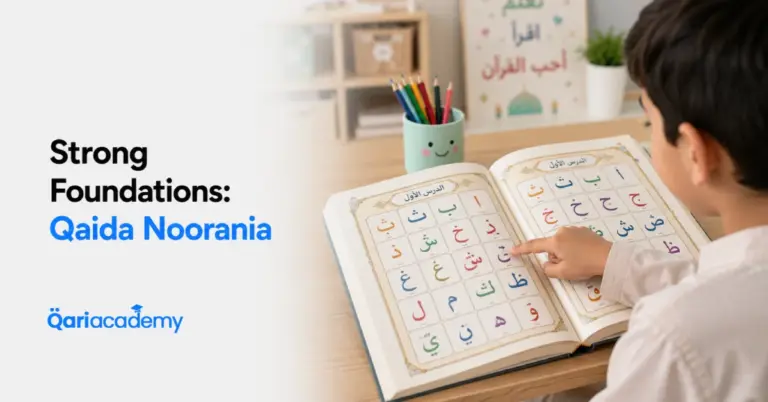
Should Children Learn Qaida Before Juz Amma?
For many beginners, yes.
If a child is still struggling with Arabic letters, Harakat, or connected letters, a structured Qaida can provide the foundation needed for independent Quran reading.
But learning Qaida and memorizing short surahs do not necessarily have to be completely separate.
A teacher may combine:
Quran reading practice + small amounts of memorization.
For example, a child could continue learning Arabic reading while memorizing a short familiar surah.
The correct balance depends on the child’s ability.
The important thing is not to allow memorization to completely replace reading development.
What Are the Main Benefits of Starting With Juz Amma?
1. It Creates Early Success
Short surahs can give children achievable milestones.
2. It Builds Familiarity
Children may already recognize many of these surahs from salah or family recitation.
3. It Supports Prayer
As children develop their salah, memorized short surahs can become part of their regular recitation.
4. It Encourages Revision
Because many surahs are short, several can be reviewed within a relatively short period.
5. It Makes Hifz Feel Manageable
Instead of thinking about memorizing a large portion of Quran, the child focuses on one surah at a time.
6. It Can Build Confidence
Completing a surah can give a young learner a sense of achievement and encourage continued effort.
The Biggest Risk: Confusing Speed With Success
Imagine one child memorizes ten short surahs in a few months.
Another child memorizes five.
Which child is progressing better?
You cannot answer that question without asking:
How much of those surahs can they still recite accurately?
The first child may have memorized quickly but forgotten much of the material.
The second may have stronger retention.
This is why Hifz should be measured by more than quantity.
A better system tracks:
- New memorization
- Retention
- Revision
- Reading
- Tajweed
- Accuracy
- Independence
The goal is not simply to add more pages.
The goal is to keep what has been learned.
Memorization and Retention Are Different
Initial memorization means the child can recite a passage after learning it.
Retention means the child can still retrieve it days, weeks, or months later.
For long-term learning, active retrieval is important. Instead of repeatedly reading while looking at the Mushaf, children should also have opportunities to close the Mushaf and recite from memory.
A simple cycle is:
Read → Close → Recite → Check → Correct → Review Later
This principle can be especially useful for Hifz because it encourages the child’s memory to retrieve the verses rather than simply recognize them visually.
Why Revision Should Begin From Day One
One of the biggest mistakes parents make is treating revision as something that starts after a child has memorized a large amount.
It should begin immediately.
Suppose your child has memorized five short surahs.
When learning the sixth, continue reviewing the previous five.
A simple structure could be:
| Category | What to Review |
|---|---|
| New | Current surah |
| Recent | Last 2–3 surahs |
| Older | Previously memorized surahs |
| Weak | Any passage with repeated mistakes |
This prevents the child from constantly moving forward while their older Hifz becomes weaker.
Should Your Child Memorize Juz Amma in Order?
Not necessarily.
Some families prefer to begin from An-Nas and move through Juz Amma systematically.
Others may start with surahs the child already knows or hears frequently.
Both approaches can work.
The important thing is to have a clear plan.
A teacher may choose the sequence based on:
- The child’s current level
- Familiarity with the surah
- Surah length
- Pronunciation difficulty
- Motivation
- Existing memorization
- Overall Hifz curriculum
There is no need to treat one exact sequence as the only correct approach.
What If Your Child Already Knows Many Short Surahs?
Do not make the child repeat material simply because they are “supposed to start with Juz Amma.”
First test their retention.
Can they:
- Recite without prompts?
- Continue after stopping?
- Read the surah from the Mushaf?
- Recite it accurately several weeks later?
- Recognize the words while reading?
- Apply basic pronunciation correctly?
If the answer is yes, the child may be ready to progress toward longer passages while keeping Juz Amma in their revision schedule.
What If Your Child Is Still Learning to Read Quran?
Then reading should remain a major part of the program.
A child who can memorize through listening but cannot read the Mushaf independently may eventually become overly dependent on audio or teacher recitation.
Ideally, Hifz should develop alongside:
Quran reading + pronunciation + Tajweed + memorization + revision.
If your child needs help developing reading skills, you can explore QariAcademy’s Quran for Kids program as one possible structured approach.
How Does Tajweed Fit Into Juz Amma?
Children should not wait until they have memorized a large portion of Quran before receiving pronunciation guidance.
However, five- and six-year-olds do not necessarily need lengthy theoretical explanations.
Instead, the teacher can gradually correct:
- Letter pronunciation
- Harakat
- Madd
- Ghunnah
- Shaddah
- Stopping and starting
- Common recitation mistakes
The goal is not to overwhelm the child with terminology.
The goal is to help them develop accurate recitation habits.
Parents interested in developing these skills can also review age-appropriate Tajweed resources for children.
Should Children Understand the Meaning?
Yes, but keep it age-appropriate.
A child does not need advanced Arabic grammar before memorizing Quran.
However, simple explanations can make memorization more meaningful.
For example:
“Surah Al-Falaq teaches us to seek Allah’s protection.”
Or:
“This surah reminds us that Allah knows what is hidden and what is visible.”
Short explanations are often enough.
The goal is to help the child understand that they are not simply memorizing unfamiliar sounds. They are gradually becoming familiar with the message of the Quran.
How Much Juz Amma Should a Child Memorize?
There is no universal number.
One child may memorize several short surahs in a month.
Another may need several weeks for one surah.
Neither is automatically better.
The appropriate pace depends on:
- Age
- Reading ability
- Memory
- Practice time
- Lesson frequency
- School workload
- Retention
- Motivation
The better question is not:
“How many surahs should my child memorize this month?”
It is:
“How much can my child memorize accurately and retain?”
A Practical Weekly Routine
A young child might follow a routine such as:
| Day | Main Focus |
|---|---|
| Monday | New memorization + recent revision |
| Tuesday | New memorization + previous lesson |
| Wednesday | Revision-focused day |
| Thursday | New memorization + revision |
| Friday | Family Quran and familiar surahs |
| Saturday | Teacher lesson + larger review |
| Sunday | Light revision |
This is only an example.
The schedule should be adapted to the child’s school, activities, attention span, and teacher’s recommendations.
How Much Home Practice Is Needed?
For younger children, short and consistent practice can be more realistic than long sessions.
A 10–15 minute routine might include:
5 minutes: Current surah
5 minutes: Previous surah
5 minutes: Older revision
The exact duration is less important than consistency.
A child who practices briefly five days per week may develop a stronger routine than a child who studies for an hour once every weekend.
What Should Parents Do When Their Child Forgets?
Stay calm.
Forgetting does not automatically mean that the child is lazy or incapable.
It may indicate that the material needs more retrieval practice.
Instead of:
“You already memorized this!”
try:
“Let’s see which part needs more review.”
Then identify the difficult section.
The solution may be:
- Smaller memorization portions
- More frequent revision
- Better spacing between reviews
- Less new material
- More guided recitation
Forgetting is information. Use it to improve the learning plan.
When Should a Child Move Beyond Juz Amma?
A child may be ready to progress when they can:
- Recite most memorized short surahs independently
- Retain older material
- Read Quran with reasonable confidence
- Apply basic pronunciation correctly
- Handle regular revision
- Work with less parental prompting
- Manage slightly longer passages
The teacher should assess the child’s actual performance before recommending a new stage.
Moving beyond Juz Amma should not mean abandoning it.
Older memorized surahs should continue to be part of the revision rotation.
What If Juz Amma Is Not Working?
Do not immediately conclude that your child is not capable of Hifz.
Ask what is actually going wrong.
If reading is weak, strengthen reading.
If retention is weak, increase revision.
If attention is weak, shorten sessions.
If motivation is declining, reassess the workload.
If pronunciation is the problem, introduce targeted Tajweed practice.
If the teaching relationship is poor, discuss it with the teacher.
The starting point may be correct while the method or pace needs adjustment.
How Parents Can Support Hifz Without Creating Pressure
Parents do not need to become Quran teachers.
Your main responsibilities are to:
- Protect the practice schedule.
- Encourage consistency.
- Provide a quiet learning environment.
- Listen occasionally.
- Encourage revision.
- Avoid comparison.
- Communicate with the teacher.
- Celebrate progress.
Avoid turning every interaction into:
“How much did you memorize?”
Instead ask:
“What did you learn today?”
“What part was easy?”
“What part was difficult?”
“What should we practice?”
This keeps communication focused on learning rather than performance alone.
How QariAcademy Can Help
The right answer to “Should your child memorize Juz Amma first?” depends on the individual child.
QariAcademy offers one-on-one Online Quran Classes for children, allowing the teacher to assess the student’s current level and adjust the learning path accordingly.
Depending on the child’s needs, lessons can include:
- Quran Reading
- Tajweed
- Hifz
- Quranic Arabic
For example, a child who is still learning Arabic letters may need to strengthen reading foundations first.
A child who already reads Quran confidently may be ready for more focused Hifz.
A child who already knows much of Juz Amma may be ready to progress while continuing regular revision.
This individualized approach is particularly useful for families in the USA, UK, Canada, Australia, and other countries where children may be balancing Quran education with school and extracurricular activities.
Parents can also use the QariAcademy enrollment and free trial page to explore whether the teaching approach is suitable for their child.
FAQ: Should Your Child Memorize Juz Amma First?
Should every child memorize Juz Amma first?
No. Juz Amma is an excellent starting point for many children, but the best starting point depends on the child’s reading level, existing memorization, age, and learning goals.
Why is Juz Amma popular for children’s Hifz?
Many surahs are short and familiar, making them manageable for young learners and providing frequent opportunities for recitation and revision.
Should my child learn Qaida before memorizing Juz Amma?
If the child has weak Arabic reading foundations, Qaida can be very useful. A teacher may also combine reading instruction with a small amount of memorization.
Can a child memorize Juz Amma while learning Quran reading?
Yes. In many cases, reading and memorization can develop together, provided that Hifz does not completely replace reading practice.
Should Juz Amma be memorized in order?
Not necessarily. A teacher can choose a sequence based on the child’s level, familiarity, motivation, and curriculum.
How many surahs should a child memorize each week?
There is no universal target. Retention and accuracy are more important than the number of surahs completed.
What if my child keeps forgetting?
Increase revision and active retrieval, and consider reducing new memorization temporarily. Discuss the pattern with the teacher.
Should Tajweed be taught during Hifz?
Yes, children should receive appropriate pronunciation and recitation guidance while memorizing. The complexity of Tajweed instruction should match the child’s age and ability.
What if my child already knows most of Juz Amma?
Test their retention and reading ability. If their memorization is strong, the teacher may recommend progressing to longer passages while keeping Juz Amma in regular revision.
Can children who primarily speak English memorize Quran?
Absolutely. They may need additional support with Arabic reading, pronunciation, and vocabulary, but English as a primary language does not prevent successful Quran memorization.
Conclusion
So, should your child memorize Juz Amma first?
For many children, yes.
Juz Amma can be an excellent starting point because its shorter surahs provide manageable goals, familiar passages, opportunities for salah, and frequent opportunities to experience progress.
But it should not become a rigid rule.
The best Hifz plan is the one that starts with the child’s actual abilities.
If your child is still learning Arabic letters, strengthen those foundations.
If they need Qaida, use it.
If they can already read Quran, combine reading with memorization.
If they already know many short surahs, test their retention before deciding where to go next.
And whatever starting point you choose, build revision into the process from the beginning.
The biggest mistake is not starting with the “wrong” surah.
The bigger mistake is focusing so heavily on completing more Quran that the child fails to retain what they have learned.
A strong Hifz journey should develop:
Reading → Pronunciation → Tajweed → Memorization → Revision → Independence
Juz Amma can be an excellent first step within that journey.
But the ultimate goal is much bigger than completing one Juz.
You want your child to become someone who can read the Quran, recite it accurately, memorize it carefully, revise it consistently, and continue learning independently.
That is why the right question is not simply:
“Should my child memorize Juz Amma first?”
It is:
“What is the right Hifz starting point for my child?”
Once you answer that question, the rest of the journey becomes much clearer.
QariAcademy provides one-on-one online Quran learning for children, with programs that can include Quran Reading, Tajweed, Hifz, and Quranic Arabic. A personalized approach allows the teacher to adjust the starting point and pace according to the student’s actual needs.
If you are unsure where your child should begin, you can book a free trial with QariAcademy and use the lesson to understand your child’s current level and the most appropriate next step.
Start with the right level. Build strong revision habits. Protect your child’s confidence. And let Hifz become a lifelong journey—not a race.