Table of Contents
Parents often ask a simple question: What should a 6-year-old learn in Quran classes?
Should a six-year-old already be reading from the Mushaf? Should they still be learning Arabic letters? Is it time to start Tajweed? What about memorization?
The answer depends less on age than many parents expect.
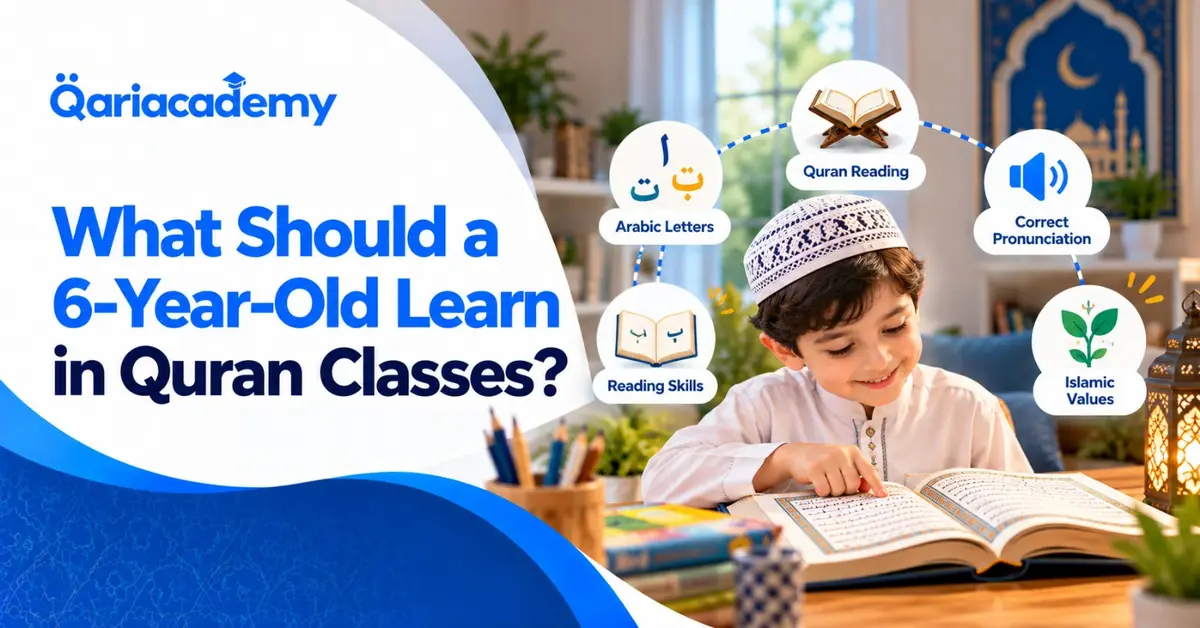
A six-year-old may learn Arabic letters, letter sounds, Harakat, connected-letter reading, basic Quranic words, short Surahs, and age-appropriate Tajweed. However, the exact starting point should depend on the child’s current ability rather than age alone.
A child who has never studied Arabic may need to begin with the alphabet and basic sounds. Another six-year-old may already read simple Arabic words. A third may already read Quran but need to improve pronunciation, fluency, or Tajweed.
That is why two children of the same age can be at completely different stages of Quran learning.
The more useful question is not:
“Is my six-year-old ahead or behind?”
It is:
“What skill does my child need to develop next?”
What Should a Six-Year-Old Learn in Quran Classes?
For a six-year-old beginning Quran education, the learning path may include:
- Arabic letter recognition
- Correct letter sounds
- Basic pronunciation
- Fathah, Kasrah, and Dammah
- Connecting Arabic letters
- Simple Arabic reading patterns
- Basic Quranic words
- Short Surah memorization
- Gradual introduction to correct recitation
- A consistent Quran learning routine
These skills should not be treated as a rigid checklist. A child who has already mastered some of them should move forward rather than repeating material simply because they are six.
The goal is progress through skills, not progress through birthdays.
A Six-Year-Old’s Starting Point Matters

Before deciding what a child should learn next, it helps to identify what they can already do.
| What Your Child Can Do | Main Focus | Possible Next Milestone |
|---|---|---|
| Does not recognize Arabic letters | Letter recognition and sounds | Recognize letters randomly |
| Knows the alphabet | Sounds and Harakat | Read simple combinations |
| Reads connected letters | Qaida and decoding | Read simple words |
| Reads basic Arabic words | Quran reading | Read short Quranic passages |
| Reads Quran | Accuracy and Tajweed | Improve fluency and self-correction |
This is why placement matters.
A six-year-old who started learning Arabic yesterday should not be compared with a six-year-old who has been studying Arabic for two years.
The age is the same. The starting point is not.
1. Arabic Letters Come First for Complete Beginners
If your six-year-old cannot recognize Arabic letters, there is no need to rush directly into Quranic passages.
The first goal is to build a reliable foundation.
A child may begin by learning letters such as:
ا — ب — ت — ث — ج — ح — خ
But recognizing the letters is more important than simply memorizing their sequence.
A child may confidently recite:
Alif, Baa, Taa, Thaa…
while still struggling when a teacher shows them a letter randomly:
ث
True progress happens when the child can recognize the letter without depending on the order of the alphabet.
Early Arabic reading instruction generally involves connecting letter shapes and sounds so that children can eventually use that knowledge to decode words. [Reading Rockets – The Alphabetic Principle]
For Quran learning, this foundation becomes especially important because the child will eventually need to recognize letters in different positions and combinations.
2. Letter Sounds Matter as Much as Letter Recognition
Knowing that ق is called Qaf is not enough.
The child also needs to learn how the letter sounds.
This is particularly important for children growing up in English-speaking environments, where some Arabic sounds may not have direct equivalents in everyday speech.
A six-year-old may initially struggle with sounds such as:
ح — خ — ع — غ — ق — ص — ض — ط — ظ
The teacher does not need to overwhelm the child with technical terminology.
Instead, the learning process can be simple:
- The teacher models the sound.
- The child listens.
- The child repeats.
- The teacher gently corrects the pronunciation.
- The child practices again.
- The sound is reviewed regularly.
This approach allows pronunciation to develop gradually rather than treating correct pronunciation as something that should only be addressed after the child learns to read.
3. Harakat and Basic Reading Patterns
Once a child recognizes Arabic letters and can produce their basic sounds, the next major step is learning how letters work with short vowels.
For example:
بَ — بِ — بُ
The child begins to understand that the same letter can produce different sounds depending on the Harakah.
A six-year-old beginner may gradually learn:
- Fathah
- Kasrah
- Dammah
- Connected letters
- Sukoon
- Tanween
- Madd
- Shaddah
These skills should be introduced progressively.
Not every six-year-old needs to master every item at the same pace.
The important question is whether the child can use the skill independently, not whether the teacher has technically covered it.
What Does Progress Look Like?
| Skill | Beginning Stage | Developing Stage |
|---|---|---|
| Letters | Recognizes some letters | Recognizes letters randomly |
| Sounds | Repeats after teacher | Produces sounds more independently |
| Harakat | Learns individual patterns | Reads combinations |
| Connected letters | Needs significant help | Reads simple combinations |
| Words | Cannot decode independently | Reads familiar simple words |
The goal is not to rush through every rule.
The goal is to make each new skill usable.
4. Qaida Can Be an Important Bridge
For many six-year-olds, the journey is not simply:
Alphabet → Mushaf
There is often an important middle stage:
Alphabet → Sounds → Harakat → Connected Letters → Qaida → Quran Reading
Qaida gives children an opportunity to practice the mechanics of Arabic reading before dealing with the complexity of complete Quranic passages.
It can be particularly useful for children who know the letters but still struggle to combine them.
However, Qaida should not become a destination in itself.
If a child can already read basic Arabic combinations confidently, the teacher should assess whether continued Qaida practice is necessary or whether the child is ready to apply those skills to Quranic text.
5. Quran Reading Should Develop Gradually
Once a child has the necessary foundation, Quran reading can become a more central part of the lesson.
At this stage, the teacher may help the child:
- Recognize Quranic words
- Read short passages
- Apply learned sounds
- Reduce hesitation
- Correct recurring pronunciation mistakes
- Develop reading confidence
- Become increasingly independent
A beginner should not be expected to read quickly.
Speed should not be the main goal.
Accurate, controlled reading is more valuable than rushing through a page while repeating the same mistakes.
As reading develops, fluency should gradually include accuracy, appropriate pace, smoother decoding, and greater independence.
6. Should a Six-Year-Old Learn Tajweed?
Yes, but Tajweed should be introduced at an age-appropriate level.
There are two common extremes.
One is:
“My child is only six. Tajweed can wait.”
The other is expecting a young beginner to memorize and explain many formal Tajweed rules before they can read comfortably.
Neither is necessary.
A better approach is to develop correct recitation habits from the beginning and gradually introduce more formal Tajweed concepts as the child’s reading ability develops.
For a beginner, Tajweed may simply mean:
- Pronounce the letter correctly.
- Notice differences between similar sounds.
- Listen carefully.
- Repeat after the teacher.
- Correct mistakes.
- Practice again.
Later, the child can gradually learn more formal rules.
A Practical Tajweed Progression
| Reading Stage | Tajweed Priority |
|---|---|
| Arabic alphabet | Correct letter sounds |
| Basic Qaida | Pronunciation and Harakat |
| Early Quran reading | Makharij and basic recitation rules |
| Developing reader | Madd, Ghunnah, Qalqalah, and other core rules |
| Stronger reader | Refinement and self-correction |
The important principle is:
Early Tajweed does not mean advanced Tajweed theory.
It means developing correct recitation habits from the beginning.
7. Short Surah Memorization Can Be Included
Memorization can also be part of Quran education at age six.
However, memorization should develop alongside reading rather than replace it.
A child may memorize a Surah by repeatedly listening to a parent or teacher while still being unable to read that same Surah independently from the Mushaf.
That is why reading and memorization should support each other.
Depending on the child’s ability, memorization may include:
- Al-Fatihah
- Short Surahs from Juz Amma
- Short Quranic passages
- Selected duas
The amount should depend on the child.
One child may enjoy memorization and progress quickly. Another may need more time to strengthen reading before increasing the memorization load.
The goal is not to reach a particular number of Surahs by a particular birthday.
The goal is sustainable learning and retention.
8. Does a Six-Year-Old Need to Learn Arabic Before Quran?
Not necessarily.
Learning to read Quranic Arabic and learning Arabic as a language are related, but they are not the same skill.
A child can develop Quran reading while also learning broader Arabic language skills.
For example, lessons can gradually introduce:
- Simple Quranic vocabulary
- Common Arabic words
- Basic meanings
- Simple expressions
- Vocabulary connected to the Surahs being studied
A child does not need to become conversationally fluent in Arabic before beginning Quran reading.
For Muslim children growing up in English-speaking environments, learning some Arabic alongside Quran education can also help make the words they recite more meaningful.
Quran Reading, Quranic Arabic, and Arabic Language Are Different Goals
Parents sometimes use “learning Arabic” to describe several different objectives.
| Goal | Main Purpose |
|---|---|
| Quran Reading | Read the Quran accurately |
| Quranic Arabic | Understand common Quranic vocabulary and meanings |
| Arabic Language | Develop broader language and communication skills |
These goals can overlap, but they do not have to be taught in exactly the same way.
A six-year-old can begin Quran reading without waiting until they are fluent in Arabic.
9. A Six-Year-Old Should Not Be Taught Like a Teenager
The curriculum matters, but the way it is taught matters too.
A six-year-old can learn challenging material, but they generally benefit from lessons that include:
- Short learning activities
- Repetition
- Listening
- Visual material
- Interaction
- Positive reinforcement
- Clear goals
- Variety
- Frequent opportunities to participate
Children’s attention, working memory, and self-regulation continue to develop through childhood. Age-appropriate support and practice can help children develop these skills over time. [Harvard Center on the Developing Child – Executive Function Activities]
The goal is not to make a six-year-old behave like an adult learner.
The goal is to create a lesson in which the child can actually learn, participate, and retain what they are taught.
10. What Should a 30-Minute Quran Lesson Look Like?
There is no single structure that works for every six-year-old.
However, a 30-minute lesson can include several different activities rather than spending the entire session on one task.
For example:
| Approx. Time | Activity | Purpose |
|---|---|---|
| 5 minutes | Review | Strengthen previous learning |
| 7 minutes | New reading skill | Introduce the day’s target |
| 8 minutes | Guided practice | Apply the new skill |
| 5 minutes | Quran reading or memorization | Connect skills to Quran |
| 5 minutes | Review and feedback | Reinforce learning and prepare for home practice |
This is only an example.
A child who needs frequent changes in activity may benefit from shorter segments. Another child may be able to spend longer on reading.
The lesson structure should be adjusted according to the child’s attention, reading level, and learning goals.
11. What Should Parents Practice at Home?
Parents do not need to become their child’s Quran teacher.
Their most important role is to create consistency.
For a six-year-old, a short daily review may be more sustainable than one long practice session each week.
For example, a simple 10-minute routine could include:
- Review the letters or words from the previous lesson.
- Practice the specific sound or reading pattern identified by the teacher.
- Read the assigned material.
- Finish with something the child already knows confidently.
The purpose is reinforcement, not another full lesson.
Parents can also help by keeping the practice environment calm and encouraging rather than turning every mistake into a correction session.
12. How Can Parents Know If Their Six-Year-Old Is Progressing?
Do not measure progress only by asking:
“How many pages has my child finished?”
A better question is:
“What can my child do now that they could not do before?”
Meaningful progress may include:
- Recognizing more letters
- Confusing fewer similar letters
- Producing sounds more accurately
- Reading Harakat more confidently
- Connecting letters
- Reading simple words
- Needing fewer prompts
- Remembering previous material
- Participating more confidently
- Developing a regular Quran routine
A Simple Progress Framework
| Area | Question for Parents |
|---|---|
| Reading | What can my child read independently? |
| Pronunciation | Which sounds have improved? |
| Tajweed | Is the child applying corrections? |
| Memorization | What can the child retain and recite? |
| Confidence | Does the child attempt difficult material? |
| Independence | Does the child need fewer prompts? |
This gives parents a much clearer picture than counting pages or Surahs.
13. What If Your Six-Year-Old Is Still a Beginner?
Being six does not mean your child is supposed to be reading Quran already.
Consider two children.
Child A
- Six years old
- Has never studied Arabic
- Does not recognize the alphabet
- Is beginning Quran classes
Their immediate pathway may be:
Arabic letters → Sounds → Harakat → Connected letters
Child B
- Six years old
- Knows the Arabic letters
- Reads basic words
- Has previous Quran experience
Their pathway may be:
Qaida → Quran reading → Pronunciation → Tajweed
These children simply have different starting points.
There is no educational reason to force both children through exactly the same material at the same pace.
14. What If Your Six-Year-Old Is Already Reading Quran?
The same principle works in the opposite direction.
If a six-year-old already:
- Recognizes Arabic letters easily
- Reads connected words
- Reads Quranic passages
- Has reasonable pronunciation
- Has some Tajweed knowledge
then repeating the alphabet every lesson would not be an effective use of their learning time.
The teacher can instead focus on:
- More fluent Quran reading
- Pronunciation refinement
- Tajweed
- Short Surah memorization
- Quranic vocabulary
- Reading independence
- Self-correction
This is one of the major benefits of individualized instruction.
The child can progress according to their actual ability rather than being locked into a curriculum based only on age.
A Practical Quran Learning Roadmap for a Six-Year-Old
Think of the following as a roadmap rather than a deadline.
| Stage | Main Goal | What the Teacher May Work On |
|---|---|---|
| Beginner | Recognize Arabic | Letters and sounds |
| Early reader | Decode Arabic | Harakat and connected letters |
| Qaida stage | Build reading ability | Reading patterns |
| Quran reader | Apply reading skills | Quranic words and passages |
| Developing reciter | Improve accuracy | Tajweed and pronunciation |
| Stronger learner | Build independence | Fluency, revision, and memorization |
Some children will move through the early stages quickly.
Others will need more repetition.
Neither situation automatically means something is wrong.
The Goal Is Not to Make a Six-Year-Old “Advanced”
Parents can unintentionally turn Quran learning into a comparison.
They hear that another child is already reading Quran.
Another child has memorized ten Surahs.
Another child attends Quran class five days a week.
Then they start asking:
“Is my child behind?”
A more useful question is:
“Is my child developing?”
If your child recognizes more letters than before, that is progress.
If pronunciation is improving, that is progress.
If they can read a word that previously required help, that is progress.
If they are becoming more confident during class, that is progress.
If they are beginning to practice with less resistance, that is also meaningful progress.
Quran learning should be measured by developing skills, not simply by the number of pages or Surahs completed.
What Should Parents Ask the Quran Teacher?
Instead of asking only:
“How is my child doing?”
try asking:
- What can my child do independently now?
- What is their biggest current difficulty?
- Which letters or sounds need more practice?
- Are they ready to move beyond the current material?
- What should we practice at home?
- What should be the next milestone?
- What should we focus on during the next few weeks?
These questions give parents information they can actually use.
They also help the parent and teacher work toward the same goal.
FAQ: Quran Classes for a 6-Year-Old
Should a 6-year-old already be reading Quran?
Not necessarily. A child’s starting point matters. A beginner may still need to learn Arabic letters, sounds, and Harakat, while a child with previous experience may already be reading Quran.
Should a six-year-old learn Tajweed?
Yes, but at an age-appropriate level. Correct pronunciation can be developed from the beginning, while more formal Tajweed rules can be introduced progressively as the child’s reading develops.
Should a six-year-old memorize Quran?
Short Surah memorization can be included through listening, repetition, and regular review. However, memorization should develop alongside reading rather than replace it.
Should my six-year-old learn Arabic before learning Quran?
No. A child can begin learning Quran reading while developing broader Arabic language skills alongside it.
How long should a six-year-old practice Quran at home?
There is no universal requirement. A short, consistent review routine may be more sustainable than occasional long sessions. Around 10 minutes can be a practical starting point for some children, but the routine should be adjusted according to the child’s ability, schedule, and teacher’s recommendations.
How many Surahs should a six-year-old memorize?
There is no single number that every six-year-old should reach. Memorization should depend on the child’s reading ability, memory, interest, consistency, and ability to retain previously learned Surahs.
How do I know if my six-year-old is ready to read from the Mushaf?
The teacher can look at whether the child recognizes Arabic letters, reads connected letters, handles basic Harakat, decodes simple words, and can apply pronunciation corrections with increasing independence.
What if my child is six and knows nothing about Arabic?
Start from the actual beginning. Arabic letters, sounds, Harakat, and basic reading patterns can provide the foundation needed for Quran reading.
What if my child already reads Quran at six?
The teacher can assess whether the next priority should be fluency, Tajweed, pronunciation, memorization, Arabic vocabulary, or greater independence.
Conclusion: What Should a 6-Year-Old Learn in Quran Classes?
So, what should a 6-year-old learn in Quran classes?
There is no single checklist that every six-year-old must complete.
For a complete beginner, the journey may look like:
Arabic letters → Sounds → Harakat → Connected letters → Qaida → Quran reading
For a child who already has a foundation, the focus may move toward:
Quran reading → Pronunciation → Tajweed → Fluency → Memorization
The most important principle is simple:
Age provides a general framework. Ability determines the next step.
A six-year-old does not need to compete with another six-year-old.
They need a learning pathway that starts at their current level, builds the right skills, and gives them enough practice to progress with confidence.
At QariAcademy, the Quran for Kids program is designed for children ages 5–15 and supports different starting levels, including beginners, through one-on-one instruction.
Not Sure Where Your Child Should Start?
Every child begins from a different level.
A trial lesson can help identify your child’s current Quran reading ability and the skills they should work on next.
[Start Your Child’s Quran Learning Journey with QariAcademy]
Suggested Internal Links
- Quran for Kids:
/quran-for-kids/ - How Long Does It Take a Child to Learn to Read the Quran?
- Should Children Learn Arabic Before Learning to Read the Quran?
- Should Your Child Start Hifz Before Reading Fluently?
- The First 90 Days of Quran Learning: What Parents Should Expect
- Why Quran Progress Is Not Measured in Pages
- How to Support Your Child’s Quran Learning Online
- Teaching Quran to Young Children Without Expecting Adult-Level Focus
Suggested External Sources
- Reading Rockets — The Alphabetic Principle: https://www.readingrockets.org/reading-101/reading-101-learning-modules/course-modules/phonics/practice/alphabetic-principle
- Harvard Center on the Developing Child — Executive Function Activities: https://developingchild.harvard.edu/resources/activities-guide-enhancing-and-practicing-executive-function-skills/