Introduction
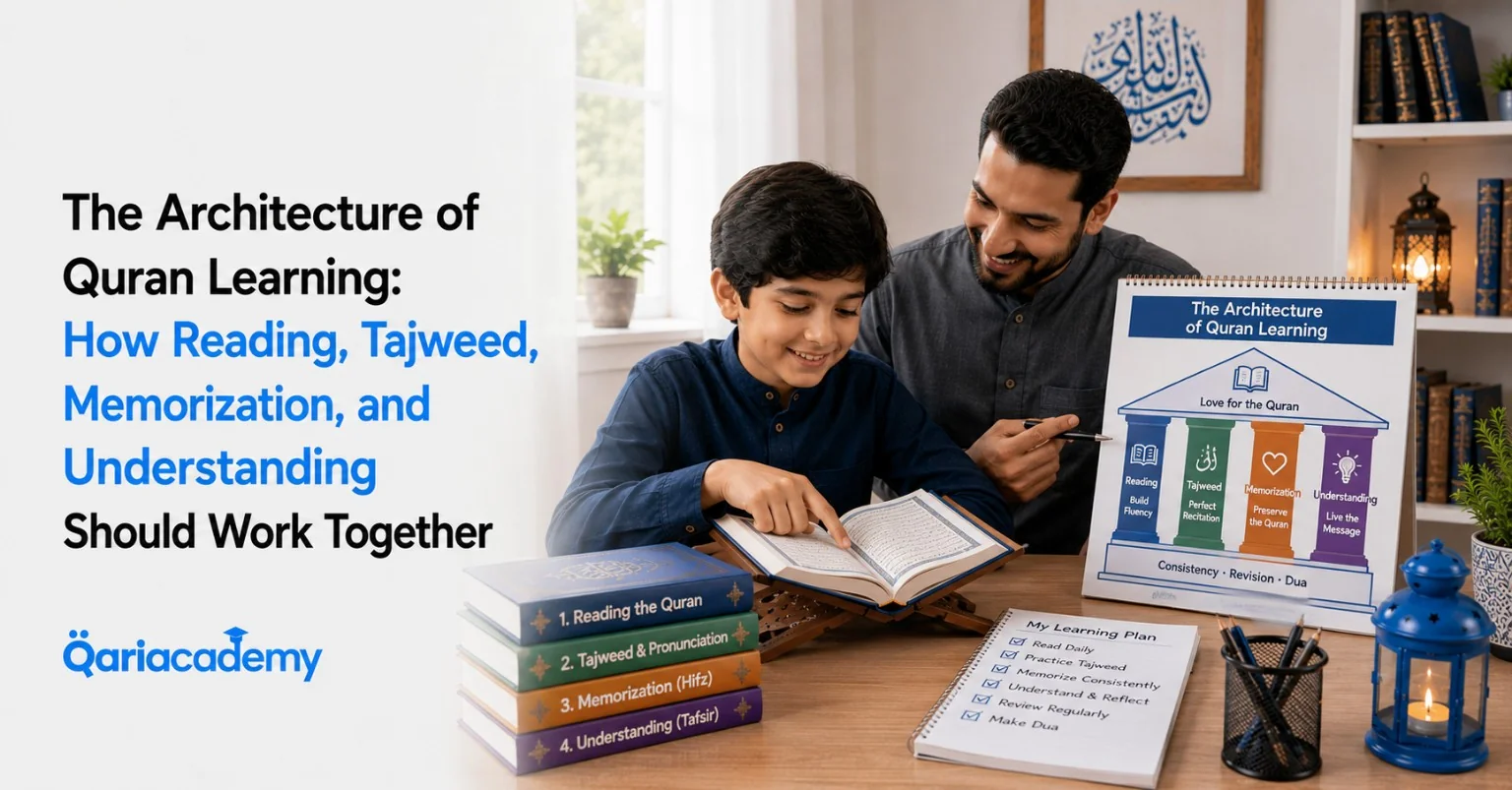
The Architecture of Quran Learning is not simply about deciding whether a child should focus on reading, Tajweed, memorization, or Arabic.
The deeper question is how these skills should connect.
A child may memorize several Surahs but struggle to read them independently. Another may read the Quran accurately but have little understanding of what they are reciting. A third may know many Tajweed rules but still read hesitantly because basic reading patterns have not become automatic.
These children are not necessarily failing.
They may simply be developing one part of Quran learning without strengthening the parts that should support it.
A strong Quran education works more like a structure.
Reading provides access.
Tajweed protects accuracy.
Memorization strengthens familiarity and retention.
Understanding gives the words meaning and context.
When these components develop together, Quran learning becomes more than completing pages or collecting memorized Surahs.
It becomes a connected learning system that can continue developing throughout childhood and into adulthood.
The challenge for parents is knowing what should come first, what can happen simultaneously, and how much emphasis each skill should receive at different stages.
What Is the Architecture of Quran Learning?
Think of Quran education as a structure with several interconnected layers.
| Component | Main Purpose | What It Develops |
|---|---|---|
| Quran Reading | Decode the written text | Literacy and fluency |
| Tajweed | Recite accurately | Pronunciation and recitation |
| Memorization | Retain passages | Recall and familiarity |
| Understanding | Connect words with meaning | Comprehension and reflection |
These are not four completely separate subjects.
They influence one another.
A child with stronger reading skills can memorize from the Mushaf more independently.
A child who understands vocabulary may find memorization more meaningful.
A child who learns Tajweed while reading can develop better pronunciation habits before mistakes become deeply established.
A child who memorizes regularly becomes increasingly familiar with Quranic vocabulary and recurring structures.
The architecture therefore looks more like:
Reading ↔ Tajweed ↔ Memorization ↔ Understanding
rather than:
Reading → finish → Tajweed → finish → Hifz → finish → Understanding
There is no final point where one component simply disappears.
Reading Is the Foundation, but It Is Not the Whole Building
For a child who cannot read Arabic, the first priority is naturally developing the ability to decode Quranic text.
That may involve:
- Arabic letters
- Letter sounds
- Harakat
- Connected letters
- Sukoon
- Tanween
- Madd
- Shaddah
- Basic Quranic word patterns
Without this foundation, the child may become overly dependent on listening and repetition.
This distinction becomes especially important when memorization begins.
A child can memorize a Surah by listening to a teacher without being able to read that Surah independently from the Mushaf.
That is useful memorization, but it is not the same as reading development.
QariAcademy’s The Secret to Teaching Kids Makharij Al-Huroof (Articulation Points) Easily emphasizes building correct letter recognition and pronunciation from the foundation rather than treating pronunciation as something that only matters later.
Tajweed Should Be Integrated, Not Added as an Afterthought
One common approach is:
“First teach the child to read, then teach Tajweed.”
There is some logic behind this because a child needs basic reading ability before they can handle more advanced Tajweed instruction.
But pronunciation should not be ignored until reading is “finished.”
A child should begin developing correct sounds from the beginning.
The sophistication of Tajweed can increase as the child’s reading ability develops.
| Learning Stage | Tajweed Emphasis |
|---|---|
| Alphabet/Foundation | Correct letter articulation |
| Early Reading | Harakat and basic pronunciation |
| Developing Reader | Core Tajweed patterns |
| Strong Reader | More systematic Tajweed |
| Advanced Learner | Refinement and self-correction |
This is a more realistic model than expecting a young beginner to memorize complicated terminology.
QariAcademy’s Tajweed for Kids: A Parent’s Guide recommends beginning with sounds rather than overwhelming young children with rules, while using repetition, short practice, and gentle correction.
The objective is eventually:
Know → Hear → Apply → Internalize
Memorization Should Strengthen Reading, Not Replace It
Hifz is one of the most valuable parts of Quran education, but it can create an unintended problem if parents measure success only by how much a child has memorized.
Consider two children.
Child A has memorized ten Surahs but struggles to read them from the Mushaf.
Child B has memorized six Surahs and can read those Surahs independently with reasonably accurate Tajweed.
Which child has developed the stronger overall Quran skill?
The answer depends on the goal, but if the objective is long-term Quran literacy, Child B may have a more integrated foundation.
Memorization should ideally reinforce:
- Reading
- Pronunciation
- Fluency
- Revision
- Recognition
- Understanding
QariAcademy’s Quran Hifz for Kids describes memorization alongside consistent revision, pronunciation, fluency, Tajweed, and confidence rather than treating new memorization as the only measure of progress.
Understanding Changes the Nature of Memorization
There is another important connection.
A child can memorize sounds without understanding them.
But when children gradually learn the meanings of familiar Quranic words, memorization can become more meaningful.
For example, learning the meaning of recurring words such as:
- رب
- رحمة
- يوم
- كتاب
- مؤمن
- صبر
can help children begin recognizing linguistic patterns across different Surahs.
QariAcademy’s How Learning Arabic Helps Kids Connect to the Quran explains how Quranic Arabic can support vocabulary recognition, comprehension, memorization, and a deeper connection with the Quran.
This does not mean a child must become fluent in Arabic before memorizing Quran.
It means Arabic understanding can grow alongside Quran reading and memorization.
Understanding Should Grow With the Child
The level of explanation should match the child’s age.
A five-year-old may understand a simple story or concept.
A nine-year-old may begin learning recurring Quranic vocabulary.
A twelve-year-old may be ready for more detailed explanations of vocabulary, themes, and connections between verses.
An older teenager can increasingly engage with tafsir and broader reflection under appropriate guidance.
| Age/Stage | Understanding Goal | Example |
|---|---|---|
| Young child | Simple concepts | Allah’s mercy, gratitude, prayer |
| Early reader | Familiar words | Recognizing repeated Quranic vocabulary |
| Older child | Verse-level meaning | Understanding what a passage teaches |
| Preteen/Teen | Deeper connections | Themes, context, reflection |
The goal is not to turn every Quran lesson into a long lecture.
It is to ensure that the child gradually moves from pronouncing words toward knowing what those words communicate.
The Quran itself repeatedly directs believers toward reflection and understanding. Quran 38:29 describes the revelation as something whose verses are to be reflected upon and understood.
The Four Components Should Reinforce Each Other
The strongest Quran learning happens when the components interact.
Imagine a child learning Surah Al-Fatihah.
Reading
The child learns to recognize and decode the written words.
Tajweed
The child learns to pronounce them correctly.
Memorization
The child retains the verses.
Understanding
The child learns what the verses mean.
Now each skill reinforces the others.
When the child sees the word later, recognition is easier.
When they hear it, pronunciation is familiar.
When they recite it, the meaning gives the words context.
When they understand it, memorization becomes less disconnected from meaning.
This is the architecture.
Why Focusing on Only One Dimension Can Create Gaps
| Overemphasis | Possible Gap |
|---|---|
| Memorization only | Strong recall but weak reading |
| Reading only | Accurate decoding but limited retention |
| Tajweed theory only | Knowledge of rules without fluent application |
| Arabic only | Language development without enough Quran recitation |
| Pages completed | Progress measured by quantity rather than mastery |
The solution is not to give every component exactly equal time.
That would be unrealistic.
The balance should change according to the child’s needs.
The Balance Should Change With Age and Ability
A beginner may spend most of their time developing reading.
A developing reader may need more Tajweed and fluency practice.
A stronger reader may devote more time to Hifz and revision.
An older child may increasingly add Quranic Arabic and understanding.
| Stage | Reading | Tajweed | Memorization | Understanding |
|---|---|---|---|---|
| Beginner | High | Foundation | Light | Simple |
| Developing reader | High | Growing | Moderate | Growing |
| Strong reader | Moderate | High | Moderate/High | Moderate |
| Advanced child | Maintenance | Refinement | Personalized | Increasing |
These are not fixed percentages.
They are priorities.
A teacher should continuously reassess the child’s strongest and weakest areas.
Reading Fluency Connects Everything
Fluency is the bridge between basic reading and higher-level Quran learning.
A child who reads extremely slowly may struggle to:
- Review larger passages
- Memorize independently
- Follow meaning
- Maintain concentration
- Read without teacher assistance
That is why fluency deserves deliberate practice.
QariAcademy’s Quran Tajweed Step-by-Step: 30-Day Plan for Kids includes a progression from letters and sounds through Tajweed patterns toward fluency and consolidation, with repetition and self-correction included in the process.
The important point is that fluency should not mean “read faster.”
It means reading with increasing:
Accuracy + smoothness + confidence + independence.
Revision Is the Glue Holding the Structure Together
Without revision, each component becomes unstable.
A child may learn a Tajweed rule but forget it.
They may memorize a Surah but lose it.
They may understand a vocabulary word but fail to recognize it later.
They may read a passage well one week and struggle the next.
Revision turns temporary learning into retained ability.
This is particularly important in Hifz.
QariAcademy’s Start Quran Memorization Early: A Parent’s Guide recommends making review part of daily life and emphasizes consistency, manageable practice, and flexibility for young learners.
The architecture therefore needs another layer:
Learning → Practice → Revision → Retention
The Teacher’s Role Is to Connect the Pieces
A good Quran teacher should not see reading, Tajweed, Hifz, and understanding as isolated boxes.
They should ask:
- Is the child’s reading strong enough for the memorization goal?
- Are pronunciation errors affecting Hifz?
- Is the child memorizing without understanding familiar vocabulary?
- Does the child need more reading repetition?
- Is Tajweed being applied or merely explained?
- Is revision sufficient?
This is where individualized instruction becomes particularly valuable.
QariAcademy’s Quran for Kids program describes one-on-one lessons, step-by-step instruction, personalized pacing, regular feedback, Tajweed, reading fluency, and gradual memorization as interconnected parts of the learning experience.
The Child Should Eventually Become More Independent
At the beginning, the teacher may need to provide nearly every answer.
Over time, that should change.
The child should increasingly be able to:
- Read familiar passages independently.
- Attempt unfamiliar words.
- Apply learned Tajweed.
- Review memorized material.
- Recognize recurring vocabulary.
- Notice some mistakes.
- Ask meaningful questions.
- Manage parts of their own practice.
This is one reason Quran learning should not be judged only by the amount of material covered.
The deeper goal is transfer.
Can the child use what they learned when the teacher is not immediately providing the answer?
Parents Are Part of the Architecture Too
Parents do not need to teach every Tajweed rule.
Their role is often more valuable when they provide:
- Consistency
- Encouragement
- A suitable routine
- Communication with the teacher
- A calm learning environment
- Opportunities for practice
- Positive reinforcement
QariAcademy’s How Busy Parents Can Keep Their Children Consistent With Quran Learning highlights the importance of shifting the parent’s role from being the primary source of instruction toward supporting consistency and routine.
Similarly, How Parents in the USA, UK, and Canada Can Create a Quran-Friendly Home Environment focuses on small daily habits, positive reinforcement, reduced pressure, and visible parental involvement.
The home does not need to become another classroom.
It needs to make the classroom’s work sustainable.
A Practical Weekly Architecture
A child’s weekly Quran routine could combine the four components without making every lesson identical.
For example:
| Learning Component | Example Practice |
|---|---|
| Reading | Read a previously learned passage |
| Tajweed | Practice one or two targeted rules |
| Memorization | Learn a manageable new section |
| Understanding | Discuss key words or simple meaning |
A teacher might combine several of these during one lesson while assigning short practice between lessons.
The exact balance depends on:
Age + Reading Level + Tajweed Level + Hifz Goal + Available Practice Time
What Parents Should Measure
Instead of asking only:
“How many pages did my child finish?”
ask a broader set of questions.
Reading
Can the child read more independently?
Tajweed
Are recurring pronunciation errors decreasing?
Memorization
Is previously learned material being retained?
Understanding
Does the child recognize more Quranic vocabulary?
Independence
Does the child need fewer prompts?
| Area | Weak Measurement | Better Measurement |
|---|---|---|
| Reading | Pages completed | Accuracy and independence |
| Tajweed | Rules memorized | Rules applied |
| Hifz | New verses added | New + retained verses |
| Understanding | Vocabulary lists | Ability to explain familiar concepts |
| Overall progress | Speed | Sustainable development |
This changes the parent’s focus from quantity to quality.
Common Mistakes in Building Quran Learning
Treating Hifz as the Entire Goal
Memorization is valuable, but it should sit within broader Quran education.
Delaying Pronunciation Correction
Basic pronunciation should be developed early rather than allowing avoidable habits to become deeply established.
Teaching Tajweed as Pure Theory
Children need to apply rules while reading.
Ignoring Meaning
Understanding should gradually accompany recitation.
Moving Too Fast
A child who has not mastered the foundation may struggle when the curriculum suddenly becomes more advanced.
Moving Too Slowly
A child who has already mastered a skill can become bored when repeatedly exposed to beginner material.
Measuring Only Pages
Pages are a poor substitute for actual skill development.
What a Balanced Quran Learning Journey Can Look Like
The overall progression might look like:
Arabic Foundation
↓
Quran Reading
↓
Tajweed Development
↓
Fluency
↓
Memorization + Revision
↓
Quranic Arabic
↓
Understanding + Reflection
But this should not be interpreted as a rigid staircase.
A child can memorize while learning Tajweed.
They can develop Arabic while reading Quran.
They can discuss simple meanings while memorizing.
They can revise reading while working on Hifz.
The components should overlap.
The Long-Term Goal Is Integration
Eventually, the ideal outcome is not:
“I have a child who memorized many Surahs.”
Nor is it simply:
“I have a child who reads Quran accurately.”
A stronger outcome is a child who can:
Open the Mushaf → Read accurately → Apply Tajweed → Recall what they have memorized → Understand familiar words → Reflect on the message → Continue learning independently
That is an integrated Quran learner.
And integration takes time.
It cannot be rushed by simply increasing the number of lessons or pages.
Frequently Asked Questions
Should children learn Quran reading before memorization?
Basic reading ability is highly valuable, but memorization can begin alongside early reading development. The important point is not to let memorization replace the development of independent Quran reading.
Should Tajweed be taught before Hifz?
Tajweed and Hifz can develop together. Correct pronunciation should be incorporated from the beginning, while more advanced Tajweed can be introduced as the child’s reading ability develops.
Does a child need to learn Arabic before learning the Quran?
No. A child can learn to read and recite the Quran without becoming fluent in Arabic. However, Quranic Arabic can be developed alongside recitation to gradually increase understanding.
How can parents know whether their child is really progressing?
Look beyond pages completed. Evaluate reading accuracy, fluency, Tajweed application, memorization retention, understanding, confidence, and independence.
Should every Quran lesson include reading, Tajweed, Hifz, and Arabic?
Not necessarily. Trying to force every component into every lesson can make learning fragmented. The balance should reflect the child’s current needs and goals.
What is the most important part of Quran learning?
There is no single component that replaces the others. A strong foundation combines accurate reading, sound recitation, meaningful memorization, understanding, revision, and gradual independence.
Conclusion
The Architecture of Quran Learning is best understood as a connected system rather than a list of separate subjects.
Reading gives the child access to the written Quran.
Tajweed helps protect accurate recitation.
Memorization builds retention and familiarity.
Understanding gives the words meaning and helps the child move beyond mechanical repetition.
None of these should exist completely on its own.
The strongest learning journey allows them to reinforce one another:
Read → Recite Correctly → Memorize → Understand → Review → Apply → Grow
The balance will change as the child develops.
A beginner may need much more reading instruction.
A developing reader may need stronger Tajweed and fluency.
An older child may need more structured Hifz, revision, and Quranic Arabic.
But the destination remains broader than completing a curriculum.
The goal is to raise a child who can approach the Quran with accuracy, confidence, understanding, and increasing independence.
That is why QariAcademy’s approach combines personalized Quran reading, Tajweed, gradual memorization, and Arabic development rather than treating them as completely disconnected skills. Its one-on-one programs allow the emphasis to change as the child’s needs change.
For parents who want help identifying the right balance for their child’s current level, a personalized assessment can be a useful starting point.
Explore QariAcademy’s Online Quran Programs
Internal Articles Used — 10 Verified QariAcademy Articles
- The Secret to Teaching Kids Makharij Al-Huroof (Articulation Points) Easily
Open Article - Tajweed for Kids: A Parent’s Guide
Open Article - Quran Tajweed Step-by-Step: 30-Day Plan for Kids
Open Article - Start Quran Memorization Early: A Parent’s Guide
Open Article - The 20-Minute Challenge: How to Memorize a Short Surah with Your Child Daily Without Stress or Boredom
Open Article - How Learning Arabic Helps Kids Connect to the Quran
Open Article - 7 Magical Secrets to Turn Your Child from a Struggling Reader into a Skilled Quran Memorizer in 90 Days
Open Article - How Busy Parents Can Keep Their Children Consistent With Quran Learning
Open Article - How Parents in the USA, UK, and Canada Can Create a Quran-Friendly Home Environment
Open Article - Why Children Struggle with Noon Saakinah – Common Challenges
Open Article
Reliable External Sources
- Quran 38:29 — reflection and understanding:
Quran 38:29 — Quran.com - Quran 73:4 — measured and deliberate recitation:
Quran 73:4 — Quran.com - Quran 47:24 — reflection upon the Quran:
Quran 47:24 — Quran.com