Table of Contents
Introduction
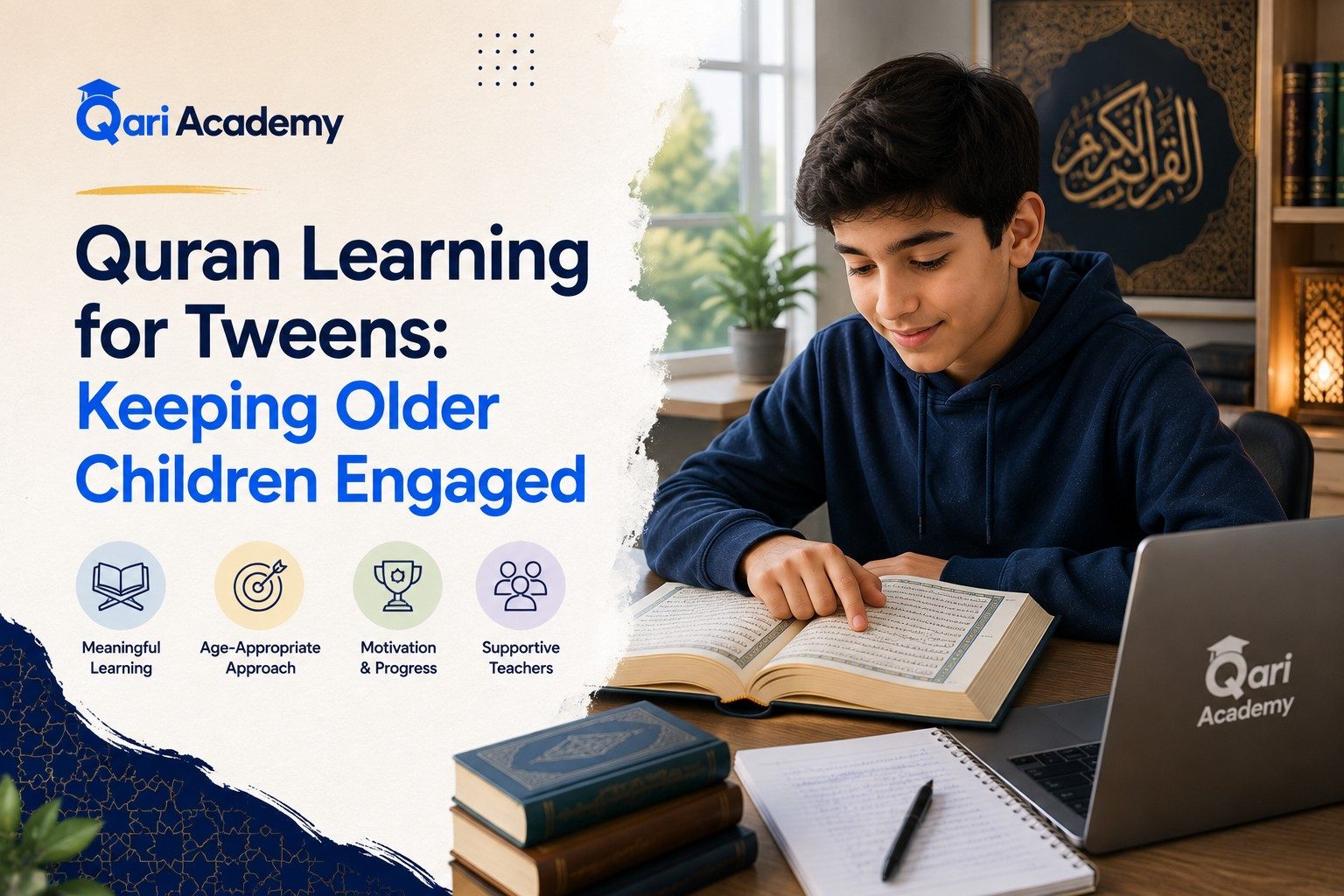
Quran learning for tweens can be very different from Quran learning for younger children.
A child who is eight may still enjoy games, repetition, colorful activities, and frequent encouragement.
A ten-, eleven-, or twelve-year-old may want something completely different.
They may want to understand why they are learning something.
They may become more sensitive to criticism.
They may compare themselves with their friends.
They may have stronger opinions about their teachers.
They may also have a much busier schedule because of school, homework, sports, friends, technology, and other activities.
And this creates a challenge for parents.
A child who once happily attended Quran class may suddenly say:
“I don’t want Quran today.”
Or:
“Why do I have to keep doing this?”
Or:
“I already know this.”
Sometimes parents interpret these statements as laziness or a lack of religious commitment.
That interpretation can be a mistake.
The problem may not be that the child has stopped caring about the Quran.
The problem may be that the way they are being taught has not evolved as they have grown.
Quran learning for tweens should become more intellectually engaging, more age-appropriate, and gradually more independent.
That does not mean abandoning structure.
It means changing the structure.
A tween may still need repetition, correction, memorization, and practice. But they also need opportunities to understand, make decisions, ask questions, set goals, and see their own progress.
This is especially important for Muslim children growing up in English-speaking environments, where the Quran may compete for attention with school, social media, gaming, sports, and an overwhelmingly English-speaking culture.
The goal is therefore not simply to make the child attend Quran class.
The goal is to help them develop enough ownership of their Quran journey that they can continue learning even as parental supervision gradually decreases.
What Is a Tween?
The term “tween” generally refers to children between childhood and adolescence, often around ages 9–12.
This period is educationally significant.
The child is no longer a young learner, but they are not yet a teenager either.
They are developing:
- Greater independence.
- More complex reasoning.
- Stronger personal preferences.
- Greater awareness of social expectations.
- More sensitivity to criticism.
- Better ability to understand abstract concepts.
- Greater capacity for self-directed learning.
That means Quran education should gradually respond to these developmental changes.
A nine-year-old and a twelve-year-old should not necessarily receive identical instruction simply because both are classified as “children.”
How Tweens Are Different From Younger Children
| Younger Child | Tween |
|---|---|
| Needs frequent external encouragement | Can develop internal motivation |
| Short activities often work best | Can handle deeper discussions |
| Repetition may be enough | Needs to understand purpose |
| Parent manages most practice | Can gradually manage practice |
| Teacher directs most activities | Student can participate in goal setting |
| Learning is often concrete | Can increasingly handle abstract concepts |
The mistake is assuming that growing older means children simply need more difficult material.
They also need a different learning experience.
Why Quran Learning Can Become Difficult During the Tween Years
There is nothing unusual about a child becoming harder to engage around this age.
Their life is changing.
School becomes more demanding.
Friendships become more important.
Technology becomes more attractive.
They become increasingly aware of how they compare with other children.
They may also start questioning things they previously accepted without much thought.
This can affect Quran learning.
A child who once memorized because a parent asked them to may eventually ask:
“Why am I memorizing this?”
That question should not automatically be treated as disrespect.
It can be an opportunity.
A mature Quran education should eventually help the child understand not only what they are learning, but why it matters.
The Biggest Mistake: Teaching a Tween Like a Preschooler
One of the most common problems in Quran education is failing to adjust teaching methods as children grow.
A five-year-old may enjoy:
- Repetition games.
- Flashcards.
- Songs.
- Simple rewards.
- Very short activities.
A twelve-year-old may find the same approach childish.
That does not mean interactive learning should disappear.
It means the interaction should become more sophisticated.
Instead of:
“Let’s play a letter game!”
a tween might respond better to:
“Let’s see if you can identify all the Tajweed mistakes in this passage.”
Instead of simply memorizing a verse, ask:
“What do you think this verse is teaching us?”
Instead of only telling the student what to practice:
“Choose one reading skill you want to improve this week.”
The underlying educational principle remains the same:
Engagement matters.
But the form of engagement must evolve.
Quran Learning for Tweens Should Become More Meaningful
Younger children can often learn successfully through repetition before they understand everything deeply.
Tweens increasingly benefit from meaning.
Suppose a child is learning Surah Al-Hujurat.
Instead of focusing exclusively on pronunciation and memorization, the teacher might introduce age-appropriate discussion about:
- Speaking respectfully.
- Avoiding gossip.
- Verifying information.
- Treating other people well.
- Social responsibility.
Now the Quran is connected to the child’s actual life.
That can change the learning experience dramatically.
From Recitation to Reflection
| Basic Approach | More Engaging Tween Approach |
|---|---|
| Memorize the verse | Understand the main message |
| Repeat after teacher | Read independently |
| Correct every mistake | Identify and correct some mistakes |
| Finish the page | Master a specific skill |
| Follow instructions | Participate in goal setting |
| Recite without context | Connect verses to real life |
This does not mean every Quran lesson needs to become a Tafsir class.
It means meaning should gradually become part of the educational experience.
Give Tweens a Reason to Care
This is one of the biggest challenges in Quran learning for tweens.
Parents sometimes say:
“Because you’re Muslim.”
That answer may be true, but it is not always educationally sufficient.
A tween is capable of asking more sophisticated questions.
Why is Tajweed important?
Why should I memorize this Surah?
Why do I need to revise?
Why should I learn Arabic?
Why does pronunciation matter?
Why should I understand what I’m reciting?
These questions can actually strengthen Quran education if handled properly.
Instead of shutting down questions, use them as opportunities for deeper learning.
Don’t Confuse Motivation With Bribery
Parents sometimes attempt to solve motivation problems with constant rewards.
“If you memorize this page, I’ll buy you something.”
“If you finish this Juz, you’ll get a gift.”
Occasional rewards are not inherently wrong.
But if every Quran activity requires a material reward, the child may learn an unintended lesson:
Quran is something I do to receive something else.
A stronger long-term goal is internal motivation.
The child should gradually develop:
- Satisfaction from improvement.
- Love for recitation.
- Appreciation of the Quran.
- Pride in mastering difficult skills.
- Curiosity about meaning.
- A sense of personal responsibility.
Rewards can support motivation.
They should not become the foundation of it.
For more practical ideas about motivation and consistency, parents can also read How To Motivate Your Child To Continue Quran Memorization.
Give the Tween More Ownership
One of the most effective strategies for Quran learning for tweens is to give them controlled choices.
Not:
“Do you want to study Quran or not?”
That makes attendance optional when it should not necessarily be.
Instead:
“Would you rather review Surah Al-Mulk first or work on your Tajweed mistakes?”
Or:
“Would you prefer three shorter practice sessions or one longer review?”
Or:
“Which Surah would you like to understand better?”
The parent maintains the boundary.
The child gets some autonomy within that boundary.
This is a much healthier form of independence.
Set Goals Together
A tween should increasingly understand what they are working toward.
Instead of:
“Keep studying Quran.”
create specific goals.
For example:
This month:
- Improve pronunciation of selected letters.
- Memorize five verses.
- Review two previously memorized Surahs.
- Read one page independently.
- Learn ten Quranic vocabulary words.
Now the child can see progress.
Example Tween Quran Goals
| Goal Area | Example Goal |
|---|---|
| Reading | Read one page with fewer prompts |
| Tajweed | Improve two specific rules |
| Memorization | Memorize five new verses |
| Revision | Review two older Surahs |
| Arabic | Learn 10 Quranic words |
| Understanding | Explain the main idea of a short Surah |
The exact goals should be adjusted to the child’s level.
Don’t Measure Progress Only by Memorized Surahs
This is an important blind spot for parents.
Memorization is visible.
Understanding and reading improvement are less visible.
So parents naturally ask:
“How many Surahs has my child memorized?”
But a tween may be making significant progress in:
- Fluency.
- Tajweed.
- Pronunciation.
- Vocabulary.
- Confidence.
- Independence.
- Retention.
A child who memorized five Surahs but forgets them quickly may have weaker long-term progress than a child who memorized two Surahs and retained them accurately.
This is why retention deserves as much attention as new memorization.
Build Independence Gradually
The ultimate goal of Quran education is not to create a child who can only study when a parent is standing beside them.
The goal is increasing independence.
For younger children:
Parent reminds → child practices
For tweens:
Parent schedules → child practices
Eventually:
Child manages → parent checks in
That transition should happen gradually.
A Healthy Independence Progression
| Age/Stage | Parent Role | Child Role |
|---|---|---|
| Younger learner | Direct supervision | Follow instructions |
| Early tween | Regular reminders | Complete assigned practice |
| Older tween | Check-ins | Manage parts of routine |
| Teenager | Guidance | Increasing self-management |
The goal is not to withdraw parental involvement completely.
It is to transfer responsibility gradually.
Let the Teacher Become a Coach
The teacher’s role should also evolve.
For a beginner, the teacher may need to say:
“Repeat after me.”
For an older student:
“Try reading it first. I’ll correct you afterward.”
That small change matters.
The child is no longer simply receiving information.
They are practicing a skill.
A strong teacher can increasingly ask:
- “What mistake did you notice?”
- “Which rule applies here?”
- “Can you read it again without my help?”
- “What was difficult about this passage?”
- “What would you like to improve this week?”
These questions develop metacognition—the child’s ability to think about their own learning.
Teach Tweens to Recognize Their Own Mistakes
Self-correction is a major milestone.
Instead of correcting every error immediately, the teacher can sometimes give the student a chance to notice the mistake.
For example:
Teacher:
“Try that word again.”
Student:
“Oh, I missed the Madd.”
That is much more valuable than:
Teacher:
“You missed the Madd.”
The student is beginning to monitor their own recitation.
This is one of the skills that can eventually allow Quran learning to continue with greater independence.
Make Tajweed More Relevant
For a tween, Tajweed can be taught more explicitly than it might be for a very young child.
Instead of simply saying:
“Read it this way.”
the teacher can increasingly explain:
- Why the sound changes.
- What rule is being applied.
- Where the letter comes from.
- How the rule affects recitation.
- What common mistakes to avoid.
This does not mean turning every lesson into a technical lecture.
It means giving the student enough understanding to become an active learner.
For additional guidance specifically focused on children’s Tajweed development, parents may also explore Online Tajweed for Kids: A Parent’s Guide.
Don’t Introduce Advanced Tajweed Just to Make Lessons “Harder”
Another mistake is assuming that an older child always needs more complicated material.
Difficulty is not the same as quality.
A child may technically be old enough to learn advanced Tajweed terminology but still have basic pronunciation weaknesses.
The correct sequence is:
Foundation → Accuracy → Understanding → Fluency → Advanced refinement
not:
Older age → Harder material
If your child needs a stronger foundation, going back to it is not going backward.
What If Your Tween Says, “I Already Know This”?
Sometimes they are right.
Parents and teachers should not automatically interpret this statement as resistance.
Ask:
What exactly do you know?
Can the child:
- Explain the rule?
- Apply it consistently?
- Recognize it in unfamiliar text?
- Correct another mistake?
- Use it independently?
If yes, move forward.
If not, the child may know the concept theoretically but still need practice.
This distinction is particularly important in Quran learning.
Avoid Keeping Older Children in Beginner Material Too Long
A child who has already mastered the alphabet should not spend months repeating basic alphabet exercises.
Likewise, a tween who can already read Quran should not be treated like a complete beginner.
The principle is simple:
Start at the lowest skill the child has not yet mastered.
For a deeper explanation of how to determine whether a child needs alphabet instruction, Qaida, or direct Quran reading, parents can read Qaida, Arabic Alphabet, or Quran Reading: What Should Your Child Start With? as part of the same learning pathway.
What If Your Tween Still Struggles With Arabic Reading?
Don’t assume that age automatically solves reading problems.
A twelve-year-old who never properly learned Arabic decoding may still struggle with:
- Similar letters.
- Harakat.
- Connected forms.
- Sukoon.
- Tanween.
- Madd.
- Shaddah.
- Reading speed.
The solution is not embarrassment.
The child needs targeted instruction.
Older children can absolutely learn.
They simply need instruction appropriate to their actual starting level.
Don’t Assume Memorization Means Reading Ability
A tween may have memorized Juz Amma but struggle to read those same Surahs from the Mushaf.
That is possible because memorization and reading are different skills.
The child may have learned through:
- Listening.
- Repetition.
- Following the teacher.
- Audio recordings.
- Repeated recitation.
Now they need to connect memory to written Arabic.
A useful strategy is to use familiar memorized Surahs as reading material.
The child already knows how the words sound.
Now they can focus on recognizing them visually.
Connect Quran Learning to Real Life
Tweens are increasingly aware of real-world problems.
This creates an opportunity.
When studying relevant verses, ask:
“Where could this idea apply in your life?”
For example:
- How should Muslims respond to gossip?
- What does honesty look like at school?
- How should we treat someone we disagree with?
- What does patience look like when you’re frustrated?
- How should we handle online behavior?
- What does Islam teach about respecting parents?
This makes Quran learning less abstract.
The child begins to see the Quran as guidance rather than simply an academic subject.
Use Age-Appropriate Quran Discussions
You do not need to turn every lesson into a debate.
But occasional discussion can be extremely valuable.
A teacher might ask:
“What do you think this verse is asking us to do?”
Then:
“Can you think of a situation at school where this would apply?”
Then:
“What would be difficult about following this advice?”
Now the child is engaging intellectually.
That type of conversation is often more appropriate for a tween than simply repeating the same worksheet.
Give Tweens Opportunities to Ask Questions
A healthy Quran learning environment should allow questions.
Some questions may be simple.
Others may be challenging.
The teacher or parent does not need to have an immediate answer to everything.
A mature response can be:
“That’s a good question. Let’s look into it.”
This teaches the child something important:
Learning Quran does not mean you are never allowed to ask questions.
It means you are learning how to seek reliable answers.
Don’t Turn Every Question Into an Argument
If a tween asks:
“Why do I have to memorize this?”
responding with anger may close the conversation.
Instead, explore the question.
Maybe the child is bored.
Maybe the memorization target is too large.
Maybe they don’t understand the purpose.
Maybe they want more autonomy.
Maybe they simply need a better explanation.
The question itself can reveal the problem.
Quran Learning for Tweens and School Pressure
One of the biggest practical challenges is scheduling.
A tween may have:
- School.
- Homework.
- Exams.
- Sports.
- Clubs.
- Family commitments.
- Social activities.
This makes unrealistic Quran schedules difficult to maintain.
A sustainable schedule matters more than an impressive schedule.
If three weekly lessons work consistently, that may be better than five lessons that create exhaustion and eventually lead to missed classes.
Parents can also explore our broader guidance on how Quran instruction should evolve as children mature, rather than expecting the same lesson structure at every age.
Protect the Child’s Relationship With the Quran
This becomes increasingly important during the tween years.
If every Quran interaction involves:
- “You didn’t practice.”
- “You’re too slow.”
- “Your cousin is better.”
- “You keep making mistakes.”
- “Why can’t you memorize this?”
the child may gradually associate Quran with failure.
That is a serious long-term problem.
Correction is necessary.
Accountability is necessary.
But the emotional environment matters too.
The child should experience Quran as something meaningful—not simply another source of parental pressure.
For practical ideas about creating a supportive environment at home, see How Parents in the USA, UK, and Canada Can Create a Quran-Friendly Home Environment for Kids.
Don’t Compare Your Tween With Other Children
Comparison is particularly dangerous during this age.
Tweens are already comparing themselves with classmates, friends, siblings, and people they see online.
They don’t need Quran to become another scoreboard.
Avoid:
“Your cousin has memorized more than you.”
Instead:
“You can read this passage much better than you could three months ago.”
The second statement focuses on growth.
How Parents Should Give Feedback
Good feedback should be specific.
Instead of:
“Good job.”
Try:
“Your pronunciation of those two letters was much clearer today.”
Instead of:
“You need to practice more.”
Try:
“Let’s review these five lines for ten minutes tonight.”
Instead of:
“You are falling behind.”
Try:
“What is making this part difficult? Let’s figure it out.”
Specific feedback gives the child something they can act on.
A Simple Weekly Quran Routine for Tweens
A practical routine might include:
2–3 teacher-led Quran lessons per week
plus:
10–20 minutes of focused home practice on most days
plus:
regular listening or independent Quran reading
The exact schedule should be individualized.
A child preparing for Hifz may need a very different routine from a child primarily working on reading and Tajweed.
Example Weekly Structure
| Activity | Frequency | Purpose |
|---|---|---|
| Quran lesson | 2–3 times | Guided instruction |
| Reading practice | 4–6 times | Fluency |
| Memorization | 3–5 times | New material |
| Revision | Most days | Retention |
| Quranic vocabulary | 2–3 times | Understanding |
| Independent reading | 1–2 times | Ownership |
This is an example, not a universal prescription.
Keep Home Practice Short Enough to Succeed
A common parental mistake is making home practice too long.
A tired tween who has already completed schoolwork may not be capable of another hour of intense Quran study.
Start with a manageable amount.
For example:
15 minutes of focused practice can be more productive than 45 minutes of arguing.
The goal is consistency.
Parents who want more practical guidance on supporting online Quran learning can also read How To Support Your Child’s Quran Learning Online.
Teach the Tween How to Practice
Don’t just say:
“Go practice Quran.”
Show them what effective practice looks like.
For example:
Step 1: Read the passage once slowly.
Step 2: Mark difficult words.
Step 3: Repeat those words.
Step 4: Read the full passage again.
Step 5: Check one Tajweed rule.
Step 6: Read without assistance.
Now the child has a method.
That method can eventually be used independently.
Use Technology Carefully
Technology can be useful for Quran learning.
Tweens are already comfortable with digital tools, so online lessons and digital resources can sometimes increase engagement.
But technology should remain a tool.
The goal is not:
“Make Quran as entertaining as TikTok.”
That is an impossible competition.
The goal is to use technology to make learning:
- Accessible.
- Interactive.
- Convenient.
- Structured.
- Personalized.
Online one-on-one classes can be particularly useful when families need flexible scheduling and individualized instruction.
One-on-One Lessons Can Be Especially Valuable for Tweens
A tween’s needs can vary dramatically from another child’s needs.
One student may need:
Reading + Tajweed
Another:
Hifz + Revision
Another:
Arabic + Quranic vocabulary
Another:
Confidence rebuilding after struggling in previous classes
In a one-on-one setting, the teacher can respond directly to these differences.
QariAcademy offers live one-on-one Quran and Arabic lessons for children and adults, allowing instruction to be adjusted according to the student’s level and goals.
How to Know If Your Tween Is Actually Engaged
Engagement is not always visible as excitement.
A quiet child can still be deeply engaged.
Look for behaviors such as:
- Asking questions.
- Attempting difficult words.
- Remembering previous lessons.
- Correcting their own mistakes.
- Practicing without constant reminders.
- Talking about what they learned.
- Connecting verses to real situations.
- Setting personal goals.
These are stronger indicators than simply appearing cheerful during class.
Engagement Indicators
| Weak Indicator | Stronger Indicator |
|---|---|
| Sits quietly | Participates actively |
| Completes worksheet | Applies the skill independently |
| Memorizes quickly | Retains material |
| Says “yes” to teacher | Asks meaningful questions |
| Finishes lesson | Understands what was learned |
| Attends class | Practices independently |
What If Your Tween Says They Hate Quran Class?
Take the statement seriously—but don’t take it literally without investigating.
Ask:
“What do you dislike about it?”
Possible answers might include:
- “It’s boring.”
- “It’s too hard.”
- “The teacher keeps correcting me.”
- “I don’t understand.”
- “I have too much homework.”
- “I don’t like reading aloud.”
- “Everyone else is better.”
- “I don’t like the class time.”
Each answer requires a different solution.
The problem may be the subject.
But it may also be the learning environment.
For children who struggle with attention or boredom, parents can also review My Child Gets Bored Quickly! 5 Quick Steps to Improve Your Child’s Focus in Online Quran Class.
When Should Parents Consider Changing Teachers?
Don’t change teachers because of one difficult lesson.
Look for patterns.
Consider a change if:
- The teacher consistently fails to understand the child’s level.
- The child is repeatedly humiliated.
- There is little meaningful feedback.
- The curriculum is clearly inappropriate.
- The teacher refuses to adapt.
- The child has persistent anxiety around the lessons.
- There is no measurable progress despite appropriate practice.
But first investigate the problem.
Sometimes changing the schedule or teaching method solves the issue.
What Should Parents Expect From the Teacher?
A good teacher working with tweens should be able to:
- Teach Quran accurately.
- Explain age-appropriate concepts.
- Correct pronunciation respectfully.
- Encourage independent thinking.
- Set measurable goals.
- Track progress.
- Adjust the lesson pace.
- Communicate with parents.
- Maintain appropriate boundaries.
- Keep the student engaged without treating them like a preschooler.
The teacher should be neither overly strict nor excessively permissive.
The goal is structured independence.
What Should the First 90 Days Look Like for a Tween?
The answer depends on the child’s starting level.
A tween who cannot read Arabic may need foundational work.
A tween who already reads Quran may need Tajweed.
A Hifz student may need memorization and revision.
A useful framework is:
Days 1–30: Assessment and Stabilization
Focus on:
- Current reading level.
- Pronunciation.
- Tajweed gaps.
- Memorization ability.
- Practice routine.
- Learning goals.
Days 31–60: Skill Development
Focus on:
- Reading accuracy.
- Tajweed.
- Memorization.
- Vocabulary.
- Independent practice.
Days 61–90: Independence
Focus on:
- Self-correction.
- Independent reading.
- Revision habits.
- Personal goals.
- Deeper understanding.
The objective is not simply to finish more material.
It is to make the student a more capable learner.
What If Your Tween Is Behind?
First, define “behind.”
Behind whom?
Another child?
A sibling?
A cousin?
A classmate?
There is no universal Quran-learning timeline.
A child who starts at ten with no Arabic reading experience cannot reasonably be compared with a child who started at five.
If your tween is struggling, measure their current skills against their own previous level.
For example:
Three months ago:
Could not read connected letters.
Today:
Reads basic words independently.
That is substantial progress.
What If Your Tween Has Never Learned Arabic?
Don’t panic.
A twelve-year-old can still begin.
The approach should simply respect their age.
Do not teach them exactly like a five-year-old.
They may need:
- Clear explanations.
- Respectful communication.
- Efficient exercises.
- Realistic goals.
- More autonomy.
- Practical connections to Quranic text.
If the child is starting from zero, the foundational pathway remains:
Alphabet → sounds → Harakat → connected letters → Qaida → Quran reading → Tajweed
Age changes the teaching style, not the fundamental reading process.
Should Tweens Learn Arabic Alongside Quran?
For many children, yes.
At this stage, Arabic can become increasingly valuable because the child has enough cognitive ability to begin connecting vocabulary and meaning.
They can learn:
- Common Quranic words.
- Basic sentence structures.
- Verb patterns.
- Pronouns.
- Simple grammar.
- Quranic vocabulary.
This can gradually transform Quran learning from:
“I can pronounce this.”
to:
“I know what this means.”
Parents interested in broader Arabic development can also explore Learning Arabic for Non-Arabic Speaking Kids.
Build a Vocabulary From the Quran
Instead of teaching completely unrelated Arabic vocabulary, connect language learning to the Quran.
For example:
| Arabic Word | Meaning | Learning Connection |
|---|---|---|
| رب | Lord | Quranic vocabulary |
| رحمة | Mercy | Quranic meaning |
| كتاب | Book | Common Islamic vocabulary |
| علم | Knowledge | Useful across contexts |
| صبر | Patience | Quran + daily life |
Now vocabulary has a purpose.
The child is not just memorizing random Arabic words.
They are building a language that helps them understand what they recite.
Use Questions to Encourage Deeper Thinking
A tween can handle questions such as:
- What is the main message of this Surah?
- Which word do you recognize?
- What Tajweed rule did you notice?
- What was difficult about this passage?
- What do you think this verse teaches us?
- How could this apply at school?
- What would you like to improve next week?
This creates a more active learning environment.
Let the Tween See Their Progress
Progress should be visible.
Consider using a simple monthly review.
Track:
- Reading accuracy.
- Tajweed.
- Memorization.
- Revision.
- Vocabulary.
- Independence.
Example Progress Review
| Area | Previous Level | Current Level | Next Goal |
|---|---|---|---|
| Reading | Frequent pauses | Fewer pauses | Improve fluency |
| Tajweed | Frequent errors | Better accuracy | Master 2 rules |
| Hifz | Weak revision | Better retention | Review weekly |
| Arabic | 10 words | 25 words | Add 10 more |
| Independence | Constant prompts | Occasional prompts | Practice independently |
This gives the child evidence that effort produces results.
Don’t Make Quran a Competition
Competition can occasionally motivate.
But it can also create anxiety.
A tween should not feel that their Quranic worth depends on being ahead of someone else.
The goal is:
Better than yesterday.
Not:
Better than my cousin.
What Parents Should Do When Motivation Drops
Motivation will fluctuate.
That is normal.
The solution is not always to make lessons more exciting.
Sometimes the child needs:
- Better sleep.
- A different lesson time.
- Less homework pressure.
- Smaller goals.
- A teacher adjustment.
- More autonomy.
- A break from an unrealistic target.
- More connection to meaning.
Before saying:
“My child doesn’t care about Quran.”
ask:
“What changed?”
That question can reveal the real problem.
Don’t Let School Become the Enemy of Quran
During exam periods, some flexibility may be appropriate.
But avoid teaching the child that Quran is always the first thing to sacrifice when life becomes busy.
Instead, reduce the workload temporarily.
For example:
Normal week:
20 minutes practice.
Exam week:
10 minutes focused revision.
The message becomes:
We adapt the routine, but we don’t abandon it.
That is a much healthier long-term habit.
How Parents Can Support Without Becoming “Quran Police”
Tweens often push back against excessive supervision.
If every day begins with:
“Did you practice Quran?”
and ends with:
“Why didn’t you practice?”
the parent-child relationship can become unnecessarily tense.
Instead, create predictable systems.
For example:
- Fixed lesson schedule.
- Fixed practice time.
- Weekly progress review.
- Teacher communicates assignments.
- Child checks off completed practice.
The system carries some of the responsibility.
The parent does not need to become a constant monitor.
The Parent’s Role Should Change With Age
For a young child:
Parent = manager
For a tween:
Parent = coach
For a teenager:
Parent = advisor
That transition is important.
If parents continue managing every tiny detail as the child gets older, the child may never develop ownership.
What Success Looks Like for a Tween
Success is not necessarily:
“My child memorized five Juz.”
For one child, success might be:
“She now reads Quran independently.”
For another:
“He finally corrected a pronunciation problem.”
For another:
“She practices without being reminded.”
For another:
“He understands the meaning of the Surahs he is memorizing.”
For another:
“He stopped feeling embarrassed about being behind.”
These outcomes matter.
A Practical Quran Learning Plan for Tweens
Here is a flexible framework.
1. Assess the Current Level
Identify reading, Tajweed, Hifz, Arabic, and understanding.
2. Choose Two or Three Main Goals
Avoid overwhelming the child.
3. Create a Sustainable Weekly Schedule
Match it to school and family commitments.
4. Give the Tween Some Choice
Allow autonomy within clear boundaries.
5. Practice Short and Consistently
Focus on quality.
6. Connect Learning to Meaning
Add age-appropriate vocabulary and discussion.
7. Review Progress Monthly
Use skills rather than pages.
8. Increase Independence
Gradually transfer responsibility to the child.
The Tween Quran Roadmap
| Stage | Main Focus | Parent’s Role |
|---|---|---|
| Assessment | Identify level | Provide information |
| Foundation | Fix gaps | Encourage |
| Skill building | Reading/Tajweed/Hifz | Support routine |
| Application | Quranic text | Listen and discuss |
| Understanding | Vocabulary/meaning | Ask questions |
| Independence | Self-practice | Check in |
| Long-term | Lifelong learning | Guide |
How QariAcademy Can Support Quran Learning for Tweens
Quran learning for tweens requires a balance between structure and independence.
QariAcademy’s one-on-one online Quran classes can allow the teacher to adjust instruction according to the student’s current reading level, Tajweed ability, memorization goals, and learning pace.
For a tween who is still developing Quran reading, the teacher can focus on foundational skills.
For a student who already reads Quran, lessons can move toward:
- Tajweed.
- Fluency.
- Hifz.
- Revision.
- Quranic vocabulary.
- Deeper understanding.
The one-on-one format also means that the teacher does not have to force every student through the same lesson at the same pace.
Parents can explore the academy’s online Quran programs and use the trial/evaluation process to determine an appropriate starting point.
Why the Teacher-Student Relationship Matters More as Children Get Older
As children grow, they become increasingly aware of how teachers speak to them.
A tween may respond strongly to:
- Being embarrassed.
- Being compared.
- Being spoken to like a baby.
- Being ignored.
- Being corrected harshly.
At the same time, they often respond positively to teachers who:
- Respect them.
- Listen to them.
- Challenge them.
- Explain the “why.”
- Recognize their progress.
- Give them responsibility.
This is one reason teacher fit becomes increasingly important during the tween years.
What Parents Should Ask the Teacher
Instead of:
“Is my child doing well?”
ask:
- What is my child’s strongest Quran skill?
- What is their biggest weakness?
- What is the next measurable goal?
- Are they becoming more independent?
- What should we practice at home?
- Is the current schedule appropriate?
- Does the child need more challenge?
- Does the child need more foundational review?
These questions turn parent-teacher communication into something useful.
Don’t Rush Your Tween Into Hifz Just Because They Are Older
Older children may be capable of memorizing more.
But Hifz should still be approached carefully.
If the child has weak reading, weak Tajweed, or poor revision habits, increasing memorization volume may create a fragile foundation.
A strong Hifz routine should balance:
New memorization + recent revision + older revision + accurate recitation
If memorization becomes stressful, the approach may need to be reconsidered.
Parents can also explore How To Motivate Your Child To Continue Quran Memorization for practical strategies around consistency, autonomy, achievable goals, and motivation.
The Long-Term Goal Is Not Obedience
This may be the most important point for parents.
When a child is four, you may need to manage almost everything.
By twelve, the goal should be changing.
You want the child to gradually become someone who can say:
“I know what I need to practice.”
“I know where I made mistakes.”
“I know how to review.”
“I want to improve this Surah.”
“I want to understand this verse.”
That is genuine Quranic ownership.
Frequently Asked Questions
What age is considered a tween for Quran learning?
Tweens are generally around 9–12 years old. However, children develop at different rates, so Quran instruction should be based on ability and maturity rather than age alone.
How can I keep my tween interested in Quran?
Give them appropriate challenges, connect lessons to meaning, allow controlled choices, set measurable goals, and gradually increase independence. Avoid treating an older child exactly like a preschooler.
Should tweens still use games during Quran lessons?
Yes, but the activities should be age-appropriate. Older children may benefit more from challenges, quizzes, self-correction exercises, discussions, and problem-solving than from very childish games.
For ideas on making children’s Quran learning more engaging, see Make Quran Learning Fun for Kids Online.
How many Quran lessons should a tween take each week?
There is no universal number. Two or three weekly lessons can be a practical starting point for many families, but the appropriate frequency depends on the child’s level, goals, school schedule, and home practice.
Should a tween learn Quran and Arabic together?
They can. Quran reading can continue while the child gradually develops Quranic vocabulary, comprehension, and broader Arabic skills.
What if my tween refuses to attend Quran class?
Find out why before assuming the child is simply rebellious. Difficulty, boredom, teacher fit, schedule, embarrassment, and excessive pressure can all contribute to resistance.
Should parents supervise every Quran practice session?
Not necessarily. As children approach adolescence, parents should gradually transfer responsibility while maintaining reasonable accountability.
Is it too late for a tween to start Quran reading?
Absolutely not. A tween who has never learned Arabic can still build Quran reading skills. The teacher should begin at the child’s actual level and use an age-appropriate teaching style.
How can I tell if my tween is really progressing?
Look beyond memorized Surahs. Track reading accuracy, Tajweed, retention, vocabulary, independence, confidence, and the ability to self-correct.
Conclusion
Quran learning for tweens requires a shift in mindset.
Your child is no longer a preschooler.
They are developing stronger reasoning skills, greater independence, more complex interests, and a stronger sense of identity.
Their Quran education should grow with them.
That does not mean making lessons unnecessarily difficult.
It means making them more meaningful.
A successful tween Quran program should gradually move from:
Teacher-led → Student-involved
Memorization only → Memorization + understanding
Correction → Self-correction
Parent supervision → Shared responsibility
External motivation → Internal motivation
Following instructions → Setting goals
This does not happen overnight.
It is a gradual transition.
Parents should still provide structure.
Teachers should still provide guidance.
Children should still practice.
But the ultimate goal is to help the tween increasingly take ownership of their Quran journey.
And that is the real opportunity during these years.
If your child is struggling with engagement, don’t immediately conclude that they no longer care about the Quran.
Ask better questions.
Is the material too easy?
Is it too difficult?
Does the teacher understand their level?
Do they understand why they are learning?
Are they getting enough independence?
Are expectations realistic?
Are they being compared too much?
Does their schedule allow them to succeed?
Sometimes the answer is not more pressure.
Sometimes the answer is a better learning system.
QariAcademy provides live one-on-one online Quran and Arabic lessons designed around individual student levels, goals, and schedules. For tweens, this can make it easier to adjust the balance between Quran reading, Tajweed, memorization, revision, Arabic, and understanding as the child develops.
The first goal is not to make your tween love every single Quran lesson.
That’s unrealistic.
The goal is more important:
Help them develop the skills, confidence, understanding, and habits that allow them to continue learning Quran as they grow.
Because the real success of Quran education is not what a child can memorize at age ten.
It is whether, years later, they still know how to open the Mushaf, read it, understand it, learn from it, and return to it willingly.
Start Building a Stronger Quran Routine for Your Tween
If your child is between childhood and adolescence and you’re unsure whether their Quran lessons are challenging enough, too repetitive, or simply not matching their current level, a one-on-one assessment can help identify the next step.
QariAcademy offers online Quran and Arabic classes for children with individualized instruction, flexible scheduling, and a trial/evaluation option.
A teacher can assess your child’s current level and help determine whether the priority should be:
Quran Reading → Tajweed → Hifz → Revision → Arabic → Understanding
or a combination of these areas.
Book a Free Trial With QariAcademy
The goal is not to keep your tween busy with Quran lessons.
The goal is to help them grow through Quran learning.
That difference becomes increasingly important as children get older.