Table of Contents
Introduction
Why Quran progress is not measured in pages is an important question for any parent who has ever looked at a child’s Quran book and thought, “They only completed a few pages this month.”
Pages are easy to count.
Learning is not.
A child may complete ten pages while still struggling to read independently. Another child may spend several weeks on a small section but make a major improvement in pronunciation, Tajweed, fluency, or retention.
That difference matters.
Quran education is not simply about moving from one page to the next. A child is developing several skills at the same time: reading accuracy, pronunciation, Tajweed, memorization, retention, understanding, confidence, consistency, and eventually independence.
QariAcademy’s own guidance on measuring children’s Quran and Arabic progress recommends looking beyond traditional tests toward daily observation, consistency, real-life application, engaging activities, and teacher feedback.
So the better question is not:
“How many pages did my child finish?”
It is:
“What can my child do now that they could not do before?”
Why Page Count Is Such an Attractive Measure
Parents naturally want something measurable.
Pages provide a simple number:
- 5 pages completed
- 10 pages completed
- 1 Juz completed
- 3 Surahs memorized
The problem is that page count measures exposure to material, not necessarily mastery of it.
Consider two children.
Child A reads 20 pages with frequent teacher correction.
Child B reads 8 pages accurately and independently.
Who is making greater progress?
There is no meaningful answer without looking at the quality of the reading.
| Page-Based Measure | Skill-Based Measure |
|---|---|
| Pages completed | Reading accuracy |
| Surahs completed | Retention |
| Lessons attended | Consistency |
| New verses memorized | Long-term recall |
| Book pages finished | Independence |
This is why page count can be useful as a record, but dangerous as the primary definition of progress.
What Does “Progress” Actually Mean in Quran Learning?
Progress means that a meaningful skill is becoming stronger.
Depending on the child’s level, that could mean:
- Recognizing Arabic letters more quickly
- Reading Harakat correctly
- Connecting letters more confidently
- Making fewer pronunciation errors
- Applying Tajweed rules
- Reading with less hesitation
- Memorizing more reliably
- Retaining older Surahs
- Understanding more Quranic vocabulary
- Practicing more consistently
- Needing fewer teacher prompts
A child’s progress may therefore be invisible if parents only look at how much text has been covered.
Reading Accuracy Matters More Than Page Count
Imagine a child who previously needed the teacher to pronounce almost every word.
After several months, the child begins decoding most words independently.
The child may not have completed many additional pages.
But their reading ability has changed dramatically.
That is genuine progress.
A useful reading assessment should ask:
- Can the child recognize the words?
- Can they decode unfamiliar words?
- Are pronunciation mistakes decreasing?
- Do they rely less on prompts?
- Is their reading becoming smoother?
QariAcademy’s Quran for Kids program describes gradual progression, attention to Tajweed and pronunciation, regular feedback, and lessons tailored to the child’s pace rather than simply pushing every student through material at the same speed.
Tajweed Progress Cannot Be Measured by Pages
This becomes even clearer once a child moves beyond basic reading.
A student may read the same passage repeatedly while working on:
- Makharij
- Sifat al-Huruf
- Madd
- Ghunnah
- Qalqalah
- Noon Sakinah
- Meem Sakinah
- Waqf and Ibtida
The page does not change.
The child’s recitation does.
That is the point.
QariAcademy’s Tajweed program focuses on correct articulation, core Tajweed rules, accurate and fluent recitation, gradual instruction, consistent practice, revision, and personalized feedback.
So if a child spends two weeks improving the pronunciation of difficult letters, that should not be described as “no progress” simply because the child did not finish additional pages.
Memorization Creates Another Measurement Problem
Hifz is particularly vulnerable to page-count thinking.
A parent may celebrate:
“Alhamdulillah, my child memorized two pages this week.”
But what happens three weeks later?
Can the child still recite them accurately?
If not, the original page count tells an incomplete story.
Strong memorization requires both new material and revision.
QariAcademy’s Hifz program explicitly combines new memorization with regular review and revision to strengthen retention.
| Weak Measurement | Better Measurement |
|---|---|
| New pages memorized | New pages retained |
| Surahs completed | Surahs recalled accurately |
| Speed of memorization | Stability of memorization |
| Amount learned | Amount remembered |
| Short-term performance | Long-term retention |
A child who memorizes more slowly but retains strongly may be developing a healthier foundation.
Retention Is One of the Most Important Hidden Metrics
Retention answers a simple question:
Can the child still use what they learned?
For reading, this means previously learned patterns remain familiar.
For Tajweed, it means the child applies rules beyond the exact exercise where they were taught.
For Hifz, it means older Surahs remain available without extensive prompting.
For Arabic, it means vocabulary continues to be recognized and used.
This is why a progress review should always include older material.
Learning something once is exposure.
Being able to retrieve and apply it later is stronger evidence of learning.
Fluency Is Different From Accuracy
A child can read accurately but very slowly.
Another may read quickly but make frequent mistakes.
Neither measure alone tells the complete story.
The ideal progression is:
Accuracy → Fluency → Confidence → Independence
Parents should therefore track both.
| Reading Pattern | What It May Mean |
|---|---|
| Slow but accurate | Fluency still developing |
| Fast but inaccurate | Accuracy needs attention |
| Slow and inaccurate | Foundation may need strengthening |
| Accurate and increasingly smooth | Healthy progression |
| Independent and fluent | Ready for greater challenge |
This prevents parents from accidentally rewarding speed at the expense of correct recitation.
Understanding Is Also Progress
A child who can recite a Surah beautifully but cannot explain any of its basic meaning has developed an important skill—but not the entire learning relationship.
As children become older, Quran education can gradually include:
- Quranic vocabulary
- Simple meanings
- Word roots
- Basic Arabic
- Lessons from Surahs
- Age-appropriate reflection
QariAcademy’s Arabic learning resources explain how developing Arabic can help children connect language skills with Quranic understanding.
This creates another important distinction:
Reciting the Quran is progress. Understanding what you recite is another dimension of progress.
Consistency Is a Better Long-Term Metric
A child who studies sporadically may occasionally complete many pages.
But long-term Quran learning depends heavily on sustainable consistency.
Parents should therefore ask:
- Is the child attending regularly?
- Are they reviewing between lessons?
- Are old skills being maintained?
- Is the routine realistic?
- Does the child know what to practice?
QariAcademy’s guidance for busy parents emphasizes consistency and sustainable routines rather than relying on occasional intensive study.
A small amount of meaningful practice repeated consistently can be more valuable than occasional bursts of effort.
Confidence Is Progress Too
This is easy to overlook.
A child who previously refused to read aloud but now willingly attempts a difficult passage has made progress—even if their reading still contains mistakes.
A child who used to wait for every word from the teacher but now attempts unfamiliar words independently is progressing.
Confidence is not a substitute for accuracy.
But it is an important condition for continued learning.
QariAcademy’s approach to child-focused Quran education emphasizes encouragement, interactive learning, and creating an environment where children can participate rather than simply listen.
Independence Is One of the Best Measures of Development
Ultimately, Quran education should not create permanent dependence on the teacher.
The child should gradually move from:
“Tell me what to read.”
to:
“I can read this.”
And eventually:
“I know what I need to practice.”
This progression may include:
| Earlier Stage | Later Stage |
|---|---|
| Teacher prompts | Child attempts independently |
| Parent reminds | Child follows a routine |
| Teacher identifies every mistake | Child notices some mistakes |
| Teacher chooses every review task | Child participates in planning |
| Child follows | Child takes responsibility |
This is particularly important as children approach their preteen and teenage years.
How Parents Should Evaluate Progress Every Few Months
Instead of asking only how many pages were completed, conduct a broader review.
Reading
Can the child read more independently?
Accuracy
Are recurring pronunciation errors decreasing?
Tajweed
Can the child apply previously learned rules?
Memorization
Is older material still strong?
Understanding
Does the child recognize more Quranic vocabulary or understand more of the passages they recite?
Consistency
Has Quran practice become more regular?
Independence
Does the child need less prompting?
These questions produce a much more accurate picture.
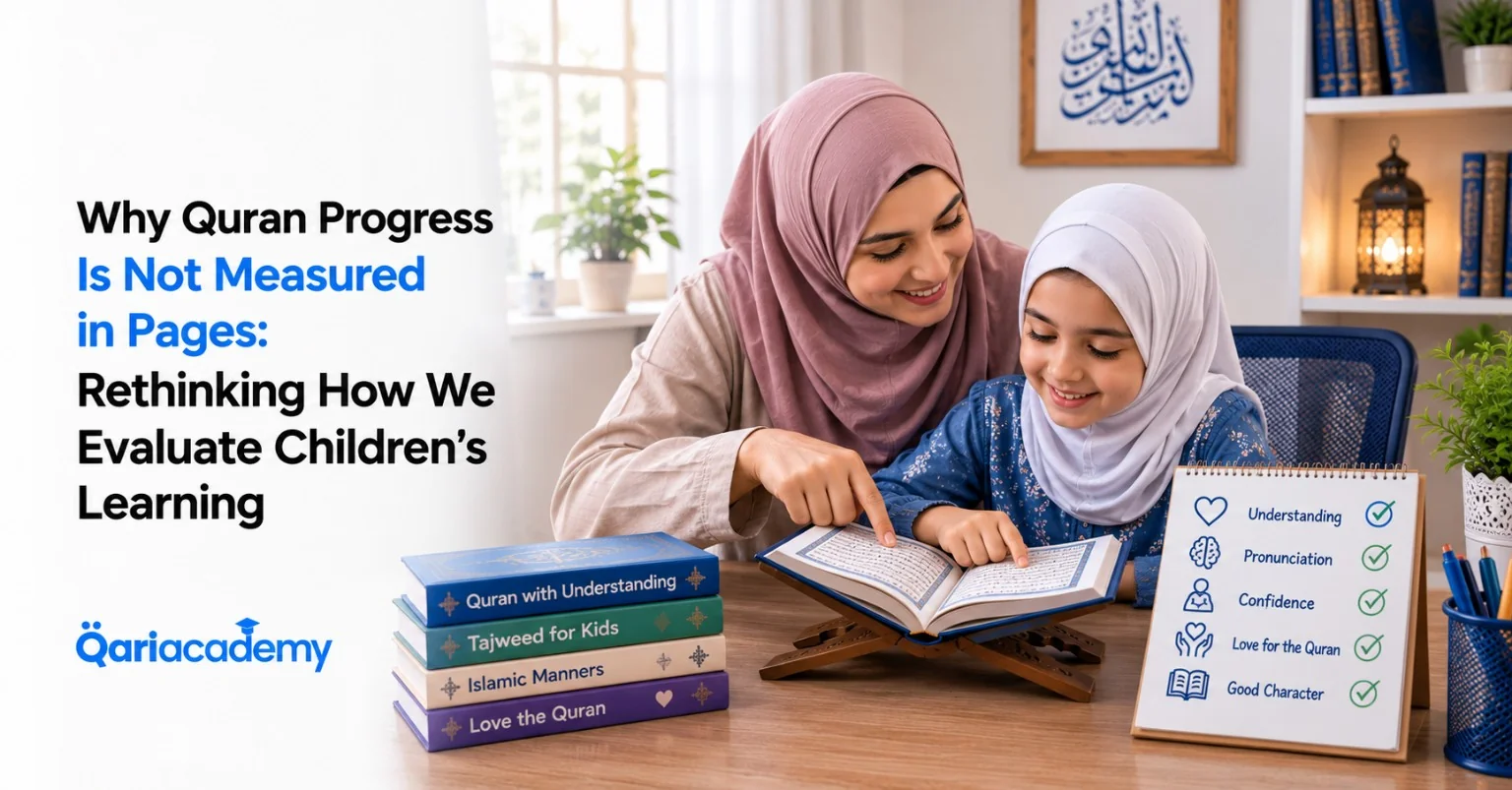
A Better Quran Progress Scorecard
Parents can use a simple skill-based framework.
| Area | Question to Ask | Evidence of Progress |
|---|---|---|
| Reading | Can my child read independently? | Fewer prompts |
| Tajweed | Are rules being applied? | Fewer recurring errors |
| Hifz | Is memorization retained? | Stronger old revision |
| Understanding | Does the child understand more? | Growing vocabulary |
| Consistency | Is practice regular? | Stable routine |
| Independence | Does the child self-correct? | Less supervision |
The purpose is not to turn Quran learning into another school report.
It is to make progress visible.
What Parents Often Get Wrong
1. Comparing Children
Every child has a different starting point.
2. Rewarding Speed Alone
Fast memorization is not necessarily strong memorization.
3. Ignoring Revision
New material can hide weak retention.
4. Measuring Only Attendance
Showing up is important, but attendance alone does not prove mastery.
5. Treating Mistakes as Failure
A mistake can reveal exactly what needs to be taught next.
QariAcademy’s article on Quran Learning Mistakes Parents Should Avoid identifies expecting quick results, teaching without structure, neglecting revision, ignoring learning differences, and overloading children as common problems.
What a Good Teacher Should Report to Parents
A useful teacher update should be more informative than:
“Your child completed three pages.”
Parents should ideally know:
- What the child learned
- What improved
- What remains difficult
- Which Tajweed rule needs practice
- Whether memorization is being retained
- What should be reviewed at home
- What the next learning target is
QariAcademy’s online learning model includes progress tracking and regular updates so parents can remain informed about development.
What If Your Child Is Progressing Slowly?
Do not immediately assume the child needs to work harder.
First diagnose the bottleneck.
Ask:
- Is the child struggling with a specific reading skill?
- Is the lesson too difficult?
- Is the material too easy?
- Is practice consistent?
- Is the child distracted?
- Is the teaching approach suitable?
- Is there enough revision?
- Does the child understand the goal?
If the problem is identified accurately, the solution becomes much easier to find.
QariAcademy’s focus guidance recommends structured goals, shorter manageable segments, interaction, consistent routines, and positive reinforcement to support children’s engagement.
When Pages Still Matter
This does not mean pages are completely useless.
Page count can help with:
- Planning
- Scheduling
- Tracking curriculum coverage
- Estimating workload
- Organizing revision
The mistake is using pages as the only measurement.
Think of page count as a secondary metric.
The primary metrics should be:
Accuracy + Fluency + Retention + Understanding + Consistency + Independence
That is a much stronger evaluation system.
How QariAcademy Can Help Parents Measure Real Progress
A personalized learning model makes skill-based measurement easier.
QariAcademy’s Quran for Kids program uses one-on-one lessons, step-by-step progression, regular feedback, and pacing tailored to the child’s level.
For Hifz, the program combines memorization with revision and retention.
For Tajweed, children work on pronunciation, articulation, rules, fluency, and consistent correction.
This matters because a child does not need to “finish pages” simply to prove that lessons are working.
The better objective is to know exactly what the child can do better now.
Frequently Asked Questions
Is completing more Quran pages a sign of better progress?
Not necessarily. Page completion measures how much material was covered, but it does not show accuracy, fluency, retention, understanding, or independence.
What should parents measure instead of pages?
Focus on reading accuracy, fluency, Tajweed application, memorization retention, consistency, understanding, confidence, and independence.
Should my child memorize Quran quickly?
Speed should not be the only goal. Strong retention and accurate recitation are essential parts of meaningful memorization.
How often should Quran progress be reviewed?
A broader review every few months can be useful, while teachers can provide shorter feedback more frequently. The important thing is to identify specific skills that are improving or still need attention.
What if my child completes very few pages?
Look at what happened during those pages. If the child became more accurate, needed fewer prompts, improved pronunciation, or developed stronger fluency, the learning may be substantial even if page coverage is low.
How can I know whether my child’s Quran lessons are working?
Ask for evidence of skill development rather than only curriculum completion. A good progress update should explain what improved, what remains difficult, and what the next learning target is.
Conclusion
Why Quran progress is not measured in pages becomes clear once we stop treating Quran learning like a race through a textbook.
Pages tell you where the child has been.
They do not necessarily tell you what the child has learned.
Real progress can look like a child reading a previously difficult passage independently, correcting a pronunciation mistake, retaining an older Surah, applying Tajweed more consistently, understanding a new Quranic word, or practicing without being reminded.
Those changes may not add a single extra page to the child’s progress record.
But they may represent significant educational development.
The strongest Quran learning journey therefore measures mastery rather than movement.
Instead of asking:
“How many pages did my child finish?”
ask:
“What can my child do today that they could not do three months ago?”
That question changes the entire way parents evaluate Quran education.
And it shifts the focus from speed to substance, from comparison to development, and from finishing material to building skills that can remain with the child for life.
For families looking for a structured approach, QariAcademy combines one-on-one instruction, personalized pacing, progress tracking, Tajweed, Quran reading, and Hifz support to help parents see development beyond simple page counts.
The goal is not to finish the most pages.
The goal is to help the child become a better reader, reciter, learner, and eventually an independent companion of the Quran.
A Better Way to Measure Your Child’s Quran Progress
If you’re unsure whether your child’s progress is actually on track, a skill-based assessment can reveal what is improving and where the next stage of learning should focus.
Explore QariAcademy’s Quran for Kids Program
Internal Articles Used — 10 Verified QariAcademy Articles
- 5 Smart Ways to Measure Your Childs Quran and Arabic Progress Without Traditional Tests
- Quran Learning Mistakes Parents Should Avoid with Kids
- Effective Techniques to Enhance Children’s Focus During Quran Classes
- How Busy Parents Can Keep Their Children Consistent With Quran Learning
- Top Ways to Motivate Your Child to Continue Quran Memorization
- How to Support Your Child’s Quran Learning Online
- How Parents in the USA, UK, and Canada Can Create a Quran-Friendly Home Environment
- Make Quran Learning Fun for Kids Online
- How Learning Arabic Helps Kids Connect to the Quran
- Quran Tajweed Step-by-Step: 30-Day Plan for Kids