
Table of Contents
Hearing Arabic at home does not automatically mean a child is learning Arabic.
This is one of the most confusing situations for Muslim parents raising children in the USA, UK, Canada, and other non-Arabic-speaking environments. A child may hear Arabic from parents every day, understand familiar instructions, recognize Quranic phrases, and even respond to simple expressions—yet struggle to speak, read, or understand Arabic beyond those familiar situations.
Parents may then ask:
“If my child hears Arabic at home, why don’t they actually know Arabic?”
The answer lies in an important distinction between exposure and language development.
Children need opportunities not only to hear a language, but also to understand it, use it, interact through it, read it, and gradually expand the situations in which they use it.
For Muslim families, understanding this difference can completely change how they approach Arabic education.
Hearing Arabic Is Not the Same as Learning Arabic
Imagine a child whose parents speak Arabic at home.
The child may hear:
“Come here.”
“Have you eaten?”
“Go to sleep.”
“Where are your shoes?”
“Come pray.”
These are familiar family expressions.
The child understands these phrases because they have heard them repeatedly in meaningful situations.
But what happens when someone asks the child to describe their day in Arabic?
Suddenly, the child may switch to English.
This does not necessarily mean the child has “forgotten Arabic.”
It may mean their Arabic knowledge has developed primarily in specific contexts rather than across a broad range of communication.
| What the Child Experiences | What It May Develop |
|---|---|
| Repeated family instructions | Understanding familiar phrases |
| Short conversations | Basic receptive vocabulary |
| Quran recitation | Familiarity with Quranic sounds and words |
| Storytelling and discussion | Broader vocabulary and expressive language |
| Reading and structured lessons | Literacy and more complex language |
This distinction is important because parents often measure exposure by asking:
“Does my child hear Arabic?”
A better question is:
“What kinds of Arabic does my child hear, and what opportunities do they have to use it?”
The Home Language May Be Smaller Than Parents Realize
A family can genuinely speak Arabic at home while still providing a relatively limited Arabic environment.
For example, Arabic might be used mainly for:
- Commands
- Family routines
- Religious expressions
- Basic questions
- Food
- Discipline
- Household conversations
But the child may rarely hear Arabic used for:
- Explaining ideas
- Telling stories
- Discussing school
- Describing emotions
- Reading books
- Asking complex questions
- Talking about science
- Discussing hobbies
- Watching educational content
- Writing
This creates a context gap.
The child may know the Arabic needed for home life without developing the broader vocabulary and grammar required for independent communication.
This is why simply increasing the amount of Arabic a child hears may not be enough. The child also needs a wider range of meaningful situations in which Arabic is used.
Why English Often Becomes the Stronger Language
For many Muslim children growing up in the West, English is not simply another language they hear.
It is the language of almost everything around them.
They use English at:
- School
- Sports
- Friendships
- Video games
- YouTube
- Books
- Homework
- Social media
- Television
- Technology
Arabic may occupy only a small part of their day.
Consider the difference:
| Daily Environment | English | Arabic |
|---|---|---|
| School | High | Low or none |
| Friends | High | Low |
| Entertainment | High | Variable |
| Homework | High | Low |
| Family | Variable | Often higher |
| Quran/Islamic learning | Low | Higher |
Even if Arabic is spoken at home, the child’s overall language experience may still be overwhelmingly English.
The issue is therefore not necessarily that parents are “not speaking enough Arabic.”
The larger issue may be that Arabic does not have enough functions in the child’s life.
A child who uses English to learn, play, read, socialize, and solve problems receives opportunities to develop English across many different contexts. If Arabic is mostly limited to family instructions and religious routines, its functional range may remain much narrower.
Passive Understanding Is Not the Same as Active Speaking
This is one of the biggest misunderstandings parents encounter.
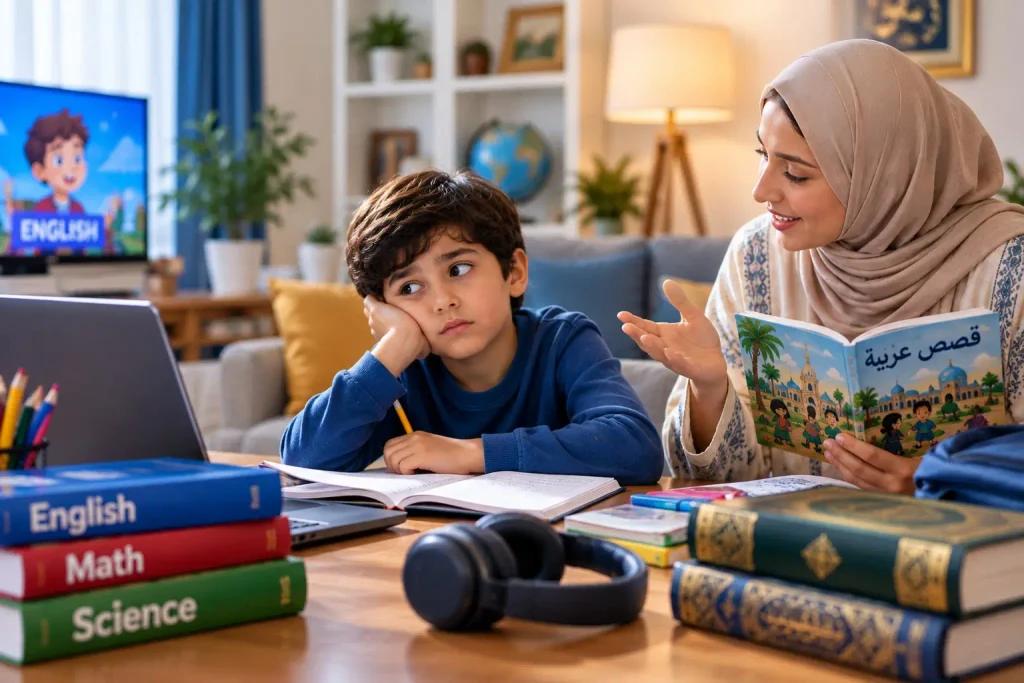
A child may understand much more Arabic than they can speak.
For example:
Parent:
“روح هات الكتاب من الأوضة.”
Child:
Understands immediately.
But if the parent asks:
“What did you do at school today?”
the child answers in English.
This can happen because receptive language and expressive language are different abilities.
The child may recognize the meaning of familiar words without having enough active vocabulary or grammatical practice to construct longer sentences.
| Language Skill | What It Means |
|---|---|
| Listening | Understanding what someone says |
| Speaking | Producing your own sentences |
| Reading | Understanding written Arabic |
| Writing | Producing Arabic in written form |
| Vocabulary | Knowing words and their meanings |
| Grammar | Combining words accurately |
A child may therefore be relatively strong in one area and weak in another.
That is why saying “my child knows Arabic” or “my child doesn’t know Arabic” can be too simplistic.
The better question is:
Which Arabic skills has the child actually developed?
Quran Arabic Adds Another Layer
Muslim parents sometimes assume that because their child attends Quran classes, they are also learning Arabic.
Not necessarily.
A child can learn to:
- Read Arabic letters
- Recite Quran
- Memorize Surahs
- Apply basic Tajweed
without understanding the language deeply.
Quran reading and Arabic language development overlap, but they are not identical.
QariAcademy’s article Should Children Learn Arabic Before Learning to Read the Quran? explains the distinction between the Arabic skills needed for Quran reading and the broader language skills involved in understanding Arabic.
This is why a child might recite Surah Al-Ikhlas beautifully while understanding only a few of its words.
That is not necessarily a failure.
It simply means recitation and language comprehension are different learning tracks.
Why Familiar Arabic Can Create an Illusion of Fluency
There is another trap parents can fall into.
A child may understand dozens of phrases because they have heard them hundreds of times.
That can make the child’s Arabic seem stronger than it really is.
For example, the child may understand:
“تعال”
“استنى”
“كل”
“نام”
“هات”
“روح”
“يلا نصلي”
But familiarity with these expressions does not necessarily mean the child can:
- Explain an idea
- Tell a story
- Describe an event
- Read a paragraph
- Write a sentence
- Understand unfamiliar vocabulary
- Hold a sustained conversation
This is why functional range is more useful than simply counting how many Arabic words a child recognizes.
Exposure Needs Interaction
Children learn language through meaningful interaction, not merely by being surrounded by sounds.
Compare these two situations.
Situation A
The child watches Arabic television for 30 minutes.
Situation B
A parent spends 30 minutes reading an Arabic story with the child, asking questions, explaining new words, and encouraging the child to respond.
Both provide exposure.
But the second creates far more opportunities for the child to process and produce language.
The lesson for parents is simple:
Don’t only increase the amount of Arabic. Increase the variety of things your child does with Arabic.
That can include listening, speaking, reading, answering questions, describing experiences, telling stories, and writing.
What Arabic Should Children Actually Be Learning?
If your goal is for your child to genuinely develop Arabic, the program should eventually go beyond memorizing vocabulary lists.
A balanced learning path might include:
| Area | Examples |
|---|---|
| Listening | Stories, conversations, instructions |
| Speaking | Questions, descriptions, conversations |
| Reading | Letters, words, sentences, stories |
| Writing | Letters, words, short sentences |
| Vocabulary | Home, school, emotions, hobbies |
| Quranic Arabic | Frequently occurring Quranic words and expressions |
| Grammar | Simple sentence structures as appropriate |
Not every child needs all of these at the same time.
A five-year-old may focus on listening, vocabulary, simple speaking, and early literacy.
An older child may gradually add reading, writing, grammar, and Quranic comprehension.
The important point is that Arabic development needs progression.
QariAcademy’s Learning Arabic for Non-Arabic Speaking Kids also emphasizes foundational vocabulary, listening, recitation, engaging activities, and consistent practice for children who do not speak Arabic as their primary language.
Why Reading Matters More Than Many Parents Expect
Parents often focus on speaking because it is the most visible sign of language ability.
But literacy can significantly expand a child’s Arabic input.
Books introduce vocabulary that may never appear in everyday family conversations.
A child might never hear the Arabic word for a particular animal, profession, environment, or scientific concept at home—but encounter it in a story.
Reading also exposes children to:
- More varied vocabulary
- More complex sentences
- Formal Arabic structures
- Narrative language
- Descriptive language
- Written grammar
This is one reason structured Arabic education can complement what happens at home rather than replace it.
A child does not have to choose between family Arabic and structured learning. The two can serve different purposes.
What Parents Can Do Differently
The solution is not to suddenly speak Arabic for 12 hours a day.
That is unrealistic for many families.
Instead, increase the quality and range of Arabic experiences.
1. Expand Beyond Commands
Instead of:
“Go get your shoes.”
Add:
“Where are your shoes? Are they in your room or by the door?”
The child now has to process more language.
2. Read Arabic Stories
Choose books appropriate to the child’s level.
Ask simple questions:
“Who is this?”
“What happened?”
“Why did he do that?”
The goal is not to turn reading into an exam. It is to create interaction around Arabic.
3. Give the Child Reasons to Speak
Don’t only ask questions with one-word answers.
Instead of:
“Did you eat?”
Try:
“What did you eat today?”
4. Use Arabic Around Real Activities
Cooking, shopping, driving, drawing, and family outings all provide opportunities for meaningful Arabic.
The language becomes connected to real experiences rather than existing only inside a lesson.
5. Introduce Quranic Vocabulary
When your child memorizes a Surah, choose a few recurring words and explain their meanings.
QariAcademy’s How Learning Arabic Helps Kids Connect to the Quran discusses how Arabic learning can help children move beyond recitation toward greater understanding of Quranic language.
Don’t Turn Arabic Into a Constant Test
A child who constantly hears:
“Say it in Arabic.”
“What’s this in Arabic?”
“You should know this!”
may eventually associate Arabic with being tested.
The goal is to create more meaningful Arabic use, not more pressure.
QariAcademy’s article Learn Arabic for Kids: Why Every Muslim Child Should Master the Language of the Quran also emphasizes consistent practice, varied learning methods, and encouraging children rather than expecting perfection.
Parents do not need to know every word themselves.
The important thing is to create an environment where Arabic has a purpose.
When Structured Arabic Classes Can Help
Home exposure gives children something an Arabic class cannot completely replace: natural family interaction.
But home exposure also has limitations.
Parents may:
- Use a limited vocabulary
- Switch languages frequently
- Lack time for structured practice
- Focus mainly on everyday expressions
- Be unsure what their child should learn next
- Avoid correcting or developing more advanced language skills
A structured teacher can fill some of these gaps.
QariAcademy’s Arabic for Kids program is designed for children ages 5–15 and covers reading, writing, listening, speaking, vocabulary, and Quranic comprehension through one-on-one instruction.
The goal should not be to replace Arabic at home with classes.
It should be:
Home exposure + meaningful interaction + structured learning + consistent practice.
A Better Way to Measure Your Child’s Arabic
Instead of asking:
“Does my child speak Arabic?”
look at specific skills.
Can your child:
- Understand simple instructions?
- Answer questions in Arabic?
- Describe something that happened?
- Read simple Arabic words?
- Understand a short story?
- Write basic sentences?
- Recognize common Quranic vocabulary?
- Continue a conversation without immediately switching to English?
This gives you a much clearer picture of where your child actually stands.
| If Your Child Can… | They May Need More Practice With… |
|---|---|
| Understand but rarely speak | Expressive Arabic |
| Speak familiar phrases but struggle with stories | Vocabulary and sentence building |
| Speak but cannot read | Arabic literacy |
| Read but understand little | Vocabulary and comprehension |
| Understand Quranic words but not conversations | Broader Arabic exposure |
| Speak basic Arabic but avoid complex topics | Advanced vocabulary and grammar |
This approach helps parents identify the actual gap instead of simply labeling the child as “good” or “bad” at Arabic.
The Goal Is Not to Make the Home 100% Arabic
This is another misconception worth challenging.
For many families raising children in the West, creating a completely Arabic-speaking household may not be realistic.
And it may not be necessary.
The more useful goal is to ensure that Arabic has enough meaningful space in the child’s life to continue developing.
That might mean:
- Arabic conversations with parents
- Arabic books
- Quran lessons
- Arabic classes
- Quranic vocabulary
- Arabic stories
- Arabic-speaking relatives
- Activities conducted partly in Arabic
Over time, these experiences can give the child something that passive exposure alone cannot provide:
a reason to use Arabic.
How QariAcademy Can Help
If your child hears Arabic at home but still struggles to speak, read, or understand it, the first step is not to assume that the child simply needs more memorization.
The more useful step is to identify the missing skill.
Is it vocabulary?
Speaking?
Reading?
Grammar?
Listening comprehension?
Quranic Arabic?
At QariAcademy, one-on-one Arabic lessons allow the teacher to adjust instruction around the child’s current level rather than treating all children as if they have the same background.
The Arabic for Kids course is designed for children of different levels, from beginners to students with prior exposure, and develops reading, writing, speaking, listening, vocabulary, and Quranic comprehension step by step.
This can be particularly useful for Muslim children growing up in English-dominant environments, where Arabic may be present at home but absent from much of the child’s wider daily life.
The aim is not simply to make children “know more Arabic.”
It is to help them gradually understand, use, read, and connect with the language.
Conclusion
So, why do children struggle with Arabic even when they hear it at home?
Because exposure alone is not the same as language development.
A child may hear Arabic every day but experience it mainly through short family instructions, familiar expressions, or religious routines. Meanwhile, English may dominate school, friendships, entertainment, reading, and almost every other part of daily life.
That imbalance can produce a child who understands familiar Arabic but struggles to speak, read, or express complex ideas.
The solution is not necessarily more pressure or simply “speaking Arabic more.”
It is richer and more purposeful Arabic exposure.
Give children reasons to listen, speak, read, ask questions, tell stories, and use Arabic in different situations. Combine natural family interaction with structured learning when needed.
For Muslim families, this can also create a valuable bridge between Arabic as a family language and Arabic as the language of the Quran.
If your child hears Arabic at home but is still struggling to develop real language skills, explore QariAcademy’s Arabic for Kids program to see how personalized one-on-one instruction can complement the Arabic your child already hears at home.
Frequently Asked Questions
1. Why does my child understand Arabic but not speak it?
Understanding and speaking are different language skills. A child may have developed strong receptive knowledge from hearing Arabic at home without having enough opportunities to actively construct sentences and express ideas in Arabic.
2. Is hearing Arabic at home enough for a child to become fluent?
Not always. Hearing Arabic provides valuable exposure, but children also need opportunities to actively use the language through conversations, stories, reading, questions, and other meaningful activities.
3. Why do Muslim children in Western countries often struggle with Arabic?
English may dominate school, friendships, entertainment, reading, and technology, while Arabic may be limited to home and religious settings. Over time, this can create a much stronger functional environment for English.
4. Should parents speak only Arabic at home?
Not necessarily. Families have different circumstances. A more realistic goal is to increase meaningful Arabic interaction and gradually expand the situations in which the child uses Arabic.
5. Does Quran memorization help children learn Arabic?
It can introduce children to Arabic sounds and recurring Quranic vocabulary, but memorization alone does not develop full Arabic language proficiency. Speaking, listening, reading, vocabulary, and comprehension need their own development.
6. When should a child start structured Arabic lessons?
There is no single age that works for every child. Structured lessons can be useful when parents identify a gap that everyday exposure is not addressing, whether in speaking, reading, vocabulary, comprehension, or Quranic Arabic.