Table of Contents
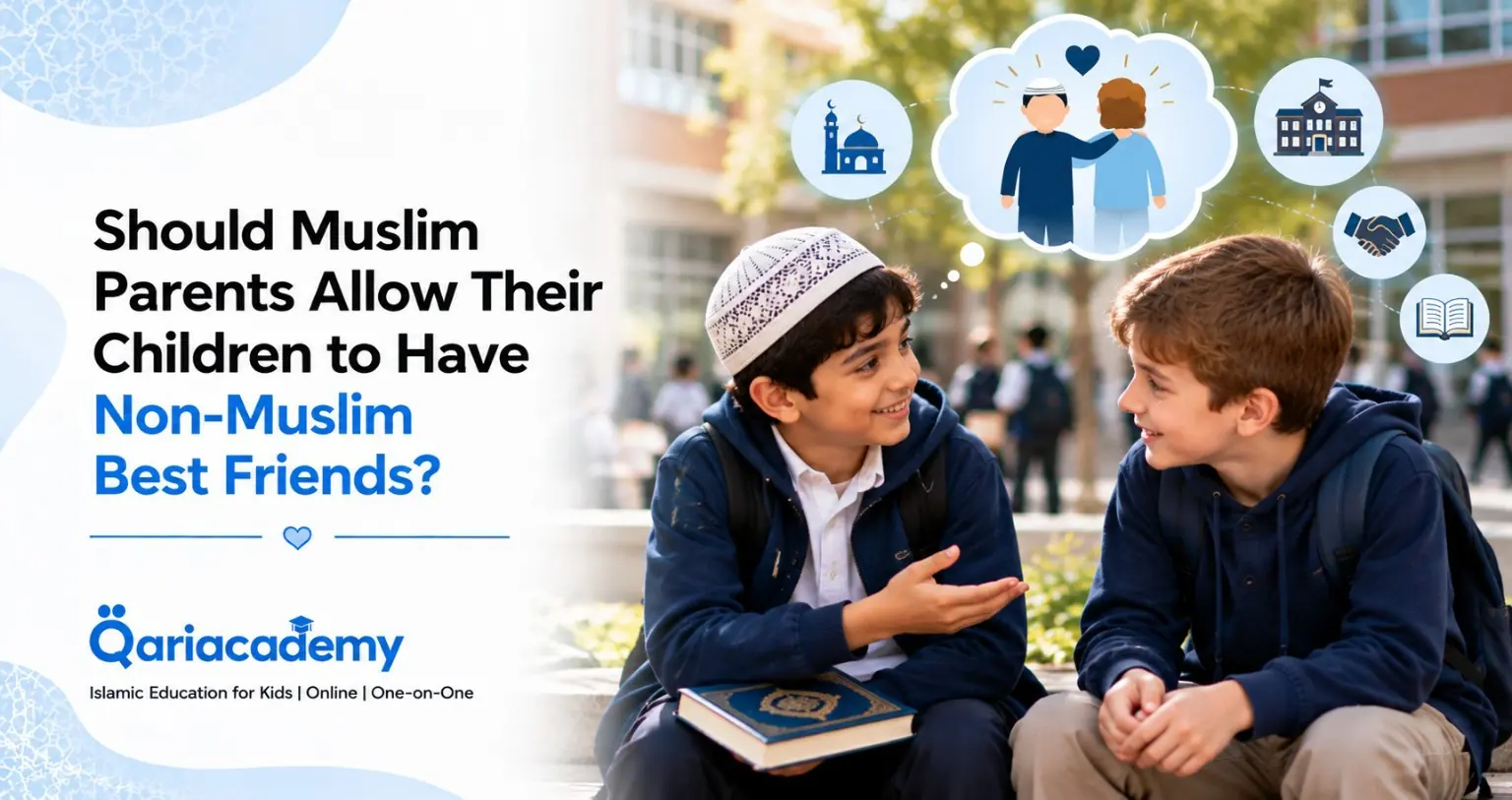
A child comes home from school and says, “My best friend isn’t Muslim.” Perhaps they want to invite that friend over, spend the weekend together, or talk about things their friend believes that are different from what they learn at home.
For Muslim parents raising children in the United States, the UK, Canada, and other diverse communities, this situation can raise important questions. Should you encourage the friendship? Should you be concerned about its influence? And how can you help your child build strong relationships without becoming disconnected from their Islamic values?
The answer is not simply to approve or reject a friendship because of the other child’s religion. Parents need to consider the nature of the relationship, the influence it has on their child, and whether their child is learning to make thoughtful decisions.
Islam teaches Muslims to treat others with kindness and justice. In Surah Al-Mumtahanah, Allah says that He does not forbid Muslims from showing kindness and fairness to those who do not fight them because of religion or drive them from their homes (Quran 60:8). This provides an important foundation for teaching children to treat people of different beliefs with dignity.
At the same time, parents have a responsibility to guide their children, teach them Islam, and help them understand the values and boundaries that shape their family life.
The goal is not to make children suspicious of everyone who believes differently. It is to help them develop healthy friendships while becoming confident, practicing Muslims.
Should Muslim Parents Allow Non-Muslim Best Friends?
In many situations, a Muslim child can have a close friendship with a non-Muslim child. The more useful question is whether the friendship is respectful, healthy, and compatible with the values parents are teaching.
A child’s friend may be kind, honest, supportive, and respectful of the child’s religious practices. Another child, regardless of religion, may encourage dishonesty, bullying, or behavior that puts pressure on the friendship.
A friend’s religious background alone does not tell parents everything they need to know about that relationship.
Muslim parents can welcome positive friendships while remaining involved in their children’s social lives. They can get to know their child’s friends, learn what the children enjoy doing together, and discuss situations that may require guidance.
What Does Islam Teach About Treating Non-Muslims?
Children should understand that maintaining their Islamic beliefs does not require treating people of other faiths unkindly.
Quran 60:8 explicitly highlights kindness and justice toward those who are not hostile to Muslims. Parents can use this verse to explain that Muslims should behave fairly, keep their promises, avoid hurting others, and treat people with good manners.
However, kindness and agreement are not the same thing. A Muslim child can respect a friend’s beliefs without adopting them. They can enjoy playing together without participating in every activity their friend chooses.
Parents should also avoid turning one Quranic verse into a complete ruling about every kind of close friendship. Questions about religious loyalty, particular activities, or specific circumstances may require more detailed guidance from a qualified Islamic scholar.
For everyday parenting, a useful starting point is to teach children both principles: treat people well, and make your own choices according to what you believe is right.
Is the Friend’s Religion the Main Concern, or Their Influence?
Parents sometimes become worried when their child develops a close friendship with someone from another religious background. That concern may be understandable, especially if the child is young or still learning basic Islamic practices.
But before making a decision, it helps to separate the child’s religious background from the actual behavior of the friendship.
| What parents notice | What it may mean | A helpful response |
|---|---|---|
| The friend has a different religion | The children come from different belief systems | Teach respectful differences and explain your family’s beliefs |
| The child wants to copy every activity the friend does | The child may be seeking acceptance or belonging | Discuss decision-making and healthy boundaries |
| The friend respects Salah, fasting, and halal food | The friend is making room for the child’s practices | Encourage mutual respect |
| The child hides activities or lies about the friendship | There may be a trust or boundary issue | Explore the reason calmly and set clear expectations |
| The friend repeatedly mocks Islam | The relationship may be emotionally harmful | Discuss respect, involve adults if necessary, and reconsider the friendship’s boundaries |
The point is not to ignore concerns. It is to respond to the real concern rather than assuming that every difference in religion creates a problem.
How Can Parents Tell Whether a Friendship Is Healthy?
You do not need to investigate every conversation your child has with a friend. However, you should know enough about the relationship to recognize whether your child feels safe, respected, and free to follow their religious practices.
Look for these signs.

1. The Friend Respects Your Child’s Muslim Identity
A positive friend does not need to share your family’s beliefs to respect them.
For example, a friend may understand that your child does not eat certain foods, needs time to pray, or celebrates Eid rather than the same religious holidays as their classmates. They may ask questions out of curiosity without making the child feel embarrassed.
Children should also learn to respect their friends’ beliefs and family traditions.
2. The Friendship Encourages Good Character
Notice how the children treat each other. Do they share, tell the truth, keep promises, and apologize when they make mistakes? Can your child disagree with the friend without being threatened with rejection?
These qualities matter because friendship can influence how children behave and how they understand acceptable treatment.
A friendship should not require a child to lie, bully someone else, break important rules, or hide harmful behavior to remain accepted.
3. Your Child Can Say No
One of the most important signs of a healthy friendship is that a child can disagree without feeling forced to comply.
Your child might decline an activity, explain that their family follows a different rule, or choose not to join a conversation that makes them uncomfortable.
If the friend repeatedly responds with insults, threats, or exclusion, parents should take that pattern seriously.
4. The Friendship Does Not Replace Every Other Supportive Relationship
A child may become especially close to one friend. That is not automatically a problem. However, it is healthy for children to have relationships with family members, other classmates, and supportive adults too.
Muslim children may also benefit from spending time with other Muslim children, particularly if they rarely encounter Muslims in their school environment.
This is not about forcing children to choose friends according to religion. It is about helping them develop a wider support network and experience a positive sense of belonging within their Muslim community.
How Can Parents Teach Islamic Values Without Isolating Their Children?
Parents sometimes feel caught between two concerns: they want their child to fit in socially, but they also want the child to remain connected to Islam.
These goals do not have to conflict. A child can learn to build friendships across religious differences while understanding that not every choice is appropriate for them.
Teach the Reason Behind Your Family’s Boundaries
Children are more likely to understand a rule when they know what it means and why it matters.
Instead of saying only, “You cannot do that because we are Muslim,” explain the relevant principle in language your child can understand.
For example:
- Food: “Our family eats halal food. You can still enjoy time with your friend, and we can help you choose something suitable.”
- Prayer: “You can play together, but you still need time for Salah.”
- Honesty: “Even if your friend asks you to hide something, telling the truth matters.”
- Religious celebrations: “Different families celebrate different occasions. We can be kind and respectful without taking part in every religious activity.”
- Peer pressure: “You do not have to do something just because your friends are doing it.”
These conversations help children connect Islamic values with everyday decisions.
Help Your Child Understand That Respect Does Not Mean Agreement
A child may assume that refusing an activity means rejecting the friend. Parents can help them understand the difference.
They can say:
“I like spending time with you, but I don’t do that.”
Or:
“My family follows different religious practices, but we can still be friends.”
A child does not need to debate religion or criticize another family every time a difference appears. They can explain their own choice calmly and move on.
Keep Islamic Learning Positive and Practical
Children need opportunities to understand their faith, not only reminders about what they cannot do.
Talk about the Quran, the character of Prophet Muhammad ﷺ, kindness, honesty, responsibility, Salah, and how Muslims should treat other people. Connect those teachings to situations children actually experience at school and with friends.
For example, if your child describes a disagreement with a classmate, you might discuss fairness, patience, apologizing, and standing up against bullying.
Regular, age-appropriate Islamic education can help children build a foundation for these conversations. The aim is not to make them fearful of different beliefs, but to help them understand their own beliefs with greater confidence.
What If Your Child Starts Copying Their Non-Muslim Best Friend?
Children naturally imitate people they admire. They may copy a friend’s expressions, clothing preferences, hobbies, or interests. This is a normal part of social development, and not every change is a religious concern.
The important question is what your child is copying and why.
| Situation | A constructive parental response |
|---|---|
| Your child adopts a new hobby or harmless expression | Show curiosity and decide whether it fits your family’s expectations |
| Your child asks why your family follows different rules | Listen first, then give an age-appropriate explanation |
| Your child wants to join an activity that conflicts with a family boundary | Explain the boundary and discuss suitable alternatives |
| Your child begins lying to avoid disagreement | Explore whether they fear your reaction, then rebuild trust and clarify expectations |
| Your child is pressured to mock Islam or abandon a practice | Reassure them, discuss what happened, and help them respond confidently |
| Your child is repeatedly bullied or manipulated by the friend | Take the behavior seriously and consider involving appropriate adults |
Avoid assuming that a new interest means your child is losing their faith. Ask what they like about the activity and whether anything about it concerns them. You can appreciate their desire to belong while still making a clear decision about what is acceptable.
If a boundary needs to be enforced, focus on the behavior rather than attacking the friend. Saying “I am concerned about the pressure you are experiencing” is usually more constructive than saying “Your friend is a bad person.”
Should You Forbid the Friendship if You Disapprove of the Friend?
Sometimes parents need to restrict a friendship or certain activities, particularly when there is bullying, manipulation, repeated pressure, dishonesty, or a genuine safety concern.
But an immediate ban based only on the friend’s religion may not address the underlying issue. It may also make the child less willing to discuss their friendships honestly.
Before making a decision, consider these questions:
- What specific behavior concerns me?
- Have I heard my child’s account of what happened?
- Is this an isolated incident or a repeated pattern?
- Have I explained the relevant family or Islamic boundary?
- Can the situation be addressed through supervision, clearer limits, or a conversation with another parent?
- Is there a genuine risk that requires stronger action?
For younger children, parents may need to supervise playdates more closely and choose suitable activities. Older children may need more opportunities to explain their choices and participate in decisions, while still following reasonable family rules.
If a friendship is consistently harmful, parents can set stronger limits. The decision should be based on the child’s well-being and the actual circumstances, not on assumptions about every child who belongs to a different religion.
How Can You Talk to Your Child About Their Best Friend?
A calm conversation can reveal much more than a lecture. Choose a relaxed moment rather than starting the discussion immediately after an argument.
You might ask:
- “What do you enjoy most about spending time with your friend?”
- “Do you feel comfortable being yourself around them?”
- “What happens if you disagree about something?”
- “Have you ever felt pressured to do something you didn’t want to do?”
- “Does your friend understand the things that are important to our family?”
- “Is there anything about the friendship that makes you uncomfortable?”
Listen to the answers without treating every response as evidence of a problem. Your child may simply want you to understand an important relationship in their life.
If a concern emerges, address it specifically. Explain what needs to change, give your child language they can use, and agree on a plan together where appropriate.
What Should Muslim Parents Do if Their Child Has No Muslim Friends?
This is a different concern from having a non-Muslim best friend.
A child may attend a school where there are very few Muslim students. Their closest friends may naturally come from the people they see every day. That does not automatically mean the child is becoming disconnected from Islam.
Still, a sense of community can help children feel that their religious identity is understood and shared by others.
Parents can create opportunities for children to meet Muslim peers through mosque activities, family gatherings, community events, sports, and Islamic learning programs. The goal is to add positive relationships, not to make children feel guilty about the friends they already have.
Read our related guide: My Child Says, “None of My Friends Are Muslim.” Should I Be Worried?
You may also find it helpful to read How to Teach Your Muslim Child to Respect Others Without Giving Up Islamic Values.
How Does the Right Approach Change as Children Get Older?
A five-year-old and a fifteen-year-old do not need the same level of explanation or independence. Parents should adjust their guidance to the child’s maturity and circumstances.
| Age or stage | What the child may need | How parents can help |
|---|---|---|
| Early childhood | Simple rules and adult guidance | Supervise play, model kindness, and explain differences in simple language |
| Primary school years | Help understanding friendship and fairness | Discuss respect, honesty, boundaries, and how to respond to pressure |
| Preteen years | More complex questions about identity and belonging | Listen carefully, explain Islamic principles, and encourage thoughtful decisions |
| Teenage years | Greater independence and more complicated social situations | Maintain open communication, agree on clear boundaries, and discuss consequences respectfully |
These are broad developmental guidelines, not strict age limits. Some children need more support than others, and parents should adapt their approach to the individual child.
As children grow, the goal is to move from making every decision for them toward helping them understand how to make sound decisions independently.
A Practical Checklist for Parents
Before deciding how to handle a close friendship, consider the following:
- I know who my child’s friend is and understand the nature of their relationship.
- I have considered the friend’s actual behavior rather than relying only on religious identity.
- My child knows that our family welcomes questions and honest conversations.
- We have discussed important Islamic values and family boundaries.
- My child knows how to say no respectfully when something conflicts with those boundaries.
- My child has opportunities to develop positive relationships within the Muslim community.
- I am prepared to intervene if the friendship becomes harmful or unsafe.
You do not need to solve every possible situation in advance. The purpose of this checklist is to build a foundation of trust, knowledge, and sensible guidance.
Frequently Asked Questions
Is it haram for a Muslim child to have a non-Muslim best friend?
This question can involve different meanings of friendship and religious guidance, so it should not be reduced to a blanket statement based only on the friend’s religion. The Quran encourages kindness and justice toward non-hostile people of other faiths (60:8), while Muslims are also responsible for maintaining their beliefs and religious commitments. For a specific religious ruling about close friendship in particular circumstances, consult a qualified and trusted Islamic scholar.
Should I encourage my child to have Muslim friends as well?
It can be beneficial for Muslim children to build friendships with other Muslim children, especially when they have few opportunities to connect with peers who share their religious practices. This does not mean they must reject their non-Muslim friends. Parents can create more opportunities for Muslim friendships through community events, mosque activities, family connections, and Islamic programs.
What if my child’s non-Muslim friend invites them to a religious celebration?
Listen to what the invitation involves and consider your family’s religious boundaries. Explain your decision respectfully and help your child respond politely. If the circumstances raise a specific religious question, seek guidance from a qualified scholar rather than assuming every invitation is identical.
What if my child says their non-Muslim friend is kinder than their Muslim classmates?
Take the comment seriously. Children should not be taught to assume that someone is kind or unkind simply because of their religion. Ask about the experiences behind the comparison, address any bullying or exclusion, and continue teaching Islamic values through both words and actions.
How can I stop my child from being influenced by everything their friends do?
You cannot control every influence, and trying to do so may not prepare a child for greater independence. Instead, teach them how to evaluate choices, explain your family’s boundaries, maintain open communication, and model the values you want them to develop. If a particular influence becomes harmful, address it directly.
Should I meet my child’s best friend and their parents?
When practical, yes. Getting to know the friend and their family can help you understand the relationship and build trust. It also gives you an opportunity to discuss practical matters, such as supervision, food, activities, and family expectations, without making assumptions about one another.
Conclusion: Guide Your Child Without Teaching Them to Fear Differences
Should Muslim parents allow their children to have non-Muslim best friends? In many situations, a respectful and healthy friendship can be part of a child’s everyday life in a diverse community. The important task is to understand the relationship, teach Islamic values, and respond appropriately when real concerns arise.
Help your child understand that they can treat others with kindness without agreeing with every belief or joining every activity. Teach them how to maintain their religious practices, recognize unhealthy pressure, and speak about their boundaries respectfully.
Most importantly, make home a place where your child can talk honestly about friends, school, faith, and difficult questions. A strong parent-child relationship, positive Islamic learning, and sensible guidance can help children develop both confidence in their Muslim identity and respect for the people around them.
Help Your Child Build a Strong Islamic Foundation
QariAcademy offers one-to-one online Quran and Islamic learning for children, helping them develop their understanding of Islam with personalized support.
Explore Quran and Islamic learning at QariAcademy or register your child.