Table of Contents
Arabic has influenced languages and cultures around the world for centuries. Today, that influence is not limited to history, literature, or academic vocabulary. Arabic words and expressions can also be heard in everyday conversations, particularly in Muslim households, multicultural communities, social media, and popular culture.
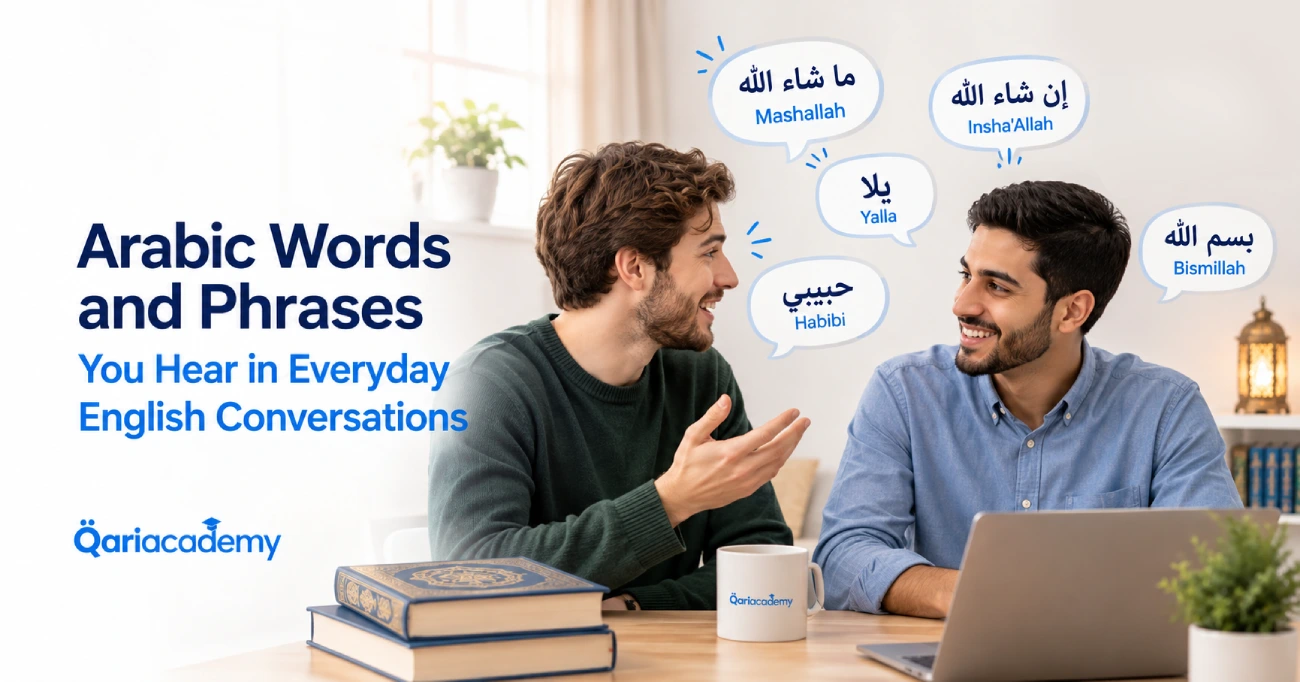
You might hear someone say “Insha’Allah” when talking about future plans, “Alhamdulillah” when expressing gratitude, or “Habibi” when addressing a friend. Even when the rest of the conversation is in English, these Arabic expressions often carry meanings and cultural associations that go beyond a simple translation.
For Muslims living in the United States, the United Kingdom, and Canada, understanding these expressions can make everyday communication more meaningful. They are also interesting for non-Arab Muslims, language learners, and anyone curious about the influence of Arabic on modern culture.
In this guide, we’ll explore six Arabic words and phrases you may encounter in English conversations, explain what they mean, show you how to pronounce them, and give examples of how they are used.
Arabic Words in English: Understanding the Different Types
Not every Arabic word used in an English conversation belongs to the same category. Some words have been part of the English language for centuries, while others are expressions that people continue to use in their original Arabic form.
It helps to distinguish between three groups:
- Historical English loanwords: Words that entered English through Arabic or through languages influenced by Arabic. Examples include algebra and cotton. These words are now established parts of English vocabulary.
- Conversational Arabic expressions: Words such as Habibi and Yalla, which may appear in conversations among Arabic speakers and in some multicultural communities.
- Islamic expressions: Phrases such as Insha’Allah, Alhamdulillah, Mashallah, and Bismillah. Muslims around the world use these expressions in everyday life, even when speaking languages other than Arabic.
The expressions in this article are not necessarily used by every English speaker. Their use is especially familiar in Muslim communities, Arab households, and multicultural environments where Arabic language and culture are part of everyday life.
1. Habibi / Habibti (حبيبي / حبيبتي) – My Love, My Dear
- Arabic spelling: حبيبي (Habibi) / حبيبتي (Habibti)
- Meaning in English: My beloved, my love, or my dear
- Pronunciation: Ha-BEE-bee / Ha-BEEB-tee
- Usage: Affectionate and conversational
Habibi is one of the most recognizable Arabic expressions outside the Arabic-speaking world. It comes from the Arabic word habib, meaning “beloved,” combined with a possessive form meaning “my.”
The word has two common forms:
- Habibi (حبيبي): Used when addressing a male.
- Habibti (حبيبتي): Used when addressing a female.
Although Habibi can mean “my love,” its everyday use is much broader than the English phrase might suggest. Depending on the relationship and context, Arabic speakers may use it with a spouse, family member, close friend, or even an acquaintance as a warm expression of affection.
In some situations, it can be similar to saying “my dear,” “buddy,” or “my friend” in English. It is not necessarily romantic.
Why Did “Habibi” Make American Headlines?
In November 2026, the Arabic word Habibi attracted renewed attention after Abdul El-Sayed used it during his Michigan Senate election victory speech.
Addressing Vice President JD Vance, El-Sayed said:
“JD, habibi, there is this delicious irony in the fact that you’re constitutionally obligated to swear me in in January.”
The remark was a pointed joke about the irony of Vance being expected to administer the oath of office after the political disagreements between them during the campaign.
The moment received attention in American media and sparked interest in the meaning of Habibi. The Associated Press also reported reactions from Arabs who celebrated El-Sayed’s use of Arabic expressions in his speech.
You can read more about the moment in The Associated Press’s coverage and The Washington Post’s explanation of the word.
Example in Conversation
“Thanks for helping me move this weekend, habibi. I really appreciate it.”
Here, Habibi is used as a friendly expression of affection rather than a romantic term.
2. Insha’Allah (إن شاء الله) – God Willing
- Arabic spelling: إن شاء الله
- Meaning in English: If God wills / God willing
- Pronunciation: In-sha-Allah
- Usage: Expressing hope or referring to future plans
Insha’Allah is one of the most frequently used Islamic expressions in everyday Muslim life. It means “if Allah wills” or “God willing.”
Muslims say Insha’Allah when talking about something they hope to do in the future. It reflects the Islamic understanding that people can make plans and take action, while recognizing that the final outcome is in Allah’s hands.
The expression is used by Arabic speakers and non-Arab Muslims alike. You may hear it in conversations about work, travel, appointments, family plans, and everyday commitments.
For example, a Muslim living in London might say, “I’ll see you tomorrow, Insha’Allah,” even though the rest of the conversation is in English.
The expression is sometimes used humorously online, particularly when someone is unsure whether a plan will actually happen. However, its original meaning is a sincere reference to God’s will, and its use should be understood in the context of the speaker and situation.
Example in Conversation
“We’re planning to visit our family next summer, Insha’Allah.”
3. Alhamdulillah (الحمد لله) – All Praise and Thanks Be to Allah
- Arabic spelling: الحمد لله
- Meaning in English: All praise and thanks be to Allah
- Pronunciation: Al-ham-du-lil-lah
- Usage: Expressing gratitude, praise, and contentment
Alhamdulillah is an important Islamic expression used to acknowledge Allah’s blessings and express gratitude.
Muslims use it in many situations: after receiving good news, when recovering from illness, after completing a task, or simply when someone asks how they are doing.
For many Muslims, it is also a natural way to acknowledge Allah’s blessings during difficult circumstances. It expresses gratitude and contentment without suggesting that every situation is easy.
In English-speaking Muslim communities, it is common to hear someone answer “Alhamdulillah” when asked, “How are you?” The response can mean that they are doing well and are grateful to Allah.
Example in Conversation
“How have you been feeling?”
“Much better, Alhamdulillah. Thank you for asking.”
4. Mashallah (ما شاء الله) – What Allah Has Willed
- Arabic spelling: ما شاء الله
- Meaning in English: What Allah has willed
- Pronunciation: Ma-sha-Allah
- Usage: Expressing admiration and appreciation
Mashallah is commonly said when admiring something good, beautiful, or impressive. It may be used when seeing a newborn baby, complimenting someone’s home, celebrating an achievement, or noticing a blessing.
For Muslims, the expression is a reminder that blessings come from Allah. It is also commonly associated with asking for blessing and expressing appreciation without envy.
You might hear a parent say Mashallah when someone compliments their child, or a friend use it when congratulating someone on a new home or a personal achievement.
Although it is often translated as “What Allah has willed,” its conversational meaning is closer to expressing admiration while acknowledging Allah’s will.
Example in Conversation
“Your children have grown so much! Mashallah, they’re lovely.”
5. Yalla (يلا) – Let’s Go / Come On
- Arabic spelling: يلا
- Meaning in English: Let’s go, come on, or hurry up
- Pronunciation: YAL-la
- Usage: Informal and conversational
Yalla is a widely recognized colloquial Arabic expression. It is commonly used to encourage someone to move, begin an activity, or hurry up.
Its meaning changes slightly depending on the situation. It can mean “Let’s go” when leaving a place, “Come on” when encouraging someone, or “Hurry up” when someone is taking too long.
Unlike the more formal Islamic expressions in this article, Yalla is primarily conversational. It is heard across different Arabic-speaking communities and is also familiar to some people outside the Arab world through music, social media, and multicultural interactions.
Example in Conversation
“Yalla, put your shoes on! We’re going to be late.”
6. Bismillah (بسم الله) – In the Name of Allah
- Arabic spelling: بسم الله
- Meaning in English: In the name of Allah
- Pronunciation: Bis-mil-lah
- Usage: An Islamic expression used before beginning an action
Bismillah means “In the name of Allah.” Muslims commonly say it before beginning an activity, especially when eating, drinking, starting a journey, or undertaking something important.
Saying Bismillah is a way of remembering Allah and seeking His blessing before beginning an action. It can be used in both ordinary daily routines and more significant moments.
For example, a Muslim family may say Bismillah before a meal, while a student might say it before starting an exam.
In English-speaking Muslim households, the expression is often used naturally within an otherwise English conversation.
Example in Conversation
“Everyone ready? Bismillah, let’s begin.”
Frequently Asked Questions About Arabic Words and Phrases
What does Habibi mean in English?
Habibi (حبيبي) is an Arabic word that means “my beloved,” “my love,” or “my dear.” It is commonly used as a term of affection when addressing a male. Depending on the context, it can refer to a romantic partner, family member, or friend.
What is the difference between Habibi and Habibti?
The main difference is the person being addressed. Habibi is the masculine form, used when speaking to a male, while Habibti is the feminine form, used when speaking to a female. Both express affection and can mean “my love” or “my dear.”
Why do Muslims use Arabic words when speaking English?
Arabic has a special place in Islam because it is the language of the Quran and Islamic worship. Many Muslims around the world use expressions such as Insha’Allah, Alhamdulillah, and Bismillah in their daily conversations, even when speaking English, French, Urdu, or another language.
These expressions allow Muslims to maintain familiar religious practices and communicate meanings that are deeply connected to their faith.
Are Arabic words like Habibi and Yalla part of the English language?
Words such as Habibi and Yalla are used in some English-speaking communities, especially in multicultural settings and among people familiar with Arabic culture. However, they are generally better described as Arabic expressions used in English conversations rather than standard English vocabulary.
Other words, such as algebra and cotton, have a much longer history in English and are established dictionary words with historical connections to Arabic.
How do you pronounce Arabic expressions correctly?
Pronouncing Arabic expressions correctly involves learning sounds that may not exist in English. Listening to native speakers can help, but structured practice with a qualified Arabic teacher can make a significant difference, especially when learning Arabic sounds, letters, and pronunciation rules.
Conclusion: Arabic Expressions That Bring Cultures Together
Arabic words and phrases are more than simple translations. They carry cultural meaning, reflect personal relationships, and express values that are important to millions of people around the world.
Whether you hear someone say Habibi to a friend, Yalla before leaving, or Alhamdulillah when expressing gratitude, understanding these expressions gives you a better appreciation of the language and the people who use it.
For Muslims who do not speak Arabic, learning the language can also open the door to a deeper understanding of Islamic expressions and the Quran.
If you would like to move beyond familiar phrases and develop your Arabic skills, Qari Academy offers one-on-one online learning with qualified teachers, helping students build their Arabic foundations at their own pace.