Table of Contents
Many Muslim parents want their children to develop a strong connection with the Quran. They encourage them to read it, memorize short Surahs, learn Tajweed, and maintain a regular Quran routine.
But there is another important question:
Does your child understand what they are reciting?
A child may recite Surah Al-Fatihah correctly without understanding the meaning of its words. They may memorize several short Surahs but have little idea what those verses communicate. They may recognize familiar Quranic expressions without understanding how the words work together.
This is where Arabic can make a meaningful difference.
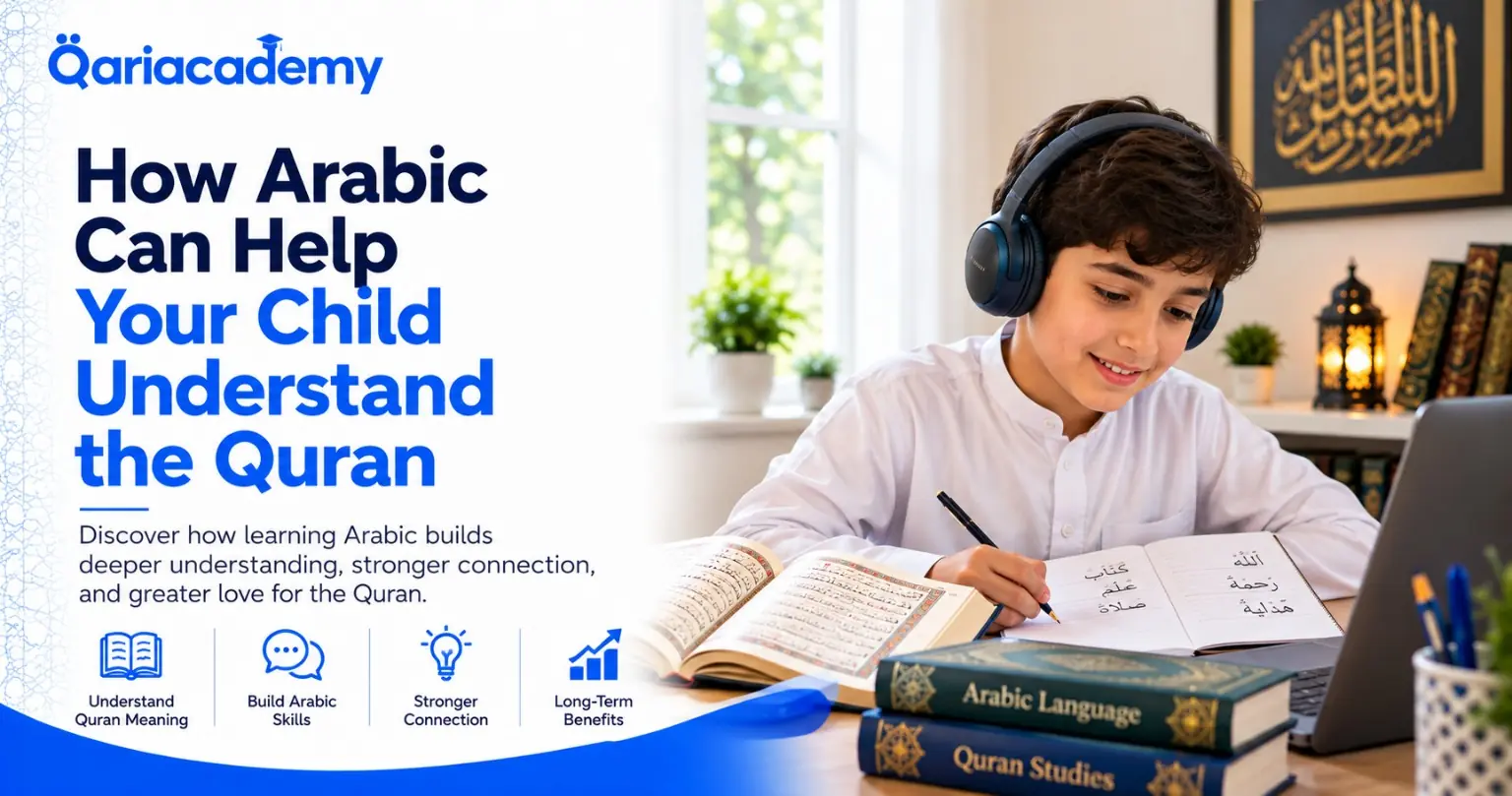
Learning Arabic can help children move beyond recognizing and reciting Quranic words toward understanding their meanings, noticing repeated expressions, and developing a deeper connection with what they read.
For Muslim families raising children in English-speaking countries, this can be especially valuable. English may be the language children use at school, with friends, and in everyday life, while Arabic may appear mainly during Quran lessons, Islamic studies, and family religious practices.
The good news is that children do not need to become fluent in Arabic before they can begin understanding the Quran. Parents can introduce Arabic gradually, alongside age-appropriate Quran reading, memorization, and comprehension.
In this guide, we will explore how Arabic supports Quran understanding, what children should learn first, and how parents can help them make meaningful progress.
Why Reading the Quran and Understanding It Are Different Skills
Reading the Quran and understanding its meaning are related, but they require different abilities.
Reading involves recognizing Arabic letters, connecting them correctly, pronouncing words, and applying appropriate Tajweed rules. Understanding requires additional knowledge of vocabulary, sentence structure, and the meaning of verses in context.
Consider a child who can recite Surah Al-Fatihah from memory. The child may know every word’s sound and sequence but struggle to explain what Alhamdulillah, Rabb al-‘Alamin, or Ar-Rahman means.
This does not make the child’s recitation less valuable. It simply means there is another area in which learning can develop.
| Quran Learning Skill | Main Focus | Example of Progress |
|---|---|---|
| Quran reading | Letters, words, and reading accuracy | Reads a short Surah correctly |
| Tajweed | Pronunciation and recitation rules | Applies learned Tajweed rules |
| Memorization | Recalling verses | Recites a memorized Surah |
| Arabic vocabulary | Understanding individual words | Recognizes familiar Quranic words |
| Quran comprehension | Understanding phrases and messages | Explains the general meaning of a familiar passage |
These skills support one another, but progress in one does not automatically mean mastery of the others.
If your child is still developing the foundations of Quran reading, QariAcademy’s Quran for Kids course can be a starting point for structured reading, pronunciation, and gradual skill development.
1. Arabic Helps Children Understand the Words They Recite
One of the most practical benefits of learning Arabic is that children can begin recognizing the meanings of familiar Quranic words.
Instead of treating every verse as a sequence of sounds, they gradually learn that individual words carry meaning.
For example:
| Arabic Word | Transliteration | General Meaning |
|---|---|---|
| رَبّ | Rabb | Lord, Sustainer |
| رَحْمَة | Rahmah | Mercy |
| عِلْم | ‘Ilm | Knowledge |
| كِتَاب | Kitab | Book |
| صَلَاة | Salah | Prayer |
| يَوْم | Yawm | Day |
Learning these words does not mean a child will immediately understand every verse containing them. Arabic words can have different meanings depending on context, grammar, and how they relate to other words.
However, familiar vocabulary gives children a foundation. When they encounter a word they have studied before, they may recognize it more easily and begin connecting it with the surrounding verse.
Start With Familiar Surahs
Parents do not need to begin with complicated vocabulary lists. A more practical approach is to select a few useful words from Surahs the child already knows, explain their meanings in simple English, and revisit them regularly.
For example, a child who memorizes Surah Al-Fatihah can gradually learn the meanings of Rabb, Rahman, and Rahim. Later, the teacher can help the child recognize these words in other appropriate learning materials.
The aim is not to memorize a dictionary. It is to develop familiarity through repeated encounters with meaningful language.
2. Use Surah Al-Fatihah to Connect Recitation With Meaning
Surah Al-Fatihah is a useful starting point because children encounter it regularly in Salah.
Many children memorize it early in their Quran journey, creating an opportunity to connect familiar recitation with basic meaning.
For example, parents and teachers can introduce the meanings of these phrases gradually:
- Alhamdulillahi Rabbil-‘Alamin: All praise is for Allah, Lord of all worlds.
- Ar-Rahman ir-Rahim: The Most Compassionate, the Most Merciful.
- Maliki Yawmid-Din: Master of the Day of Judgment.
- Iyyaka na’budu wa iyyaka nasta’in: You alone we worship, and You alone we ask for help.
These explanations provide an accessible starting point, not a complete linguistic or scholarly commentary. The teacher can introduce more detail as the child’s Arabic and comprehension develop.
A Practical Learning Sequence
| Stage | Learning Activity | Purpose |
|---|---|---|
| 1 | Recite a familiar verse | Build on existing knowledge |
| 2 | Learn two or three key words | Introduce vocabulary |
| 3 | Discuss the general meaning | Connect words with the message |
| 4 | Review the words later | Strengthen recall |
| 5 | Revisit the passage in context | Develop comprehension |
This approach makes understanding part of Quran learning rather than treating it as an entirely separate subject.
3. Arabic Helps Children Recognize Repeated Quranic Vocabulary
Children may encounter familiar Arabic words across different Surahs. Recognizing these words can make later learning more accessible.
Suppose a child learns the meaning of a word while studying one short Surah. When the word appears again, the child may recognize it without having to learn it from the beginning.
Each new encounter can reinforce previous knowledge while introducing the child to a wider range of Quranic language.
This process develops gradually:
- First encounter: The child learns a word’s basic meaning.
- Repeated encounter: The child recognizes the word more easily.
- Contextual learning: The child sees how the word is used in a verse.
- Broader exposure: The child notices the word in other passages.
- Deeper study: The child explores related words and language structures.
However, recognizing a word does not automatically mean understanding the whole verse. Children still need appropriate explanations of the context and message.
The goal is to help them move from isolated vocabulary toward a more connected understanding of what they read.
4. Does Your Child Need Conversational Arabic to Understand the Quran?
No. A child can begin learning Quranic vocabulary without being able to hold a full conversation in Arabic.
Quranic Arabic and conversational Arabic overlap, but they serve different learning goals.
Conversational Arabic focuses on everyday communication, listening, and speaking. Quranic Arabic learning focuses on the vocabulary and language structures that help children understand expressions found in the Quran.
Both can be valuable, but children do not need to master one completely before beginning the other.
| Learning Path | Main Focus | Suitable Goal |
|---|---|---|
| Quran reading | Letters, Harakat, and reading accuracy | Read the Quran correctly |
| Quranic Arabic | Quranic vocabulary and language structures | Understand familiar Quranic expressions |
| Conversational Arabic | Everyday speaking and listening | Communicate in Arabic |
A child may read the Quran fluently but understand little Arabic vocabulary. Another child may understand Arabic spoken at home but struggle to read Arabic script.
Their learning plans should reflect these differences.
For a more detailed comparison, read Quranic Arabic vs. Conversational Arabic: What Should Your Child Learn First?.
5. What Should Children Learn First in Arabic?
The right starting point depends on what the child can already do.
A complete beginner needs a different approach from a child who reads Arabic fluently or understands everyday Arabic conversations.
Before choosing a course or textbook, parents should identify their child’s current abilities.
| Child’s Current Ability | Recommended Focus |
|---|---|
| Does not recognize Arabic letters | Alphabet and letter sounds |
| Recognizes letters but struggles to read | Letter connections, Harakat, and basic reading |
| Reads Arabic but knows little vocabulary | Common words and simple meanings |
| Understands spoken Arabic but struggles with formal reading | Reading and vocabulary development |
| Reads Quran fluently but understands little | Quranic vocabulary and guided comprehension |
| Has a strong Arabic foundation | More advanced reading, grammar, and comprehension |
The goal is to avoid teaching skills the child has already mastered while making sure important foundations are not skipped.
A child who struggles to recognize letters will usually benefit from strengthening that foundation before attempting extensive vocabulary work. A fluent reader, on the other hand, may be ready to explore the meanings of familiar Quranic expressions.
For children who need broader language development, QariAcademy’s Arabic for Kids course is worth exploring.
Parents can also read Should Children Learn Arabic Before Learning to Read the Quran? for a more detailed discussion of how the two learning paths can work together.
6. How Parents Can Teach Quranic Vocabulary at Home
Parents do not need to become Arabic teachers to support their child’s understanding.
Small, consistent activities can make a difference, especially when they build on words and passages the child already knows.
A Simple 10-Minute Routine
| Time | Activity |
|---|---|
| 2 minutes | Review a familiar Quranic word |
| 3 minutes | Read or listen to a short familiar passage |
| 3 minutes | Discuss its general meaning |
| 2 minutes | Ask the child to recall the word or explain the idea |
For younger children, even a shorter activity may be enough. The routine should feel manageable, not like another long homework assignment.
A Practical Example: Learning the Word Rahmah
Imagine your child already knows a short Surah and is beginning to learn Arabic vocabulary.
You could introduce the word رَحْمَة (Rahmah) and explain that it means mercy.
A simple learning sequence might look like this:
- Day 1: Introduce the word and explain its basic meaning in English.
- Day 2: Ask your child if they remember the word and its meaning.
- Day 4: Review it again and help them recognize it in an appropriate Arabic learning passage.
- Day 7: Ask them to recall the meaning without showing the answer immediately.
This is an illustrative routine, not a fixed timetable. The pace should depend on the child’s age and ability.
The important principle is to revisit words over time rather than teaching them once and assuming they will be remembered.
Use Questions Instead of Constant Testing
Instead of asking the child to translate every word, try gentle questions such as:
- Do you remember what this word means?
- Have you seen this word before?
- Which word do you recognize in this verse?
- What is the general message of this passage?
If the child does not know the answer, explain it gently and return to it later.
The goal is to build familiarity and curiosity, not to turn every Quran session into a test.
7. What If Your Child Is Growing Up in an English-Speaking Home?
For Muslim children growing up in the United States, the United Kingdom, Canada, and other English-speaking environments, Arabic may receive much less daily exposure than English.
Children may use English at school, with friends, while reading books, and when watching videos. Arabic may be limited to family conversations, Quran lessons, or weekend Islamic classes.
This can create a gap between their ability to recite Arabic and their ability to understand it.
Parents can help by creating small opportunities for Arabic outside formal lessons:
- Review one or two Quranic words after Salah.
- Read a short Arabic passage together.
- Use simple Arabic expressions during daily routines.
- Ask the child about the meaning of a familiar Quranic word.
- Connect vocabulary learning to Surahs the child already knows.
- Choose books and activities suited to the child’s age.
The objective is not to replace English or demand immediate fluency. It is to make Arabic a language the child encounters regularly and meaningfully.
Parents should also avoid assuming that hearing Arabic occasionally is enough to develop reading and comprehension skills. Children usually need structured instruction, repeated practice, and opportunities to use what they learn.
8. How Arabic Can Make Quran Memorization More Meaningful
Memorization and understanding are different goals, but they can reinforce each other.
When children know the general meanings of familiar words and phrases, they may begin connecting the words they recite with the message of the passage.
For example, while memorizing a short Surah, a teacher may explain a few key words and the overall meaning of the verses. This gives the child another way to engage with the material.
However, understanding should not become an additional burden that makes memorization unnecessarily difficult. The amount of explanation should match the child’s age, language level, and attention.
| Activity | Benefit |
|---|---|
| Memorize a short passage | Develop recall |
| Learn selected vocabulary | Recognize familiar words |
| Discuss the general meaning | Build comprehension |
| Revise the passage | Reinforce recitation and vocabulary |
| Revisit the meaning later | Strengthen understanding over time |
Children who are ready for structured memorization can explore QariAcademy’s Quran Hifz for Kids course.
Parents can discuss with the teacher whether selected vocabulary and simple explanations can be integrated into the child’s learning plan.
9. How Can Parents Know If Their Child Is Improving?
Progress in Arabic comprehension is not always obvious. A child may not suddenly begin translating entire Surahs. Instead, development may appear through small changes.
They may recognize more words, understand familiar phrases, answer questions more accurately, or explain the general meaning of a short passage.
Parents can track these changes over time.
| Skill | Early Progress | Developing Progress | Stronger Progress |
|---|---|---|---|
| Vocabulary | Recognizes a few words | Remembers common words | Recognizes words in different passages |
| Phrase meaning | Understands isolated words | Understands familiar expressions | Explains simple phrases |
| Recall | Needs frequent reminders | Recalls words with some help | Recalls familiar vocabulary independently |
| Comprehension | Needs a full explanation | Understands simple explanations | Summarizes familiar passages appropriately |
| Connections | Treats words as isolated items | Notices repeated words | Connects familiar vocabulary across passages |
These are practical observations, not formal grading criteria. Children will develop at different rates.
The important question is whether their understanding is gradually expanding from their own starting point.
Parents should also remember that understanding a translation, recognizing Arabic vocabulary, and independently interpreting a verse are different levels of ability. More complex meanings should be explored with qualified teachers and trustworthy tafsir resources.
10. Should Arabic and Quran Be Taught in Separate Classes?
There is no single arrangement that works for every child.
Some children benefit from separate Arabic and Quran lessons because each subject requires focused attention. Others may benefit from a coordinated plan in which Arabic vocabulary complements Quran study.
For example, a child may use Arabic lessons to develop reading and vocabulary, while Quran lessons focus on recitation, Tajweed, or memorization.
The important thing is to make sure the lessons have clear goals and do not overwhelm the child.
A coordinated plan might look like this:
| Arabic Lesson | Quran Lesson |
|---|---|
| Learn Arabic letters and vocabulary | Practice Quran reading |
| Develop reading fluency | Improve recitation accuracy |
| Study selected word meanings | Memorize or revise Surahs |
| Build comprehension | Discuss selected Quranic vocabulary when appropriate |
For children who need both, parents can explore Arabic for Kids and Quran for Kids to compare their learning objectives and discuss a suitable combination.
11. How One-on-One Lessons Can Support Quran Understanding
Children have different Arabic backgrounds.
One child may recognize Arabic letters but struggle to read. Another may read fluently but understand little vocabulary. A third may already know conversational Arabic but need support with formal Arabic and Quranic language.
A one-size-fits-all approach may not address these differences effectively.
One-on-one lessons allow the teacher to identify the child’s current abilities and focus on the next useful skill.
For example, the teacher may spend more time on basic reading with a beginner, introduce selected Quranic vocabulary to a stronger reader, or use more advanced Arabic activities with a child who already has a solid foundation.
Parents should ask how learning goals will be assessed and how the teacher plans to connect those goals with the child’s Quran studies.
QariAcademy’s live online courses offer individual instruction for children learning Quran and Arabic. Families can explore the full range of QariAcademy courses to identify an appropriate starting point.
A Practical Three-Month Starting Plan
Parents who want to introduce Arabic alongside Quran learning can begin with a simple plan.
The schedule below is an example, not a fixed curriculum. A teacher should adjust it according to the child’s level and progress.
| Period | Main Focus | Example Goal |
|---|---|---|
| Month 1 | Assess the child’s level and introduce foundational vocabulary | Recognize and explain a small set of familiar words |
| Month 2 | Revisit vocabulary in familiar Quran passages | Recognize words in context |
| Month 3 | Develop simple comprehension and independent recall | Explain the general meaning of selected phrases |
During this period, continue appropriate Quran reading, memorization, and revision activities.
At the end of each month, ask:
- Which words does my child remember?
- Can they recognize those words in a familiar passage?
- Can they explain the general meaning of a short phrase?
- Which concepts need more review?
- What should we introduce next?
The aim is steady development, not completing a fixed number of words within a deadline.
How QariAcademy Can Help Your Child Connect Arabic With the Quran
Arabic can help children understand more of what they recite, but the learning path should match their current abilities.
Some children need to begin with Arabic letters and reading. Others are ready to develop vocabulary and comprehension. Some families want Arabic and Quran reading to progress together.
QariAcademy offers different learning paths to support these goals:
- Arabic for Kids: For children developing Arabic reading, vocabulary, writing, speaking, and comprehension.
- Quran for Kids: For children building Quran reading, pronunciation, Tajweed, and related foundational skills.
- Quran Hifz for Kids: For children working on Quran memorization and revision.
These courses address different learning objectives. The best starting point depends on what your child already knows and what your family wants to prioritize.
Parents can book a free trial through QariAcademy to discuss their child’s level and learning needs.
Final Thoughts
Arabic can help children develop a deeper understanding of the Quran by giving them access to the meanings of familiar words, phrases, and expressions.
But children do not need to master the entire Arabic language before they can begin understanding what they recite.
Start with familiar Surahs. Introduce a few useful words. Explain meanings in age-appropriate language. Review regularly. Connect vocabulary to context, and allow understanding to grow alongside reading and memorization.
For some children, the first step is learning Arabic letters. For others, it is expanding vocabulary or understanding the words they already recite in Salah.
The important thing is to choose the right next step rather than expecting every child to follow the same path.
The goal is not only for your child to recite the Quran, but also to gradually understand more of its words and message.
With consistent learning, appropriate guidance, and realistic expectations, Arabic can become a bridge between your child’s Quran recitation and a more meaningful understanding of what they read.
Frequently Asked Questions
Can learning Arabic help my child understand the Quran?
Yes. Learning Arabic vocabulary and basic language structures can help children understand familiar Quranic words and expressions. Deeper comprehension develops gradually and may require guided explanations and tafsir.
Does my child need to be fluent in Arabic to understand the Quran?
No. Children can begin learning the meanings of selected Quranic words and familiar phrases without conversational fluency. Their understanding can expand as their Arabic skills develop.
Should children learn Arabic before learning to read the Quran?
Not necessarily. Children can begin learning the foundational skills required for Quran reading while developing Arabic vocabulary and comprehension alongside them.
What is the difference between Quranic Arabic and conversational Arabic?
Quranic Arabic learning focuses on vocabulary and language structures that help students understand Quranic expressions. Conversational Arabic focuses on everyday communication. Both can be useful, but the right priority depends on the child’s goals.
What Arabic words should children learn first for Quran understanding?
Start with useful words from familiar Surahs and common Quranic expressions. Introduce a small number at a time, explain their meanings in context, and review them regularly.
Can my child understand the Quran through English translation alone?
English translations can help children access the Quran’s general meaning. Arabic learning adds the opportunity to recognize original words and understand aspects of the language directly. Both can be valuable learning resources.
How can I teach my child Quranic vocabulary at home?
Choose a few words from a familiar passage, explain their meanings simply, and revisit them over several days. Ask gentle questions and encourage the child to recognize the words again when they encounter them.
Is Arabic useful for children who already memorize the Quran?
Yes. Arabic vocabulary can help children connect familiar recitation with meaning. However, memorization, Tajweed, and comprehension remain distinct skills and should be developed appropriately.
How long does it take a child to understand Quranic Arabic?
There is no universal timeline. Progress depends on the child’s age, starting level, previous Arabic exposure, lesson frequency, and practice. Begin with manageable goals and review progress regularly.
Should Arabic and Quran be taught together?
They can be taught together or through separate, coordinated lessons. The best arrangement depends on the child’s needs, schedule, and goals. Parents should ensure that both subjects have clear learning objectives.
Recommended QariAcademy Resources
- Arabic for Kids
- Quran for Kids
- Quran Hifz for Kids
- Quranic Arabic vs. Conversational Arabic
- Should Children Learn Arabic Before Learning to Read the Quran?
Help Your Child Take the Next Step
If you want your child to develop Arabic skills alongside Quran learning, QariAcademy offers live, one-on-one online lessons designed around the child’s level and learning goals.