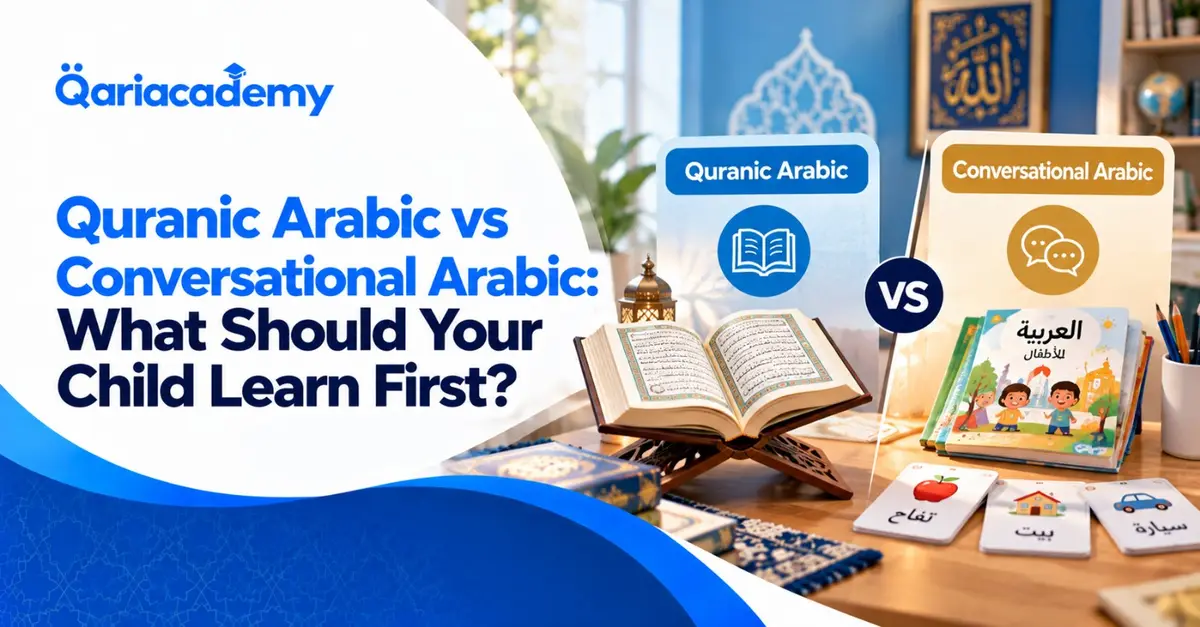
Many Muslim parents raising children in English-speaking countries face the same question:
Should my child learn Quranic Arabic first, or should they learn conversational Arabic first?
The answer becomes confusing because the word “Arabic” can mean several different things.
A child may be learning:
- Arabic letters and reading
- Quranic Arabic
- Modern Standard Arabic (MSA)
- Conversational Arabic
- An Arabic dialect
- Arabic writing
- Arabic grammar
These are related skills, but they are not the same goal.
A child who wants to read the Quran does not necessarily need to become conversationally fluent in Arabic first.
At the same time, a child who wants to speak Arabic with grandparents, communicate with Arabic-speaking relatives, or develop broader Arabic literacy needs a wider language-learning program.
The important question is therefore not simply:
“Which Arabic should my child learn?”
It is:
“What is my child trying to achieve with Arabic?”
For Muslim children growing up outside the Arab world, understanding this distinction can help parents choose a learning path that is more focused, realistic, and age-appropriate.
Quranic Arabic and Conversational Arabic Are Not the Same Goal
The first thing parents should understand is that Quranic Arabic and conversational Arabic serve different purposes.
Quranic Arabic focuses on the language and vocabulary needed to understand the Quran, while Quran reading also requires a separate foundation in Arabic letters, sounds, Harakat, and recitation.
Conversational Arabic focuses on communication in everyday situations.
For example, a child learning conversational Arabic may practice:
- Introducing themselves
- Asking for food
- Talking about school
- Describing their family
- Asking and answering questions
- Having simple conversations
A child learning Quranic Arabic may instead focus on:
- Common Quranic vocabulary
- Understanding frequently repeated words
- Recognizing words in verses
- Understanding basic meanings
- Connecting vocabulary with Quranic passages
- Gradually understanding simple Quranic structures
These objectives overlap, but they are not identical.
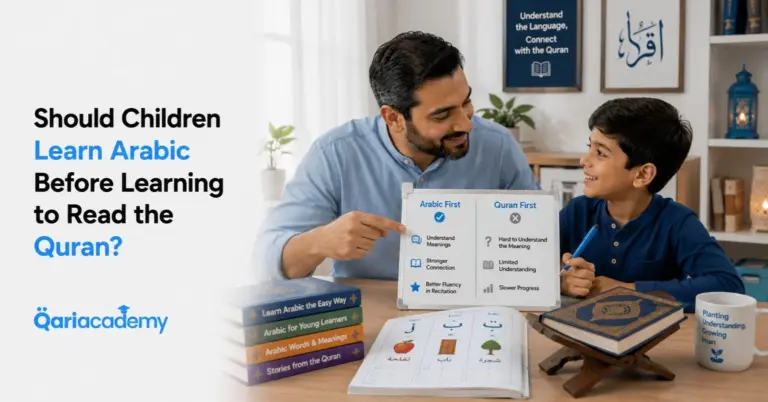
QariAcademy’s current article on Should Children Learn Arabic Before Learning to Read the Quran? makes this distinction directly: Quran reading, Quran recitation, and Quran understanding can be developed as connected but separate learning tracks.
| Learning Goal | Main Focus | Directly Needed for Quran Reading? |
|---|---|---|
| Arabic Reading | Letters, sounds, Harakat, words | Yes |
| Quranic Arabic | Vocabulary and language used in Quranic texts | Helpful for understanding |
| Conversational Arabic | Everyday communication | Not required to begin reading Quran |
| Modern Standard Arabic | Formal reading and broader literacy | Helpful for broader Arabic education |
| Arabic Dialect | Everyday regional communication | Useful for family and social communication |
This distinction is also consistent with Arabic-language scholarship. Modern Standard Arabic is the formal variety used in contemporary written communication and education, while regional dialects are commonly used in everyday informal settings.
Does a Child Need Conversational Arabic Before Learning the Quran?
No.
A child does not need to know how to have a conversation in Arabic before learning to read the Quran.
A beginner can learn the Arabic reading system step by step:
Arabic letters → sounds → Harakat → connected letters → words → Quranic text
For example, a child can learn:
بَ — بِ — بُ
without being able to say:
“I went to school yesterday.”
These are different language abilities.
This is one of the most important distinctions for parents to understand.
QariAcademy’s Quran for Kids course is designed for children ages 5–15 and focuses on Quran reading, Tajweed, recitation, and memorization. The academy also has a separate Arabic for Kids course that develops broader Arabic skills including reading, writing, vocabulary, and conversational abilities.
So the two goals can exist together without one having to completely wait for the other.
What Does a Child Actually Need to Read the Quran?
A complete beginner does not need thousands of Arabic words before starting Quran reading.
They first need foundational literacy skills.
These can include:
- Recognizing Arabic letters
- Distinguishing similar letters
- Learning letter sounds
- Reading Fathah
- Reading Kasrah
- Reading Dammah
- Understanding Sukoon
- Recognizing Tanween
- Learning basic Madd patterns
- Recognizing Shaddah
- Developing accurate pronunciation
This is Arabic reading, not conversational fluency.
A child can therefore begin learning the tools needed to read the Quran even if they cannot speak Arabic.
QariAcademy’s current guidance explains that children do not need to become fluent Arabic speakers before beginning Quran reading. Instead, they can develop the reading system first while gradually adding vocabulary and language understanding.
Parents can also read Learning Arabic for Non-Arabic Speaking Kids for a practical look at how children who do not speak Arabic at home can gradually develop Quranic Arabic skills.
What Is Quranic Arabic?
The term Quranic Arabic is often used broadly to describe the vocabulary, expressions, and language structures encountered in the Quran.
It is important, however, not to treat it as simply a synonym for “all Arabic.”
A child studying Quranic Arabic might learn words such as:
- رحمة — Mercy
- صبر — Patience
- شكر — Gratitude
- علم — Knowledge
- كتاب — Book
- رب — Lord
- قلب — Heart
The objective is not only to memorize vocabulary.
The child should gradually recognize these words when they appear in Quranic passages and begin connecting the vocabulary with meaning.
QariAcademy’s article How Learning Arabic Helps Kids Connect to the Quran emphasizes this connection between Arabic learning, Quran comprehension, memorization, and a child’s relationship with the Quran.
What Is Conversational Arabic?
Conversational Arabic is different because the main objective is communication.
Depending on the family’s background, this could involve Egyptian Arabic, Levantine Arabic, Gulf Arabic, or another regional variety.
A child may learn phrases such as:
- كيف حالك؟
- ماذا تريد؟
- أين ذهبت؟
- ماذا فعلت اليوم؟
- هل تريد أن نلعب؟
The goal is to understand and produce language in everyday situations.
This can be extremely valuable for children who have Arabic-speaking parents, grandparents, relatives, or communities.
But it does not mean the child must master conversational Arabic before learning to read the Quran.
In fact, parents may choose to develop both tracks at the same time.
Why Arabic Dialects Make This Question More Complicated
Arabic is not used in exactly the same way in every situation.
A child might hear Egyptian Arabic from their parents, Levantine Arabic from relatives, Modern Standard Arabic at school, and Quranic Arabic during Quran lessons.
That means a child can genuinely hear “Arabic at home” while still struggling to understand the Arabic they encounter in a book or the Quran.
Modern Standard Arabic is used in formal written contexts and education, while regional varieties are commonly used in everyday informal communication.
For families raising children outside the Arab world, this difference can become even more noticeable.
A child may understand:
“تعالى هنا”
when a parent says it at home, but struggle to understand a formal written sentence.
This does not necessarily mean the child “doesn’t know Arabic.”
It may mean that the child has developed one variety or register of Arabic more strongly than another.
The Qatar Foundation International also discusses the distinction between Quranic Arabic and Modern Standard Arabic in Arabic education for non-native contexts.
So Which One Should Your Child Learn First?
The answer depends on the child’s primary goal.
If the immediate goal is Quran reading
Start with:
Arabic letters → pronunciation → Harakat → reading patterns → Quran reading
Conversational Arabic does not need to come first.
If the goal is understanding the Quran
A useful pathway is:
Quran reading + Quranic vocabulary + gradual language understanding
The child can learn to read the Quran while progressively learning what common words and expressions mean.
If the goal is speaking Arabic
Conversational Arabic should have a significant place in the curriculum.
The child needs opportunities to:
- Listen
- Repeat
- Ask questions
- Answer questions
- Describe things
- Build sentences
- Practice real conversations
If the goal is both
Then the strongest option may be a two-track approach.
| Child’s Goal | Quranic Arabic | Conversational Arabic |
|---|---|---|
| Read Quran | High priority | Optional |
| Understand Quran | High priority | Helpful but not essential |
| Speak with relatives | Helpful | High priority |
| Broader Arabic literacy | Helpful | Helpful |
| Islamic studies | Very helpful | Helpful |
| Full Arabic development | Important | Important |
There is no reason a child has to choose only one.
A Two-Track Arabic Learning Model
For many Muslim families, the most practical approach is:
Track 1: Quran
The child develops:
- Arabic reading
- Quran recitation
- Tajweed
- Quranic vocabulary
- Memorization
- Understanding
Track 2: Arabic Language
The child develops:
- Speaking
- Listening
- Reading
- Writing
- Vocabulary
- Sentence formation
- Everyday communication
This creates a broader language foundation without delaying Quran education.
QariAcademy’s Learn Arabic Online page currently presents Arabic learning for children around reading, writing, listening, speaking, vocabulary, and Quranic Arabic as connected but distinct learning goals.
Should a Beginner Start With Quranic Arabic or the Alphabet?
If the child cannot recognize Arabic letters, the alphabet should come first.
It does not make sense to begin with complex Quranic vocabulary if the child cannot decode the written script.
The progression might look like:
Stage 1 — Arabic Letters
ا — ب — ت — ث
Stage 2 — Letter Sounds
بَ — بِ — بُ
Stage 3 — Connected Letters
بَتَ — كَتَ — عَلَ
Stage 4 — Basic Quranic Words
رَبّ — كِتَاب — قَلْب
Stage 5 — Quranic Passages
The child gradually applies the skills to actual Quranic text.
This is why QariAcademy’s Quran for Kids program is structured for different starting levels rather than assuming that every child begins with the same abilities.
What If My Child Already Speaks Arabic?
This changes the situation.
A child who speaks Arabic at home may not need the same amount of conversational instruction.
But parents should still ask:
Which Arabic can my child use confidently?
A child might speak a family dialect fluently but struggle with:
- Formal Arabic reading
- Quranic vocabulary
- Quranic grammar
- Arabic spelling
- Reading unfamiliar words
This is why “my child speaks Arabic” does not automatically mean:
“my child understands Quranic Arabic.”
The child’s actual skills should be assessed separately.
What If My Child Understands Arabic but Cannot Read It?
This is common among heritage-language children.
A child may understand spoken Arabic reasonably well but struggle to read Arabic independently.
In this situation, the child does not necessarily need a full conversational Arabic course first.
They may need focused Arabic literacy instruction:
- Letter recognition
- Reading
- Harakat
- Word decoding
- Spelling
- Written Arabic
QariAcademy’s Arabic for Kids course specifically covers Arabic reading and writing alongside vocabulary and speaking, while the Quran program focuses on Quran reading and recitation.
The appropriate choice depends on the child’s goals and current ability.
What If My Child Can Read Quran but Doesn’t Understand It?
This is a different learning need.
The child may have developed Quran reading ability without developing enough Quranic vocabulary and language comprehension.
They can pronounce:
الْحَمْدُ لِلَّهِ رَبِّ الْعَالَمِينَ
but may not know what the individual words mean.
That is not necessarily a reading problem.
It is an understanding gap.
In this situation, adding Quranic vocabulary and simple explanations can complement the child’s existing reading skills.
QariAcademy’s How Learning Arabic Helps Kids Connect to the Quran discusses how recognizing Quranic vocabulary can support comprehension, memorization, and a stronger connection with the Quran.
Does Learning Conversational Arabic Help With Quran?
Yes—but indirectly.
Conversational Arabic can build broader language abilities, including:
- Vocabulary
- Listening
- Sentence awareness
- Confidence
- Familiarity with Arabic sounds
- General language experience
However, conversational Arabic alone does not automatically teach a child how to read the Quran correctly.
A child can speak an Arabic dialect fluently and still need to learn:
- Arabic script
- Quranic reading
- Tajweed
- Quranic vocabulary
- Formal Arabic structures
This is why parents should not assume that conversational fluency automatically equals Quranic literacy.
Does Quranic Arabic Help With Conversational Arabic?
It can.
Quranic Arabic introduces children to Arabic vocabulary, word patterns, structures, and sounds.
But Quranic language is not the same as everyday conversation.
A child who learns many Quranic words may recognize vocabulary such as:
رحمة — صبر — شكر — علم
while still needing specific practice to hold an everyday conversation.
This is normal.
The two forms of learning can complement each other, but they have different immediate objectives.
What Should Children Growing Up in the West Learn?
For Muslim children growing up in the USA, UK, Canada, or other non-Arabic-speaking environments, the answer often depends on what the family wants Arabic to do in the child’s life.
If the main priority is:
“I want my child to read the Quran.”
Prioritize Quran reading and pronunciation.
If the priority is:
“I want my child to understand what they recite.”
Add Quranic vocabulary and language understanding.
If the priority is:
“I want my child to speak Arabic with family.”
Build conversational Arabic into the program.
If the family wants all three:
Quran reading + Quranic understanding + conversation
then a broader Arabic program alongside Quran lessons may be appropriate.
ASHA notes that children can learn and maintain multiple languages and recommends giving children meaningful opportunities to use those languages through talking, singing, playing, and reading together.
NAEYC similarly emphasizes that supporting a child’s home language can strengthen their existing knowledge base and support language development.
The practical lesson for Muslim families is not that every child needs the same Arabic program.
It is that the child’s different language goals should be recognized rather than treated as one single skill.
A Practical Arabic Roadmap for Muslim Children
Here is a simple model parents can use.
| Child’s Current Level | Primary Focus | Secondary Focus |
|---|---|---|
| No Arabic knowledge | Letters and sounds | Basic vocabulary |
| Knows letters | Reading and Harakat | Simple Quranic words |
| Reads basic Arabic | Quran reading | Quranic vocabulary |
| Reads Quran | Tajweed and fluency | Understanding |
| Speaks Arabic at home | Arabic literacy | Quranic vocabulary |
| Reads Quran but doesn’t understand | Quranic Arabic | Broader Arabic |
| Wants to speak Arabic | Conversation | Reading and writing |
| Wants full Arabic development | Balanced program | All four skills |
This is not a fixed curriculum.
It is a way to identify what the child needs next.
Should Parents Teach Both at the Same Time?
In many cases, yes.
There is no educational rule saying:
“Your child must finish conversational Arabic before starting Quran.”
Nor is there a rule saying:
“A child who studies Quran should never learn conversational Arabic.”
The two can run in parallel.
For example, a weekly plan might include:
Quran lessons
- Reading
- Tajweed
- Memorization
- Quranic vocabulary
Arabic lessons
- Speaking
- Listening
- Vocabulary
- Reading
- Writing
The amount of time allocated to each should depend on the family’s goals.
What About a Child Who Is Very Young?
Young children generally benefit from age-appropriate lessons rather than being expected to handle an adult-style language curriculum.
QariAcademy’s guidance on Teaching Quran to Young Children Without Expecting Adult-Level Focus recommends manageable learning activities, repetition, interaction, and realistic expectations for young children’s attention.
For a younger child, Arabic learning may therefore look like:
- Listening
- Repetition
- Pictures
- Simple vocabulary
- Songs or chants where appropriate
- Letter recognition
- Short reading activities
- Simple Quranic words
The objective is to build familiarity without overwhelming the child.
How Should Parents Decide What Comes First?
Ask four questions.
Question 1: What does my child already know?
Can they:
- Recognize Arabic letters?
- Read Arabic?
- Speak Arabic?
- Understand Arabic?
- Read Quran?
- Understand Quranic vocabulary?
Question 2: What does the family actually want?
Is the priority:
- Quran reading?
- Quran understanding?
- Hifz?
- Conversation?
- Arabic literacy?
- Communication with relatives?
- A combination?
Question 3: What does the child enjoy?
A child who enjoys speaking may respond well to conversational activities.
A child who enjoys stories and Quran may respond strongly to Quranic vocabulary and comprehension activities.
Question 4: What is the next realistic step?
The best program is not necessarily the broadest one.
It is the one that addresses the child’s most important current need.
A Simple Decision Guide
| If Your Child… | Consider Prioritizing… |
|---|---|
| Cannot recognize Arabic letters | Arabic alphabet and reading |
| Knows letters but cannot read | Qaida and Arabic reading |
| Reads Quran but doesn’t understand | Quranic Arabic |
| Understands Arabic but cannot read | Arabic literacy |
| Speaks Arabic but struggles with Quran | Quran reading + Tajweed |
| Wants to speak with relatives | Conversational Arabic |
| Wants to understand Quran | Quranic vocabulary and language |
| Wants both speaking and Quran | Parallel Arabic + Quran learning |
This approach prevents parents from choosing a program simply because the word “Arabic” appears in its name.
Why One-on-One Learning Can Help
Children often have mixed language profiles.
A child might be:
- Strong in listening
- Weak in reading
- Strong in vocabulary
- Weak in speaking
- Strong in Quran memorization
- Weak in Quran comprehension
A group class may not always have enough time to address every difference.
One-on-one learning allows the teacher to adjust:
- Pace
- Vocabulary
- Reading level
- Speaking activities
- Quran material
- Tajweed correction
- Homework
- Review
QariAcademy’s Learn Arabic Online program emphasizes one-on-one lessons personalized around the student’s level, goals, and learning pace.
Quranic Arabic vs Conversational Arabic: A Quick Comparison
| Feature | Quranic Arabic | Conversational Arabic |
|---|---|---|
| Main Goal | Understand Quranic language | Communicate in everyday situations |
| Vocabulary | Quran-focused | Everyday vocabulary |
| Speaking | Not the primary objective | Major objective |
| Reading | Important | Important depending on program |
| Quran Understanding | Directly relevant | Indirectly helpful |
| Family Communication | Helpful | Directly relevant |
| Tajweed | Often paired with Quran study | Not normally the focus |
| Dialect | Usually not the focus | Often depends on region |
| Best For | Quran understanding | Everyday communication |
Neither is universally “better.”
They simply answer different questions.
The Biggest Mistake Parents Can Make
The biggest mistake is treating Arabic as one single subject.
A child can:
Speak Arabic but not read Arabic.
A child can:
Read Quran but not understand Arabic.
A child can:
Understand spoken Arabic but struggle with Quranic vocabulary.
A child can:
Know many Quranic words but struggle with everyday conversation.
These are different language profiles.
Once parents understand this, choosing a learning plan becomes much easier.
What Should Your Child Learn First?
For most Muslim children who are starting Quran from zero, the immediate foundation is:
Arabic letters → sounds → Harakat → reading → Quranic recitation
Then Quranic vocabulary and understanding can develop alongside the reading journey.
Conversational Arabic can be introduced at the same time if the family wants the child to communicate in Arabic.
There is no need to make the child wait until they become conversationally fluent before beginning Quran.
At the same time, if the family’s main goal is broader Arabic fluency, then conversational Arabic deserves dedicated time and practice.
The important thing is to match the program to the child’s goal.
FAQ
Should my child learn Arabic before learning the Quran?
Not necessarily. A child does not need conversational fluency before learning to read the Quran. They first need the Arabic reading skills necessary to decode Quranic text.
Is Quranic Arabic the same as Modern Standard Arabic?
They are closely related, but the terms are not identical. Classical/Quranic Arabic belongs to the Arabic literary tradition, while Modern Standard Arabic is the modern formal variety used in education, writing, media, and formal communication.
Is conversational Arabic necessary for Quran reading?
No. Conversational Arabic can be valuable, but a child can learn to read and recite the Quran without first becoming conversationally fluent.
Can my child learn Quranic Arabic and conversational Arabic together?
Yes. In fact, they can complement each other. The important thing is to give each one a clear objective.
My child speaks Arabic at home. Does that mean they know Quranic Arabic?
Not necessarily. They may be comfortable with a family or regional dialect while still needing instruction in Quranic vocabulary, formal reading, or Quranic language structures.
My child reads Quran but doesn’t understand it. What should they learn?
They may benefit from Quranic vocabulary and language instruction alongside their existing Quran reading and Tajweed studies.
Should younger children start with conversational Arabic?
If the family’s primary goal is speaking Arabic, conversational learning can begin early. But if the immediate goal is Quran reading, Arabic literacy and Quranic reading skills may deserve priority.
How can parents support Arabic learning at home?
Use Arabic naturally in daily life, read together, practice vocabulary, listen to Arabic, and give the child regular opportunities to use the language. ASHA recommends meaningful interaction through activities such as talking, singing, playing, and reading in the languages used by the family.
Conclusion
So, Quranic Arabic vs Conversational Arabic: What should your child learn first?
There is no single answer for every child.
If the immediate goal is to read the Quran, start with the Arabic reading foundation:
Letters → Sounds → Harakat → Reading → Tajweed
If the goal is to understand the Quran, add:
Quranic vocabulary → Meaning → Language understanding
If the goal is to speak Arabic, then conversational Arabic should have a dedicated place in the child’s learning.
And if the family wants both, there is no need to choose only one.
A child can learn:
Quran + Quranic Arabic + Conversational Arabic
through a balanced, age-appropriate plan.
The key is to understand that these are different learning goals, not competing versions of the same subject.
For Muslim children growing up outside the Arab world, this distinction can make Arabic learning much more practical.
The goal is not simply to teach a child “Arabic.”
The goal is to help the child read the Quran, understand its language, communicate in Arabic when needed, and build a lasting connection with the language of their faith.
QariAcademy offers separate but complementary pathways through its Quran for Kids program and Arabic for Kids program, allowing parents to choose the learning focus according to their child’s current level and goals.
If you are unsure whether your child needs Quran reading, Quranic Arabic, conversational Arabic, or a combination of them, the best place to start is with an assessment of what your child can already do.